
That is all. I’m too busy to say more.
Hopefully blogging will pick up again in a few days.

That is all. I’m too busy to say more.
Hopefully blogging will pick up again in a few days.
Last Friday, I accompanied Ginny for a day of achieving nebulous wedding related goals that took us traipsing across town. I say nebulous because really all we had in mind was to go get pedicures…
Note: For whatever reason, Ginny and I step out of our decidedly non-girly roles when we spend days together. On one of our first dates, we went searching in antique stores for tea cups and bought yarn. Subsequently there have been days filled with us wearing spiffy dresses, getting pedicures, and drinking overpriced specialty “martinis”. Whatever, don’t judge us, Judgey McJudgerstein.
Anyway, we ended up stopping at several places in a futile attempt to find comfortable shoes to complete her wedding outfit. I was also looking for shoes to go with my awesome Wedding Band Star outfit, but my requirements are a bit more specific. I wanted light blue, open toed shoes of some sort and was experiencing complete failure in finding any.
I know…you’re sitting at the edge of your seat by now wondering what I’m going to talk about. I can feel it in the air.
So, I thought today I would look on the Internet for a quick solution. If the shoes I want exist, surely the Interwebz will give them to me. I found my way to Amazon after the “rest” of the internet thoroughly disappointing me in terms of design AND prices I’m willing to pay.
Note: I am willing to pay $15 for shoes at this point. Maybe $20 if they’re awesome. Maybe.
Well, I thought Amazon was failing me too. Who knew that my shoe inspirations were so obscure and expensive? But then…then they showed me the way:

Can you hear the angels? ‘Cause they’re totes singing. If I ever saw a more impressive shoe, it must have erased my memory due to being too incredibly awesome to be remembered. Now, get a load of the item name:
First of all, I didn’t even know they made shoes that were 7.5 inches tall. Second of all, apparently I can strip in these and not die. I mean, they wouldn’t put that into the description if I could die wearing them, right? Of course not! and, of course, they light up in a way that is reminiscent of any of one of my favorite things: Oscilloscopes or Jacob’s ladders .
OK, I know that’s supposed to be pretty lights or something, but I choose to assume that it’s a tip of the hat to 1800’s science. You know the kind I mean: Bringing the dead back to life by harnessing the power of the swirling lighting storm above your roof. Or, um, using oscilloscopes to look cool. That’s a thing right?
So yeah, these shoes combine my love of impractical, dangerous science with my love of being 7.5 inches taller. In addition to those excellent things, wearing a ridiculous pair of light up stripper heals to Shaun and Ginny’s wedding would make me THAT woman at the wedding.
Picture it: I show up in a tube dress of some sort and those shoes, barely able to walk because those shoes are basically stilts and I am not trained in the art of not walking like an idiot in them. In my hand is a handle of vodka and my hair looks like I just came back from a pretty wild night that resulted in me falling off of a dock somewhere. I come in, see the looks from their family and friends and say something to the tune of, “Hey! DON’T JUDGE ME!” Maybe I’ll quote Jesus in a garbled fashion like, “mumble mumble mumble LEST YE BE JUDGED!” and then fall over…all classy like. Then Peter will revive me with smelling salts and say “It’s time to play music now, Gina” and then we’ll all know how much of a rock star I really am.
This is how memories that last a lifetime are made, people.
Or…you know…not. But only because the shoes cost over $100.
But seriously, folks:
When I went to meet Shaun’s mom on Easter (in the post I realize I described a similar “slut crashing the party” scene…), I put decidedly too much thought in the best way to NOT look like a slut. This is, under any other circumstances, not difficult for me because I tend to not particularly dress like a typical hooker (mainly because I don’t have the budget for lightning shoes), but I was terrified that I was going to be walking into some kind of situation where she would want to brand me “Home Wrecker”. Much in the same vane, I really don’t want to do anything to bring about the idea of “Oh…there’s that (married) whore who is invalidating their marriage”. So, I will be looking like something out of Mad Men along with the rest of the band who will be similarly nicely dressed.
But still…I will dream about those shoes…and making a YouTube video of the scene I described above, because that’s fucking funny.
I was talking with Staks last weekend, and he was glad to see that we went and got ourselves a domain, but thought we could use a little branding. I had been using the gnu atheist symbol for some time , and liked it because not only was I really amused by the “gnu” moniker, but I also thought the horns were appropriate.
Horns…as in horny. Because we are poly, and we like sex with more than one person…responsibly…whatever! I thought it was a little clever (or was it cleaver….).
 In any case, I had even mocked up a little icon to use, so that I could have a little reference to the blog (that is hardly visible), but ultimately we need our own logo. So I created a logo today.
Now, I am not a graphic artist by any stretch of the imagination. I don’t have any great picture editing software (I use Gimp, and might need a better one for future ventures). But I came up with a concept I like, and tolerably decent first attempt.

It certainly is not professional, and with more time and perhaps better software I might be able to do something better, but in the future I might have a real graphic artist take a crack at it.
If you are a graphic artist and think you’d like to give it a shot, I would love that! I don’t know what I have to give in barter or payment, but perhaps something could be worked out.
I have a confession to make: I used to watch Baywatch. Even better? I watched Baywatch with my dad.
You see, back in the late 60’s/early 70’s my dad was a lifeguard at Zuma Beach near Malibu in southern California. Things about the job haven’t really changed much since then. As you might guess, the reality of lifeguarding in South Bay expressed on Baywatch was…um…not accurate at all. It was so very inaccurate, with Pam Anderson’s giant boobs barely being controlled by her flimsy uniform and David Hasselhoff…well…being David Hasselhoff, that we watched it for the pure hilarity of it. It was one of the most entertaining shows on tv because it was so very terrible.
Watching CSI (any of them) gives me similar entertainment. Here you have a group of Hollywood Attractive men and women who are all supposedly chemists who run around solving mysteries. I don’t know much about being an actual crime scene investigator, but I’m fairly certain that they don’t generally investigate AND get into fire fights with deranged maniacs AND arrest them. I’m pretty sure they pick up hairs, dissolve them in stuff and then put the solution in a variety of analytical machines.
I mean, I could be wrong about what the job actually entails, but much in the way that I’m pretty sure that most marine biologists start out (and never stop) crawling around in mud collecting samples of various mollusks as opposed to getting to swim with dolphins on a regular basis, the CSI shows make it seem like forensic chemistry is ridiculously exciting, dramatic, and entirely populated by sexy chemists. Every time one of the female investigators shows up at a crime scene in leather pants, low cut shirts, and high-heeled boots, I laugh as they step around in blood and discuss the great abundance of semen on the walls and floor lamps. Every time one of them glides through the lab with an unbuttoned, completely stain-free lab coat, I laugh because that’s not how you wear a lab coat and also, there’s probably not a safety manager there.
In short, I find the science in movies and television geared towards the general public HIGHLY entertaining. It is most certainly one of my favorite things about popular media. I know the awfulness of some scientific premises in media thoroughly annoy scientific people, but to me it’s just hilarious. It’s not that I suspend disbelief. It’s that it adds an element of comedy to a movie that probably isn’t all that serious to begin with.
I went to see The Avengers this week. I absolutely loved it. I have really enjoyed all of the Marvel movies that have come out in preparation for this one and it did not disappoint me. It also had one of the greatest idiotic science sentences that I have ever heard. It was so bad that I actually laughed out loud in a quiet theater about it.
I wouldn’t really call this a spoiler, but fair warning, I’m going to talk about a tiny part of it.
So, Bruce Banner, world renowned gamma ray expert and giant green anger monster, is talking to Tony Stark, one genius to another. Banner jumps into gear to help look for this thingy that has a specific gamma ray signature. He is told that they have tried all methods of detection and have failed (whatever that means). Banner says something to the tune of “You haven’t tried everything…Get all of your spectrometers, put them on the roof and set them to detect gamma rays.”
That sentence is basically meaningless. Stark says something about how brilliant that idea is and all I could think was, “I don’t think you know how spectrometers work…”
First of all, spectrometer is a catch-all term for analytical machines that analyze chemicals by exposing them to different wavelengths of light (infrared, UV/Visible, for instance). When you say something like, “GET ALL THE SPECTROMETERS!” you are saying that all spectrometers work in the same way, require the same sampling methods, etc. They aren’t and they don’t. In addition, you don’t just walk up to a spectrometer, throw an unknown sample on it and say “tell me what that is”. You either have to have a library of spectra for known substances to compare against or be really good at reading spectra (which, for me at least, is very difficult). If you’re trying to figure out the concentration of something in a sample, you don’t just throw the sample on there and say “tell me how much is in there”. Again, analytical chemistry is a science of comparison. To figure out the concentration of something in an unknown mixture, you have to make up several samples with that particular thing in various known concentrations. This is called a calibration curve.
What I’m saying is that analytical chemistry is a pain in the ass.
Readers of this blog will probably start to figure out that I have biases against various realms of chemistry. I have already ranted at length about inorganic and now I’ve got my sights on analytical. I should point out that I am very happy that both of these things exist…I just don’t want much to do with them myself and commend the people who have a passion for them. My dislike of analytical chemistry is what made my graduation from college take 10 years instead of 5 (I just didn’t want to write those damned lab reports, so I had one class to finish for 5 years following the completion of everything else). Luckily, the analytical professor at my university is one of the most patient saints in the world. But I digress…
So that’s just what’s wrong with saying “use the spectrometers”. Next he says that they should put all the spectrometers on the roof and set them to “Gamma Ray”. Look, I know that gamma rays are waves just like light, but a generic “spectrometer” is not going to just detect them for you. What’s more hilarious is that the reason they need an expert is that the particular thingy they’re trying to find has a particularly strange and faint gamma ray signature, so it would stand to reason that you would need a really specialized, VERY SENSITIVE detector to pick it up.
We have an infrared spectrometer in my lab. It cost $35,000. It’s a pretty good IR spec, but ultimately, infrared spectroscopy is a pretty limited analytical technique. You sample by putting a drop of your unknown stuff onto a diamond. IR light gets refracted and reflected through the diamond all up in your sample. The bonds of the molecules get all excited and shake, rattle and roll and the machine converts these movements into an image, a spectrum. You can tell the structure of a molecule by where peaks on the graph are. It can only tell you big components. For instance, in an organic molecule you will always see huge peaks indicating the presence of carbon-hydrogen bonds because organic molecules are ALL ABOUT those. If there are subtle things you’re trying to find, good luck. IR, at least a $35,000 IR, doesn’t do subtle very well. It’s like your loud uncle at Thanksgiving who outs your in the closet cousin…but instead of a cousin, it’s carbon.
That’s a terrible simile, but whatever. I like the image of a loud, asshole IR spectrometer eating a mountain of mashed potatoes saying, “DID YOU KNOW THAT CARBON IS GAY? HE’S TOTALLY GAY.” And then everyone at the table says, “Yes, IR, we know. And since we are all made of carbon, perhaps we’re all a little bit gay…” and then a conversation about how we are all equals in the eyes of atoms and how we should all just get over who people fall in love with or are attracted to because we’re all just bags of chemicals anyway and chemicals just react. It’s what they do.
Well, this just got really off topic. Whatever, that’s what they pay me here for.
Hmm…I don’t actually get paid. Well, then, um, I can talk about whatever the hell I want.
Anyway, back to Avengers science. So the point I was making about the IR is that even not particularly sophisticated ones are hella expensive. Spectrometers get more expensive the more impressive their detectors are. Could you imagine how much a spectrometer with a detector calibrated to pick up a very particular gamma ray signature to find a strange alien cube by just scanning the ambient air on the roof would cost? That’s NASA money…nay, that’s “Haha, we won’t pay for our foot soldiers to have working equipment and proper personal protective equipment, but by God, we need that thing that finds alien gamma rays deep in the arctic or something” money.
I’m sure there’s some sort of equipment that could be used for this process. I don’t feel like googling it. But I would think that if you had a spectrometer that did all that, you wouldn’t really want to stick it up on the roof. You also wouldn’t want to walk outside with it on a flying aircraft carrier. Just sayin’.
After Banner says this brilliant nonsensical thing, he and Stark exchange a bunch of techno babble to which Captain America says something like, “Uh, what?” Don’t worry, Captain America, they didn’t actually say anything.
It is a generally known fact in the Geek Realm that Star Trek: The Next Generation scripts regularly had places where the characters were just supposed to adlib techno babble. I suspect that’s why there were just so many mentions of tachyon pulses, polarity reversal, dilithium, and deflector shields. I got the feeling during the particularly scientific moments in Avengers that this was what they were doing.
Stark: Hmm, science science science science.
Banner: Yes, that’s because of science and science.
Stark: Science! Brilliant!
Banner: Yes, brilliant! GET ALL THE SPECTROMETERS.
Yeah, I laughed a lot. Just like in Iron Man 2 when Stark makes a new element by building a proton accelerator out of crap he found around his beach mansion. I thought that was simultaneously hysterical AND completely hot. I often describe that scene as one of the hottest things ever filmed. Stop laughing at me. Whatever. Robert Downey, Jr. plus tank top, plus proton accelerator = Drool.*
*Disclaimer: The views expressed in this article are not necessarily shared by all contributors to Polyskeptic.
In conclusion, I love good science, but bad science can be fabulous…when in movies featuring Norse Gods, giant dudes with anger management problems, people with eyepatches and Uzis, and Captain America. I never have a problem with stupid science if the point of the media is not to be scientific. Comic books are awesome and also ridiculous, therefore the science gets to be far fetched and a little nonsensical. Plus, it’s fun to be a scientific person poking holes in the scientific claims of someone like The Incredible Hulk. It doesn’t take away from my enjoyment of the movie that he says a bunch of bullshit, it just makes it Marvel. I go into it expecting to hear it and get a little disappointed when I don’t.
Hmm…now all I want to do is watch a bunch of Mystery Science Theater 3000. Stupid work.
I’m not going to address the canard that without god we can’t have meaning in our lives. OK, yes I am. But only briefly, and the rest will only deal with that question indirectly. Yes, it is quite obvious that people without a belief in gods have meaning in their lives. Perhaps not inherent, absolute, and cosmically significant meaning, but those things are illusory, just like gods.
I have been, since childhood, rather introspective. I do a lot of thinking about thinking, reflecting on experience, and asking simple “why…” questions about mundane things that most people take as granted. To me, the beginning of skepticism begins with the ability to ask why something is, and then asking for reasons to keep accepting it. I never merely accepted the way things are and that they need to be that way. Thus, my becoming a degenerate deviant is not surprising.
Ultimately, I think seeing polyamory, atheism, and skepticism as deviant and degenerate is, well, unfortunate and morosely funny. It does not speak well of our species that such basic values as demanding evidence for claims and then not accepting worldviews that can’t stand up to such demands is the weird thing. But I digress…
Anyway, I’m one of those annoying people who thinks asking why we do and believe certain things is good. I also am interested in various experiences. I was very interested in meditation while young, and much of what I learned and experienced during those times in my life have influenced how I see the world, how I think, and how I try and improve as a person. I “experimented” with drugs while younger (meaning I enjoyed their effects while on them), and while I have little interest in such things now, I am glad that I had those experiences.
When I got to college, I was very interested in taking as many courses that dealt with religion, philosophy, and anthropology as I could. I was interested in questions about meaning, belief, and knowledge in culture and psychology. Is there any surprise that I graduated with a degree in ‘religious anthropology”? Is there any surprise that I write about religion, think about religion, and ultimately oppose religion?
I knew that the history of ideas which dealt with meaning, experience, etc are contained in philosophy, theology, and religion. I also knew that I didn’t believe in any gods, had strong issues with religions, both organized and less-than-organized, and that I had an attraction to science and philosophy.
After reading religious thinkers from over the centuries, including many scriptures and apologetic writing, I knew that these things had something to offer us, even if much of it was meshed with absurd theological assertions and assumptions; I knew that it is all too easy to conflate interesting psychological insights with the tradition adjacent to their origin. That is, I understood that a Catholic, Moslem, or Hindu thinker could say something interesting, insightful, or even true without that idea having any logical relevance to the theology they believed.
So, any sophisticated theologian who attempts to claim that this gnu atheist is unfamiliar with sophisticated theology, I can confidently reply that they are simply incorrect. No Courtier’s Reply can stick to me, especially since the Reply is absurd on its face.
—
For a few years I have thought about how we, as a community of reason, could talk about such things outside of a theological context. I mean, philosophers do it all the time, right? (And I do have a MA in philosophy). Then today I ran into this post by Dale McGowan which talks about the importance of social interactions in happiness. It is a quick review of a study about why religion makes people happier.
Essentially the point is encapsulated here, stolen from McGowan’s post, in these quotes by Chaeyoon Lim:
[Life satisfaction] is almost entirely about the social aspect of religion, rather than the theological or spiritual aspect…
and Raising Freethinkers co-author Amanda Metskas:
[T]heology is less important to most churchgoers than a number of other benefits. In many cases, they attend despite the theology. It is telling that only 27 percent of churchgoing US respondents to a 2007 Gallup poll even mentioned God when asked for the main reason they attend church. Most people go for personal growth, for guidance in their lives, to be encouraged, to be inspired—or for the community and fellowship of other members. These, not worship, are the primary needs fulfilled by churches. (p. 206)
This is illuminating, and speaks to precisely the point that many gnus have discussed over the last few years; it is not the beliefs which make people happy (they are usually harmful), but it is the social connections that keep many people in church.
The implication, I believe, is that we do need to do more to create social environments for atheists and such. Skeptics in the pub, conventions, campus groups, etc are all great steps in that direction, even if some people take things too far in terms of emulating religion. That is, Alain de Botton is wrong precisely because he does not just want to keep the social aspects around, but he wants to keep some of the theological parts alive too.
Part of what will cultivate community, I think, will be organizing under a banner, a label (or a very small set of labels at most), and a small set of major organizations who represent what we do share, our political concerns, and our social presence. The Reason Rally was a step in defining much of these things, and the next few years will have a lot to tell us about the nature of our collective message, what organizations will be saying them, and how broad we need to be to draw people in.
We have issues, as a community, in terms of drawing in the voices of women, ethnic and racial minorities”, genderqueer people, and even blue collar secularists. I don’t know what all the solutions are, but I am keeping my ears tuned to people who offer some and will be thinking and writing about it from time to time.
I know I am guilty of many of the things that turn many people away; my writing is esoteric, my tone is sometimes harsh, and I include commentary which does not fit in with most atheists and skeptics (specifically polyamory. To what degree, if any, I may change any of this will depend on the strength of arguments, the evidence supporting said arguments, and my ability to actually change.
But I think we, the community of reason and skepticism, have a lot to say about how to create meaning in important ways and how to live lives of general contentment and happiness. Fore me, my life project to be happy lead me to atheism and polyamory, while sharpening my skeptical tools along the way. I think my story and views have something to add to this conversation.
I have been a fan of the past executive directors of the SCA. Lori Lipman Brown and Sean Faircloth are both smart, friendly, fun-loving people who I enjoyed getting to know. When Sean left the position to be with the Richard Dawkins Foundation, there was the hanging question of who would be chosen to succeed him.
And today we have an answer from Hemant Mehta’s blog. The choice is a former Republican lobbyist named Edwina Rogers. I have never heard of her until today, but let me tell you, based on what I read from Hemant’s interview, why I think that the choice is a good one.
First, her answers to Hemant’s questions are encouraging. She’s a nontheist (her preferred term), secularist, and she seems to be aware of the issues which the SCA is designed to confront. In short, she’s one of us.
Second, the fact that she is a she is a plus in the sense that we do have some issues with gender inequality in the larger community of reason. Not that hiring a man would have been a mistake, but this is an added bonus from an equality point of view.
Third, she has inroads to Republicans. This, I think, is the most important part. For some time there has been an idea that there is a divide in our “culture wars” which divide along the lines of Democrat/liberal/secularist versus Republican/conservative/theocrat. This divide is way too simplistic, and as Edwina Rogers states, its not true in the majority of cases.
Secularism is not a uniquely liberal value or cause. Yes, there are many conservative voices who declare their opposition to the liberal and secularist agendas, but even those conservatives have much to gain, and maintain, in a secular government. With Edwina speaking for us, perhaps some of those voices will be forced to allow their connected ears to get some exercise. Seculaism has much to offer conservatives, especially the religious ones.
Yes, I have stark political and philosophical differences with conservative people (some who are family members) who view me as some crazed, brainwashed, confused elitist who has been fed the liberal lie of separation of church and state. Perhaps Edwina’s voice can carry a little more weight with such people (perhaps not, in many), ot at least be able to frame them in ways those people will understand.
And there may in fact be a majority of conservative contituents who hold similar views about us elitist progressive secularists, but there are paths towards developing political alliances with secular conservatives who hold, or at least are near, levers of power and authority.
I would prefer to see America become more progressive as a whole. I would like to see the Democratic party become truly progressive, fully secular, and deal with real social inequalities such as those brought up by the Occupy movement. I would like to see the Republican party return to leaders such as Barry Goldwater, rather than the theocracy-downed idiocy that so often sways Republican constituents and legislation.
I would like to see real, substantive, argument about policy between people who intelligently disagree, rather than be distracted by Biblical proclamations and religiously-based anti-gay, anti-women, and anti-science ideologies which end up doing damage to the nation we all live in. There is much to love about America, but sometimes those attributes become smudged with too much mud from religious contamination.
Theocratic tendencies in politics harm us all in ways which we often don’t even realize, unless we are paying close attention. Having someone familiar with conservative lobbying circles assisting in our efforts to support secularism in America will be a boon for us all–liberal, conservative, etc–long-term.
I think that the SCA made a smart move in choosing Edwina Rogers. Let’s see if I’m right. In the mean time, let’s all welcome Edwina to her new position.
Before my family moved to 4th and South, we used to visit the area frequently to go shopping and have dinner. We would often have dinner at the Copa Cabana, a staple of South Street that is still there. In fact, we celebrated my mom’s 61st birthday there just a few weeks ago. It’s a bar with an extensive food menu. My dad always said that he thought it was a great place to bring kids because they could be loud in there and no one would care because it’s loud anyway. I never really took advantage of the allowance to scream like an idiot in the place, but it’s nice to know that I could have without incurring the wrath of my parents. I probably still wouldn’t be as loud as the drunken Girls Night Out happening in the table next to us.
My dad had very predictable beer choices back then. When we went to the Philadelphia Pizza Company, he would order a Moosehead. When we had pizza at home, he would go down the street and grab a six-pack of Yiengling or a 40 of Budweiser (high class!). When we went to the Copa, he always got a Dos Equis. If he were the Most Interesting Man in the World, his slogan would be something like, “I don’t always drink Dos Equis, but when I do, I am probably eating cheap tacos”.
As a child, these trips to the Copa resulted in Equis being the first Spanish word I learned, far before “Hello” and “1,2,3,4,5,6,7,8,9,10”. It was also where I learned to dislike the taste of beer immensely (a malady that would only be cured years later when I went to Belgium and discovered that there are beers, many many beers, that taste better than Dos Equis or Budweiser). I was inquisitive as a kid and so when my dad was drinking his beer, I would ask about it. He would then give me the bottle and let me have a sip. I would take him up on this and remember that it was terrible. My mom never gave me any of her margarita.
So, I consider this fabulous parenting. If you were to watch public service announcements now about parents and underage drinking, you would think that my parents were the worst ones in the world for letting me taste beer. But there’s a few things here. First, my parents drank around me. It wasn’t something they did when I wasn’t around or banned altogether from the household. I was used to seeing alcohol around (I actually frequently went with my dad for liquor runs and helped him carry stuff), seeing adults imbibe responsibly (I have never seen my mom drunk and have rarely seen my dad that way), and because my dad didn’t drink a beer and then say “drinking is bad! DON’T DO IT”, I was raised with the general impression that if I wanted to drink at home, I could, right there with my parents. There was no vice in it. They gave me a similar view on drugs. They never hid the fact that they’re Baby Boomers and that they both did various drugs frequently throughout the years. What they would say to me about drugs is this, “They’re not worth getting arrested over.” This is all they had to say. They didn’t tell me I couldn’t. After smoking a joint for the first time (I was 15), I came home and told them about it and how I was completely unimpressed with the whole thing. My dad described his experience with LSD as “the lights get really bright. I always hoped I’d see a crab painted like a checkerboard, but I never did.” He tried coke once and said that the experience was “meh”. And everyone generally agreed that we should all stay away from heroine. Again, I was raised with the idea that drugs were not forbidden, that they can be fun, but not worth getting into trouble.
So, the other day I see a link to this article saying that kids are now ingesting hand sanitizer in an attempt to get wasted. I read the article and could barely muffle my laughs. All I could think of was an Ellen Degeneres bit I heard a while back about how humans will do anything to get high. We will lick the anus of a muskrat if it holds the remote chance of giving us a buzz. Apparently, this is a big problem because teenagers are making themselves sick and having to go to the hospital. I don’t think anyone is dying though so I’m going to laugh at them. Teenagers are hilarious.
One time when Peter and I were in highschool, he and another friend of ours got the idea of snorting Smarties. I honestly can’t remember what he thought would happen when he did this, or why this idea seemed like something he should do. So one day, they brought in a tube of Smarties and he smashed one on our shared table in Home Room with his Calculus book. Then he snorted some of it and at the moment that the Smartie particles (Smarticles?) entered his nose, he went into a convulsion of hilarious proportions. Am I a heartless bitch? Maybe, but also he wasn’t convulsing because his brain was melting or anything. He was convulsing because Smarties sting like a motherfucker in your nose. We all learned an important lesson that day about snorting things. We’re not going to do it.
So if we’re going to coke, we’re going to freebase it.
Anyway, back to the idiots drinking hand sanitizer. So, if you read the article, the author states that the main ingredient in sanitizer is ethyl alcohol (ethanol, or the fun and horrible ingredient in “booze”) and that kids are getting sick because “ethyl alcohol is toxic”. I know it’s an NPR article and all, but something about this just cracked me up further. I think it was the “Reefer Madness” sound of the whole thing. Sure, ethanol is toxic, but in a way that even a lot anti-chemical people can get behind. It’s a fun kind of toxic, like having surreal conversations with Swamp Thing. (I have no idea what I mean by that, but the image is awesome.) To say “ethyl alcohol” instead of ethanol, to not put the caveat that this is the same shit in booze…I don’t know, it just sounds like they’re saying, “the kids are drinking HORRIBLE TOXINS THAT NO ONE ELSE CONSUMES AT HAPPY HOUR. Did you know that ethyl alcohol is TOXIC? OOoooOOOOoooOOOoOoOH.” Yes, I’m reading a lot into it, but I’m on a kick about this stuff right now.
So, here’s the thing about this. I don’t think it’s the ethyl alcohol that’s making them sick. I think it’s all the other alcohols in them that are also in it. Many of them have isopropanol in them (rubbing alcohol) and various other assorted alcohols. Readers of this blog probably know this, but did you know that you can drink methanol and isopropyl alcohol and still get a buzz on? Did you know that you should stick to ethanol because metabolizing the other two is way worse news than the toxicity of ethanol? Fun Facts: Ethanol turns into vinegar in your liver. Methanol turns into formaldehyde (you’ll be blind and well preserved if you drink enough). Rubbing alcohol turns into acetone (nail polish remover). Which of these three sounds the least illness inducing?
In addition, I don’t really know what the gel part of the hand sanitizer is, but I’m sure it doesn’t help. See? I can be anti-consumption of chemicals! I don’t think you should consume things found next to the can of Comet underneath your sink (unless you keep muffins there…but that would be strange, and likely covered in cleanser), or things that have revolutionized the Port-a-Potty industry. I have standards! My favorite part of the whole article was when they said that the best way to combat the problem is to keep hand sanitizer out of the reach of your teens. Like, only you, the responsible parent, can dispense it for them when they want to kill a bunch of bacteria. Otherwise, keep it in locked cabinets or something. Really? That’s what you should do?
Forgetting for a moment that I think you just shouldn’t have hand sanitizer around because soap and water is fine and that I think everyone is paranoid about germs. CONTROVERSIAL! You really think that the problem is that the kids have access to hand sanitizer? Or is it that they have a completely unhealthy relationship with alcohol and drugs? Don’t you know that one of the biggest things that makes the idea of getting drunk/high for teens is that it’s forbidden? Apparently, eating hand sanitizer makes them look cool to their friends. There isn’t a lot of currency higher than that in the teen world. I’m sure some parental board will crucify me for this and say that it’s different when I have kids or something, but honestly, what’s wrong with having a drink with your kids? It takes the mystery away and you can teach them how to do it responsibly. They won’t then go to college or whatever and end up in the hospital in the first week with alcohol poisoning. Also, they won’t feel the need to find bizarre and creative ways to consume alcohol.
I did a quick Google search for “drinking isopropanol” and most of what came up was teenagers asking the internet if they could drink it and not die. It makes sense…it’s cheap and unregulated…also, it’ll make you ill a lot faster and worse than a jar of Georgia Moon. Wouldn’t it be better if you had some positive influence on how your children, who clearly want to drink, experience alcohol? I would say the same for some drugs, but like I said, it’s really not worth getting arrested over. If only Ron Paul was president…I will never say that again. But you can say the same for many of the other forbidden things that kids are dumb about due to lack of guidance. Be honest with kids about things like drugs, alcohol, and sex. Is it so bad that you be completely upfront about your flaws, your struggles, your life history? I never saw parents as perfect or infallible. They told me everything, and ultimately I respect them more for that and feel like I was able to be relatively mature about things like this at a young age.
OK, so I still was pretty fucked up about sex, but they did a lot of other stuff right!
I have been thinking about my up-coming bachelor party. I’ve been to a few over the years and have had good times at each, but mine will be different. At mine, there will be no strip clubs on the agenda.
I know this will disappoint a few people who will be there, but they can go do such things on their own time. Oh right…bachelor parties are excuses for momogamous married men to act like they are single for a while. My not allowing them their vacation from reality is a bit selfish of me, or something. See why I’m convinced that monogamy aligns with people’s true desires?
The reason that I have insisted that my best man not include strip clubs into the plans (he is not married, and is not interested in such things anyway) is that I don’t find them exciting. Sure, I like seeing naked and often attractive women, but such clubs are all a farce. It isn’t real.
And although it may sound contradictory at first, fantasies which are not realistic are not exciting to me. I can appreciate the aesthetic beauty of human bodies in such clubs, but it rarely does anything for me sexually.
Perhaps its because I actually get to see real live naked women (notice the plural) fairly often, also that I am not restricted from other women, that strip clubs don’t do much for me. Perhaps, although even when I was unattached and monogamous I still didn’t get much out of the experience.
When I think about it more seriously, I realize that I simply cannot get caught up in the lie. I realize that these women stripping for our money are not into me. I know that this is not flirtation, pre-foreplay, or how real relationships develop. And in the rare case where a stripper might be into me, I would still be unable to find it really arousing until she made that clear to me on her own (I don’t ever expect this to happen). I’m certainly not going to ask them for their real name or contact info, knowing how often they receive such requests and how annoying it can be.
In contrast, I get quite excited when meeting fully clothed women with whom I share flirtatious bantor, playful affection, and maybe even phone numbers. And in my fantasy life, my thoughts may occasionally start with outlandish possibilities, but ultimately I find myself attracted to more realistic possibilities as fodder for, well….
The point is, I am much more interested in fantasy tied to real people with whom I really have, continue to, and might again interact. I have serious trouble suspending disbelief too much, especially when it comes to sex.
Also philosphy, theology, etc.
See, I baited you with sex talk, and now I’m talking philosophy. But now that I have you dug in this deep you might as well see it through, right? Right.
So, I can’t get excited about stuff that isn’t real, or at least real-ish (this is why I prefer science fiction which at least tries to be scientifically plausible). Belief in silly unskeptical things leaves me cold, and so my mind is more attracted to what can be demonstrated to be real.
I grant that I have cognitive biases. I understand that my mind is more attracted to certain ideas than others and that this cognitive gravity does not necessarily align with reality in all cases. I’m not some super rational skeptical guru who was born with some freakish reality detecting brain (but that would be awesome!).
Quite often I have to apply skeptical methodology to check my thoughts for such biases. But I have a strong tendency to move towards what seems to be tied to reality. And when something seems unfettered, my mind cannot any comfort from it, and what enjoyment it can get is short-lived and superficial.
So when I hear people talking about things such as faith, hope, and other synonyms for wanting to believe something which is clearly, demonstrably, untrue, I cannot sympathize. I may be able to empathize, but it is not an experience I have which I can share, and so I see such faith as nothing more than a self-delusion.
I realize that many other people do get genuine pleasure out of fantasy detached from reality, and I can sometimes hold onto such pleasure briefly as well. But this pleasure disintegrates quickly, much quicker than it seems to do for others, and I find myself mostly disappointed by the promise of fictions. Sometimes I wish I could sustain such pleasure from facades, delusions, and lies. But even that wish is effemeral.
Heaven does not appeal to me. The fact that the idea seems so absurd and impossible to me, let alone unpleasant even if true, makes it unappealing to me. I simply cannot get caught up in the lie. I holestly do not understand how other people can find it so beautiful, inspiring, and worth wanting. Perhaps the failing is mine.
A loving, merciful, nor even a self-sacrificial God is not appealing to me either, nor are angels or other such things. I can’t see them as things which would be nice to want to believe in. I can’t see them as positive symbols, helpful metaphors, or even happy thoughts. They seem vacuous and undimensional to me.
I just see them as fictions, unhelpful and distracting from the real pleasures, beauty, and even the naked ugliness of reality. There is more than enough in reality such that adding extra sparkly, null-colored fantasy on top of it does not help at all.
I do not like strip clubs, and I could not look forward to heaven. My mind is not enticed by such fleeting and superficial distractions when there is real, gritty, dirty fun to be had.
“Oooh, Heaven is a place on Earth”?
Yeah, that works. I will spare you my image of a heaven on Earth. There are some things that nobody who reads this blog needs to have in their minds.
I was scrolling through my Facebook feed today, like I do, and I stumbled across this picture: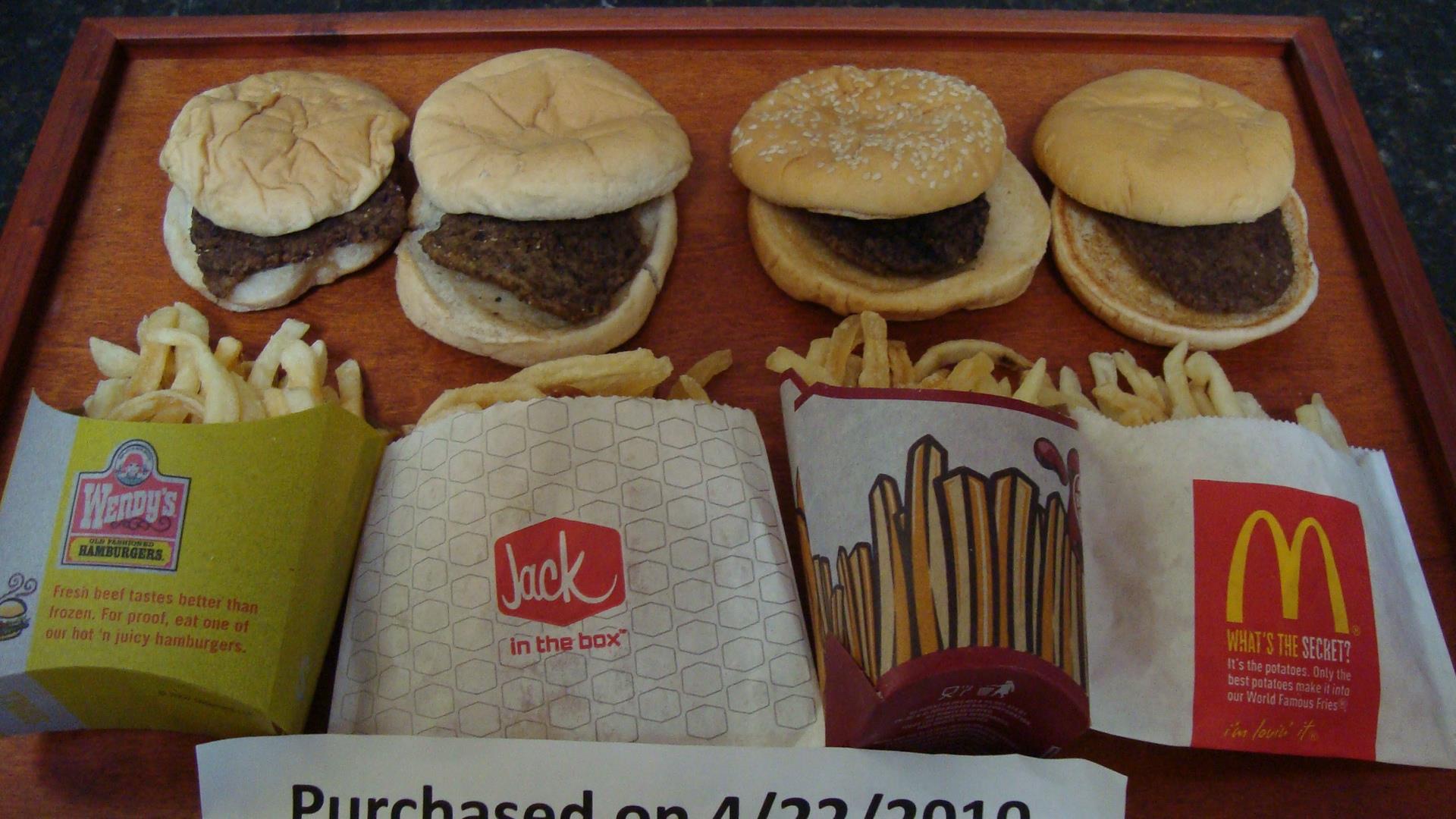
It had the following caption: Our fast “food” display is now 2 years old. The word food is questionable, since the bread-like and meat-like substances have not molded or spoiled in any way. Bugs won’t even bother with it. Please think twice about giving this to your kids. You have a choice, but they don’t. We truly are what we eat.
— from LiveWell Wellness Centers
This is not the first time I have seen these things. A few years ago I saw something similar about how Cool Whip is totally disgusting because it doesn’t separate or decompose, vs. real whipped cream that barely lasts 10 minutes before it starts to separate and get kind of gross. The comments followed were the obligatory “Eww!”, “Yeah, I stay away from that because it’s all CHEMICALS!” and “OMG DISGUSTING!” It bothered me then and it continues to bother me now. When I saw the Cool Whip thing, my main annoyance was that claiming that something is bad because it has chemicals in it is possibly the dumbest overly simplistic statement you can make. You may as well say, “I have a personal problem with atoms”. Not to be a smart ass, but everything everywhere is a chemical. The air we breathe is made of chemicals. The water we drink is a chemical. WE ARE ALL CHEMICALS. Our minds and bodily processes are a series of chemical and electro-chemical reactions. DNA is a chemical. Do you get it? When you say “Chemicals are bad” you are betraying yourself as being ignorant and woefully misinformed about the nature of physical reality. Also, to equate “natural” with “chemical-free” is to deny that there are a whole lot of things in nature that will drop you like a bullet, but more nastily. Hemlock is natural. Arsenic occurs naturally in nature. Do I need to remind you about snake venom or the evil Brown Recluse?!? How about how elements of the air will suffocate you if they are in the wrong percentage? How about if you drink enough distilled water (free of horrible chemicals, other than water), your cells will burst and you will DIE! See what you’ve done? Now you’ve got my chemist up!
Deep breath…
But, still, when I outlined the above rant, it didn’t seem to completely address the underlying issue that I have with claims like that. Making the entire argument be about how ignorant fear of “chemicals” makes no sense doesn’t really get to the heart of the problem.
So, I tried to think about it further. I went searching for links about this kind of thing and found this. The author sounds possibly intelligent for a little while, but then goes into the following tirade:
So why don’t fast food burgers and fries decompose in the first place? The knee-jerk answer is often thought to be, “Well they must be made with so many chemicals that even mold won’t eat them.” While that’s part of the answer, it’s not the whole story.
The truth is many processed foods don’t decompose and won’t be eaten by molds, insects or even rodents. Try leaving a tub of margarine outside in your yard and see if anything bothers to eat it. You’ll find that the margarine stays seems immortal, too!
Potato chips can last for decades. Frozen pizzas are remarkably resistant to decomposition. And you know those processed Christmas sausages and meats sold around the holiday season? You can keep them for years and they’ll never rot.
With meats, the primary reason why they don’t decompose ist heir high sodium content. Salt is a great preservative, as early humans have known for thousands of years. McDonald’s meat patties are absolutely loaded with sodium — so much so that they qualify as “preserved” meat, not even counting the chemicals you might find in the meat.
To me, there’s not much mystery about the meat not decomposing. The real question in my mind iswhy don’t the buns mold?That’s the really scary part, since healthy bread begins to mold within days. What could possibly be in McDonald’s hamburger buns that would ward off microscopic life for more than two decades?
As it turns out, unless you’re a chemist you probably can’t even read the ingredients list out loud. Here’s what McDonald’s own website says you’ll find in their buns:
Enriched flour (bleached wheat flour, malted barley flour, niacin, reduced iron, thiamin mononitrate, riboflavin, folic acid, enzymes), water, high fructose corn syrup, sugar, yeast, soybean oil and/or partially hydrogenated soybean oil, contains 2% or less of the following: salt, calcium sulfate, calcium carbonate, wheat gluten, ammonium sulfate, ammonium chloride, dough conditioners (sodium stearoyl lactylate, datem, ascorbic acid, azodicarbonamide, mono- and diglycerides, ethoxylated monoglycerides, monocalcium phosphate, enzymes, guar gum, calcium peroxide, soy flour), calcium propionate and sodium propionate (preservatives), soy lecithin.
Great stuff, huh? You gotta especially love the HFCS (diabetes, anyone?), partially-hydrogenated soybean oil (anybody want heart disease?) and the long list of chemicals such as ammonium sulfate and sodium proprionate. Yum. I’m drooling just thinking about it.
Now here’s the truly shocking part about all this: In my estimation, the reason nothing will eat a McDonald’s hamburger bun (except a human) is because it’s not food!
OK, come on now. Your argument is that the burgers contain a bunch of chemicals, in addition to organic matter (BTW, just to continue by smart ass trend, most of the additives in food are also organic chemicals. Organic means that they are based on carbon. Durpa do!) and so microbes and bacteria show up at the site of the burgers and go: Oh, I’m sorry, there’s too many chemicals in this.
Are you serious? Bacteria are intelligent now? If that’s true, we might be fucked. Look, perhaps they don’t necessarily go after all the Big Bad Big Words that only a chemist can pronounce (that’s what my entire education was for, btw…to learn how to pronounce things like sodium and look hella smart and also to dismantle the health of the American public. The secret is out!), but they will eat, you know, everything else. McDonald’s hamburgers are not made up entirely saw dust. They also include Grade Meat meat and soy and other things that sustain life. Bacteria love that!
In addition, just to remind you that my chemist is still up, just because something is hard to pronounce does not mean that it is evil. Yes, saying cheese is easy. Saying the names of the chemicals that occur naturally from the cheese making process is hard. It’s still cheese.
In addition to all this, I find it idiotic to say that food = decomposition. Shitty food is still food. Our bodies can digest them and extract useful stuff from it.
Of course, I am not the only person to answer these claims. I found this wonderful blog entry about a study debunking the whole thing. In short, if you leave a burger and a bun, any burger and a bun out in the air to dry out, bacteria will die because bacteria requires moisture to survive. As is mentioned in the article, dehydrating food is a proven preservation method. Beef jerky is simply dehydrated meat. Also, food like this is loaded with salt, a known preservative (that’s apparently “natural” because it doesn’t have too many syllables). In addition, under circumstances where a homemade burger and a McDonald’s burger were kept moist, mold grew on them both. It must be food then since bacteria are food critics or something.
Now, here’s what I’m not saying. I’m not saying that you should eat McDonald’s food. It IS bad for you. But, I shouldn’t even have to say that. Making the grand accusation to today’s modern public that McDonald’s is bad is as obvious a statement today as “Cigarette cause cancer, like, really”.
Today while looking at that picture, I kept asking myself why I was so annoyed. Clearly I agree that you should avoid this crap, that ingesting large amounts of it many times a week will lead to probable health problems. So what’s my problem? I mean, the underlying message that they’re promoting is ultimately correct even if the various associated beliefs are wrong, right?
And there it is. There is the problem. The sharing of these ideas makes you come across as a proper skeptic, not swallowing what the main stream wishes you to accept. The chemical industry, big business, everyone who stands to make a profit from the ignorance of the public are taking full advantage of it at all times. Not only do they not care about your welfare, but they wish to put it in danger. It is black and white.
Obviously. If there’s anything that’s black and white and not difficult to predict it’s nutrition or medicine or human physiology. That’s why it’s so easy for people to lose weight. I mean, if it’s just that humans are stupid and eat shit (while animals never do that, ever), then shouldn’t it be easy to lose weight and get healthy when you’ve cut out all the Bad Shit? Why isn’t it? Could it be that the obesity problem, the general health problems that people are more aware of now, all of that might be more complicated than fast food?
If you take these claims as fact without question, you are not a skeptic. Yes, you should question everything and you should require evidence that the ideas that the main stream have accepted are true. But why does that stop when the dissident perspective is presented? Is it not possible that the point of view is not particularly accepted because it’s actually bullshit? There are whack jobs on every side of an issue. There are people who spread misinformation in both conservative and liberal circles. People, regardless of politics or religion, will believe anything if they do not properly engage in a skeptical outlook.
Again, this is all a matter of skepticism being properly applied. I am bothered by the spreading of this woo woo, ignorant information with a general hint of truth because it is shared with an air of “we are smarter than them”, an arrogance fueled by a general misunderstanding of science. When you say that eating something because of all the chemicals in it and then say that the names of all the chemicals are hard to say, you don’t sound any better than the idiot claiming that evolution isn’t true because…THE BIBLE. You are saying that science is hard, that being science literate isn’t important. You just need to know enough to be scared and then avoid it all together. Yes, you are right in that you should not accept that everything the FDA says is edible will do you no harm, but you are wrong if you justify this skepticism with bullshit facts. This makes you just as bad as all the other ignorant people you feel superior to.
I’ve been thinking a lot recently about what it means to be sexually liberated. The 1960s began a new cultural revolution for sexuality in the west, and it has allowed the once radical idea of sexual freedom for adults to become mainstream. And, as I see it, what was once radical traversed through liberal/progressive to mainstream, and its trajectory is pushing it towards conservativism for future generations.
Currently many people, who would have been thought of as radical to 1950’s repressive standards, are now trying to defend our cultural accomplishment of liberated sexuality against the remaining religiously-motivated reactionaries who are trying to maintain a pseudo-traditional view of strict abstinence towards life-long monogamous marriage.
I don’t have statistics available to me right now, but I would bet that evidence exists to support the claim that the majority of people in countries like the US, Western Europe, etc agree that non-married adults who choose to maintain sexual relationships with other non-married adults should be permitted to do so at their whim. That is, our freedom to have relationships of our choosing, as adults, is mostly uncontroversial.
This, in our culture, has not always been the case in the last couple of centuries. There were many social stigmas as well as other cultural control mechanisms which made such things rather difficult for adults, especially woman, even if it did happen (our desires are too strong to eliminate completely!).
So, having gone through a couple of generations since the sexual revolution of the 60s, most people accept a worldview of sexually active adults. Many people still may have reservations about gay marriage, the alternative sex world, or non-monogamy but do not object to the extistence of relationships which include homosexual, kinky, or non-monogamous behavior if that is what people want.
When we talk about “conservatives,” then, we are talking about people who oppose homosexuality, non-procreative sex, and “adultery,” right? I mean, people who oppose such things certainly are conservative, but are they the extreme conservatives or merely the standard conservatives?
For me, to be conservative is to attempt to maintain some “normal” or mainstream behavior in order to preserve cultural practices which are beneficial either because they are valuable in themselves or because they work to maintain some other aspect of culture which is valuable.
As an example, take the rhetoric about traditional v. Gay marriage. Gay marriage, it is claimed, seeks to destroy “traditional marriage”, even though the “tradition” of marriage has already changed from a property arrangement to an agreement between two individuals to remain committed to each other and share responsibility for resources, children, etc.
That is, the former tradition of a property arrangement, a tradition once defended by conservatives of an era past, has been transformed by progressives (“liberals”) of the same era, and has become traditional. And now that new tradition is being defended again by people who share the opinion of those once-radical progressives, but we call them conservatives today.
We at least call them not-liberal (as my own father’s political status is on facebook). The point is that history is currently moving towards liberalization, progressive values, etc. Even if it is moving slower than I would like. Also, it could possibly start moving in the other direction just as easily, so we need to keep up the effort.
My hypothesis is this; within the next generation or so, or at least within my lifetime, what we now see as the mainstream view of relationships will begin to look more conservative—what is now centrist, mainstream, or traditional will shift as progressive people recognize the legitimacy of views which are seen as radical now; things like polyamory, for example.
Liberals of today are maintaining pretty tame views about sexual liberation. Even my own generation, people I went to highschool, college, etc (as well as those 10 years younger, in many cases) hold views about relationships which look to me, from my “radical” point of view, as conservative by comparison.
These are people who self-identify as liberals. They support Barack Obama, gay marriage, science, and are almost exclusively pro-choice. But they see much of BDSM, swinging, polyamory, etc as radical. They think it is damaging, impractical, or at best experimental. They tend to question whether my engagement and relationships can really be legitimately serious, important, and be a function of mature, responsible, true love.
Ladies, gentlemen, and genderqueerfolk, I present to you tomorrow’s tradition-defending, centrist (but leaning conservative), pragmatic culture. They will take what they have learned, in response to yesterday’s conservatism, and create a newer conservatism of their own.
And when they are retired, grandparents, and defending the tradition they were raised with, our grandchildren will be pushing the possibilities of relationships, sexuality, etc in directions that us weird folk can only imagine and dream about now.
And we will be proud while those whining conservatives we grew up with will be grumbling about traditional one-at-a-time spouses, how they had to fumble around with their first sex partners to learn, rather than having excellent comprehensive sex education which makes young adults unashamed to enjoy sex, etc. Just like conservatives do.
And these future generations will be the newer liberals, progressing in ways hard for us to imagine. Our generation will be the conservative generation, with some of us weird folks sticking around to appreciate what legacy we worked for, were ostracized for, and for which we were labeled as freaks all our lives.
Well, let’s get on with it then, freaks! Let’s pave an easier road for the next couple of generations, and see what unrepressed, unshamed, and radical people can do with the possibilities of love, sex, and (hopefully) skepticism.
 Skepticism, Properly Applied