The title of the blog is Atheist, Polyamorous Skeptics. That is, we are atheists and we are polyamorous, but those are qualifying terms of our (at least my) primary identification; skeptic.
I identified as an atheist before either of the others, temporally. It was somewhere in the late 1990’s that I started thinking of myself that way, and the winter of 2002, upon meeting Margaret Downey and joining the Freethought Society, that I came out of the closet, as it was. I never believed in any gods (I toyed with pantheism for a little while, but pantheism is ontologically indistinct from atheism), but I didn’t always see the point in talking about this much or thinking of it in larger cultural and historical terms.
Over the next few years, I was introduced to people such as Michael Shermer, Penn and Teller, James Randi, and others who usually identify as skeptics. I had already taken critical thinking, logic, and philosophy courses (By 2003, I had a MA in philosophy), but the term skepticism was pretty much academic to me until a couple of years later, even though I was actively writing about and advocating for atheism as a cultural force during both college and graduate school.
I had discovered polyamory as an idea, and practiced it to some degree, in the late 1990’s as well. But it was not until around 2006 or so that I started to re-think about the idea beyond the fact that I liked the idea of being able to pursue other girls while I was with my girlfriend at the time. And I believe that the way I started taking polyamory more serious was related to my growing interest in skepticism as a means to living, rather than merely an intellectual exercise.
I had not come to articulate it thus yet, but I was beginning to apply skepticism to all of my life; my beliefs, suspicions, and to other people’s idea which I heard. It did not always make me popular at parties, and it certainly did not make my native insecurity any better (as I wrote about last night, I still have anxieties about talking to people from this point of view). But while it didn’t make me popular, it made me feel better about myself and gave me epistemic foundations for my worldview, even while that worldview was shifting.
Most importantly, it gave me a process by which I could counter-act my natural human tendency to allow my biases and fears to skew my worldview, and thus I grew the strengthened ability to challenge myself and learn about other people and ideas better.
Skepticism became, for me, a way of living, thinking, and perceiving. But I had to train myself to be this way, which my philosophical training helped with. And it often fails me anyway because skepticism is not easy and it is not natural to our brains. I’m still prone to things such as selection bias, rejection of ideas which don’t mesh with my worldview, etc. It takes a constant vigilance to notice and attempt to counter-act such tendencies, and it creates a cognitive uncertainty around my thoughts, quite often.
So, not only do I have to deal with a quite visceral and powerful insecurity at an emotional level, the nature of intellectual processes require me to be unsure about myself and my ideas. A double dose of uncertainty, which I would rather do without, envelopes me. And thus I understand people being turned off by skepticism; it feels better to be sure. Questioning our values and beliefs is difficult, and people really don’t like their values and beliefs to be questioned, even liberal and “open-minded” people.
And yes, I am intellectually very certain about many things, but nuances and stupid semantic distinctions mean I cannot merely insist upon my superiority (although that is something I am prone to, as well). I resist the urge to be arrogant, insistent, and authoritative because these desires are a defense mechanism against feeling insecure, and not necessarily the result of feeling overwhelmingly right or warranted in my opinion. That is, there is an air of confidence which is only air.*
This is not to say I’m not occasionally arrogant, insistent, or think I’m intellectually superior. I have weak moments, after all, and ironically my weakest moments often look, to others, as my strongest moments. This is why I have trouble trusting people who appear boastful or arrogant; I suspect that underneath this appearance lies insecurity, like it does in me. And sometimes I genuinely feel confident; the distinction is that when I’m actually confident, I’m calmer, less insistent, and I will probably be governing a wry smile.
And then, of course, I think that maybe some people don’t ever have that feeling of insecurity and that not only do they not feel insecure underneath their apparent certainty, but may have no reason to feel such insecurity because they are smarter and better than I am.
And then I really feel insecure, all because I think it’s important to be skeptical.
But that’s a lie; I just feel insecure fundamentally, and it just happens that skepticism is benefited by a reservation of opinion, which emotional insecurity provides.
Capt. Picard & Dr. Crusher are being held captive by an alien race that implants telepathic devices on both of them, enabling each to hear the other’s thoughts.
While trying to escape, Capt. Picard & Crusher come upon an area which has two possible paths to take. Crusher is unsure which path to follow. Capt. Picard points in one direction and assertively indicates that it is the correct path.
As they start down the path, Crusher hears Capt. Picard’s thoughts and realizes that Capt. Picard had no better idea than her as to which path they should be taking and that he was only guessing earlier when he chose which path to take.
When Crusher tells Capt. Picard about her telepathic observation of him and asks if he does that often when giving orders, Capt. Picard answers, that there are times when it is necessary for the Captain to give the appearance of confidence.
And when I see people confidently proclaiming a decision, I think of this and wonder how universal it is that leaders just appear confident.
So, Nice Guys of OKC has shut down. For those of you who missed it, it was a tumblr posting screenshots of okcupid guys who claimed to be “nice,” then proving elsewhere in their profile that they were racist, homophobic, sexist, or otherwise assholish. The main legacy of the blog is inspiring a lot of posts (seriously, a lot) about the use of the term “friendzone.” According to Nice Guys of OKC, the mere use of the term precludes one from actually being nice.
Most posts on the topic rely on the “nice guy” stereotype. It looks like this:
1. You become attracted to a woman.
2. You are friendly to that woman in the hopes she will show you her vagina.
3. She mistakes your friendliness for friendliness and befriends you, neglecting to show you her vagina.
4. You act like a butthurt little asswipe, forever placing yourself firmly outside of the circle on the Venn diagram of dudes she will ever show her vagina to.
5. You complain about it on the internet, and 1000 other maladjusted bro-dudes go, “I know that feel,” and you are validated in your misogyny.
Like all stereotypes, some people fit it, and those people deserve the collective derision they’ve been receiving throughout the the internet for the past week or so. But, like all stereotypes, it unfairly lumps people together and makes a lot of assumptions based on very little information. In my mind, the view that use of the term “friendzone” implies all of that is a bit much. Wikipedia defines it as “a platonic relationship where one person wishes to enter into a romantic relationship, while the other does not.” Urban Dictionary, as it tends to, has a few more colorful definitions, some reflecting Wikipedia’s simple definition, some reflecting the Nice Guy stereotype.
I recently had a discussion about this on my friend Angie’s blog:
the term [friendzone] itself always made sense to me. Unrequited feelings suck, and hearing “let’s just be friends” from your crush sucks. To me, the “friendzone” often bespeaks entitlement both ways. Both sides seem to think that, if the other person weren’t such a jerk, THEY would be the one to dictate the terms of the relationship* (i.e. a sexual relationship vs. a platonic friendship), and the other person ought to acquiesce to their preference. To me, getting “put in the friendzone” is being forced into a category that I don’t want. I HATE being categorized, and I hate being assigned labels that come with arbitrary baggage.
It also makes sense because I always saw the “friend zone” as a different thing than just being friends. As many recent articles point out, if you’re complaining about being friendzoned, you’re not really a friend. But you’re not a lover. You’re occupying a strange friend-like place that has its own rules. I view it as a term akin to monogamish. It’s LIKE being friends, but not really.
Angie makes some really good points, so I encourage you to read the whole discussion.
I’m still figuring out how I feel about all of this, but I think a lot of my discomfort with the negative judgments going around is because I can envision a number of situations which I think are rather common where a man (in these articles, it’s always a man) gets friendzoned merely because of a miscommunication, and not out of anything more malicious or blameworthy than that.
Men and women tend to interpret signals differently. Men tend to interpret things as being far more sexual than women do. I can easily envision a situation where a man is behaving in a way that he believes is sending romantic/sexual messages, the female object of his affections interprets his signals as friendly. Then, she reciprocates, sending only friendly messages, but the man interpreting them as sexual or romantic. Then, when the rejection comes, both sides feel as if they have been misled and lied to, and may get angry and/or whiny. Textbook friendzoning.
In that situation, I see the parties equally at fault. They’ve both misinterpreted the other’s signals while being less-than-explicit about their own. However, I don’t think either party is feeling entitled or misogynistic. It’s just been a misunderstanding. The man’s anger isn’t because he’s owed sex. It’s because he feels like he’s been misled and used. In his mind, he was being obvious about his feelings, and the woman in question ignored his feelings and tried to force him into a relationship model that he didn’t want. He’s wrong, of course, but there’s nothing entitled or misogynistic about his view.
I don’t know. I haven’t heard the term “friendzone” much (though according to Wikipedia, it was coined by Friends, the worst show ever). Is it exclusively used by entitled douchebags? Is there a better word to use that means “wants to be friends, but not touch each other’s genitals”? Is it routinely accompanied by the type of entitlement and misogyny noted above?
______________________________________________
*in the comment, I expanded on what I meant by “dictating the terms of the relationship”:
Each participant always and without exception has an absolute right to dictate what the relationship will NOT be. But inversely, neither participant has the right to dictate what the relationship IS. When I hear the term “friendzone,” I sort of automatically assume the dude (let’s face it, it’s always a dude) in question does not actually want to be friends. The presumption on his part is the he thinks the object of his affection is obligated to touch his naughty bits. The presumption on the other side, though, is the presumption that he wants to have a nonsexual relationship. Maybe he does, maybe he doesn’t, but it’s not cool to assume that he does if that hasn’t been discussed.
Today Shaun sent me this from PZ Meyers, which links to an article about a pretty bad ass, terrifying molecule:
It’s a beast, all right. The compound is wildly, ridiculously endothermic, with a heat of formation of 357 kcal/mole, all of which energy is ready to come right back out at the first provocation (see below). To add to the fun, the X-ray crystal structure shows some rather strange bond distances, which indicate that there’s a lot of charge separation – the azides are somewhat positive, and the tetrazole ring somewhat negative, which is a further sign that the whole thing is trembling on the verge of not existing at all.
Apparently, this stuff will explode at the drop of a hat, or if you happen to be thinking about a hat while looking at it. Yep, it’s just going blow the fuck up. It don’t care. It don’t give a shit. It’s the molecular equivalent of a honey badger:
Make a little bit in the lab? BOOM. Manage to make some and have it not explode but then touch it with a spatula? BOOM. Make some, touch it, and manage to get it into the light of a spectrometer? BOOM. This molecule does not give a shit. It will explode all over your damn lab. I would venture to say that it would also fuck a honey badger up because it is a nasty ass exploding compound and it does not care about honey badgers.
Though perhaps it is unfair to assume that this molecule wreaks havoc on laboratory environments and the chemists that love them due to sheer James Dean levels of apathy. Maybe it’s really just the molecular equivalent of Malfunctioning Eddie, who explodes at even the thought of being startled:
Or maybe it just wants to be a star in Michael Bay’s next movie:
Whatever the reason, I am happy to admire these brave, crazy ass chemists from afar. If they want to do death defying research that results in one picture in a general chemistry book that enables a professor to say, “This is some nasty shit”, then I am all for it.
Four years ago I was trying to figure out what to do for Wes’ birthday. From early on in our relationship, I had wanted to take him away on a ski vacation. This was not because I like skiing…quite to the contrary. Wes took me skiing once and what resulted was a day long blooper reel of me falling on my face, my skis flying off my feet skidding across the mountain, and impressive amounts of me rolling around in the snow like some kind of beached whale who fell out of the sky only to find itself in the wrong habitat.
Needless to say, it was not something that I wanted to particularly do again. But I wanted Wes to get to do it, but ski vacations in places like Vermont are very expensive. So four years ago I was clicking around on Craigslist and I happened upon an ad for rental of a little 3 bedroom ski chalet in the Poconos only 10 minutes or so from Jack Frost…and it was $300 for the weekend…in January. This is, I am pretty sure, quite unheard of. And thus a tradition was born. We invited a bunch of friends and had a party weekend. There’s karaoke, a fireplace, copious amounts of booze and food. It is theoretically a really good time.
And for many, it has been. For me, however, it has most often been somewhat of a nightmare.
If you have been reading my entries here and at my old blog, you are aware of my journey to mental health. One of the things I have touched on a lot is that up until recently, I just thought that all my problems were philosophical. I think that this is a good place to start when trying to improve yourself emotionally, but, as you have read, I eventually zeroed in on a seemingly chemical problem as well. So you can imagine that with my particular set of challenges, hosting a weekend long party sequestered in the mountains when you struggle with generalized anxiety, depression, and an unrelenting need to take care of people and make everybody happy could be a recipe for disaster.
On the bright side, my issues rarely affected anyone else horribly during the weekend. Obviously, the people close to me cared and were bothered by it…and it certainly drove me crazy to be such a mess when we were trying to celebrate Wes’ birthday. The first year happened to be the first year I really started to work to tackle my problems in earnest. It’s not that I wasn’t working on it before that, but it was that year that I wished to make big strides to be happier because I was so tired of being miserable. The first year at the chalet was rough and I fell apart multiple times. The second year was better, but still tough. The third year was almost perfect except for some unexpected drama that sucked royally. I am able to look at last year in two parts, pre and post drama and more objectively see that overall, it was a big improvement over previous years. Each year I made adjustments from what I had learned the previous year and enjoyed more of the party. I like upward trends like that.
And here we are at year number four and we’re getting ready to head back up there this coming weekend and for the first time since the tradition’s beginning, I am looking really forward to it without a care in the world. I’m actually excited about it!
I have been wanting to do some sort of 2012 In Review kind of post, but as opposed to previous years where I have various events that I can point to as Important and Worth Enumerating, 2012 feels like an entire devoted to process.
Obviously there were a few Big Deals. Arcati Crisis began a recording project of Herculean proportions. Shaun and Ginny got married and then a few months later, they moved in with Wes, Jessie and me. I stood up for myself in ways that I never have before. But honestly, it is pretty hard for me come up with a list of the significant because this was the year my mental health became something that I had to deal with in a very big way.
For years I had been dealing with the philosophical: What is it about X situation that bothers me? Why does it bother me? Is this the best way to think about it? What can I do to improve the situation and my reaction to this particular stimulus? Why am I so insecure? Why do I yearn for the things I do from people? All these and many other burning questions preoccupied most of my thinking.
And it was really great stuff I was doing. I made a lot of progress and I can honestly say that my general happiness increased the more I handled things like this head on. But then I noticed that while my thinking had become considerably more rational and productive, my reactions to things were not…or at least, not to my liking. It was a daily fight to keep my mind from going to dark and destructive places and much of my time was spent just trying to avoid total meltdowns. And though I could say rational things to myself, things I knew to be true, I couldn’t quiet the other voice. A good day was one in which I could feel the anxiety and depression bubbling under the surface, but felt able to keep it at bay.
It was in 2012 that I allowed myself the possibility that additional measures were required to give all this philosophical work I’ve been doing a chance to be the predominant driver of my mind. And though I have been depressed and full of anxiety for years, I finally decided to try therapy and medication.
And now at about the 6 week mark of taking Zoloft, I can say with a beaming grin that I am doing really well. I have never felt this good for as long as I can remember. I don’t wakeup anxious and sad anymore. I begin each day at a delightful level of OK and generally maintain that level, even if faced with something stressful. Of course I still get upset about things here and there, but I get upset, deal with them and then I’m done with it. I don’t tear myself apart for my imperfections. I actually have the ability to move on from things. I don’t stew so much and I don’t spiral nearly as often. And the best part is that I have such increased interest in my life. I am more creative, more productive, and just plain happier.
I admit that when I first got my prescription, I felt like I was giving up on myself because it was a point of pride that I was able to make so much mental progress through hard work and commitment to a general goal of happiness and stability. When I started taking it, I was afraid that I was going to get lazy and look at it like some kind of magic pill. There were moments when I did think that…mainly after moments of disappointment when I felt that the pill had failed me when I got really upset about something. But eventually its effects evened out and what I was left with was, well, me.
It was not until I had achieved this general feeling of being alright that I realized how much of a goal that had been. It seems so simple…all I want is to be alright. Being alright means that I can look at my life and see how amazing it is, how much fun it is, and how rewarding it is. Some people worry that medication will strip away the parts of them that they like, right along with the parts they don’t. I can understand that fear, as I shared it. But all I can say is that I have gotten incredibly lucky here and this treatment pretty much exorcised a nagging demon that kept me from being the person that I knew, deep down, I was. And now I can see that all the work I did, the life philosophies I adopted in the time leading up to this, are there, ensconced, and effective. I have not lost the flexibility required for continued growth…I believe it has increased.
So here’s to a new year. May it be one unobsessed with emotional process. May that process be simply engrained and positive. May the accomplishments be viewed with joy and humility and may the setbacks be seen as mere hiccups on the road to a life less ordinary. May we have health, luck, and love.
And if you have embarked on a similar journey, keep trying but always remember to try hardest to by kind to yourself. That is the thing that is often the hardest for me. And know that you are not alone. This is a journey that ends only when we ourselves end, but it is a trip that is worth it.
The Federalists also fixated on Jefferson’s religious beliefs, maligning him as an atheist. This was grounded on what Jefferson had written in Notes on the State of Virginia, drafted in 1782 and first published in the United States in 1788. Jefferson had lauded the Virginia Declaration of rights of 1776, which provided for religious toleration, but, wishing to go further—he hoped for a law that would separate church and state—Jefferson had dilated on the “rights of conscience,” about which individuals were “answerable [only] to…our God” and never to the state. He then added that “it does me no injury for my neighbor to say there are twenty gods, or no God. It neither picks my pocket or breaks my leg.” These two sentences were reprinted endlessly in Federalist newspapers as proof of Jefferson’s impiety. In addition, Federalist scribes cautioned that Jefferson viewed the clergy as “curses in a country.” Primarily, however, they depicted him as a “howling atheist” and “infidel.” Filled with contempt for Christ, Jefferson supposedly embodied iniquities that would bring on the moral decline of the United States. In New England people were told to hide their Bibles should Jefferson be elected, and the warning went out that his election would call down God’s vengeance on the United States.Though more from the pulpit than the press, lurid tales were told of bizarre worship services at Monticello at which Jefferson supposedly prayed to the Goddess of Reason and offered up dogs on a sacrificial altar. One Federalist newspaper advised its readers to vote for “GOD—AND A RELIGIOUS PRESIDENT or impiously declare for JEFFERSON–AND NO GOD.”
How many current cultural tropes did you notice there?
Thomas Jefferson, never self-identified as an atheist, as far as I know. The conflation of religious tolerance and freedom with repression felt by the dominant religion was as real then as it is now. We are not dealing with anything new, in talking about this religious privilege and the association with separation of church and state with impiety and even lack of patriotism.
There are simply some people, whether in 1800 or 2013, who simply cannot see that asking for religious neutrality from our government is a good idea. Those that declare the United States to be a Christian nation have the precedence of idiots from the 18th century who did not grasp the importance of said separation then, and who wanted a Christian president rather than a supposedly godless president. And those who see the legal foundations of the United States as secular, as its founding documents state, have the precedence of people like Jefferson and Madison on their side. It’s not simply that we were a secular nation and people forgot, it’s that some people simply could not grasp it at the time, and that tradition seems to have run parallel to the actual law and history.
In short, there are always idiots in society, and it may be the case that they will never go away. One of the weaknesses of democracy is that those idiots also get to vote, and thus we have Michel Bachmann and Rick Perry.
For many years I have thought that through determined effort, rational thinking, and patience, it was possible to change people. And sure, people change their minds in the face of facts, or more likely experience which includes emotion and reflection, but this happens through appealing to a central set of values, inclinations, and other emotional considerations. I once thought that it might be possible to actually change the core emotional values people have; to make them more prone to caring about self-improvement, authenticity, and thus to become better skeptics (and thus better people). Granted, I never thought this was possible for all people, perhaps not even most, but now I think such a thing might be impossible, or at least vanishingly rare.
Much of what I have written here at polyskeptic.com, even before the creation of that newer URL nearly a year ago, has been in the hope of making an argument for the application of self-challenging skepticism in order to show that faith is perhaps the worst human trait, as well as to explore the social and cultural predominance of an often stifling and broken view about sexuality and relationships. I was hoping that through a combined application of rational argument and a perspectivist’s critique of cultural norms, I could demonstrate that skepticism was a tool for our improvement as people, and hopefully create some new atheists and polyamorous people, because I believed that the truth of atheism and the promiscuous inclinations of the vast majority of humans was universal and that more people should be able to see that.
And while such actions may create new atheists and polyamorous people, what I am leaning towards concluding is that the underlying skepticism is harder to inspire. There are certain sets of inclinations, desires, and fears which either make a person more or less likely to utilize skeptical thinking, and if some personality traits are not present, you might as well try and yell down a wall.
So, as a result of this leaning (which is even more cynical than I have been previously), I am leaning towards an updated approach to writing about the topics of religion and relationships. The casual reader may not notice much of a difference, but anyone who knows me will notice the importance of the subtle distinction. Rather than try and find people who are stuck in the cultural milieu of theism and monogamy, and try and convince them that they would, perhaps (and probably), be happier giving up such things, I want to focus on finding people who display certain personality traits, in order to grow a better atheist and/or polyamorous community. Rather than transform people, I want to cultivate certain types of people in the hope of finding ways to educate and inspire them, while looking for others to inspire me as well.
Because in many cases, such communities have done a fairly good job at growing (especially the atheist community in recent years), but in doing so it seems we are more interested in quantity, rather than quality.
Build Quality Rather Than Mere Quantity
Here’s the thing; the atheist community has become a cultural phenomenon. it’s not quite mainstream yet, but it is on the path towards it. But many people seem to think that we just need to grow, rather than actually improve, what exists. The goal is not to create more atheists per se, the goal should be to find and cultivate better people, and better people will become atheists because atheism is rational (and if it isn’t, those better people will discover that). Similarly, the goal is not to create more polyamorous people, it is to have people better understand their own romantic and sexual desires, and show them how to find a more healthy way to explore and express those desires. Thus, better people will tend towards polyamory (or accidental monogamy).
Getting numbers for our communities is an important part of the larger cultural shift, and I will not disparage it altogether as a strategy, but there is a point when the community needs to pause and take note of the shape of the community, rather than its mere size. What values do we have? How skeptical are we being? Are we keeping in perspective the larger goal of cultural improvement, rather than merely caring about our immediate concerns? Etc. And I think that many in this community have got caught up in squabbles about stupid shit, and frankly I don’t want to associate with some of them who do not display traits worth wanting.
So, having said that, what types of qualities do I want to seek out and help cultivate in our communities?
1) Attention and empathy.
You know, like mirror neurons and shit. I want to seek out people who have the capability, and desire, to see the world through the perspective of others. This means listening, yes, but more importantly trying to understand concepts like privilege and cognitive biases. By empathy, or even compassion, I don’t mean merely being nice and gentle with people, because sometimes people need a (metaphorical) kick in the ass, and accommodating is not always a good solution. I mean that we need to make a genuine attempt to understand what is being said, including the context of those ideas, so that when we do unleash our raptor-like wit and eviscerating critiques, we can hit as many of the actual weaknesses of their position, as well as be aware of our own weaknesses.
Also, it’s possible that we are wrong, or at least partially wrong, and understanding the argument of others might actually teach something about ourselves, including our own privileges and cognitive biases.
In short, the best means to criticism is to make sure you understand the other positions as well as they do (if possible), and the best way to know such things is to listen carefully and try to understand their perspective, especially if it seems ridiculous. Makes me want to quote some Sun Tzu or someshit.
2) Judgment
We need to be able to be authentic concerning what we think, and be honest with our conclusions (tentative as they may be). We need to exercise our abilities to discern rationality from irrationality, rationalization from explanation, and good from bad.
There are bad people in the atheist community. There are bad people in the polyamorous community. These people have bad ideas, treat people badly, and make rationalizations and excuses for why they are not bad, and for some reason people follow them. Yes, those people are still part of the larger community, but they should not be our inspirations. But mostly, there are people who have a mix of bad and good ideas and behaviors, and we need to be able to separate those things. There are many people who have contributed very much to our success as a community, but who maintain ideas which are damaging. We need to be able to criticize them without eschewing them, but we should be able to eschew when necessary, at least in terms of our support or respect for such people.
We need to encourage good ideas and criticize bad ideas, and be able to not divide into camps which no longer talk with each other because of disagreements. We need to be able to take judgment, give judgment, and not create battle lines because of judgments made against us. In short, we need to accept judgment as a good thing, rather than as a thing which divides us.
Judgment being a bad thing is a religious idea, more often than not, and we need to re-appropriate it for our use as a tool, not a weapon.
3) Expanding our domain of understanding and concern.
Battle lines create quasi-dogmas. It prevents communication, yes, but more fundamentally it prevents us from taking seriously the perspectives of others. We need to be perpetually broadening our arena of concern, even if our actual arena of action remains small. That is, we might only fight for the rights of polyamorous people in the workplace, church state violations in your state or city, or focus on the relationship between race and religion in your culture. All of these things (and many more) are worth doing, but if you are doing those things, it is important to be aware of how the concepts that you use in your work map onto other parts of our struggle for social justice. And yes, you should care about social justice in general, and apply skepticism to such questions. If you don’t care about such things, then there is no point in talking to you, is there? I can’t make you care about something that you don’t care about. Similarly, if you don’t have the basic emotional capability to empathize, talking to you about morality would be futile except as an intellectual exercise.
The idea that religious people have a privileged status in American culture is not exactly like the privilege that men have, but the concept is transferable to some extent. How some people understand one while rejecting the other makes no sense to me, and strikes me as a fundamentally conservative mind-set which acts to undermine the larger goal of improving our culture.
Self-improvement is not always linear, in the direction of your personal goal, it is more like a network, where concepts and efforts that we use are related to other things around us, and we should see that the effort to solve issue X is related, in some way, so solving Y and Z. Skepticism is a tool to be applied to religion, astrology, and homeopathy for sure, but also to gender, relationships, and many other cultural concepts that are too often unquestioned or not analyzed.
4) Exclusion.
There are some people I don’t want at my party. They simply don’t care about the perspective of others and are unable to comprehend the problem and so they mock it, they either judge in only one direction or pretend not to judge, or they see no reason to expand their scope of applying skepticism and rational analysis to their lives. Whether it’s fear, apathy, or simple cognitive or emotional inability to understand, there is no point in exerting much effort on some people; they just don’t want the discussion, and it will just be time wasted on your end. The resources will exist, on the internet, in books, and in your head, if they start to care, but before they do care it’s not really worth the effort.
Such people may still be atheists, they may be non-monomagous, they may be skeptical about some things. But they are probably not worth my time when it comes down to explaining nuanced concepts which they will not retain even if I tried. We have to be willing to cut our losses in some cases, and realize that some people simply are not equipped to be real adults with the ability to understand certain concepts.
Fuck ’em.
I’m not wasting much of my time fighting them anymore. If you want to, then by all means do so. But I wash my hands of people who don’t have the fundamental values and desires to make themselves better people. They won’t be going anywhere, it’s just that they are not worth arguing with so I leave them to others who still feel like they can do something to get through to them. I certainly did for many years, and I can’t change their mind for them either.
I want to see more effort in improving what community we have, rather than merely get more attention and attract more people. Yes, we want more people, but we should make sure those people are worth wanting.
Meh, call me an elitist if you will, but I think that many people just are not capable of being good as people. I view relationships the same way; some people are not really worth pursuing. Why would I try to date a person who I didn’t respect (or wasn’t attracted to)?
This is not a universal creed, it’s just where I stand on this issue at the moment. And like I said before, I will not decry anyone who wishes to howl at the moon or yell down walls (hell, it sometimes even works!). I’ll just be watching, paying close attention, judging openly or quietly (depending on the circumstances), while trying to expand my own understanding so that I can keep growing myself.
Because I have to post something, while I’m dealing with my existential crisis, I quote Stuart Hampshire:
Philosophy is a game with objectives and no rules.
Mathematics is a game with rules and no objectives.
Theology is a game whose object is to bring rules into the subjective.
Partially inspired by Jerry Coyne’s recent thoughts about theology, which were inspired by another great thinker, Walter Kaufmann.
And, for kicks, here’s more Hampshire:
A man becomes more and more a free and responsible agent the more he at all times knows what he is doing.
and…
As self-consciousness is a necessary prelude to greater freedom of will, so it is also a necessary prelude to a greater freedom of thought.
Once I figure out my current philosophical crisis, I will be writing more.
The WordPress.com stats helper monkeys prepared a 2012 annual report for this blog.
Here’s an excerpt:
19,000 people fit into the new Barclays Center to see Jay-Z perform. This blog was viewed about 110,000 times in 2012. If it were a concert at the Barclays Center, it would take about 6 sold-out performances for that many people to see it.
According to some, the world is about to end on December 21st. Of course, those people are pretty ignorant.
You see, the Mayan calendar “ends” on that date. I use the quotes there because the Mayan concept of time was more cyclical, and all that will happen is the Mayan long count will reach the date 13.0.0.0.0, the end of the 13th baktun, which will mean, well, nothing really.
But today I’m not going to find a bunch of nut jobs to quote and rebut concerning this stupd “prophecy,” while making comments about how skepticism is da shiznit. Today, I’m going to post what was a paper about the Mayan Calendar and their concept of time. This was written in the Spring of 1998 (long before anyone was making a fuss about the 2012 issue, I think, so it does not come up in the paper), and was completed and turned in on April 20th, 1998; or what was the Mayan date of 12.19.5.2.1.
I will not blame you for skipping this one, as it is fairly dry and is after all a term paper from a college sophomore. But in case you wanted to learn a little something about the Mayan calendar, here’s one way to do so.
I have made some minor edits, and included some images.
—-
Time and the the Mayan Calendar
Introduction:
We can admire the Maya for many things including their monumental temples and their wonderful hieroglyphic writing found on countless Stelae and other monuments throughout the Yucatan lowlands and Guatemalan highlands. But when we study the Maya in depth we discover that they had very old and very solid roots in things like agriculture that dealt with religious rituals and seasonal changes. Related to these things very directly were a complex set of calendars and time keeping systems that acted as a axis for all of their religious and secular activity. The Maya had calendars—plural—meaning that not one system of time-keeping was used, but three (maybe four, depending on how technical we want to be). These different time-keeping mechanisms were based on different cycles and were not alike in most ways but were related in very clear-cut and significant ways.
Of the three time keeping devices, the two calendars that were used were the sacred 260-day calendar—tzolkin—and the 365 day calendar known as the haab. Both were very different from our Gregorian calendar in structure as well as mechanics and combined to create a cycle of 18,980 days, slightly less than 52 solar years (Meyer 1). This 52-year cycle in known as the calendar round to the Maya and is significant because it is the amount of time that the tzolkin and the haab, running in unison, will not repeat. In a sense, the calendar round worked for the Maya like the century does in our calendar. The third time keeping method of the Maya is the Long Count dating method. When dates are found in Mayan sites the date is recorded using this method, along side the tzolkin and haab dates, which allowed us to coordinate the systems for our understanding.
The last mechanism worthy of mention is the very specific calculated solar year of 365.2422 days which is mentioned here to establish that the Maya were very aware that their 365-day haab, also known as the Vague Year, was not perfect in calculating the solar year. However, the Maya made no attempt to account for this difference by use of a leap day as we do because of the delicate relationship between the haab and the Tzolkin. If every four years another day is added to the haab, then the cycles of the year bearers (that will be discussed later) and their significance to the Maya would disappear. It is also important to note that despite the fact that the Maya did not use a leap day, they were very aware of and measured closely the effects of this decision, i.e. the accumulated change in seasons as the years cycled (Thompson 121).
Throughout this paper I will be using Mayan names for the days and Uinals (20-day “months”) in the Yucatec language as recorded in Sir J. Eric S. Thompson’s book, Maya Hieroglyphic Writing (pages 68, 106 respectively) and sometimes followed by the Quiché equivalent, found in Tedlock’s book on page 89, in parentheses. Example: Yucatec (Quiché). This will be done as to not confuse the different spellings or words used to express the same days or Uinals in different languages. The other names of days from the other Maya languages are included in the attached section #3.
The Mayan conception of time was by no means elementary or simple; “Mayan astronomers at Palenque were recording calculations which sweep more than 1, 250, 000 years into the past, and then foreword to dates over four millennia in the future” (Thompson 141). It is a controversial topic of whether the unit of time for the Maya was the day or the tun (360-days). If it was the tun, which can be vaguely called a year, then the kins (days) and Uinals (20 days) are just fractions of this basic unit like minutes and seconds are fractions of an hour. From the evidence that Thompson gives us in his book it seems as if the tun would be the more likely candidate for the unit of Maya time because of the large scale view of time that the Maya held—they seemed to think bigger. In his discussion of he Long Count Eric Thompson believes that the unit of time was the tun on the grounds of evidence such as the Chilam Bilam and other sources that refer to time periods in years more and more and days less and less. Also, as he states, if the Maya count were based on the day then “it would be logical to expect a straightforward vigesimal system with a year of 400 days” (Thompson 141-142). But as I will point out, the Maya did not use a pure vigesimal system, and they did not have a calendar of 400 days.
The Long Count:
The Long count was based on a vigesimal counting system, that is, a system of counting based on 20 instead of the decimal system we use. As the system is difficult to understand, and as I write this I find it harder to describe, I will use a description used by John Major Jenkins in his article Introduction to the Mayan Calendar:
It is written using dots to indicate placement values (for example: 8.15.6.0.4). The leftward placements are of higher value. The Long Count dating method is based on a hierarchical day-count based on twenty. The above date represents the passage of 8 baktuns, 15 katuns, 6 tuns, zero uinals, and four days since the zero date (Jenkins 5).
Here is an adapted version of the table that Jenkins provides for us on the same page:
Long Count Periods (read right to left)
Number of Days
1 kin = 1 day
1
20 days = I uinal
20
18 uinal = 1 tun
360
20 tuns = 1 katun
7200
20 katuns = 1 baktun
144,000
13 baktuns = 1 Great Cycle
1,872,000 (around 5,125 years)
And compare it to a pure vigesimal system:
Placement of number (right to left)
Number of days
1 (comparable to the kin)
1
2 (“ “ “ Uinal)
20
3 (“ “ “ tun)
400
4 (“ “ “ katun)
8,000
5 (“ “ “ baktun)
160,000
As the tables above show, the Mayan Long Count, although based on the vigesimal counting system, is not a pure vigesimal system. The system of counting was altered slightly from the system used for counting objects as Peter Meyer reaffirms in his article The Maya Calendar:
When counting days, however, the Mayas used a system in which the first place [starting from the right] (as usual) had a value of 1, the second place had a value of 20, but the third place had a value not of 400 (20*20) [as a pure vigesimal system would] but of 360 (18*20). (This may have been due to the fact that 360 is close to the length of the year in days.) The value of higher places continued regularly with 7,200 (20*18*20), 144,000 (20*20*18*20), etc. (Meyer 1).
Based on the Mayan counting system, the Long Count dates events by stating how many days have passed since 3113 or 3114 BC (this depends on whether we use the Julian or Gregorian calendar, respectively). This dating method is used instead of the combination of the tzolkin and haab dates because the calendar round will repeat every 52 years, making the combination of a tzolkin and haab dates insufficient for dating events because any date, for example 1 Imix 2 Pop, will occur every 52 years or so, meaning that seeing this date on a stele will not tell us which revolution of the calendar round the event occurred, but only limits the possibilities to days that occur every 52 years.
Tzolkin:
“The Tzolkin, Mayan name derived from the word tzol which means “to put in order”, and kin that means ‘day’ (Imagenet. Origins, p. 1).” The Tzolkin calendar is the more complex and unfamiliar to us as compared to the haab and was under the control of certain individuals, called “daykeepers,” who had the responsibility of keeping track of the days and performing the rituals associated with them. Overall, the Tzolkin seems to have been a “divinatory almanac,” as Eric Thompson calls it in his book, meaning that it was used as a basis for predicting the future and what we might call fortune-telling. The days were actually considered gods or lords that carried the burden hence ruled each particular day name. Life surrounded by the Tzolkin was “not monotonous” says Thompson, the days followed “in unbroken succession, each bringing its charge of weal or woe” (Thompson, p. 66).
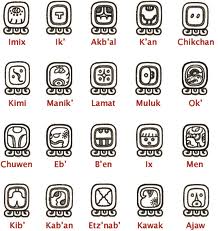
The Tzolkin was broken up into 13 day numbers and 20 day names. Here is the list of days and their equivalent names in the Quiché language. The numbers are present to list the sequence, do not confuse them with the day numbers mentioned above:1.Imix (Imöx)
Mayan glyphs for 20 day names
2.Ik (Ik´)
3.Akbal (Ak´bal)
4.Kan (C´at)
5.Chiccan (Can)
6.Cimi (Came)
7.Manik (Quej)
8.Lamat (K´anil)
9.Muluc (Toj)
10.Oc Tz´i´
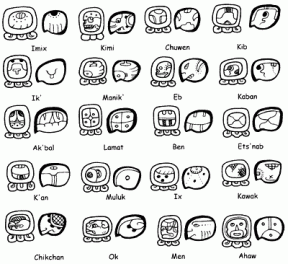
an alternate set of glyph images for the same day names
11.Chuen (Batz´)
12.Eb (E)
13.Ben (Aj)
14.Ix (Ix)
15.Men(Tz´iquin)
16.Cib (Ajmac)
17.Caban (No´j)
18.Eznab (Tijax)
19.Cauac(Cawuk)
20.Ahau(Junajpu)
The day names and numbers were indistinguishable from one-another as a single functioning unit with its own meaning and character. “The combination of number and day was a unit, and one part was as meaningless without the other as a telephone number is without the name of the exchange” (Thompson, p. 66). The day 13 Ahau, for instance would not be called 13, or Ahau because one without the other would be incomplete. Having one without the other is like me telling you that to make a cake you needed a half cup or saying that you needed sugar; if I gave you one then you would need the other to make sense of the directions. But despite the fact that a certain day is not identified by its name alone or its number alone, it is also clear that the day name, which is the name of that day lord, has a certain significance that differs from day to day and is separate from the number. Each day lord has his own characteristics and one day may be very different from the previous or the following. This relationship between the day names and numbers and their significance will be expanded when I discuss divination. The concepts of the advance of day names and numbers will become more clear when we establish how the mechanics of the Tzolkin works.
The numbers and days advance in unison; that is, the day name and number advanced on the beginning of a new day instead of the number advancing through what we would call a month. For instance, if today were 1 Manik then tomorrow would not be 2 Manik, but it would be 2 Lamat. This is because the day name Lamat follows the day name Manik in the sequence of days, and 2 follows 1. When, as the days progress, the number reaches 13, then the next day would be numbered as 1. And the last day arrives, then the names repeat in the same sequence from the beginning. This cycle continues indefinitely along with the haab which also cycles endlessly.
The major problem with the 260-day calendar, and to some extent the haab as well, is that there is no identifiable beginning. The Mayans saw time in cyclical terms, there is no beginning or end, it is just the kins, Uinals, tuns, and katuns rolling through time in an endless cycle.
A. . .major controversy about the 20-day calendar concerns the beginning day of the cycle. Central Mexican lists of the twenty day names usually begin with [Imix]. . .but the Mayan picture is less clear. Morley noted that ‘since the sequence of twenty day names was continuous, it is obvious that it had no beginning or ending, like the rim of a wheel: consequently, any day name may be chosen arbitrarily as the starting point.’ (Morley, Sylvanus. An Introduction to the study of the Maya hieroglyphics.)
Despite the lack of absolute evidence for a day that begins the cycle, it is relatively accepted that Imix is the beginning day of the cycle and that the accompanying number would be 1; hence the first day of the Tzolkin is accepted as I Imix (Thompson 102, Tedlock 94). Whether or not this day actually was seen by the Maya as the beginning of the Tzolkin is something that will be argued over and may not ever be known for sure.
While talking about beginnings, it is appropriate to discuss the origins of the Tzolkin itself. Nobody is sure why the Tzolkin developed the way it did. The theory that I most widely encountered, whether in proposing it or attempting to discredit it, was that the 260-day period is very close to that of the human gestation period. Eric Thompson is a critic of this theory, saying that it “is not a very happy explanation because there is no logical reason why the period of pregnancy should be considered in establishing a divinatory almanac” (Thompson, p. 98). But despite Thompson’s critique, the theory is held by many to be reasonable and is held in veneration within the community of Mayanists.
Another prominent theory is that the 260-day period is the amount of time that the sun is south of the zenith of the latitude 14º 30´ (a little south of Copán). The problem with this theory is that this exact latitude does not accurately represent the whole of the Yucatan peninsula and the Highlands. In Some places in Yucatan the sun would be south of this zenith on as many as 311 days of the solar year (Thompson, p. 98). Thompson states that one “must Assume then that the cycle of 260 days originated on the periphery of the area in which it was current, and that, spreading northward and westward, it was eagerly adopted by peoples for whom it had no solar significance” (Thompson 98). This is the same as saying that the tzolkin was developed by someone living along the 14º 30´ latitude and spread throughout the limits of Mayan influence and accepted as it was.
Other common answers to this problem include that this cycle was created because it is the least common denominator of the numbers “13 and 20, both of which are important in Mesoamerican thought” (Tedlock 93). One version of this I found on line and sounds like this:
The time count used for corn cultivation must have been based on the initial Maya numeration which consisted of the number of fingers on both hands and feet or the number 20, a kal. The observation that 13 kal (260 days) were needed from the choosing of the location for the milpa until the burning of the felled forest patch and equal number of kal elapsed from the planting, through the growth and harvest until the corn was stored, gave origin to the first Maya calendar. (Imagenet. Origins of the Mayan Calendar, p. 1)
This may seem reasonable, but I am wary of lending this idea credibility because the idea is not sourced, hence it may just be speculation.
The most interesting [if not far-fetched] idea to me is this one from John Major Jenkins’ article;
The 260-day cycle does not directly correspond with any known astronomical period, yet it serves as a common denominator to synthesize the cycles of Sun, Mercury, Venus, Moon, Earth [and] Mars (as well as the other planets). In essence, it is the key factor of all the planetary periods” (Jenkins 2).
It seems that the Mayan knowledge of astronomy was significantly advanced in calculating the movements of the massive bodies in our solar system and that the Maya may have used this knowledge to develop an unusual calendar.
The last theory of the tzolkin’s origin also deals with astronomy. Barbara Tedlock mentions “that a double tzolkin (520 days) equaled three eclipse half-years” (Tedlock 93). If I interpret this correctly then I conclude that this means that two tzolkin years would be the same time as one and one-half revolutions of the (lunar or solar?) eclipse cycle. Knowing that the Maya did calculate and predict eclipses, this theory is possible as well as the others. Whether any one of these theories, all of them (in parts), or none of them is correct, we at least have a good idea of what the Tzolkin was used for after its creation—a tool for divination.
Divination and Meaning of the day names and numbers:
Divination was believed, by at least some Maya, to involve the predicting of the future and fortune telling. The process itself is not particularly significant in this discussion because it would lead into too many directions that would go beyond the scope of this discussion of the calendars. What I would like to do is describe how the day names and numbers had significance when they were used for divination purposes. As I mentioned, each day name was considered to be a god to the Maya, and that as Thompson states they cannot be separated from the numbers and make any sense. However, in her study of the Quiché people and their rituals Tedlock disagrees with Thompson’s statement that day names and number were not separated based on the fact among the Quiché, “low numbers—1, 2, and 3—are ‘gentle,’ while the high numbers—11, 12, and 13—are ‘violent’” (Tedlock 107). Generally, what this means is that the higher the number along with the day name, the more serious or more severe the meaning of the day name and vice-versa relative to the value, good or bad, of the day god.
I will not describe all 20 days but will focus on how one day name—Imix–is evaluated from two different texts (Tedlock spends a whole chapter on the 20 days that is longer than this paper, thus I am doing myself and the reader a service by not discussing all of them). The mnemonic meaning that Barbara Tedlock discusses refers to her discussion of the meanings and associated phrases among the Quiché people of the Guatemala highlands. As she says in her book, “in actual practice the names [of days] are ‘read’ not as words in themselves but as a kind of oral rebus for quite other words; these other words are linked to the day name by means of paronomasia—that is, by means of poetic sound play” (Tedlock 107). In considering this, we must be aware that Tedlock’s study of the day names comes from her experience with more modern-day highland descendants of the Maya who do not share the same words as the majority of the Maya whom Eric Thompson discusses in his book. Thus, we must be aware that both of the discussions of the day names are coming from two different researchers getting their information from different places and times recorded in different languages.
Imix, according to Thompson, means the earth crocodile “whose back formed the surface of the earth” (Thompson 73) or more generally the earth and the abundance that is related to the earth. Thompson believes that this is due to the fact that the Quiche (possibly the same as Tedlock’s Quiché) associate Imox (their name for the day) with the earth god Mo´x. Whether this association is fortuitous or the two words have a common origin is unclear although Thompson seems to agree with the latter of the two possibilities (Thompson 71). The Mexican equivalent to Imix is Cipacti which symbolizes the earth crocodile. The word Cipacti itself translates loosely into “spiny creature” and the Aztec word for this day also means crocodile. The word Imox, which is similar to the modern Quiché word for this day, refers to the ceiba tree which symbolizes the abundance of mother earth in Maya religion. Thus, it seems reasonable to say that Imix at least vaguely represents the earth and hence the earth crocodile (Thompson 72-73).
Tedlock’s equivalent word for Imix is Imöx (Quiché) and she gives a different description than Thompson does. Tedlock’s approach is to break down the word into its “mnemonic phrases” and describe when the rituals are performed according to the number of the day. How she connects the word Imöx with the phrases “camöxiric (‘one becomes crazy’), nimalaj c´ulel (‘a big enemy’), and cumatz rib chiquiwäch Mam (‘humble oneself before the Mam [year-bearer]’)” (Tedlock 125) is unclear to me, however. The number of the day along with the name further defines the meaning of the day. Some of the rituals involved with this day are dependent on the number; according to Tedlock, on day Imöx numbers 1, 6, and 8, a daykeeper, someone who keeps the 260-day calendar, visits an appropriate public shrine and humbles himself or herself before the Mam (year-bearer) as to not be dominated by their power (which makes one go crazy). On high numbered Imöx days the diviners go to mountaintop shrines to present themselves to the Mam, asking the Mam to dominate persons, in the form of mental and physical sickness, who have used witchcraft against others—hence the “big enemy” (ibid.)
When divination is being performed the day Imix, say in the case of divination for an illness, indicates that an enemy (c´ulel) has asked a diviner for the illness to be put upon you (probably from a shrine on the top of a mountain on a high numbered Imix day). In a marriage divination, the presence of Imix indicates that the desired woman would cause the client to become crazy through unfaithfulness or other malign action (Tedlock 125). A final example of how the day names are used in divination is that a “child born on Imöx will be dominated by the power of the Mam. As a result, he or she will be weak, inefficient, undirected, even insane” (ibid. 126). It is relatively easy to see that the divinatory calendar was and still is highly interconnected with daily life and Mayan thought. It was not like the haab, which is almost purely a secular system for counting days [a separation of religious and secular calendars].
The Haab—365-day calendar:
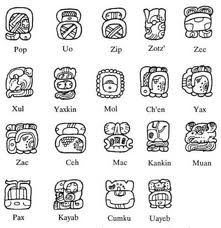
The word haab is also referred to as the vague year and seems to mean “cycle of rains” (Jenkins 2). Unlike the tzolkin the haab is more like the Gregorian calendar than the tzolkin is in that the haab is broken down into what we could call months consisting of numbers for days. The haab is a 365-day cycle that is divided into 18 Uinals of 20 days each and a short month called Uayeb 5 unlucky days added, usually, to the end of the year. The word Uayeb means “unnamed” and therefore the 5 days are not named but do include many rituals. Each Uinal name has its meaning much like the days of the tzolkin do as we saw with my example of Imix. Here is a list of the Uinals starting with Pop, Uo, Zip, etc. which is where most people seem to start the haab:
Pop
Uo
Zip
Zotz
Zec
Xul
Yaxkin
Mol
Ch´en
The Burden (see below)
Yax
Zac
Ceh
Mac
Kankin
Muan
Pax
Kayab
Cumku
Uayeb (5 days)
Like our calendar, each Uinal starts on a day and continues until all the 20 days are through then moves to the next month. The problem comes about when we start looking into the numbers and what the first day of the month is. This has to do with what is referred to as the “seating” of the month.
As Eric Thompson discusses, most Mayan scholars have accepted that the first day of the Uinal is denoted as 0 Pop, 0 Uo, etc. This view holds that the day after 19 Pop would be 0 Uo and this would be the seating of the month. Thompson has quarrels with this on the basis of evidence that he has seen and discusses in depth in his book. “From all we know of the Maya philosophy of time and from all we can gather from the glyphs, the Maya were interested in recording the completion of time” (Thompson 119) is how he begins the argument. He concludes that “the days of the months were numbered 1-19, and that the day between the nineteenth of one month and the first of the subsequent month was usually called the seating of the new month, but sometimes was called the last of the old month. It is possible that ‘seating of’ is not the correct translation” (Thompson 121). What this means is that the seating of a month may not have been part of new the month at all but may have been the end of the last month even though it carried the name of the next month. Another way to look at it would be to view the seating as more like a transition, or as Thompson himself suggests, an “entrance of.” The question is, what exactly is entering in which the Maya were greeting? This problem makes deciphering the rest of the intricacies of the calendars even harder, especially the year-bearer problem that will be discussed in a few moments.
At the beginning of this paper I mentioned that the Maya were aware of the actual length of the solar year (365.2422 days) and that they did not attempt to correct for the difference by the use of a leap day. Eric Thompson tells us that “[s]uch a correction would have played havoc with the whole orderly plan of the calendar and would have disorganized the elaborate system of. . .different time cycles, which were of the highest importance for divinatory and ritualistic purposes” (Thompson 121). But not only would it cause problems with the divinatory aspect of the calendars, it would have caused problems by throwing off the year-bearer every 4 years.
The Year-Bearers (Mam) and the concept of Burden:
The year-bearer is the tzolkin date that falls on the start of the new haab year, which is the seating of Pop (0 Pop) or the first of Pop depending on whom you ask.. Because of the way that the haab and tzolkin correlate with each-other, only 4 day names from the tzolkin can fall on the beginning of the haab. Depending on how the two are calibrated, the 4 day-names will vary, again, depending on whom you ask. The standard system, according to Thompson, had the first of Pop (as 0 Pop could be interpreted as the last day of the old year as I discussed earlier) as only coinciding with the day names Akbal, Lamat, Ben, and Etz´nab. But supposedly “in parts of Campeche and Yucatan a shift took place, as early as 9.12.0.0.0 [around July 1, 672]. . .and was apparently accepted generally in Yucatan in the sixteenth century” (Thompson 124). The change then made the days Kan, Muluc, Ix, and Cuauc the only names that fell on the first of the year. Tedlock gives the set of year-bearers used today in present-day Guatemala highlands among the Quiché; Ik (Ik´), Manik (Quej), Eb (E), and Caban (No´j) which is one of the sets that Meyer gives in the third chapter of his article.
Meyer gives the same three sets in his article that Thompson and Tedlock give together in their books. He mentions the Kan-Cuauc set that Thompson does but Meyer offers it as the result of the coming of the Spanish when the people of Mayapan “began to number their months from 1-20, instead of from 0-19” (Meyer. chapter 3, p.1) which may have been the same cause that Thompson mentioned because Thompson didn’t give a reason and Meyer only gave us a clue of the date (before the 16th century). This shift caused the set of year-bearers to change from the original Akbal-Etz´nab set to the Kan-Cuauc set just as the shift that Thompson mentioned caused. Perhaps the Spanish were the cause of this shift in the calendar when they arrived and as a result we are now having problems being sure what set of year-bearers is the correct one—assuming any one was correct.
It turns out that the set that one uses as the year-bearers depends on the month base being used, that is what the start of the month is, 0 or 1. The confusion seems to be related to uncertainty about the seating of the month, which is then transmitted to the seating of the year. It is best to let Meyer explain:
Some scholars. . .state that the Dresden and Paris Codices use the Akbal/Lamat system of yearbearers. This results from interpreting ‘the first of Pop’ to mean 1 Pop rather than 0 Pop. . .Thompson adduces some evidence that the 0 day of a month was really the last day of the preceding month, so that 0 Pop was really the last day of the old year, not the first day of the new year, but suggests that the Mayas themselves. . .may have become careless in drawing such distinctions. Be it as it may, the system of yearbearers used [here] interprets the 0 day of a month to be the first day of that month, implying that the system of yearbearers used in the Dresden Codex is Ik/Manik and not Akbal/Lamat. (ibid. p. 2).
Due to the lack of clarity in the issue of where the month is seated and the shifts that the Maya implemented in the calendar correlation’s, the problem of the year-bearer is also unclear. The sets used differs from place to place and I am only sure that the present-day Quiché use the Ik/Manik set.
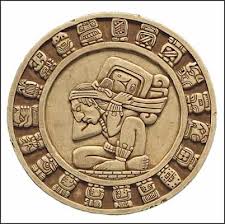
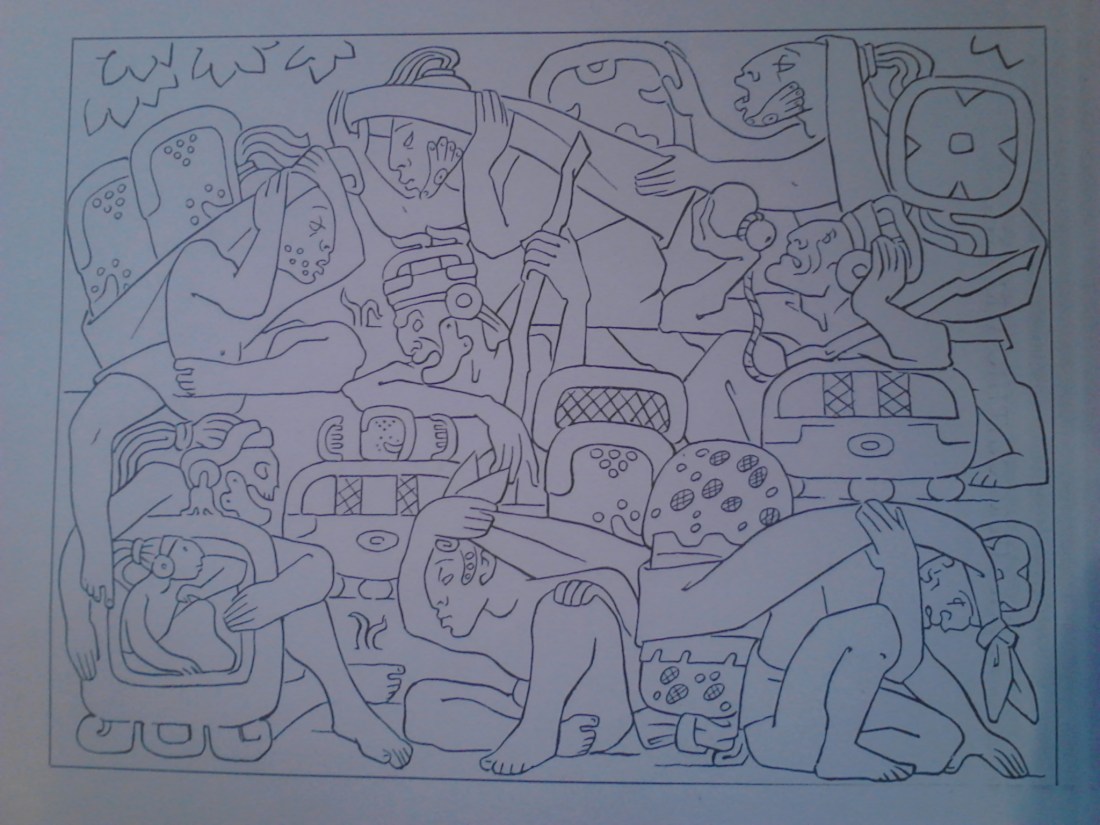
What we are sure of is how the Maya saw the year-bearer as having to carry the burden of the year “as a load on his back” (Thompson 125). A drawing by Jean Charlot is included in Thompson’s book that is adapted from full-figure glyphs that, quoted from the drawings label at the front of the book, “represent arrival at the lub, ‘the resting place,’ of the deified numbers bearing the periods as loads, at the completion of the tun” (Thompson, Frontpiece). This drawing (above) shows many year-bearers with the glyphs of day-names on their backs; some resting, others not. The significance of the concept of Burden of the year has to do with divination; the year-bearer’s characteristics will be associated with the entire year the same way as I described when discussing divination. The same influences of the names and numbers of the year-bearer will further define the characteristics of the year. As a year begins, the tzolkin date that corresponds to the start of the haab then becomes the name of the god that will bear the year on his back for that year until he reaches the lub. The number that was associated with that day when the haab began will further describe the influence of the day god. The higher the number the more severe the lower the number the less severe. But of course this severity is relative to the value, good or bad, of that particular day god. A lower number of a good day god is not a good sign and vice-versa.
A Brief Word about the Venus Round:
Venus has a cycle of 584 days, says John Major Jenkins, which means that it will “rise as morningstar approximately every 584 days” (Jenkins 3). The round that is associated with Venus occurs when the tzolkin, haab, and Venus cycles all fall in unison. This happens every 104 haab and is known as the Venus round. This round holds importance to the Maya but must be kept short here as to not step on the toes of astronomy.
[This latter comment was in the interest of not being repetitive. We students, back in 1998, were working as a class to cover many Mayan topics, and excessive discussion of astronomy would have been redundant with the work of the other students, who we were presenting these papers for]
Conclusion:
To sum what has been said in these pages it is important to emphasize that the Maya thought in terms of cycles. Each calendar was a repeating cycle in themselves and all of the time-measuring systems that the Maya used combined to make many rounds such as the 52-year calendar round, the 1,872,000 day Great cycle formed by the long count, and the Venus round of 104 haab. The tzolkin’s importance lies in the complex divination practices that the Maya seemed to live for and the day lords that came in and out with the change of each day. The tzolkin is made up of 20 day names and 13 day numbers that are inseparable in defining what day it is but not in what the day means. Divination was practiced by interpreting the day names and numbers, and on certain days of the tzolkin year rituals where performed at shrines. The 18 Uinals of the haab act like months with 20 days each with an added short month of 5 days called the Uayeb. The year-bearers carry the tuns (ok, pun intended—but the Maya would have loved it!) from year to year and never seem to complain a bit about this burden. To see that the Maya knew so much about their universe and yet still found a way to collapse as a power should be a lesson to us though. If the saying is true that the bigger you are the harder you fall, then we, as the most “advanced” society in earth’s known history, better be careful as to where we are going.
8. Craine, Eugene R. (ed). The Codex Pérez and The Book of Chilam Balam of Mani. University of Oklahoma Press: Norman. 1979.
9. Tedlock, Barbara. Time and the Highland Maya. University of New Mexico Press:
Albuquerque. 1982.
10. Thompson, J. Eric S. Maya Hieroglyphic Writing. University of Oklahoma Press: Norman.
1960.
—
I know, not very sexy. To be honest, I don’t remember if I ran into any of the 2012 Mayan calendar stuff back then and ignored it, or if it did not exist as a thing then. In either case, nothing more really needs to be said about what will not happen on 13.0.0.0.0, also known to us as December 21st, 2012.
All I know is that I have work that day and the evening before I will have (probably) attended the atheist meetup.
Every so often, an aspect of woo finds its way into the mainstream, being taken up and mentioned by people who generally don’t keep up with or believe in the body of thinking it comes from. From my very biased sample of facebook friends, it seems that Mercury retrograde is one of them. People who never otherwise mention astrology will write “Thank goodness Mercury is coming out of retrograde, it’s been a rough week” or “Missed two buses and an essential phone call: damn you, Mercury retrograde!” And since I only rarely lecture to people on their own facebook walls, I thought I’d get out all my frustrated pedantry here.
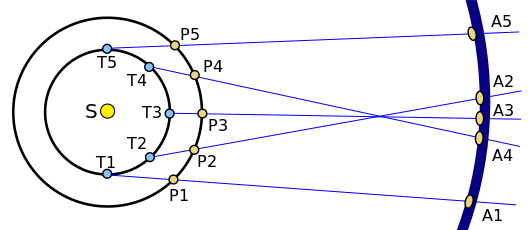
First, a brief explanation of what “Mercury in retrograde” even means. All celestial bodies, as observed from Earth, move from east to west in a daily arc across the sky: this apparent motion is caused by the Earth’s daily rotation on its axis. The stars all stay in the same relative position to one another, but the planets move from night to night, so that one day they’ll appear near one constellation, and the next day they’ll have moved slightly further away from it. Normally this relative motion is also eastward, but occasionally a planet goes into a phase where it’s moving westward relative to the stars. This is called retrograde motion, and yes, all of the planets do it — Mercury just does it more often. It’s caused by the relative positions of Earth and the planet in question, as they both move through their orbit.
So there’s nothing mystical about it, just a natural effect of perspective when you have two moving objects moving at different rates.
For astrologers (and mythology buffs) Mercury governs transportation and communication, and when Mercury is in retrograde you can expect to have difficulties in both of these areas. And now we begin to see why the “Mercury retrograde” meme has caught on, even among people who never notice or care when Mars or Venus is in retrograde. Transportation and communication, in our modern world, tend to be based on complex systems that are easy to mess up. And they also tend to form the bedrock of our lives: some day write down how much time per day you aren’t engaged in either transportation or communication of some sort. So breakdowns in transportation or communication tend to be frustrating and cause further problems, and they happen often. And when a human brain faces a frustrating, obstructive issue, it wants to try to make sense of it. So if you’re a fairly ordinary person who’s heard of the whole Mercury retrograde thing from your astrology-believing friends, and one day you miss your train and later you’re stuck on hold for two hours, and still later you have trouble with a project because you and your colleague interpreted the requirements differently… well then your frustrated brain is looking for answers to “Why is everything so difficult today?” And then you think to check if Mercury is in retrograde, and if it is, all sorts of little reward fireworks go off in your brain. There’s an explanation! These issues might be out of your control, but at least they are predictable and explicable, and that feels so much better, cognitively, than just having a rough day for no particular reason.
And if, perchance, Mercury isn’t in retrograde on this particular day, you probably barely notice, since you weren’t all that invested in the myth to begin with, and you go on to look for other reasons why today sucks. And if this happens multiple times over the course of a year, and you get two or three “Yes! My day sucks because of Mercury!” moments and twelve or thirteen “Nah, it must be something else” moments, you will probably start to believe a little in Mercury retrograde. Your brain is a bad statistician; it remembers things that have emotional impact, and the “Yes! Explanation found!” emotional impact is much more powerful than the “Nah, must be something else.”
And if you already believe in Mercury retrograde, you’ll start getting confirmations pretty quickly. Apart from illness, nearly everything that goes wrong for a person in an industrialized society can be, by some stretch of the imagination, connected to either communication or transportation. Check out this piece from Astrology Zone on what Mercury retrograde means for you: aside from the obvious travel, mail, and email issues, it predicts that Mercury retrograde might cause your DVD player to break or your boyfriend to fight with you. Also, just in case all the bases aren’t covered, Mercury retrograde can cause some things that were broken to fix themselves, so if you have an unexpected success in the area of transportation and communication (as broadly interpreted as possible), that counts too! If you know when Mercury is in retrograde, it would be incredibly improbable for you not to receive dozens of confirmations that it’s having an effect during that time.
What tickles me about the Mercury retrograde phenomenon is that it always reminds me of another colossal case of human bias. The apparent retrograde motion of the planets confused the hell out of ancient astronomers. The going theory for hundreds of years was that the stars were part of a rotating sphere, moving cleanly around the earth which sat at the center of the sphere. The sun, moon, and planets were thought to move on inner spheres, concentric with one another and moving at different rates. Most philosophy at the time accepted a few basic principles (drawing heavily from Aristotle): that the celestial bodies were perfect and unchanging, while the earth was subject to change and decay; that a circle was the perfect form of motion, and thus all celestial motions must be circular. The system of concentric celestial spheres worked great with this philosophy, except that the planets sometimes didn’t. What was going on with that retrograde motion? Astronomers, most notably Ptolemy, worked out huge elaborate systems to explain the irregular planetary motion in terms of the circles that Aristotelian physics demanded. When something fits most of our observations, as well as our underlying philosophy, we will often go to absurd lengths to make the few remaining inexplicable bits fit before we’ll stop and consider that maybe the entire system is wrong.



 Skepticism, Properly Applied
