The Deep Rift in Atheism: picking a tribe


Over the last few years, a deep rift has emerged in the atheist community.  If you don’t know about it, and don’t care, then I’m not going to summarize it for you.  For sake of clarity, I am talking about the rift between the FtB bloggers (because they are a hive mind, of course) and those who refer to them at “FtBullies” or somesuch.  You know, like many at Skeptic Ink, the slymepit, or A Voice for Men (and other such places).

venn-scopeofproblemNow, I will start out by saying that I recognize the tribalism emerging here.  For a while, say around 2007, it looked like the atheist community was going to be a tribe of it’s own; breaking away from the tribes of Christianity, Judaism, Islam, etc and creating a space for those who were interested in science, reality, and who were skeptics.   Quickly, it began to fall apart a bit at a time.  From the fall of the Rational Response Squad, through #Elevatorgate, and to the “deep rift” which still causes trembling in the blogosphere today, there are a number of tribes within the larger community of reason.  Again, I’ll start by acknowledging this, and using it as the basis to say any more about it.

Nobody here is completely right.  In every camp within the atheist community there are people who have made mistakes, with whom I disagree sometimes, and with whom I will not choose to spend my time reading (which is not to say I will refuse to do so, I just don’t follow those blogs).  But that does not mean that the answer is (necessarily) to mediate the dispute by planting oneself in some neutral zone between these camps.  That philosophy of diplomacy is fundamentally flawed, as I think The Daily Show has shown many times over the years by demonstrating that Fox News is not Fair nor balanced.  Similarly, as PZ Myers once said (and I’m identifying my” tribe here), trying to sit halfway between the evidence and “those worshipping superstition and myth is not a better place. It just means you’re halfway to crazy town.”  That is, there is a side here which is more right than others (or, in some cases, all in-accordance-with-the-evidence while the other is all wrong).  In short, I think that there exists, within this rift, a side which is one the right side of justice, and sees the long term goals of the movement are worth paying attention to.  I think that side is the FtB people, for the overwhelming majority of examples.

Many do not agree.  Justin Vacula, for example,  has said that atheism has nothing to do with feminism.  He puts it this way:

Atheism, as it’s commonly understood, and how I use the term, is lack of belief in any gods. The lack of belief in any gods does not entail any other facts about a person. Atheism — although there may be a large percentage of atheists at least in America who share some unrelated common ideals — is no indication of political views, positions on social issues, guarantee of intelligence, educational background, ideas concerning feminism, or socioeconomic status.

Here, Vacula is technically correct.  Atheism, qua atheism, will tell you nothing about a person other than their lack of belief in gods.  Vacula is here playing the part of the dictionary atheist, as defined by PZ Myers.  And I will admit that I have a small quibble with PZ’s view here about why we are atheists.  I disagree with PZ semantically (because my mind works in such a way that the lack of semantic precision bothers me), but I think I understand PZ’s point in that linked post (from February 2011, mind you…and it’s still an issue…) and agree with it mostly.   On the other hand, I find Vacula’s semantic quibbling, some 2+ years later, to be grating and annoying.  Vacula, like some many around him, is missing the point while trying to be too technical, too lawyerly.

Here’s what I posted to facebook, quickly, before going to work earlier today (in part) after reading an update by Vacula;

Atheism has nothing to do with feminism, eh? Only in the most strict sense that the lack of belief in any gods (per se) is not directly related to the role of gender discrimination and structural inequalities therein are concerned. But the same skeptical methodology and the value for human rights which led me to care enough to take part in the atheist community led me to care about the rights of all genders, discrimination, and to work towards a better world for all people no matter their gender.

And so now I want to elaborate on this.  I want to explain why I think that the atheist community has a lot to add to and contribute to the many social justice movements, feminism included, and why people like Vacula should stop being a clueless douchemonkey about this, if possible.  It’s not that I think Vacula and his ilk is always wrong, that they have nothing worth-while to add, or that he should be kicked out of anything (although I will not seek him out when I go to Women in Secularism 2 in a few weeks).  It’s that I think that they are missing the goddamned point.

ApluslogoAtheism+

I don’t participate in the A+ forums.  My wife (Ginny) is a moderator there (although I think her graduate school works and upcoming website project have made her participation there nonexistent recently).  I don’t know enough about what goes on there to speak with great authority, but I agree with their general goal as I understand it.  And despite what anyone will say about the Matt Dillahunty affair which occurred there (Matt is seemingly still on board with A+, so that should tell you something), they are a dedicated group of people who care about social justice and they are people with whom I’m willing to ally myself generally.

What is the point of atheism+? We know that atheism, per se, is simply a conclusion; the answer “no” to the question “do you currently hold an active belief in any gods?”  So why that title? Simple; it caught on from an organic conversation, and that’s how terms come to be.  It came into form here, with Greta Christina pulling together an idea that was initiated by Jen McCreight about how there is more for us to do, as atheists.  We don’t only disbelieve in gods, we have values and positive beliefs.  Granted, not all atheists share the values which the atheism+ movement embraces, but that is the nature of addition; those who don’t fall into that category are not being counted here.  If you don’t add those values, then you are not part of the set that is defined by atheism + social justice.  There is no attempt to re-define atheism, just to FUCKING ADD TO IT! Nobody has to count themselves as part of it if they are not in agreement.  Personally, I’m glad to leave some atheist dipshits behind here…OK, perhaps it would be better to educate them and bring them along, and I’m juts being cynical and negative.  Fine.

If I had my say, I’d call it skepticism+ (as I think that skepticism is the more fundamental position, compared to atheism).  But the boat sailed on that, so I’m sticking with the term until the unpredictable direction of cultural movement carries it another way.

Atheism is boring

It pains me to do it, but I will mention that Alain de Botton said that the question of whether a god exists is boring.  I detest Alain de Botton’s perspective for many reasons, and wish him the obscurity he deserves for his flat and vacuous philosophy.  But I will partially agree with him here.  It’s not the question per se  which is boring, but rather it is the way we are still answering it, the way we have been doing it for a long time, which is boring.  I’ve been around this block for more than a decade now, addressing theological claims, accommodationism, etc and it’s getting old.  Hence the need for the “third wave” of atheism which started this whole atheism+ thing.  I’m glad that there are people still handing the 101 atheist questions (my good friend Staks, who disagrees with me very strongly about the issue at hand in this post, does a good job of that even still).  In my opinion, basic atheism should no longer be the focus of anyone’s efforts within the atheist community, but should be an occasional peg to be smacked down when it becomes occasionally relevant.  We need, as atheists, to recognize that we should be concentrating on what we are for, and not merely what we are against.

I’m for feminism.

I loved Evid3nc3’s videos.  I thought his voice was remarkable and fresh, and I was glued to the monitor whenever a new video in his series about his conversion came out.  But recently he started a blog, and one of his posts from last year, entitled “Why I am not a feminist” missed the point, hard.  Being a feminist is not about ignoring the rights, plights or hardships of men [edit: Evid3nc3 wants me to clarify that his issue is that his”problem is with the word “Feminism” and the way it alienates people. It isn’t a good common banner to unite around.”  Apologies to him for misrepresenting his view.].  It’s not about focusing on women only (again, Greta Christina has said it well; the patriarchy hurts men too.  Also, see part 2).  This mistake is exactly the same as that which I identified above in discussing atheism+.  The name stuck because of the history of the subject; by studying the cultural positions, experiences, and structural discrimination of women, we learned about the problems we have with gender assumptions and the effects of those assumptions.  Feminism, as I use it (and as it is used within the atheism+ sphere) is an attempt to fix the problem for everyone, and is not misandric.  Those who identity as Men’s Rights Activists (MRAs) who argue that feminism seeks to hurt men, are simply missing the point, and often will conflate some (2nd wave) forms of feminism with what people like Rebecca Watson, Stephanie Zvan, and others espouse.  It’s not called feminism because it’s anti-man, man-apathetic, or even because it seeks to reverse sexism, but because that’s the historical title that stuck.  We could try to change it, but given how cultural memes work that seems harder than just realizing that basic point that the title is historical, and not normative.

It’s time to move on

Fighting for civil, social, and human rights of atheists is a grand cause which I was glad to be a part of, and want to see continue.  I support all of the people who continue to try ato make a better name for atheists in the world, and would love to see our status as a trusted and understood group improve.  And the fact that this will continue makes me happy.  But some of us need to move on and do more—to add on—than mere atheism   Mostly, this is because it is not sufficient to merely grow our community, it is also important to make our community stronger, more mature, and more broad.  We need diversity of opinion, perspective, and experience and we cannot do so by ignoring what those potential others may teach us.  We need to open our skills up to challenges beyond mere theological claims, and be broad skeptics who understand that there are other causes and effects to the problem of religion than theology.  The role of gender is an important narrative to trace in religious history, and so is race, physical ability (ableism), colonialism, economics, etc.  As a larger community of reason, we need to open ourselves to the various disciplines from all over the social sciences, including history and feminism.

I’ve been paying attention to all sides of this deep rift over the last few years, and they all claim the same crimes of the others, and I’m sick of it.  But the truth is that I’ve learned much more from one side of this than any other. Those at Skepchick, FtB, and even Patheos have been a source of great personal education in recent years, and rarely have I read anything which has brought about personal growth or understanding from anything written elsewhere within the atheist community in recent years.  It’s not so much that one side is right concerning the deep rift per se, but that they have been attuned to ideas which have raised my consciousness more, while other places have just been doing either the same old boring atheist blogging (and not much else) or vilifying the so-called “bullies” elsewhere.

I get it; your feelings are hurt, and you don’t like the people over there.  I don’t give a shit because your blogs are boring, your perspective parochial, and your continuous victim-playing as old as your blogging style.

I’ve moved on and think mostly about the intersection of atheism, skepticism, and polyamory.  Some others are thinking mostly about the intersection of race, feminism, etc with skepticism and atheism.  But at least they have moved on.  You, my atheist brethren who are complaining about the bullies, have not.

It’s time to do so or become irrelevant, at least to this blogger.

What has contentedness with monogamy got to do with polyamory?


I’m happy with my relationships.  Not directly related to this, however, is the fact that I’m not looking to meet anyone right now.  That is, I’m not actively seeking new partners right now, but its not merely because I’m happy.

There are women I’m interested in, to varying degrees, with whom I interact somewhat frequently but I either do not have any reason to believe my interest is reciprocated, or I know that this interest is not, in fact, reciprocated.  But I’m OK with that, because I’m not really looking anyway.  That may change at some point, but right now I’m content with the number of relationships I have.

Yesterday I was reflecting on this happiness and this contentment and it occurred to me that this was a feeling I had had while monogamous, in the past.  There were times, when exclusively committed to a girlfriend, where I had periods of genuine happiness with my life and contentedness with the nature of my relationship.  And this, in context to where I am now, made me realize two things about some of the reactions I hear from monogamous people upon being confronted with the possibility of polyamory.

The first is that that sense of happiness, when in a monogamous relationship,  does not imply that a person is built for monogamy, necessarily.  That would be mis-attributing the source of the happiness to the structure, rather than the contents, of their relationship.  Such a person, being happy and content with their monogamous relationship, could still pursue polyamory and be equally (and possibly more) satisfied with that alternative to sexual and romantic exclusivity.  The feeling of contentment with one’s relationships does not have to mean that one must merely tread the cultural water of mono-normativity, because perhaps being content, or even happy, is not always enough to stop the pursuit of each.  There are many potentialities in life which too many people miss because they are merely content where they are.  Perhaps they are capable of more, and don’t pursue more because they are merely ‘content’ or ‘happy enough.’

I call ‘bullshit’ on that.

A monogamous person who is happy with their partner may, in other words, be interested in other people but much like with other aspects of our lives (such as where faith comes in), be subject to confirmation bias when it comes to attributing that contentment to their exclusive relationship per se.  That is, they remember all the great aspect of the commitment they have (remember, commitment does not imply exclusivity), but forget all the times they have desires to love—erotically, romantically, etc—another person.  They feel a general contentment but may be mis-appropriating that contentment to the nature of the relationship, rather than the person they are with.  And being with other people does not (necessarily) take anything away from that great relationship, now does it?

If you answered yes, you are delusional.  Exclusivity does not a better relationship make, and loving two (or more) people does not necessarily diminish the love you have for any one of them.  If you really believe that then I will file you next to the creationists in terms of being un-attached to reality.

While I’m not actively pursuing anyone right now, or even feel a strong impulse to do so, I may in the future.  Hell, I might start doing so tomorrow, for all I know.   And this does not necessarily mean that my relationships are broken or that I’m lacking anything from my current partners, it just may mean that I might meet someone really awesome (as I did when I met Gina) or that variety in itself may be valuable to me (it is, just not all the time).

In short, I’m open to the fact that what I may want, need, etc will probably change throughout my life, and I want to keep my life open to all those possibilities out there (and, more importantly, I want to keep those opportunities open for those close to me).  And if someone else, say some monogamous person I’m explaining polyamory to, were to take their contentment at any given time  as a sign that the structure of their relationship is the cause of that contentment, then they are making a leap in logic which is not warranted.

The awesomeness of people bring us happiness and contentment, not how many of them you are romantically/sexually involved with.  How can adding more awesome people to your life be anything but, well, awesome?

I am not content because I’m polyamorous (again, per se), I’m content because the people I’m closest to are amazing, beautiful, and satisfying people.  In my case there just happen to be two of them who are willing to share me, but if their happened to just be one (or three) that would be awesome and contentment-inspiring.  But if I were monogamous, perhaps still married to Ginny, knowing and being around someone like Gina and wanting her constantly would NOT be a position of contentment for me.  And if I were monogamous thusly and intended to stay that way, I would therefore have to avoid being around someone like Gina (who I just can’t help but love) if I wanted to maintain the illusion of perpetual contentment with my hypothetical monogamy.

And this is what I think many monogamous people are doing; they are content often (perhaps very often), attribute that contentment to the exclusivity itself (hopefully tying it to the awesomeness of their partner), and ignoring or pretending that their extra-relationship desires don’t exist or would destroy that contentment by some magic unknown to me.  So they go on convincing themselves that monogamy is better for them, that polyamory would not work for them, etc while the truth very well may be that they would be happier being polyamorous if they were just willing to do the work.

This is why polyamory is superior.  Not because being with more than one person is better per se, but because being polyamorous, even while only involved with one person at any given time, allows open-ended pursuits of happiness and contentment rather than keeping us deluded that we are content in circumstances where we are unnecessarily limited, romantically and sexually.

Are you content with your monogamous relationship? Fine, what does that have to do with polyamory?

What is marriage, and why should we keep it around?


I’m very thankful to Libby Anne for asking about marriage in the latest of her Forward Thinking prompts. It’s something I’ve been thinking about a lot recently, and my thoughts have been steered in new directions by a few conversations and experiences I’ve had. I’d like to propose a redefinition or restructuring of the entire concept of marriage, which is both radical and extremely traditional.

The redefinition I’d love to see our society accept is this: marriage is the creation of family. (Long version: Marriage is the intentional creation of family among adults who aren’t already close relatives.) It has nothing to do, per se, with romantic and sexual bonds between people. A romantic bond is one of the strongest motivators in human life for creating a family relationship with someone new; a sexual bond may raise the possibility of children, who tend to create a lifelong connection between their parents simply by existing (although there are exceptions, and it’s obviously not always a connection based in love for each other.) For these reasons, it makes sense that marriage, the intentional creation of family, is most often practiced between lovers. But there’s no reason it has to be.

So two questions emerge: Why is family important, and why should a government have any involvement in the formation of one?

As much as we in WEIRD (Western, educated, industrialized, rich, democratic) culture would like to think it, humans are actually quite dependent on other humans. We spent the first and last couple of decades of our lives being dependent, and in the interim time only some of us are able to support ourselves, resource-wise, for a majority of that time. Illness or injury, natural disasters or becoming the victim of crime, economic fluctuations or just bad luck can leave us in need of not only emotional but material help from those closest to us. Ultimately, I define family as the people who will give that help when it’s needed. Family are the people that will stand between you and homelessness. Family are the people that will rearrange their lives to care for you when you’re sick, injured, or disabled. In WEIRD culture, this kind of material dependence is usually looked on as a sign of weakness and inferiority, and possibly being a lazy “user” who takes advantage of others’ willingness to help. We don’t like to think of ourselves as being one really bad day away from dependence, reliance on those who love us the most. But we all are.

I’m talking mostly about material support here, but love is the basis and the prerequisite for giving it. (I suppose pride can stand in in some cases.) Family is not necessarily the people we enjoy the most or have the most in common with, but they are the people we love the most: the people whose pain wounds us most directly, whose achievements we take the most pride in. Familial love is deep-rooted and stable, marked by compassion more than passion. It yields, over a lifetime, the willingness to sacrifice our own resources for the people we love.

In most cultures through human history (at least since agriculture), this immediate support network consisted of blood relatives and spouses. The rise of individualism has weakened a lot of those blood ties in WEIRD culture. People move far away from their families of origin to pursue a job or an education or an interest. People choose a career, or a religion, or a lifestyle, that their parents disapprove of. In some cases this merely results in increased distance, and in some cases it creates total estrangement. On the “total estrangement” side, a lot of people begin to identify “chosen family,” the people that are long-term, stable parts of their lives, that love them and have their back.

I think individualism is great, and I also think family is really important and necessary, both emotionally and physically. Human culture has nearly always recognized the right to choose at least one person as family: a spouse. While in previous times the right to choose a spouse as family was important so that children would be born into a stable support network, today I think it’s just as important for the two adults, who may or may not have a familial relationship with their family of origin. It’s a way of reconciling individualism with the human need for interdependent, familial relationships. If the family you’re born into is oppressive, you can choose to create a new one.

And, as no one should be surprised to see, I don’t see why this should be limited to two adults. Chosen families can be big, as big as the extended aunt-uncle-cousin-grandparents families other cultures enjoy. There’s a lot of advantage to having more than two independent, resource-earning adults in a close support network. Most obviously, if one of those adults suddenly becomes dependent or stops earning resources for a time, it’s less strain on the others to pick up the slack.

To return for a minute to romantic love: one of the things romantic love does, in that first, 6-18 month flush of passion that we call NRE, or limerence, or eros, is give people a drive to provide and sacrifice for one another in the same way that long-term familial love does. That’s probably another reason marriage has been so closely linked to family-creation through human history. Romantic love can kick-start the “mutual interdependence and resource-sharing” dynamic that later is underpinned by familial love (storge, if you want to be Greek about it.) But it doesn’t need to. Even if it never becomes mainstream, I would like to see it considered more normal in WEIRD culture for people to form long-term bonds of interdependence with other adults they’re not romantically linked to.

Because so much of my understanding of family in this context includes resource-sharing and other material considerations, I do think the government should be involved in it, to the extent of recognizing the bond and making certain concessions based on it. Whether those should be identical to the ones currently recognized as marriage, or whether they should be adjusted somewhat, is something to figure out once a large portion of the population get behind this entire concept of marriage. I’m not holding my breath, but to me the idea seems so useful, so obvious, and so compelling that it’s well worth the couple of perspective shifts required to get there.

Racism and privilege 101, with a social experiment


This video is the best illustration I’ve seen for a while of how a majority of racism and privilege actually operate.

Two teenage boys, similarly dressed, are pretty conspicuously trying to break a bike lock at a park. The white kid gets questioned a few times within an hour, but is ultimately ignored even by those who questioned him. The black kid draws an angry crowd within a few minutes, and multiple people express their intention of going to the police.

Here are some things this social experiment shows, that might help people comprehend the way privilege and racism work in our culture.

1) It operates on a social level. None of the passersby were exposed to both the black kid and the white kid “stealing” the bike. It’s quite possible, even likely, that some of the people who ignored the white kid would have also ignored the black kid, and that some of the people who got outraged at the black kid would have also gotten outraged at the white kid. We can’t possibly pinpoint any of the individuals in the scene as “racist” or “not racist” based on their behavior. What we absolutely can do is observe that the culture of people in that park is, on the whole, racially prejudiced. (The only alternative conclusion is that the group of people passing by at a later time all happened to be much more proactive and concerned about bike theft. If you believe that, I’ve got a bridge…)

2) Related to that, none of the passersby in the scene were confronted with whatever subtle level of racial judgement underlay their behavior. Whichever among them would have responded differently to the other kid won’t ever know it. If, on another day in another place, they react differently to another kid apparently stealing a bike, it’s all too easy to rationalize the different reaction by putting it down to how the kid was dressed, or the difference in the neighborhood, or even the difference in their own mood/circumstance. (“I didn’t call the cops on the white kid in the park because I was just trying to enjoy a leisurely day off… but I did call them on the black kid down the street because I was at home and trying to defend my neighborhood.”) The only people who acknowledged that race played a factor in how they reacted were the two black women (most of the other passersby were white.) White people, myself included, are really good at convincing ourselves that we are totally not racist at all, at all. It takes sustained effort and self-examination to start spotting the subtle race-based judgements we make day to day. (This is something I’ve begun doing over the last year or two, and it’s both uncomfortable and enlightening.)

3) Whether or not particular individuals are “racist” or not doesn’t matter squat to the people on the receiving end of privilege or oppression. The white kid got away with bike theft (under the pretenses of the scene) and the black kid got photographed and would have been reported to the police. Both kids were playing guilty in this scene, even admitting when asked that the bike wasn’t theirs, but one of them would have ridden away with a shiny new bike and the other one would have been arrested. The white kid has an unfair advantage, and that’s just a reality of the world that this scenario took place in: each individual passerby could do whatever mental calculations they want to prove that they’re not racist, and it would still be a reality of their world that a white teenage boy gets way more benefit of the doubt than a black one.

4) There are exceptions, and they don’t outweigh the overall trend. Someone does finally go away intending to call the cops on the white kid. When the black kid says that yes, it’s his bike and he lost the key, a passerby helps him lift it over the post. The world is not uniformly inclined to suspicion of black teenagers and tolerance of white ones. But it’s overall inclined that way, at least in this area, so pointing out one or two exceptions and saying, “See? Racism isn’t a thing anymore!” isn’t a convincing argument.

Shane, come back!


When I was younger, say in my early to mid 20’s, I had a pretty close knit group of friends, mostly from high school, who I hung out with pretty regularly.  We were spontaneous, throwing a BBQ at the drop of a hat, and we were all very privileged, educated, 20-somethings living in Philadelphia.   This time in my life started towards the end of college, but really lit up around the time I started graduate school.  It was a little before I discovered the atheist community (my earlier exposure to any such community was limited to online conversations with the long defunct Knights of BAAWA. If any other atheists out there remembers them besides me, you get serious props).  And while I knew of polyamory, I was monogamous, at least when I was not single.,..which I was for a considerable part of my early 20’s.

OLYMPUS DIGITAL CAMERA
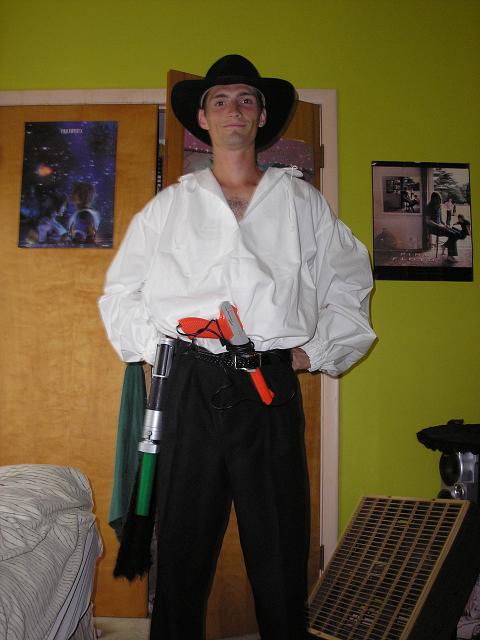
Me, c. 2005 (earliest digital picture I could find of myself, for context)

It was long before I got any grasp of who I was, what I wanted, and even knew what the problems were, let along the solutions.  On any given weekend, I could be found with my buddies (mostly guys, most with money) drinking out on the town and generally being stupid young people.  It was a lot of fun, mostly, but I’m glad I’m past that part of my life.

There was a point for me back then, while drinking, where I go through a personality change.  I am there now more frequently while sober, which is part of my growth over the years, but back then it emerged almost exclusively after, say, 4 -5 beers.  This persona I became was more social, funnier, more forward, and would talk to strangers without any sort of self-consciousness or fear. He was flirtatious, got along with everyone, although he did slur a bit.   He was the me I wanted to be while sober, but couldn’t be because I was afraid.

He was “Shane.”  At least that’s what one of our group dubbed that part of me as.  He was this part of me, hiding inside, who was happy to be alive, and enjoyed it (often to the detriment of the “Shaun” that woke up in the morning).  He was not always ideal, however, as he was also known to be a little bit of an asshole (but in a funny and friendly way, except a few rare cases when I was angry which went a different direction…that’s a post for another day, or never.).  Shane was openly emotional, affectionate, and was not inhibited.  It was the same part of me that would, in high school (when the nick-name originated), get naked in the back yard with some of the other hippies in the circle, passing around a pipe, bong, or joint.  Hey, I went to s Quaker school, what do you expect?

(Crap, I just remembered that my mom reads this blog sometimes…)

Anyway, back to embarrassing myself publicly (you’d think I’d be used to it by now).

After some time, say my mid to late 20’s (after grad school), this character began to show up a little bit in every day life (and not because I was drunk all the time, either), and became part of “Shaun.” I was able to find this part of me more easily, as I learned to allow this part of me to surface as I grew comfortable with it.  It became a perpetual part of my growing, a part that I think may have slowed too much in the least few years.  I know that I have another part of me that’s buried most of the time.  Ginny and Gina (and to a lesser extent Jessie and Wes) get to see this person more frequently, and he is certainly amplified after a couple of drinks, but around people I know, trust, and like, it has become the case that I no longer need “Shane,” because “Shaun” has become more and more like that person inside.

I think that all of this is great, but I’m slowly becoming more and more aware that there is more to me inside.  There is another level within me that I need to explore, an urge to grab life by the horns and ride it hard.  Well, that’s not exactly right.  My personality is not the kind which will be consumed by burning the candle at both ends, and this is not what I mean anyway.  What I mean is I feel a strong impulse, buried under emotional control and fear, that has a lot to teach me.  I would very much like to know now what I’m going to know about myself in 10 years.

But right now I have two problems; I am not sure how to let it out, and I’m terrified to do so.  And so I find myself thinking, this night, whether Shane might have some use.  Not that I need to start drinking heavily with 20-somethings, but that I might need to start pushing myself harder to let myself explore the limits of my capabilities.  I need to be more assertive, flirtatious (for a poly guy, I am very shy around women…especially if I like them), and I need to talk with more people about things that are not merely safe topics for me to talk about.

Let me explain.

I tend to talk about things like philosophy, polyamory, and atheism.  I have other interests, of course , but those are the things I know well, and so I feel comfortable talking about them more than other topics.  I am intimidated to talk about other things because I have this completely irrational fear about sounding stupid or dorky most of the time.  It’s irrational because sometimes I do stupid shit and I’m a bit of a dork sometimes, and so the fuck what?  The bottom line is that I need to engage with people more, and get over myself.  And I think that finding spaces, times, and people to do so with would be a good step in figuring out how to do that.

OLYMPUS DIGITAL CAMERA
Oh my good lord what was wrong with me? (c. 2005)

So, I don’t want to bring back Shane, per se, but I do want to utilize the part of me that was able to tap into a deeper part of me, to be an archaeologist of my soul (as Nietzsche put it) and find what yet lies beneath these layers of control and fear.  I want to do so because it will help with my anxieties (which are usually about wanting to do things I’m not doing, or doing things I don’t want to do because I have not been assertive enough) and will therefore help me be happier and more fulfilled.  I want to do so because I think I will like myself better if I do.

Also, chicks totes dig that side of me, or something….

But in all seriousness, it may help me gain new friends, lovers, and partners in my life, where sitting back thinking about it is gaining me acquaintances at best.  I can do better.

So, that is my project for myself for the next few months, and for the rest of my life.  If you are reading this and will be seeing me regularly or at all, you might have to give me a nudge now and then and tell me to let a little Shane out of the bottle.

But for me, that starts tomorrow morning.  For the moment, I need some sleep.

BTW, if you are not familiar with the reference of the title of this post, watch this clip from the movie, Shane:

On Depression and Reticence


I periodically go through bouts of depression.  It isn’t usually serious, but it has real-life effects on me.  I become less social,  I am much more cynical than usual, and I write a lot less.  It’s why I have not been writing recently, and the shift out of feeling depressed is why I am writing today.

One of the other things it does is causes behavior which causes stress to my relationships.  I become less affectionate, responsive, and it can lead to arguments which would otherwise not happen (because my depression leads to non-ideal behavior).  When I’m feeling depressed, I’m not much fun to be around, especially for my partners.

Another side effect can be a lack of pursuit of my desires.  I’m less likely to ask for what I want, to speak up for myself when I disagree, or to be assertive in any way.  And because live with a few extroverts (although Ginny is certainly an introvert), that can often mean I feel intimidated and shrugged off.  There is no competition, from the depressed introvert’s point of view, with confident extroverts around you, and so I don’t try to participate as much.  Not that anyone is trying to shrug me off or intimidate me ( I don’t think), but that I just feel that way and so I sort of disappear and don’t pursue what I want, and so I don’t get it.

I have thoughts, desires, and feelings during such times, it’s just that in times like the last few days I was not voicing them except where I was compelled to.  And today, feeling more energetic and happy, I am able to reflect on this periodic depression and think what I can do better next time, while still thinking that this is fruitless.  See, I am feeling somewhat confident now; right now I believe that I can continue to grow and improve as a person.  Two days ago, I did not believe that.  All I could bring myself to believe then was that I’m not really worth much, and I’d be doing the world a favor by just shutting up and going away.

And so I was not writing.

It’s anxiety-causing to admit this publicly  but it is also part of the healing process.  I know that sometime in the future I will feel crappy again, and while I’m feeling crappy I will be intellectually aware that I will feel better again soon, but while I feel crappy I am reticent–I am reluctant to speak out, up, or about much at all, and it affects those close to me.  I don’t know what to do about that.

Now that it is Spring (although it’s still too goddamn cold!), I will be starting to get outside more, get more exercise, and this will result in another cause for less writing; enjoying life.  But don’t worry, I’ll still be around disrespecting faith and finding monogamy quaint.  Ain’t much going to stop that completely, just periodically.

Thorough and Perpetual Skepticism


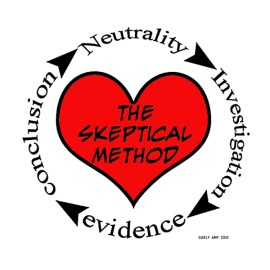
Skepticism is a method.

I’ll repeat.

skeptical-method-by-amySkepticism is a method.  It is not a set of beliefs or even tentative conclusions (it leads to the latter, however).  You cannot be a skeptic for a little while, come to some conclusions, and stop being skeptical.  OK, well, you can do that, but doing so is counter-productive, assuming you care what’s true and not merely a little better than what you used to think. I mean, if all you want is to ditch Christianity, and you use skepticism to do that and get to Scientology, then it did it’s job, but you left the job partially done (and poorly, in that case).

You have to keep that toolbox open all the time, apply it to new information, and make sure that old information is challenged in light of new data.  It may sound tiring, but being a skeptic is perpetual, and should be applied periodically.

I mean, sure, enjoy your life and don’t constantly analyze information skeptically, but when you hear new claims, be skeptical and either talk it through then or investigate it later.  Assuming you care about whether that thing is true, which brings me to the other thing.

You should be skeptically thorough.  

You should question your assumptions, carefully analyze your worldview about all sorts of things.  Again, not constantly, but periodically at least.  You should be willing to apply the tools of skepticism to all of the important ideas and behaviors you have, because you might miss some set of assumptions if you fail to do so, and end up living a silly lie for no good reason.

What happens if you don’t do this?

Well, being around the atheist community for many years, I’ve seen people find skepticism, apply it to their religious beliefs, and either accept some other religious or spiritual belief because they didn’t follow through or simply stop after doing so.  This is how Christians become Pagans or atheists who oppose inclusiveness in our community and larger skeptical movement.  I’ve also seen tons of skeptics become atheists (as they should) and then fail to apply that skepticism to other things, like Men’s Rights Activism, for example.

No! just no....
No! just no….

Or monogamy.  You know, the acceptance of possessiveness and exclusivity in romantic relationships.  That doesn’t make any sense, except as a rationalization of jealousies, fears, and other unsavory behaviors towards people they supposedly “love.”  I both laugh and cry when I see someone declare love with words clothed in possession (you are “mine”, you “belong to me”, etc). It’s absurd.  I mean, sure, if you simply are not into anyone else, then fine, but if so you don’t need to be possessive or jealous because your happiness with monogamy has nothing to do with the fact that it’s not all about you.

If you love someone, them loving other people should not matter.  Hopefully, they love you too, and you should be willing to share.

I’ve seen the same thing, in reverse order, in the poly community.  Somehow these people come to realize the absurdity of this possessiveness and exclusivity, but don’t think to criticize their basic beliefs about the nature of reality.

I know, I know, I’m weird because I think about stuff like that naturally.

—-

Strengthening your tools

I think that the more aspects of your life you apply skepticism to, the better skeptic you can become.  The more ideas you get over, the easier it can become to think through other ideas.  Don’t stop questioning just because you gave up religion, monogamy, or chasing Bigfoot (seriously, does anyone still really do that?).  Keep applying those tools, and you will be better for it in the long run.  It can be tiring, emotionally, cognitively, and socially, but there are others out there who are willing to help, befriend, and accept you as one of us weird skeptics.

The Devil, Lies, and Atheism


“The Biggest ruse of the devil is making us believe that he doesn’t exist,” said Baudelaire.  Except the devil does not exist.  The ruse here only makes sense within a very specific framework; Christian mythology.

H/T atheistcartoons.com

There is a meme, a lie, really, within much of the Christian world that atheists are Satanic, or at least deceived in this Baudelairesque fashion.  According to this meme, the devil is a liar, thus atheism is a lie.  This idea is rooted in Christian scripture where Satan is seen as the father of lies:

43 Why do you not understand what I say? It is because you cannot accept my word. 44 You are from your father the devil, and you choose to do your father’s desires. He was a murderer from the beginning and does not stand in the truth, because there is no truth in him. When he lies, he speaks according to his own nature, for he is a liar and the father of lies. 45 But because I tell the truth, you do not believe me. 46 Which of you convicts me of sin? If I tell the truth, why do you not believe me? 47 Whoever is from God hears the words of God. The reason you do not hear them is that you are not from God.”

(John 8:43-47)

So, if you accept this mythology as true, or at least inspired by a god that tells the truth, then thinking of atheists as living a lie makes sense, right? Well, I suppose, but let’s look at it this way.  The devil is a character in a set of stories–the mythology which emerges from the biblical collection of books.  This character is, by definition, evil and wrong; the narrative of the story is such that he loses, eventually, and in the mean time his power in the universe is based upon deception and lies.  Those who do not believe the story of YHWH and his various acts through “history” are seen as, essentially, conspiracy theorists who do not accept the “truth.”

But this myth cannot be stretch onto the terrain of reality.  Christianity is simply not true, and to try and live it as real can only go so far before the fabric tears and reality pokes through.  But for those who are deluded in this strange and inhuman form or LARPing, those of us who are not playing by the rules of that universe will be pegged as a kind of “muggle” who has been projected as wearing a devil mask.

We can’t seriously despute the reality of the story, can we? We can’t really actually not believe that God exists and that Jesus is our savior, Mohammed is the seal of prophets, or whatever Mormons believe, right?  Because they are convinced of the truth of their worldview, when we enter their periphery we are forced into their role-playing and seen as playing characters which represent us in their narrative.

We are devils, liars, and we have been draped with a cloth of deception to make us fit into their worldview.

But from the atheist point of view, we are a bunch of people who wandered into their D&D, Harry Potter, or Christian universe where everyone within it is LARPing fully in character. So while we know it’s all pretend, from the point of view of the players we have to play the role of muggles or devils, otherwise they have to break character.

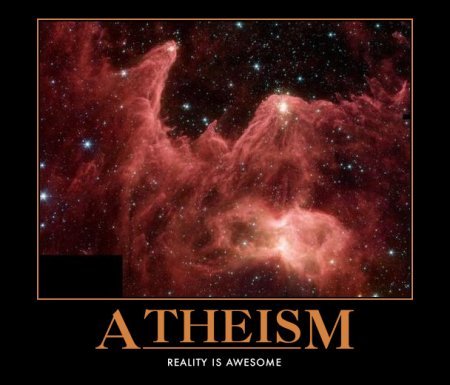
atheismExcept, in the real world, there are people who don’t know they are playing a character, they think that the role-playing is real.  And that’s religion. Atheism is simply being aware that the script(ure) is just pretend, and we cannot believe that so many people take it so seriously.  We simply want them to break character, and enjoy reality.

If you are interested in a great book about the history of the concept of the devil, see Gérald Messadié‘s wonderful book A History of the Devil.

Responses to oft-repeated comments


Oh hey internet! A whole bunch more of you know about us now, and you have opinions! That’s cool, I read all your comments, replied to a few, ignored most. But there have been a few common themes as I look at comments on various web media coverage of our Our America appearance, and I wanted to answer some of them without flooding the boards over at Gawker and the like.

OMG, you are such a bunch of hippies! You’re probably all obsessed with reiki and shit.
If you take two seconds to look around this blog, you’ll quickly see how not true that is. We run more to the “asshole skeptic” side of things. I’ll grant that woo-loving hippies are somewhat overrepresented in the poly world, but it’s not everybody by a long shot. (Also, I have a soft spot in my heart for woo-loving hippies, although I’m not sure that’s true for the other polyskeptic contributors.)

OMG, you are such a bunch of geeks! Why do all poly people love steampunk?
This, on the other hand, I plead totally guilty to. Did you see our TARDIS door? We are huge, huge geeks. I dunno why there’s such overlap between polyamory and geekdom (also kink), except perhaps that if you’re used to being called a freak and a weirdo already, there’s less barrier to entry for doing something else that will get you called a freak and a weirdo. Also probably several of your weirdo freak friends are already doing it, so you’re more likely to give it a try. There may be more to it than that, but I don’t know.

Every poly person I’ve met is incredibly smug.
Yeah, I’ve met those people too. You have my full permission to be irritated by them. We’re also all atheists, so we’re two for two on memetic smugness. Me, I’ve met people who I find intolerably smug (even if I agree with them on whatever they’re being smug about) and I’ve also met people who are convinced they’re right about something without the smugness (also, sometimes, without the rightness). I think all of us at polyskeptic believe that it is better, all else being equal, to work past the jealousies and insecurities that make polyamory seem impossible to so many people. None of us give a shit whether, having done that, a person dates one person or four people or no people. If that’s smug to you, okay I guess.

You just want to have sex with a lot of different people.
And if we do, the problem is…? But actually, it’s a lot more complicated than that. I could definitely find a way to have sex with a lot of different people that didn’t involve also negotiating how to split the budget five ways, mass round-robin conversations about why X is mad at Y, and anxiety that one of us might get a kickass job in another state and what that would mean for everybody.

You’re such attention whores! Why should you get the spotlight and applause for your stupid “lifestyle”?
While being on the show sort of necessitates that all of us are positive or neutral to public attention — and all but one of us enjoys performing in various venues — it’s not like we petitioned documentarians until someone finally agreed to do a show on us. The Our America people reached out looking for poly families willing to be featured, and after talking it over we said we’d be up for it. We’d actually be thrilled if nobody thought our way of life was interesting or weird enough to pay attention to.

You’re so brave, I could never do that.
It came easily to some of us and with great difficulty to others. One thing all of us here believe in is personal growth, and doing shit that’s hard for you if you’ve decided it’s worth doing. That doesn’t mean that you, dear reader, need to aim your personal growth in the same direction we have, but I do hope you’re doing something in your life that challenges you, and that gets you to a place where you say, “Wow, five years ago I never would have thought I could do that!” For one reason or another, all of us were strongly motivated to work toward being comfortably, happily poly, so that’s where we’ve directed a lot of our effort.

You’re incredibly emotionally immature to need more than one lover.
I sometimes wonder about people who say stuff like this. Are relationships, to them, more take than give? Because every person who comes into my life to give me emotional support also needs as much emotional support from me. One reason I don’t mind having just one serious partner is that having a second one would be more work. I’ll do it happily if I fall in love with someone else, but it’s not all sunshine and candy.

You’re all ugly.
YOU ARE! No, seriously, I don’t give two shits whether a random internet commenter thinks I’m ugly or pretty, but if it makes you feel better to say it, knock yourself out.