Women can be creepy and invasive too!


This is the kind of story Gina tells best, but I’ll do what I can.

After Gina and Wes got back from the color run a little before noon, we all went out to a local diner. This is a common Saturday activity for the Fenzorselli side of the household, but Shaun and I usually don’t go for whatever reason — usually some combination of being still in bed, being out of money, or having other plans. Today, however, we went, and I was greatly looking forward to indulging in some delicious breakfast starches of the kind I eat only sparingly under our new diet. (Have we talked about the new diet here yet? I’m sure it’ll come up at some point.)

While looking at the menu and deciding whether I was going to have hash browns, French toast, or Belgian waffles (I know, I know, a lot of you are “and” people and will suggest all three, but my stomach really isn’t big enough for that), I was dimly aware that there was a cluster of people standing sort of behind me and to my left. I was sitting right next to a waiter station, so presumably they were all waiters who had something to do there. Now, when I say, “dimly aware,” what I mean is this: I had no idea who the people were, I couldn’t tell you now if they had walked past us to get to the station or come up from behind, and if nothing had happened then their presence would probably never have fully registered on my consciousness, and I would be honestly oblivious if someone (probably Shaun) made reference to “those three waiters that were standing behind you and talking before we ordered.”

They were brought to my active attention when I heard a woman’s voice directly over my left ear say, “Can I look at your tattoo?” I made some sort of uninvolved affirmative answer like “Sure,” or “Uh huh,” and then immediately cringed because I realized I was about to have that conversation again. The one where someone says, “Oh, that’s so pretty! What do W and A stand for?” and then I have to figure out how to say, “The names we gave to the twins my mom miscarried when I was six” in a way that doesn’t create that record-scratch Unexpected Sad Story moment.

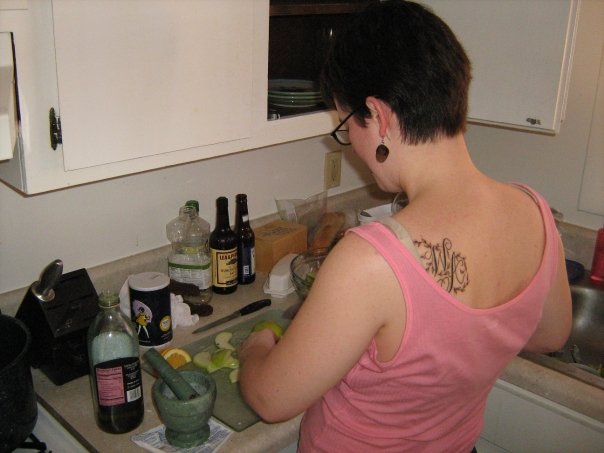
Me cooking with my shoulder tattoo showing: a large capital W and A surrounded by decorative vines.

(I imagine people who have lost someone close to them and find it coming up in response to casual social questions know this dynamic well, although it’s much easier for me since I’m not really sad about the twins anymore.) It’s my fault for only getting tattoos with emotionally heavy significance (the others are even worse!), but I do try to avoid or forestall that conversation in most situations if I possibly can. However, my mind drifts much too slowly from Dimly Aware to Actively Aware and Engaged with the Situation, and by the time it was there, I’d already said “sure.” Fortunately, what actually happened was much less expected and more hilarious.

Mind you, I still haven’t turned around, so I have no idea who the woman is who’s asked me to look at my tattoo, except I think maybe she’s a waitress? The next thing I know she’s pulling the strap of my wide-strapped tank top to the side, then lifting it away from my shoulder so she can peer underneath. I sort of freeze at that point, thinking, “Whoa, this lady is manhandling my shoulder and my clothing in a way I was not prepared for and am not really happy about.” My typical response to Unexpected Weirdness is freeze and detach, so I just went slightly rigid in the shoulders and kept staring at the menu like nothing was happening. Then one of the other people in the cluster, a man, said, “Dude, she didn’t say you could look down her shirt.” And she responded, “It’s just the shoulder, it’s not like I’m looking down the front of her shirt,” and then she added, “I just really like tattoos,” and maybe he said something else, I’m not sure, because I was just sitting there staring fixedly at the menu and thinking, “Why is this person touching me what is going on i don’t even know.” But something the guy said, or maybe just the way I was sitting there rigidly instead of turning around to engage in friendly conversation made the woman realize she was maybe being a tad inappropriate, so she let go of my clothes and patted me soothingly on the arm and said some half-apologetic patter. To which I didn’t really respond because I was still in my “I am so weirded out right now and your soothing pat is STILL YOU TOUCHING ME” frozen zone. And I think by this point she got that I was really uncomfortable, so she broke out the magic words to make it all better: “It’s okay honey, I didn’t mean anything by it, I mean, I like men, ha ha.”

And that was the moment that twisted my reaction from weird and awkward to GODDAMN HILARIOUS. She moved away and I turned to the rest of the table and made a giant :-O face, and they all cracked up. And then I had to recount it a few minutes later for Shaun, who hadn’t really been paying attention, and we all cracked up again. And then it was super-awkward every time that waitress walked by us, (which of course happened quite often) because I didn’t want to give her a friendly smile or anything that would make her think what she did was anything but Way Inappropriate, but I also didn’t want her to think I thought she was the scum of the earth. Or worse, that I thought she was a LESBIAN making LESBIAN ADVANCES. If I was the kind of person who addressed near-strangers with frankness and a desire to improve the world, I’d have stopped her at some point and said, “Listen, lady, I wasn’t weirded out because I thought you were hitting on me. I date women. I was weirded out because you were tugging my clothes around and peering underneath them, and even in such an innocuous area as the shoulder that’s not really okay to do to someone you don’t know. Keep that in mind for future reference, and also keep in mind that just because someone has a tattoo doesn’t mean it’s okay to touch them or put your face right up close to their body unless they invite you to. And also don’t touch pregnant women’s bellies unless they invite you to, because I’m 90% sure you probably do that too. In fact, in general don’t go around touching strangers and very casual acquaintances without their consent. Some of us really don’t like that, but we’re conditioned by social norms not to say anything about it and just to let it happen. And by the way, have you heard of rape culture?”

Okay, I probably would have ended my PSA somewhere before “rape culture.” But of course I didn’t give her any kind of PSA, because when someone is invasive and makes me uncomfortable the last thing I want to do is prolong my interaction with them by carefully explaining why what they did was wrong. I’m pretty sure it was an awkward experience for her too, so hopefully she’ll avoid manhandling inked appendages in the future, even if the story she tells herself is, “Some people are so uptight about their personal space, I just like tattoos!”

I’m just glad she didn’t glimpse the tattoo on my thigh.

Gina Wars: Return of the…Um…Not Jedi, but Something Equally Cool.


*THUD! A girl you recognize has appeared before you, accompanied by a loud crash.*

Oh, hi, Polyskeptic readers! It’s me, that other writer who gets a blurb on the bio page.

*Our narrator has fallen out of nowhere and is having a bit of trouble getting up.  She looks around and notices that she is being watched by the entire internet and resolves to get her ass up.  She dusts off her shoulders and notices that she’s getting old as she bends down to pick up her glasses from the ground. She turns to face…the internet…fixes her hair a bit, though she knows that it doesn’t really make a difference.  It’s hard to get rid of that “I just fell off of something” look.  A smile curls across her face.*

Good to see you’re still here.  Thank goodness Shaun, Ginny and Wes decided that writing was a good idea because yeesh.  I have been at a complete loss for words over the last several months!

I know, you are shocked and I don’t blame you, but honestly, had I been writing all this time, I likely would have been doing a whole lot of whining and no one actually likes reading that crap.  If it makes you feel any better, I also wasn’t particularly updating my Facebook page! I KNOW! Sacrilege.  But again, had I been less disciplined about that, I would have possibly put up a bunch of vague “Oh I’m so disappointed in…people…and I am so…upset…and stuff…” kind of statuses, prompting people to send me eHugs and while I would possibly appreciate the sentiment, it wouldn’t have really helped.  What I’m saying is ranting to Facebook is only acceptable to me if I can be hilarious while doing it.  I used to illustrate the ups and downs of my day with appropriate YouTube videos, but alas I cannot access them at work anymore.

So, where have I been?  What have I been doing?  Well, to put it simply, I have been engaged in an epic battle for equal pay at my job.  The story itself is boring at this point.  The important thing is that I started this debacle in January and just today got final written proof of my victory.  Yes, 6 months of fighting.

Now, firstly, I say that it was epic because it felt that way to me…but part of the frustration I was experiencing was that it wasn’t particularly epic to anyone who could make important decisions.  What happened was several months of me arguing and fighting by proxy at the powers that be and getting odd responses that, in some ways, amounted to “well, yeah, I know she’s been here a long time and is important and stuff, but is she really that great?  I mean, what does she DO?”  I internalized a lot of that and it started to seriously take its toll on me.

Secondly, when I say “equal pay”, I’m not referencing a gender inequality thing. At least, I was never able to fully buy that any of this was related to that.  I suppose the case could be made, but I really don’t think so.  The crux of this whole thing was that I wanted to stop limping along to getting my market value.  I wanted to stop having to scream about this every couple of years. I wanted it done so that I could stop fighting and just work…and I didn’t think that was a ridiculous thing to ask for.

It is, however, rare to manage what I have managed, and based on the fact that I felt like I was getting the crap beat out of me often during the process, I can certainly see why.  But I won, damn it, and now I can get back into doing what I’m good at and feeling balanced and calmer. And I know that I am valued enough to keep me happy, at market value…and that’s pretty excellent.

This was an important experience though for a whole host of reasons, the biggest being that I needed to show myself that I could fight for me like this.  I was relatively convinced that I was going to lose and almost gave up a few times, but my family wouldn’t let me.  I would come home and tell them the latest piece of the saga and they would echo my initial reactions and I wouldn’t feel so nuts anymore…but it was hard, because in the end I was the only one who could do anything.

The experience also reminded me how much depression lies and how hard it is to separate yourself from it even when you know what it is and what is causing it.  I felt very lucky to be medicated, because I don’t know how I would have gotten through it without Zoloft honestly.  I still had days where I was having to go to the bathroom at work to cry and I wasn’t able to leave it all at work when I went home.  I was sensitive and insecure.  The stress was wreaking havoc on my mind and body.  It got to the point where I was convinced not only that I was unintelligent and worthless, but also that I was ugly and completely unsexy.  I could barely look at myself in the mirror some days.  And I knew that it was an illusion, that I was looking at myself and thinking about myself with an ugly, terrible filter, but I couldn’t remove the haze.  Finally, I ended up with strep throat and antibiotics waged war on my innards and my thoughts too and I came into work after Memorial Day weekend completely fed up with the entire process.  And finally, after all of that, I got the first good news I needed: a reasonable proposal of compensation and a promise that it was being discussed and that decisions would be official soon.

It took several days for this to sink in.  Even when I got the official word, I was still in disbelief and I was still fighting off residual negativity (this is why primal scream therapy would not work for me at all.  Allow rage and negativity forward leaves burn that takes a long time to heal), BUT I could feel the haze lifting finally.

So I’m back.  I feel like writing again and I have things to say and I don’t have this general feeling that nothing matters and that no one cares.  I missed my own passion and gusto and not caring about whether I looked like an airbrushed magazine mutant.  I was aware of all these seemingly ridiculous notions, and being aware that they are ridiculous served as a light at the end of the tunnel.  “You know this is circumstantial and chemical.  This is not eternal.  This is a down in a life of ups and downs.”  And now I have burlesque shows to write about and the hilarity of family life at the Polyskeptic compound.  I am stronger now than I was before…or at least, have a bit of a sense of humor about it.  That’s pretty much the same thing, right?

What are you thinking?


This is totally trivial, y’all, but I’m curious. Most of us, I think, have had the experience of being asked “What are you thinking about?” and not being able to give an answer. We might say “nothing” or we might make something up. It’s frustrating to ask and get the “nothing” response, but it’s also frustrating to be asked. What I want to know is, when that happens, what are you actually thinking? Or what’s going on in your mind that makes it impossible to answer? I realized, for me, it’s nearly always the same thing, but I’m curious what it is for other folks.

I haven’t blocked repeat voters, so if more than one of these are common for you you can vote twice! If you put “other,” of course I’d love an explanation in the comments.

Musings of an apostate


I had a mini-revelation this morning while doing my daily blog read-through. Somebody — I don’t remember who or on what blog — mentioned that they’re an atheist now but grew up in a Christian home where grace was said before meals and church attendance was expected. The attitude with which they spoke about their Christian upbringing was both casual and unquestioningly distant: it was a piece of their personal history, but far, far removed from the person they were today. They talked about it the way I think about horseback riding or Girl Scouts, two activities that were hugely important in my childhood and have the occasional quirky relevance to my life today, but don’t have any real bearing on my sense of identity and purpose today. And that’s when I realized: I don’t feel that way at all about my Christian past. Although it’s been over three years since I called myself a Christian and over six years since I regularly practiced the religion in any way (prayer, Bible reading, churchgoing), that part of my history is with me every hour, every day. I publicly identify as an atheist, but in terms of my internal sense of identity, “ex-Christian” would be much more accurate.

Since this realization came upon me just this morning, I’m still sorting through exactly what it means and why it is. It’s partly how emotionally reactive I am to many things pertaining to Christianity, reactive in the way you can only be toward something that’s intimately intwined with your identity. But it’s partly the void of cultural identity that might replace Christianity. I don’t have this sense of practicing atheism, of atheism as serving a central function in my identity, the way I did with Christianity. One might say that that’s because atheism has no defining practices, and that could be part of it, but at the same time, I read a slew of atheist and skeptic blogs every day. (I almost certainly spend more hours weekly reading atheist and skeptic writing than I used to spend reading the Bible or other Christian writings.) I live with four other atheists and discuss matters of religion and skepticism with them regularly. I’m connected to a larger community of atheists and skeptics, and occasionally go to large conferences which are every bit as enriching and satisfying as the church retreats I used to go to.

So perhaps it’s nothing to do with how active and engaged I am as an atheist, and everything to do with how deeply engraved Christianity was on my heart. Perhaps it’s simply that the first 25 years of your life never get erased, never really fade into the background… or if they do, it takes longer than 3-6 years.

Whatever it is, it’s something I never feel I can adequately communicate to people who were never devout believers. Dan Fincke, whose blog I love reading partly because his experiences mirror mine so well, asked a month or so ago about differences between de-converts and never-believers, and as (I think) I replied then, this is the biggest difference I see. I feel like my personal history is broken — not in the sense of “destroyed and dysfunctional”, but in the sense of “has a giant hulking crack down the middle.”

Bent Oak Tree

Or like this tree. Pretty much exactly like this tree, actually. I have no idea what other people see when they look at me, but this is what I see when I look at myself: healthy and strong, but with this massive twist, this course correction that dominates the entire shape of my existence. Growing and thriving, but forever and unmistakably different from those trees that grew straight up.

And I wonder if that feeling will ever go away. If it’s just that I need more time to establish myself as a secular girl in a secular world… or if there will always be that sense of being defined by what I’ve left behind, what I’m not anymore.

Sexism and Transphobia in Doctor Who


Editorial Note: This post was written by Wes Fenza, long before the falling out of our previous quint household and the subsequent illumination of his abusive behavior, sexual assault of several women, and removal from the Polyamory Leadership Network and banning from at least one conference. I have left Wes’ posts  here because I don’t believe it’s meaningful to simply remove them. You cannot remove the truth by hiding it; Wes and I used to collaborate, and his thoughts will remain here, with this notice attached.

—–


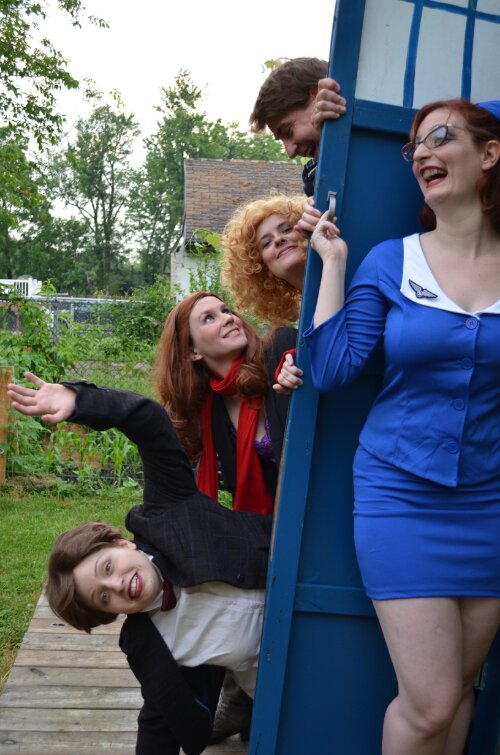
I love Doctor Who (the show. I have mixed feelings about the character). I think it’s an excellent show, particularly New Who. We all love Doctor Who. I look ridiculously forward to new episodes. At its best, Doctor Who presents masterful storytelling and character development that could be a model to television shows everywhere. I’m currently producing a freaking Doctor Who themed burlesque show I love it so much.

image

I also love that Doctor Who introduced the character Jack Harkness – one of the first openly bisexual characters in mainstream TV, and with an overwhelming sexuality that was a welcome contrast to the relative asexuality of the Doctor. It showed that the BBC is not afraid to piss off a few haters in order to create compelling characters and deal with adult topics.

However, something that’s always bother me about the show is the sexist undertones. The Doctor, through 11 regenerations, is always male, is always the smartest person in the room, and generally has a pretty young female companion (who often has a crush on him) who wanders off, gets into trouble, and need the Great Man to come rescue her. There are some exceptions (and companions often end up saving the Doctor, but never by being smarter than him), but largely the pattern holds. Even the current season was disappointing in that regard. It opened with Oswin, another pretty young woman. But this time, she was an intellectual equal of the Doctor. That lasted for one episode. When she was reintroduced midseason, her character had no memory of the resourceful genius from the first episode, and was back in the classic hapless woman companion role.

Against that backdrop, we now have this:

After bookies William Hill revealed that the new Doctor Who to replace Matt Smith when he leaves at Christmas was odds on 8/1 to be a female, bosses at the BBC have come out to rule this out as an option.

According to The Daily Star newspaper, bosses at the BBC have ruled out a female Doctor, which Sue Perkins and Miranda Hart were both being linked to also, as they feel that it would cause upset amongst its younger viewers, and awkward conversations about sex changes with their parents.

Confirming this decision, Russell T Davies explained to the publication how this mega change would never be allowed because it is “a family show”, adding:

“While I think kids will not have a problem with a female Doctor, I think fathers will have a problem with it.

“That’s because they will then imagine they will have to describe sex changes to their children.”

So much fail.* Before we even GET to the transphobia, what the fuck is Davies even talking about? He thinks kids will understand that during a regeneration, a time lord’s height, weight, hair, face, arms, legs, torso, feet, and entire personality can change, but if their genitalia changes, then IT WILL BE TOO CONFUSING!!! THINK OF THE CHILDREN!!!

But obviously, the REAL problem is that if having a female Doctor might lead parents to discussion the existence of trans* people with their children, that’s a GOOD thing! Just like Jack Harkness helped confirm the existence of bisexuals, a female Doctor could help confirm the existence of trans* people.

And let’s not neglect to point out the sexist assumption that it’s fathers who will be having this conversation. Because mothers couldn’t possibly. How uncouth.

This is extra disappointing because personally, I would love to see a female Doctor. Flipping the gender roles that have pervaded the show in the past would go a long way toward undoing some of the sexism that it’s perpetuated in the past. I would love to see how various alien races react to a hyper-intelligent woman who battles the forces of destruction with her mind and wit (and sonic screwdriver). I would love to see a woman be just as giddy, juvenile, reckless, dramatic, arrogant, playful, condescending, and ultimately lovable as David Tenant or Matt Smith.

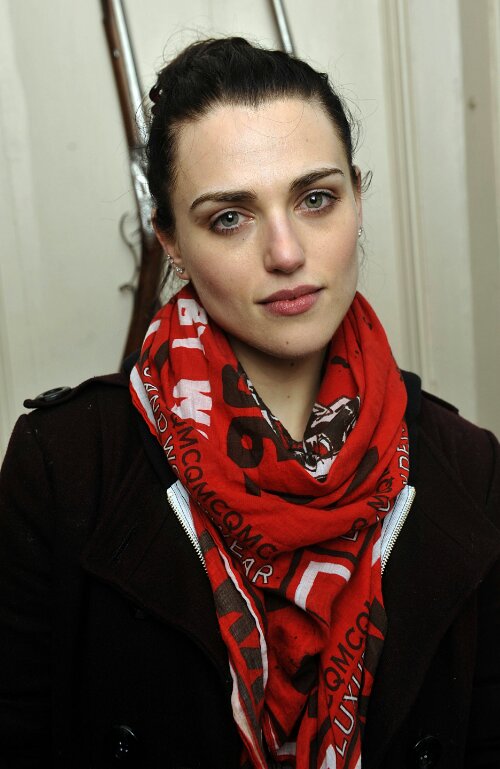
Also, Katie McGrath would be an awesome Doctor. Just sayin, BBC.

image

———
* to be fair, Davies is no longer affiliated with the show, but he was the lead writer from 2005-2010, and is still affiliated with the BBC.

Let’s just get this out of the way…


Shaun and I just got home from Women in Secularism 2, and it was a fantastic conference. Most of the internet buzz about this is already about Ron Lindsay’s opening remarks and the ensuing kerfuffle. I have a couple of thoughts on that, and I’m going to put them down right here and then move on, because I don’t want the amazingness of the conference as a whole to be overshadowed by those 15 minutes.

Basically I agree with everything Amanda Marcotte writes here. To me, his opening speech was ill-advised, tone deaf, and inappropriate for the context. His subsequent response to a criticism of his speech did not make things better. Both the speech and the responses are impolitic and inappropriate, and I suspect that when he’s cooled down a little he will be ashamed of himself. (Whether this shame results in critical self-examination or in increased defensiveness remains to be seen.) The only point I want to make that hasn’t been covered elsewhere is this: I could have told him exactly how his words would be received by his audience. I imagine many, many other people could as well, probably including many people who work for him. I could have predicted the response and the fallout with pretty good accuracy. And I assume that the fallout here is NOT what he would have wanted or intended, regardless of how right he thinks he is (if he knew ahead of time what the result would be, and went ahead with it, then we have a much bigger problem). This indicates to me that Ron Lindsay has not yet done enough listening. He still has a lot to learn about the perspective and concerns of many, many women in his movement, if he thought that that speech would be anything but a disaster.

Lauren Becker, who did a fantastic job keeping speakers and questions on track, had a job no one could envy: she delivered the closing address, on a day when warring blogs had been flying about Lindsay’s comments. Pretty much everybody I talked to agreed that the conference was one of the best we’d ever been to, and yet there was this undercurrent of anger that we were having to have this same conversation again, even here. Becker’s job was to close up the conference in a way that incorporated the positivity and sent us back into the world inspired and energized, and if she was going to touch on the conflict around Lindsay at all it would have to be very delicately done. Lindsay is her boss, and a majority (based on crowd response to various comments) of the audience was angry with him. That’s a no-win situation there, and if I’d been in her place I’d have probably spoken as if the controversy didn’t exist.

Becker proved why she’s in her place instead of me, because she did touch on the controversy, obliquely, delicately, and fairly; she said something important and yet something which (I think) nobody, whatever side they were on, could reasonably disagree with. She talked about how easy it is to misunderstand each other when we come from different backgrounds (using a personal story illustrating how even a word like “Think” can be misconstrued.) She talked about how we, as skeptics, value being able to admit when we are wrong. She talked about the importance of criticizing ideas rather than attacking people. Most importantly, she talked about giving each other space to change our minds: when we are in conflict with someone, we need to believe that they can and might change their mind, and we need to leave space in the conversation for that to happen. (Also, of course, we need to be continually reassessing our own position to make sure it’s not our mind that needs to change.) She could have been speaking to people on both sides of the issue… she probably was. But she wasn’t speaking to both sides in a way that demanded compromise or assumed a middle position was best… she was speaking to both sides in a way that reminded us of our shared value of self-criticism, reminded us that we’ve all been drastically wrong before and been able to change our minds, and that we should all be hoping that people we’re in conflict with do the same, rather than writing them off as lifelong enemies.

It’s a Women in Secularism anniversary!


One more day!

logoTomorrow morning, Ginny and I will be getting in the car and driving down to Washington DC to attend the Women in Secularism conference.  And on Sunday, Ginny and I will be celebrating our one year anniversary!  In fact, the reason we didn’t make it to the first Women in Secularism conference was because our wedding was the same weekend last year.  And while I considered skipping out on my own wedding for a conference, ultimately I decided it would not be a good decision.  Plus, our wedding rocked.

I’m looking forward to seeing some old friends, meeting some new ones, and generally having a great weekend.  I may be blogging, or at least tweeting, from the conference (@polyskeptic), but if I don’t I will certainly have something to say after I get back.

I do hope to avoid any and all potential absurdity from some certain persons who will be attending, and broadcasting, from the conference while there.  I will reiterate that I am really not interested in interacting, socially or for the sake of argument discussion, with people who perpetually fail to comprehend the intersectionality of social issues as they relate to the drive that pushes atheists to be active.  The same motivations I have to be active in this community lead me to care, and act, about other issues.  And since (with atheism and feminism, for example) there are overlapping concepts and goals, having a space for people who contain the multitudes of social justice concerns makes sense.  Again, nobody is claiming any necessary logical relationship between atheism and gender equality as envisioned by feminists such as myself.  The point is that the desire to be an activist for one set of concerns—such as the separation of church and state, education and theocracy, and atheist civil right protection—is related to the desire to see other issues dealt with in society.  And since these different issues have some overlapping concepts (like privilege), experiences (like discrimination and misunderstanding), and similar goals (general human rights) it makes sense that some people talk, write, and act on their intersectionality.  The whole point of intersectionality is that various cultural concerns have overlapping affects and experiences, and some of us care about how atheism, skepticism, gender issues, racism, ableism, etc intersect.

The problem, for many critics of this view, is that they don’t agree with or care about the kind of feminism that we espouse.  That’s fine.  They have the legal protection of believing whatever they want, and they can still do pure skepticism/atheism, if they want (I think that’s getting old and boring, personally).  On the other hand, this critical view has nothing to do with the fact that we we plussers and other atheist advocates for third wave feminism comprehend, care about, and argue for the active intersection of these issues.  Nobody is forcing anyone else to contribute or cooperate, and nobody is redefining atheism or trying to enforce community standards.

Why the fuck can’t some people comprehend that?

*sigh*

/rant

In any case, I will be there and I expect it to be a great weekend.

Will you be there? If you are reading this and plan on being there, feel free to come say hello to either of us.  I will likely be wearing the blog shirt or something equally offensive to mainstream sensibilities.

New website!


Hello all! I haven’t been writing much here lately… largely because of grad school and trying to get my sex educator career off ground. Today I’m happy to announce that a beta version of my new website, Sex in Specs, is live! (It’s been live for a few weeks, actually, but I didn’t want to talk about it until there was at least a smidgen of content.) Right now it’s an extremely bare-bones WordPress site with a couple of blog posts, and more to come… the end goal is to have it become a well-organized, easy-to-navigate static site with lots of information, advice, and resources about sexuality, all from a geeky, skeptical, science-and-analysis-loving perspective. My self-imposed deadline is midsummer’s day, although I’ll be adding content continually even after that point.

Right now the prelimary (or, as I like to think of it, larval) version of the site is there to let me start writing and posting some of the content pieces that will be part of the grown-up site. Apparently I find it very difficult to write things for an indefinite audience that might appear sometime in the future: I do much better when I’m writing something I know people will be reading immediately. So a large part of the purpose is to provide immediate incentive for me to write stuff.

Another part of the purpose is so I can hand out my business cards and there will at least be something at the web address they give.

And the third, most important part of the purpose (Reason. I should have started using “reason” back there instead of locking myself into an unwieldy phrase) is so that people can comment on what I post, and I can refine and adjust my thoughts before I integrate them into a structure that won’t allow direct commenting on articles. (Probably.) So I welcome feedback, additional thoughts and criticisms, on the posts I’ve written so far. Go check it out, and watch to see what it will become!

The atheist culture wars; applying moral foundation theory to the great schism


This morning I found myself pondering the idea of cultural relativism, tribalism, and how it relates to the various fights which have emerged in the atheist and skeptic communities.  Cultural relativism is a concept in anthropology which developed as a reaction to a kind of tribalism which is called ethnocentricism.  Just think of Bush-era conservatives with their nationalistic, jingoistic, and what they called “patriotism.”  Ethnocentricism is exemplified by the idea that America was getting it right (well, at least their red-state America, anyway).  Those of us on the political Left, those who voted for Al Gore and who saw Dubya as an awful president surrounded by an awful administration (which dragged us through scandal after scandal) would sometimes point out that perhaps we were not doing it all right.  Perhaps some relativism was necessary…which led to us being told we hated America.

culture_warsIn other words, the culture wars.

As writers such as Jonathon Haidt and the (discredited, but largely for different work) Marc. D Houser have pointed out, much of these political and cultural differences are based in differing value-sets.  There are different ways that we perceive information, in emotional and moral ways, which change how we draw conclusions about reality.  In short, what values we have will influence our intellectual opinions.

Both of these writers have emphasized two primary narratives which lead in two major directions concerning how we think about our tribe, other tribes, what kinds of rules our tribe should have, etc.  In American culture, this translates into the conservative “red state” America and the “blue state” America.  You know, the culture wars distinctions we have been talking about for more than a decade now.

I think this is what’s happened to the atheist community.  I don’t think that the main differences are precisely the same as they are in the larger culture, but I think this is the type of thing that has happened to us, and I am not sure anything can be done to fix it, just like with the larger culture wars.

How can you change someone’s values? I’m not saying that we shouldn’t do things like criticize other people’s values (I, for example, think that liberal values–such as care and fairness–are actually superior to largely conservative values –such as loyalty, authority, and sanctity.  But of course I would say that; I’m a pinko ‘Murica-hatin’ liberal).  The question is  how, assuming that I am in any meaningful way objectively (or at least inter-subjectively) right that my values are better, can I convince a loyal, authority-loving, sanctimonious…sanctified conservative of that?

That’s a harder thing to do.

imagesEver talk to a creationist? How about a “pro-life” (or pro-choice, if you are on the other side of that fence) activist? There is more than a distance of facts (although there often is that), but there is a distance of language-games, values, and worldviews.  Such a conversation needs more than a good moderator, it needs a cultural anthropologist in order to shake out the worldview distinctions.

Ever read a blogger who uses the term FTBully not ironically? Ever read a post by PZ Myers or Rebecca Watson? I do, fairly frequently.  And guess what; I think one side of that fight is crazy, and I think that they are fundamentally wrong from the bottom up (guess which).  The problem is not the factual disagreements (that is a symptom, not the cause), the problem is the fundamental worldview distinctions.  The problems are fundamentally about what values matter to us.

That is, they are not wrong because of their bad logical argument itself, but of their assumptions, worldview, and moral values. This is because logic is only a tool.  It can only manipulate information given to it.  Just like a Bible-toting evangelical conservative Christian can use logic to make their points, so can the atheist they are arguing with.  And while both may make logical errors (guess which I think is likely to make more), the source of the problem is at the level of things like values, assumptions, and biases; not mere facts.

Those who oppose the efforts of inclusion in the atheist community are not wrong because they are opposing inclusion.  In fact, the very framing of that statement was (intentionally) worded to lean one direction (hey, Fox News does it, so can I…).  They are wrong because they are valuing the wrong things.

Value divisions in the atheist community

Surely, there are both political liberals and conservatives in the atheist community.  But how the foundational values we have get expressed in the larger political sphere will differ from how they will create splits in our smaller atheist culture.  The values which split us here; values such as authority, loyalty, and sanctity being expressed in the atheist/skeptic communities as opposed to liberty, care, and fairness will illuminate the foundations of our disagreements.  In other words, I’m applying moral foundation theory to this split, and I’m claiming that it is largely analogous to the conservative/liberal split in the larger community.

Let’s take a look at the third moral foundation, for a clue:

3) Liberty/oppression: This foundation is about the feelings of reactance and resentment people feel toward those who dominate them and restrict their liberty. Its intuitions are often in tension with those of the authority foundation. The hatred of bullies and dominators motivates people to come together, in solidarity, to oppose or take down the oppressor.

I will bet that both sides of this split will identify with this, but in different ways.  Clearly, some people feel bullied by others in the community, and claim that those people are trying to wrangle authority over everyone else.  Those people trying to define what atheism, skepticism, etc mean when it’s clearly not what it means (to them).

But on the other side, the argument is that mere philosophical or semantic precision are not what matters.  PZ Myers’ concept of the “dictionary atheist” was not an attempt to redefine atheist in the philosophical sense, nor to force this definition on anyone, but to recognize that those philosophical senses are secondary to many people.  And he’s right.

See, we are not primarily rational beings.  We are emotional beings who believe things for largely non-rational reasons, and then we rationalize (or explain) the causes of our beliefs.  Hopefully, we are willing to change our minds based on new information, but believing (or not believing, in the case of atheism) is an emotional phenomenon which we later rationalize.  Some people are not aware of this and get overly focused (as I have, in the past) on the semantics and philosophical side of the question.  This is, I believe, Justin Vacula’s primary fault, as a thinker, and why he fails to get it so often.

In other words, rationalized arguments about semantics when the difference is one of values.

Let’s get back to moral foundation theory to see more facets of this disagreement.

Some people want to employ fairness:

2) Fairness/cheating: This foundation is related to the evolutionary process of reciprocal altruism. It generates ideas of justice, rights, and autonomy. [Note: In our original conception, Fairness included concerns about equality, which are more strongly endorsed by political liberals. However, as we reformulated the theory in 2011 based on new data, we emphasize proportionality, which is endorsed by everyone, but is more strongly endorsed by conservatives]

If we interpret this in the sense of giving everyone a fair chance to participate, then there are at least two ways that we can go.  The question concerns the issue of whether we should treat everyone the same or whether we should treat people in the way which produces equal outcomes.  The question of privilege, which has become a lightning rod in recent years, is relevant here.  Treating people the same, irregardless of their place relative to privilege, often leave people in different outcomes (says this liberal pinko).  This is part of an old argument which is reminiscent of not only recent atheist discussions, but culture war arguments over the last few decades.

In the atheist community, this has been most obvious in terms of the treatment of feminism, which some see as exclusive of the rights of men, but which other’s see as learning from the experience of women to make it better for everyone, regardless of gender.  If we seek to include more women, do we treat them like men or do we try to dig deeper and understand that the assumptions about gender need to be revisited so that we stop perpetuating gender roles and expectations, hopefully leading to a more gender equitable community where the varying perspectives are better seen and understood? Seems simple to me, but other people have different values and view equality either secondarily or as a simple function of treating everyone the same, even if that means people get to different places.  One of these values is superior to the other.

Then we can ask whether this foundation is more or less important than purity, or sanctity:

6) Sanctity/degradation: This foundation was shaped by the psychology of disgust and contamination. It underlies religious notions of striving to live in an elevated, less carnal, more noble way. It underlies the widespread idea that the body is a temple which can be desecrated by immoral activities and contaminants (an idea not unique to religious traditions).

But don’t let the description fool you; this is not a strictly religious behavior pattern.  This pattern of behavior, in my opinion, is not religious per se, but was usurped by religion just like morality and rituals.  The feeling that something does not belong; social justice is not relevant to atheism (for example) is a deep and important value for many people.  The question is whether this or the desire to include those affected by social injustice, and trying to counteract that, is more important.

For me, the sanctity of pure skepticism or atheism (as it is seen by some, say Jamy Ian Swiss) are not more important than addressing the intersectionality of skepticism with atheism, racism,gender inequality, etc.  But if someone else feels disgusted by that degradation of the purity of the cause of skepticism (or atheism), they will reject movements such as Atheism+.  They will feel that to include gender issues, race issues, etc into the larger cause is a form of contamination; it just is not what atheism/skepticism is about! (says our sanctimonious friends).  Again, this is a difference of values more than a difference of facts. Again, one of these sets of values is superior.

Accommodationism

Remember the old argument about accommodationism? One of the issues was whether it was important to care about people, despite their beliefs.  How nice were we supposed to be? Well, that’s all about the care/harm foundation:

1) Care/harm: This foundation is related to our long evolution as mammals with attachment systems and an ability to feel (and dislike) the pain of others. It underlies virtues of kindness, gentleness, and nurturance.

Take that in balance with other values, such as the liberty/oppression foundation:

3) Liberty/oppression: This foundation is about the feelings of reactance and resentment people feel toward those who dominate them and restrict their liberty. Its intuitions are often in tension with those of the authority foundation. The hatred of bullies and dominators motivates people to come together, in solidarity, to oppose or take down the oppressor.

and we can see why the anger at oppressive religious institutions and doctrines might override the care/harm value.  Some people were so angry, justifiably so or not, that they were not concerned about being sensitive to people’s feelings. Who cares if some Christian’s feelings are hurt when their beliefs are criticized when you balance that against the harm Christianity is doing to so many people! On the other hand, argued others, if we do not accommodate their beliefs, we will never change their minds and we will simply push them further away.  Whether this is true or not is relevant too, but at an emotional level it exposes how our values are the origin of such arguments, not the facts per se.

Big Tent Atheism

What about our desire to create a large umbrella organization or a big tent? The goal of coming together as atheists no matter our differences, for the sake of our shared rights? Well, that’s the value of Loyalty/betrayal:

4) Loyalty/betrayal: This foundation is related to our long history as tribal creatures able to form shifting coalitions. It underlies virtues of patriotism and self-sacrifice for the group. It is active anytime people feel that it’s “one for all, and all for one.”

Here, anyone who is perpetuating the drama is a traitor.  They are betraying their larger cause in the name is stupid arguments over secondary concerns.  This is, I believe, the motivation behind my long time friend Staks’ anti-drama pledge.  It is a value I understand, but which I do not share as a primary moral concern.  I am more interested in making our community better than making it bigger and closer.  That is, I would rather be a part of a smaller, more inclusive atheist community than one which is more concerned with what I see as a false sense of community around the answer “no” to the question “do you believe in any gods?” I’m more concerned with addressing social justice and the intersection of issues around atheism than focus on merely getting along for the sake of what I see as short-term atheist rights issues.

As I see it, any movement that focuses on its own civil rights over the intersectionality of all human rights is participating in short-term thinking, and will eventually be left behind with the conservatism of history.

As our community continues to grow, transform, and gain political and cultural influence, we will become institutionalized, inevitably.  How we think of ourselves now will effect how we will leave our mark on history.  I would rather leave a smaller, but more inclusive mark on history than a larger but more conservative and exclusive mark.  With this in mind, I want to address the fifth, and as of yet unmentioned, moral foundation; the Authority/subversion foundation:

5) Authority/subversion: This foundation was shaped by our long primate history of hierarchical social interactions. It underlies virtues of leadership and followership, including deference to legitimate authority and respect for traditions.

Five years ago, this foundation would have had no place in this discussion.  Five years ago, we were all subversives, pulling away from a larger tradition of hierarchical religious institutions which dominate our culture.  And, of course, this is still largely true.  But in another sense, this has become a point of division within the atheist/skeptic community, now that we have at least established, at least internally, some traditions (or at least tendencies) and some leadership.

No, there is no atheist pope.  There is, however, some hierarchy and some power.  Richard Dawkins saying something about atheism carries weight.  Not for all of us, but he is a symbol of our movement and his opinions carry some weight.  We can and do disagree with him (some more than others, of course), and his words are not officially conclusive, but because so many people respect him his words have an effect on our thinking.  He’s just one example.

If you love PZ Myers, Rebecca Watson, or Justin Vacula, then their words carry weight.  The people you are willing to listen to will influence your thinking, and those whom you vilify you will, tribalistically, either ignore or hate.

If you have written off someone like Rebecca Watson or PZ Myers (as bullies or whatever), then you will only see her words when someone you like quotes them, and your view of them is skewed.  If you hate Justin Vacula, the same is true from the other side.  Personally, I make a point to read the words of those I disagree with as well as those I tend to agree with.  I never agree with anyone all the time, but there are certainly people with whom I agree more often than not, and those with whom I rarely agree.  I am aware that this is more about values than mere facts.

Anyone who knows me knows that I’m on board with Atheism+, that I am very appreciative of Skepchick for exposing me to many ideas and perspectives I did have 3 years ago, and that I abhor Men’s Rights Activists.  I’m a third wave feminist who makes the attempt to be aware of the privileges I have, and to understand my cultural blind spots.  I have chosen my side, not because I think my side is always right and the others wrong, but because I share values with them.  Just like I am not a Republican or a conservative politically (even if I might occasionally agree with them), I voted for Al Gore, John Kerry, and Barack Obama (twice), and I think that Fox News is pretty awful, I have a side in this atheist schism.  But I still listen to the other side.  I try to understand their values and arguments, and understand that I may never be able to get them to see what I see.

But, most importantly, I think that my values are superior.  Not such that I will force them on anyone, but insofar as I think that they lead to a better world.  Am I objectively right? Well, I don’t think that’s a meaningful question.  Am I intersubjectively right? I think so.   The difference between the two is that the former assumes an objective perspective, while the latter only assumes that such a perspective is always abstracted from a subjective one, and is thus not universal or authoritarian.  This is what I think many political conservatives do not see; liberals may think their views are superior, but they are not actually trying  to demand authority over others based on it.  We want you to see that we are right and join us, are frustrated when you don’t, and we are amused when you call us bullies or totalitarians.  We find it funny because the values which make totalitarianism or bullying possible are conservative values, not ours.
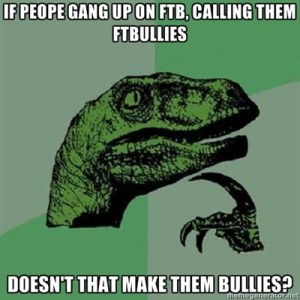
bulliesThe same is true for those in the atheist community who call people such as PZ Myers bullies, to whom the remainder of this post is addressed  The values we have do not include authority as strongly as do yours, so we are not natural bullies.  But since you have those values in stronger measures, you think everyone feels the same and so you project the authoritarian attitude onto us.  We’re not telling you what to do or what you should think, we are just saying what is better (and hopefully why they are better).  And we are sad when you don’t understand it and pull away from us, creating the schism.  We don’t create the schisms; we identify the sources of them and offer a bridge to join us where things are better, which you subsequently see as a demand, a redefinition, and as some sort of totalitarianism (a Horde, if you would).  We don’t seek to control you, we seek to have you understand that the controls already exist and that you are subject to them because you don’t see them.

We are not bullies.  The bullies are your projected values onto us.