Elevatorgate: frustrations with creepiness as a man-slut


Another male perspective on something I cannot comprehend, I know.  But I have a few frustrations I want to vent, understanding that many feminists (and I count myself among them) will view my comments as just not getting it.

I will not recap the events over the last weekend about the Elevatorgate issue that arose from Rebecca Watson’s recent video and subsequent kerfuffle.  If you don’t know, then simply skip this (or catch up and come back).  I had a long conversation with Ginny about this yesterday, one that made it clear that I’m not completely understanding Watson’s (and many other women’s) experience with this, but nonetheless an issue I have thought a lot about the last few days.

During that conversation with Ginny, I said something that was better articulated in a comment by a “Marty” on Phil Plait’s blog today (#31)

Just as it would be insulting for me to assume that every moment I spend with other women is a possible sexual encounter, it’s also insulting to treat every moment a woman spends around any man as a potential sexual assault.

This gets to the heart of part of this issue for me.  Now, I recognize that there is no comparing the issue of me being around a woman and feeling like I want to be sexual with her and the fear a woman might feel in an enclosed space, especially if he is hitting on her.  But what I think has been overlooked in the conversations about this issue in the last few days (and I have read many, not nearly half however, of the comments on the various blogs that have brought this up) is the fact that their is a two-sided responsibility here and that there are frustrations that are valid for people in elevator guy’s place.

What I have learned

I have learned that many women would feel uncomfortable, and not in just some socially anxious way, if they were in an elevator with me, alone, and I propositioned her.  Even if I used respectful words.  Even if I didn’t physically touch, or even get close to, her.  Even if (as one commenter on Pharyngula said) it were at noon.  This teaches me that it is just a thing not to do if only for the fact that it will not work.  That is, even if I was convinced there was nothing wrong with doing so per se, as many commenters still uphold, the fact is that it is not pragmatically wise.  I accept that it causes women discomfort, and I want to avoid that.

I have learned that many women think a lot about how to avoid sexual assault day to day.  I have learned that the fear of such things is prominent for many people.  I knew previously that the statistics for rape and sexual assault are astoundingly high, but I learned that an elevator is one of the places where the anxiety is a little higher.

I will not be propositioning women in elevators, ever.  Even if I see one smiling at me and giving me bedroom eyes as we ascend (or descend), I’ll wait until she is off the elevator to say anything.  Certainly, if I see Rebecca Watson in an elevator, I will wait until another time to compliment her, just in case it comes across as flirting.  Let’s just say when I’m interested in someone I don’t hide it well (And no, that was not a crude reference…).

Also, I’ll certainly never look at this song the same again:

Essentially, I understand that as a male in our culture, I have a responsibility to be aware of how my “privilege” blinds me to how I can use sexuality in ways that make women uncomfortable.  I accept that some things I may do, even while trying to be respectful of women as people, will come across as creepy and inappropriate.  I will keep trying to expand my understanding of this problem.

What I want others to understand

For clarification, much of the following is NOT directed towards Rebecca Watson per se.  this issue has grown larger than the initial encounter that spawned it.  It’s mostly a rant.

Just because statistics of rape are ridiculously high, and the vast majority of them are committed by men to women, does not mean that women are rationally justified to live their lives in fear of men, even in elevators.  I know that most women do not, but the comments in recent days concerning this issue tells me that many do.  I am an advocate of not allowing fear to dominate a person’s behavior or thinking.  Fear is a tool of oppression as much as patriarchy, white/male privilege, or wealth disparity.  When you encounter a guy hitting on you in an elevator, you need to keep in mind that even though the statistics of assault are really really high, probability states that he’s just clueless at best, overly aggressive at worst.  He’s probably just drunk.

I want women to be cautious, aware, and safe, but I don’t want them to be afraid of men without justification.  And women do have the right to request that a certain kind of behavior is not done (like hitting on women in elevators), however you have to keep in mind that you are responsible for how you are interpreting people’s actions based upon statistics.  I think it is fair to request that women do not assumes that violence is likely, even while being aware of its possibility.  I think the distinction is important.

I do not believe Rebecca Watson did anything wrong in that elevator or in her subsequent video.  The guy was probably clueless, and her advice to not do that was good advice.  Whatever increases well-being, as Sam Harris says, right?   I like Rebecca Watson.  I think she is intelligent, thoughtful, funny, and eloquent.  I have met her a few times, although we have never spoken more than a word or few to each other because she is usually inundated with fans and friends, as a person of her abilities warrants.  I happen to also think she is an attractive woman, and under the right circumstances I would like to get to know her better (both intellectually and otherwise).  Is that sexist? Am I sexualizing her? Perhaps, but I am not merely sexualizing her.  I think that creates a distinction which matters as well.

Luckily for her, I don’t drink coffee.  I would also not use this euphemism to proposition someone anyway, nor would I do so without any existing familiarity at very least.  I also don’t think that coldly propositioning anyone is wrong or creepy in all cases, just not pragmatic in most cases.

If I were to find myself  talking to Rebecca Watson and got any indication that she might be interested in getting to know me, I would probably ask her if she’d like to get a drink and talk alone (but still in public, to start).  And I would let things take their natural course from there.   I doubt I’d have that opportunity, as I have no reason to think she would be interested in me (despite the fact that I’m brilliant and beautiful, that is…).  Of course, my guess is that most men will certainly avoid, if they have been paying attention, hitting on her at any conferences from now on, and I am no exception to this.  Perhaps that was what she wanted, I don’t know.

But could I imagine a situation where I would say or do something that would set off a woman’s creeper-meter? Oh for sure! I have no doubt that if actually faced with a women I was interested in romantically or sexually, I could (and certainly have in the past) creep said woman out.  The best intentions and the utmost respect can’t always avoid that, as sometimes it is just a look in the eye, bad choice of words, or awful timing to do so.

And that sucks, because it’s very very frustrating to know this fact looms over interpersonal interactions where sexuality is a factor.  As a man who wants to be sex-positive, likes casual sex on occasion, and meets attractive women while out and about, the fact that no matter my intentions I am more likely to creep a woman out than gain her interest is frustrating.  And it’s not that I assume I have the possibility of a sexual encounter with any women for whom I have interest, its just that when I would like some sexual contact with a woman I just met or don’t know well, my asking may come across as inappropriate even while presented respectfully.

I often find myself asking myself, after hearing of stories where men are perceived as creepy, questions like ‘is there a way he could have asked which would not have been creepy?’  And, if not, was it really creepy or was she just not attracted to him in particular? Also, is it sometimes the case that people are creeped out without justification?  I think these questions expose important distinctions as well.

There seems to be a tension, here, between the ideal sex-positive world that I strive for and one described by those talking about privilege of which men are usually blind.  I have no desire to be a pick up artist (PUA), but I do desire to live in a world where sexual interest in a woman, expressed openly, honestly, and respectfully, is not called sexist.   I, as a man, simply don’t know how to approach women I am attracted to, preferably in an at-least partially public area, without being pegged as suffering from privilege-blindness. I hope there is a realistic answer to this tension, because I want to be respectful while enjoying sex with others who want the same thing.  And just like women can’t tell the good men from the bad ones (the Schrodinger’s rapist problem), I can’t always tell the sluts (not a derogatory term) from the women who will view my proposition as creepy.  Let’s call that the Schroedinger’s slut problem.

I, as a slut, just want to be able to be a slut in a feminist world.  I know there are others out there too who feel this way, but now I’m anxious about being the next elevator guy because I crossed someone’s boundaries without knowing it.  Yes, I won’t hit on a woman in an elevator now (my consciousness has been raised, thank you Rebecca), but I might do it while she’s alone at the end of the bar, while at a party where she knows nobody, or some other situation that is uncomfortable or creepy for her.   And then I’ll have to be told that this is also unacceptable, and many people will agree and see me as sexist, and I’ll be just as confused as I was when I first read about what elevator guy did.

At bottom, I want women to give us men a little more leeway concerning creepiness, and I want men to treat women better so that men can stop being feared as sexual predators.  It will be so much better for everyone, men, to stop being predators.  And it would be some improvement if women would give us a little lenience about perceived creepiness.

This is more of a rant borne of frustration than anything else.  Thanks for listening.

So, Rebecca Watson, would you like to come over to Philly for a drink?  I promise; no elevators!

(that wasn’t creepy, was it?)

The Tea Party does not want America to change: I do


Today I am going to do something which I rarely do, especially here.  I am going to talk about politics.

More specifically, I want to address an idea that has taken root in the Tea Party.  It is probably not universal among them, nor do I expect it to be the most important aspect of the Tea Party movement.  However, when I ran into a rally at Independence Mall, near Independence Hall, on Independence Day, it was a theme that was mentioned more than a few times, especially by Presidential hopeful Herman Cain, who spoke among others.  The key note speaker was John Bolton, who has no chance as a candidate, and whose speech I found silly and uninspiring.

It seems as if one of the problems that the Tea Party is trying to combat is the ‘liberal’ desire to change America.  This was said in context of the “ripping up of the Constitution” (supposedly by people like me).  Herman Cain said several times that there are people who want to change America, and many said that this is the greatest country in the world.  Perhaps.

So, what is wrong with changing America? And why is ripping up the Constitution associated with this, as if one could not change America and follow the Constritution?  Best nation? In what way; culturally, economically, politically, or some other way?

And yes, I do want America to change.  I would like to be part of what changes it, as well.  But I do not want to rip up, either literally or metaphorically, the US Constitution.  I have read the Constitution and  appreciate my rights as well as defend the rights of others even if I disagree with them. Further, my understanding of the process by which we create Constitutional amendments implies that change is an inherent part of our Constitution and therefore our country.  It just seems that this idea is empty rhetoric without real substance.

Despite the empty rhetoric of many of the speakers and apologists I heard from there yesterday, I (as a liberal, at least in most political senses), am not trying to destroy our Constitution.  I am trying to use my constitutional rights to influence the public towards a better America, by use of speech, protest, and litigation in some cases.  Our nation is ripe with cultural problems from sex negativity, poor education, and political naivete which helps cripple our growth to a better nation and a better world.

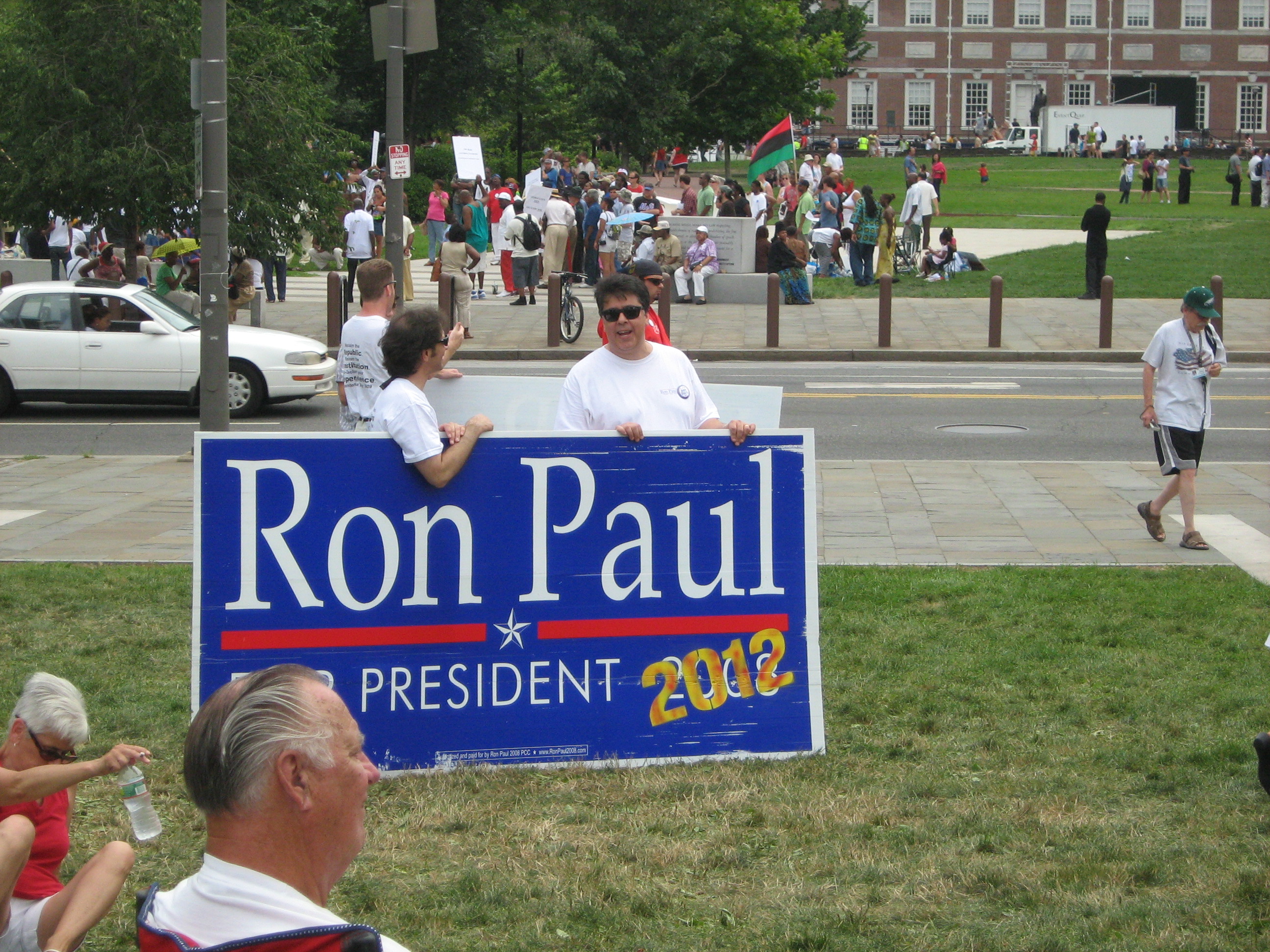
Me talking with one Ron Paul supporter

I want citizens who are more educated, mature, and willing to challenge their own worldviews.  I want the legality of gay marriage and polyamorous marriage.  I want better healthcare, whether through a single-payer system or some other option.  I want the divide between the rich and the poor to be addressed in a meaningful way.  I want discrimination, breaches in the wall between government and religion, and other effects of poor education and indoctrination to disappear.  All of these goals, and many others, can only be reached by changing America.

The idea that we should not change America is conservative by definition.  And as one conservative-minded person I know told me, there is a difference between wanting to retain traditional ideas per se and simply opposing progressive ideals.  Granted.   However, whether you want to conserve traditional ideas per se or not is not the point.  The point is that our culture, and therefore many governmental policies, need to change if we are going to improve.  Arguing that America should not change sounds a lot like a person telling there therapist that they don’t need help.

In other words, this ideal within at least some Tea Partiers that we should not change, and we should fight change, is a sign of denial of real problems within.  We, as a culture and as a nation, are sick in many ways.   We need to change, if we want to survive and thrive.  Right now, we are not thriving, and more of the same will not help.

So, in 4 years will "2016" be over the "2012"?

Finally, concerning what one Ron Paul supporter told me, which was that the Tea Party movement was started in 2007 to protest the corporate ownership of the two major parties, and that it is trying to remain independent from such influences.  But the recent motions of people associating with the Tea Party, such as Sarah Palin, have taken the name brand and changed it.  My prediction is that what remnants of the Ron Paul revolution that want to stray from corporate interests will die out completely, having been over-taken by the interests of those who have the money to make more noise.  And while I don’t support Ron Paul, I appreciate the attempt by some of his supporters  to remain unaffected by corporate interests.

I just don’t believe that changing (or restoring, as they call it) our government will make the corruption disappear.  I’m too much of a cynic, I suppose.

So, yes, Tea Party leaders, some of us do want to change America.  The fact that you don’t see anything worth changing is one of the many reasons I cannot get behind your cause.


The Israelite Church of God in Jesus Christ


image

I have seen these guys on the street in philadelphia for many years.  I usually ignore them, but I found myself near city hall today and decided to sit and eat a cheesesteak while I listened to their public sermon.

Because I am mobile, I will keep this very brief (and I will write more later).  Their basic message seems to be that many of the non-white people of the world (all in the western hemisphere) are the 12 lost tribes of Israel, and that they are the people of (the biblical) God. 

They also argue that Jesus was black, which has gained some traction in segments of culture in recent years (for me, this idea first appeared in the music of KRS-ONE).  On top of that, they have a generally dis-favorable view of white people.  At one point a few years ago, one of them referred to me as a white devil (this may remind you of the Nation of Islam).

Their sign lists two verses from the Old Testament:

Gen 49:1-28
Deut 33:1-29

I don’t know them off-hand, but I will look them up later for further comment.  I will listen for a little while longer.

(BTW, when I tried to take the picture, one of them tried to block me with his clipboard.  I had to explain to him the concept of public space and the first ammendment, of which they are now protected under.)

Youtube atheists invade Philadelphia


I spent last night hanging out with a bunch of heathens, many of whom you may have seen on the youtube trying to steal your faith away.  Of course, we got rowdy, drunk, and an orgy commenced (ok, not so much), but there was a fair amount of arguing about all sorts of things with some quanity of alcohol involved.

In any case, it looks like the revelry will continue this evening.  Luckly for me an old co-worker, Pat McHugh of Grubstake, will be playing at Fergie’s tonight (10pm, no cover), which is right near the Marriott where the atheist action is.  I had planned to see him play, now it looks lie I will be able to do both, and maybe drag a few heathens with me to one of my favorite bars downtown.

So, I will be on my way out soon to see these hell-bound videographers in an attempt to further damn my soul.  If any video of all of this pops up, I’ll post it so long as it’s not embarrassing…who am I kidding, I’d still post it..

For now, I’ll leave ths video, which includes some of the people I talked with last night.


The scientific method is not indebted to religion


Over at Why Evolution is True (which I read religiously!), Jerry Coyne has tackled an article aimed at him on BioLogos…again. I generally agree with the perspective on science and religion espoused by Coyne, and this post was not an exception.  What I want to address is a point made in the BioLogos article Coyne quotes, written by Robert C. Bishop:

Finally, Coyne completely misunderstands the force of the historical examples I gave of science/faith engagement (the Scientific Revolution and 20th century debates about steady state cosmology). They aren’t just points about the religious faith of some scientists in the past. Rather, the scientific methods these scientists created and used were intimately tied up with and motivated by their faith.

He goes on from there, explicating the old canard about how since many early scientists were religiously motivated, therefore the methods of science themselves were motivated by religion.  For example:

Galileo, Boyle and Newton among others developed methods for studying created things on their own terms in such a way that their natures could be revealed to investigators as accurately as possible. This means that they didn’t treat created things as divine or as fronts for the real activity of God, or as shadows behind which genuine reality is working. Instead, they treated pendula, animals, planets and stars as having genuine natures and properties, as responding to and contributing to order, and sought to put themselves in the best methodological and epistemological position to receive all that created things had to teach about themselves.

This all sounds good enough, I suppose.  It is generally true that scientists of the age used terms like “created things” and so forth, and viewed the universe as having a discoverable order, usually attributed to some intelligent force, AKA God.  But watch were Bishop goes next, after the claim that western intellectual culture is dominated by concepts of hierarchical levels of order in reality.

…biblical revelation stands unique historically in recognizing only one distinction and no hierarchy in nature: There is only the Creator and what is created. Everything that is created is of the same ontological order of being. In other words, the being of everything created–terrestrial and celestial–is homogenous in being.

This sounds almost Spinoza-esque in flavor (perhaps with a dash of Leibniz), as if the universe is simply all one thing, including its creator and intelligent force.  If the creator is separate, does that not imply hierarchy? Perhaps I’m splitting hairs.  What makes this more interesting is that Coyne, in his post, is addressing is the fact that the scientific method, specifically concerning evolution, makes the proposition of the supernatural unnecessary towards explaining anything. If there is no hierarchy, and all the universe is subject to the same laws, then why the perpetual appeal to an intelligent designer by BioLogos’ articles, including this one?

But I’m being led away from my point.

In any case, Bishop’s assertion of this unique “ontological homogeneity” derived from Biblical theology (which is not unique to the Bible nor even really actually Biblical, in my opinion) implies that

once the likes of Galileo, Kepler, Boyle, Descartes and Newton grasped hold of ontological homogeneity, the exploration of nature was never the same. The doctrine provided the seeds motivating Galileo, Kepler and the other scientific revolutionaries to see celestial and terrestrial regions as of the same order of being: finite, composed of the same material, operating by the same laws and secondary causes.

The assertion that this ontological worldview was derived from Biblical revelation and theology needs to be justified.  But even if it were true, the implication that the Christian worldview in which these scientists grew was the cause of the scientific method they employed is still dubious.  This is because the scientific method, especially as it is used now, is not based upon the need for revelation, gods, or any creators.  The method is simply the intellectual continuation of the proto-scientific methods that existed before Christian revelation, and was in fact put on hold by Christian history (Library of Alexandria, anyone?).  The fact that these scientists held onto the linguistic conventions of creators, universal order, etc is no more to the point than today’s scientists, even secular or overtly atheist ones, use metaphors from the Christian worldview the West is still mired in. Kepler, Newton, and the rest did hold onto religious belief to some extent, but they also were not subject to the facts that Darwin brought about which tossed away the need for much of what a creator offered to them.  Paley’s argument  still held sway for them because they had not lived at a time when science, and its method, had swept away enough of the theological riff-raff to make them useless.  That is not so anymore, and it has not been for some time.

Imagine some time in the future, say a few hundred years or so from now, where this issue is being discussed.  Imagine some debate between future intellectuals about this era and its scientific community concerning religious belief.  I could imagine some individual quoting Richard Dawkins, Sam Harris, Jerry Coyne, or PZ Myers (who will, at that time, be remembered at the first man to get tentacle implants in an attempt to take over the world) where they use Biblical imagery, metaphors, or even quote some scripture directly because the verse happens to make a point they agree with.  In a world which has moved on from religion as we know it today, where Biblical language has disappeared from common use, this would look like religion to them.  In the same way that Newton’s reference to a creator (or Thomas Jefferson’s for that matter) sounds like a religious reference today, the use of religious metaphors in the future will be strange and sound antiquated (in one possible future, of course).

This is not to say that Newton was not religious, only that relative to his time, his worldview and methods for finding truth were more secular and skeptical (even if he did believe in silly things like astrology).  I might go as far as to say that  Galileo might be on the atheist speaking tour if he were alive today (perhaps the same for Jefferson or Paine).  But what is essential here is that he methods that scientists used by these people were an improvement of methods of finding truth.  They were a step up towards a more perfect method that allows us to see, today, that ideas such as natural selection do not need a god to explain the state of life on Earth.  Even if some of the concepts that allowed this method to develop came from Western religious traditions, this does not imply that those methods are congruent with the worldview that preceded the method’s application to the natural world.

In a sense, that would be tantamount to claiming that because the logical and rational methods used by atheists in debates with theists, atheism owes its existence to Christian revelation and tehology.  When in fact atheism is the recognition that this theology is essentially nonsense, even if the  tools we use to show this was originally developed by people trying to apologize for theology in the past.  It’s an accidental relationship, one that demonstrates a growing up, transcending even, of our species’ adolescent eras.

The tools of rational thought, utilized by theology, are not enough in themselves.  When built upon the foundations of empirical and skeptical methods, they can help us achieve greater insights into the workings of the universe towards a more efficient and powerful understanding of our world.  But when they are used only in conjunction with speculation (AKA revelation) the conclusions are likely to be dubious.  And where those conclusions are occasionally true they will be so only accidentally, as even Paley’s watch, when broken, is rights twice a day.   Where theology helped developed to create the rules of logic, which is to say when it has worked to shape and sharpen the tools scientists use, it wasn’t until these tools reached the hands of people dedicated to testing their hypotheses against the world that we actually saw real progress towards the better understanding of the universe which we have today.  And the longer people like Robert C. Bishop attempt to tie this method to parochial anachronisms of theology, the slower we can reach that future when religion is relegated to linguistic devices and imagery to be used for literary effect by future scientists.


Religion and Politics: Robert Benne getting it wrong


I occasionally peruse the local online news and commentary sites to see if there is anything interesting being said about religion in the Philadelphia area.  Most of the time there is little to nothing, and when there is it is not very interesting.  Today I found this article by Robert Benne, who is a lecturer at Roanoke College and who is the Director of the Center for Religion and Society there.  I have little doubt that Dr. Benne knows a lot about religion and society.  I have no doubt that I could learn many things from him about those topics and others.  But what is clear is that Dr. Benne has little to no understanding of the opinions and goals of the vast majority of the atheist community.  His claims in the article are based on a prevailing ignorance that I find from many people, even within religious departments of colleges and universities.  They should know better, but they so often disappoint.

Here is some of what he says in the beginning of his article:

Could you ever imagine that an American government would order the Rev. Dr. Martin Luther King Jr. not to use Christian rhetoric to fuel the civil rights movement of the 1950s and ’60s?

That is precisely what some militant atheists, secularists, and even some religious leaders want to have happen today. These folks are what I call “separationists,” those who believe that religiously based moral values ought to have no place in public discourse or policy-making. While most of them merely disapprove of such an interaction of religion and politics, others are so hostile to religion – especially conservative Christianity – that they would formally prohibit it.

Separationists come in different varieties, all of which provide examples of how not to think about the relation of Christianity to the political sphere.

There are the militant atheists – Richard Dawkins, Daniel Dennett, Sam Harris – who find religion so dangerous they seem to want it banished legally from public life.

[emphasis mine]

I cannot imagine any atheist leader asking Dr. King to do any such thing.  And if one did, they would receive a lot of flack from the atheist community, as they would deserve.  Dr. King is an inspiration to me growing up, despite his religious rhetoric, as was Malcolm X.  The US government would have no legal basis to ask Dr. King or any like him to stop using religious rhetoric for any reason, at all.

The term “separationist” seems to be a reference to the separation of church and state, the idea promoted by Thomas Jefferson and James Madison, coined in a letter by Jefferson to the Danbury Baptists in Connecticut, and implied in the first amendment to the constitution (especially in how it has been interpreted in  judicial precedent since).  But there is a drastic misunderstanding on the part of Benne concerning the goals of people such as Dawkins, Dennett, and Harris.  But perhaps even more drastic is his misunderstanding of the greater community fighting for the separation of church and state to be maintained, such as Americans United for the Separation of Church and State, led by the Christian Barry Lynn.

Despite the assertion, I see no evidence in anything that Dawkins, Dennett, or Harris (or other atheist leaders) has said or written which would imply that we “militant” atheists are people  “who find religion so dangerous they seem to want it banished legally from public life.”  We do not want religion banished from public.  What many of us ask for is that there be no official, that is government led, religious activities such as the National Day of Prayer, public school-led prayer (which is essentially the same thing), or to have specific religious doctrines act as the basis for discriminatory laws (whether they be about gay marriage or otherwise).  We are not trying to deny religion to the public sphere, we are trying to prevent it’s unconstitutional inter-mingling with a secular government.  The distinction is important, Benne’s mistake common, and this type of correction tiring.

Benne continues:

Others – not so militant – want religious people to drop their religiously based moral values when they enter the political sphere. They want only secular, rational, and purportedly universal values to enter the public square. They consider religion so parochial and irrational that it will likely lead to some form of theocracy if it has its way in the public sphere. For example, they are appalled that religious people have effectively supported policies that limit abortion and wrongly say such actions are a violation of the separation of church and state.

This is more slippery, but still wrong-headed.  It’s not that we want people to drop their beliefs when they enter the political sphere, it’s that we want them to remember that their religious beliefs are not necessarily shared by their fellow representatives, their constituents, or their society in general.  Their personal religious opinions, no matter how devout they are, may not reflect the culture effected by their legislation.  And yes, many of us, including myself, ask that secular and rational consideration is given to political and legislative decisions.  Why? Because that is the appropriate constitutional attitude to take in such a position.

I realize that a person’s convictions are going to inform their opinions, but they don’t have to compel their acts as representatives.  I, as an atheist, would not try to legislate atheism into law (whatever that could mean), even if I did believe it would be the better thing to do for society.  Why? Because that would be the legal thing to do as a representative!  I will continue to try and convince people that atheism is the more rational position while I am within the public sphere, as is the constitutional right of people of all beliefs.  But I cannot do so when acting as an elected representative of American citizens.  Individuals have rights that the government does not, and people’s religious beliefs need to be checked when making legislative decisions.  That is the ideal, even if it has logistical obstacles which often make it hard to draw exactly where that line is.

Benne continues:

The First Amendment does indeed prohibit the establishment of a specific institutional form of religion (separation of church and state), but it guarantees the free exercise of religion, which historically has led to the lively involvement of Christian individuals and organizations in political life. Separation of church and state is quite a different matter than interaction of religion and politics.

Moreover, limiting Christian activity to the private sphere violates serious Christian belief, which affirms that God is active in all facets of life and that Christians are obligated to follow his will in them. Separationism goes counter to the Constitution, American history, and serious Christian conviction.

If the separation of church and state does interfere with “serious Christian conviction,” then I’m sorry for Christians because their laws are not superior to the Constitution when we are talking about American law and rights.   I think that what is going on here is a failure to understand the distinction between the public sphere and government action.  Yes, in private life–within homes, churches, retreats, etc–religious people can make what rules they want.  If they are acting in the public, that is out in the streets of towns, on the internet, in publications, etc, they have all sorts of protected rights concerning actions and speech.  They can preach, damn people  to hell, or praise all they want so long as they remember that people with different religious views can do the same.  But this, so far, is not the issue of separation between church and state.  The public sphere is not the state.  I think this distinction is part of the cause of confusion here.

Benne’s discussion about “fusion” is interesting, and he makes some points.  However, I disagree that

there are some policies – for example, racist ones – that so obviously violate core values that they have to be ruled out as permissible policies for Christians to support.

While explicit racism, as we understand the word today, is not particularly common in the Bible (while a form of nationalism is), a thorough reading of the Old Testament might create some dissonance here;  Genocide, support for slavery, and misogyny are common in the Bible and this will create lots of tension between modern sensibilities and Biblical tradition.  But I don’t want to dig into that right now., as it is not the purpose of this post.  Instead, let’s get back to the narrative:

I argue that three concerns move with a relatively straight line from core to policy: protection of nascent life, decent support for those among us who cannot participate in the economy, and religious freedom. Most Christians ought to be able to support policies aligned with those concerns, but even then policy-making is ambiguous.

Obviously, Dr. Benne’s view of Christianity is idealistic, because even if he is trying to throw a bone to both anti-abortionists and liberal, socialist Christians, he is trying to build an ecumenical bridge that has way too many logistical hurdles to overcome.  But what I want to focus on here is the third concern; religious freedom.  I seem to remember the first commandment saying something about having no other gods before that one god, you know, YHWH (not Baal!).  It is a rule that exists within Jewish and Christian history, and it is directly incompatible with the concept of separation of church and state.  Anyone who claims this is a Christian nation needs to look no further than the first commandment and the first amendment to find their error.

Above, Benne talked about ” limiting Christian activity to the private sphere violates serious Christian belief.”  Yes, it does, but again nobody is doing that.  The constitutional requirement of keeping religious doctrines away from law-making, as understood by the precedent of American judicial history, is best exemplified by not allowing this first commandment (and many Christians love to hold up the 10 Commandments, even on state property!) to be a direct influence on American law.  But in general, so long as religious beliefs, doctrines, or worldviews are not being legislated without some rational explanation to why it should be is simply absurd.  The fact that most Americans might agree with some religious opinion is not the point.  There needs to be reasons why legislation is passed that are based upon good skeptical, rational, and yes secular criteria.  I can’t imagine that being a bad thing, because if the religious opinion is true, then the skeptical, rational, and secular criteria will illuminate that.  ‘Secular’ does not mean anti-religious, it means without respect for a particular religious view.  It means that it has to pass mustard on some criteria besides mere  tradition or scriptural assertion.

By all means, Christians, have no other gods before you.  But the rest of us, represented by those elected officials, can have all the gods we want.  Personally, I need none, but I wouldn’t mind Bacchus if I had a choice.  I will not take your gods away, I have no desire to make your public religiosity illegal, so long as you don’t try and legislate your parochial doctrines as an act of government.  By all means put up billboards, write books, and even knock on my door if you like.  I simply think you are delusional, and will tell you so if you do come to my door.

So, the religious factor in politics ought generally to be indirect yet important. I also propose that for the most part the church should act indirectly in the political sphere, for its own good. If the church really is the church, it will produce well-formed laypeople – as well as lay-led voluntary associations – who will make the journey from core to policy in their lives as individuals, voters, and politicians, and as participants in voluntary associations.

One serious Christian senator is worth a thousand statements by churches. Yet, there are times when churches must speak and act directly, but those should be well-considered and rare. Let them model good ways to involve themselves in political life.

I don’t mind Christian senators per se, but I do mind senators who legislate based upon doctrines that are Christian, Jewish, Muslim, Hindu, or atheist (if there are any atheist doctrines;  I don’t know of any.).  And yes, let them “model good ways to involve themselves in political life,” which to me means legislating based upon rational analysis, evidence, and consideration for their constituents.  If that happens to coincide with their particular religious views, then by all means let it be so.  But those “good ways” cannot be to base their political life on ideas that develop solely on religious criteria.  That’s divisive, illegal, and (perhaps most importantly) unwise.

Dr Benne has little comprehension of the atheist community and its goals, which is sad because he is supposed to be an educator on the subject.  I think he needs more schooling.

Perhaps he now considers himself schooled.


Atheist clones and “stock responses” in the evolution of the atheist community


Dawkins Clones?

In a conversation at another blog, especially the comments, a criticism I have seen before arose; we atheists are all repeating the same arguments that we hear from the arch-bishops of atheism make, and we are all Dawkins clones (or PZ clones, or whatever).  This got me thinking about how the atheist community has, over the last several years, started to coalesce.  I have seen the community start to come together in social, political, and memetic ways that may look like clones to the outside, but from the inside speaks of our growing unity, even among the various in-fighting about tone, strategy, etc.  Ultimately, I believe that our clone-like behavior is indicative of a strength, not in itself, but in that it is a symptom of that growing unity.

I remember back in the days of yahoo chat (does that still exist? I’m too lazy to find out right now…), while in the religion debate chat rooms, discovering the atheist community online (this was before the days of 9/11 or around the time of the start of the Infidel Guy show).  I remember how after a few weeks of listening to and talking with people who came in, I saw the same arguments occur again and again.  Christians (and sometimes Jews, Muslims, or even some pagans) would come in, make their arguments, and the atheists in the room would seemingly repeat what they said 5 minutes ago to another theist chatter.  What I began to realize was that these atheists who came in night after night were responding to a small set of claims, or set of related claims, made by theists of many different conclusions.  In other words, it didn’t matter what they believed, they had similar arguments, emotional appeals, and experiential anecdotes to present as proof.  There was very little actual difference between theistic claims in general.  It was around this time I discovered that I had always been an atheist, and that I just didn’t know it because I had misunderstood the term and its relation to religion and belief.

Once I started to become active in the IRL community (around early 2002), I saw a lot of the same thing happening.  And so finally, in around 2005-2006, the various atheist books started to be published by Sam Harris and so forth, I started to see, in print all over book stores, all the arguments I had been seeing for years.  Yes, the arguments were often a little different, sexed up, and given flare that they may not have had in yahoo chat and in my experience with the community at the Freethought Society of Greater Philadelphia (now just the Freethought Society).  But they were really essentially the same.

Since then, atheists will freely refer to a concept of Harris, a quip of Hitchens, or a witticism of Dawkins when at meetings or in conversation with theists.  They do so for a number of reasons, whether because they like the way that person said it, that was the first way they heard it put, or because they are trying to identify themselves as being familiar with the work of said person.  But in the end, these memes that have become part of the atheist community are evidence that we are really a community with our own language, developing history, and shared experiences.  In many ways we atheists are often fiercely independent and strong minded (hopefully not stubborn, because many people think they are strong minded when they are actually stubborn), but we have developed a community that has shared ideas.  We share them because they work.  We are not repeating them merely to copy other people, but because we find them useful in conversation or debate.  It is a kind of evolution of atheist arguments, where memes which have a better zing or are more affective remain as part of our shared language.

Does this make us clones? No.  Yes, there is some fanboy behavior that occurs around Richard Dawkins, PZ Myers, etc, but that is part of human behavior and is to be expected, even if it is silly.  Atheism, for good or ill, has celebrities, minor and major.  (As a side note, I was recently talking with a long time friend about the issue of science and morality, of which we share very differing opinions, and brought up Sam Harris to which he responded “I don’t know who that is.”  It just put things in perspective for me).  The fact that I may make a point in response to a theist that sounds like something Dawkins has said does not mean I am trying to emulate him or that I idolize or worship him.  It may mean I respect him and think the point which he has uttered is a good one, but that may be accidental;  remember that many of the counter-points to theists that Dawkins and others use in their books, lectures, or debates are not all original to them.  The fact that they made many of these ideas popular for the growing atheist community, as well as much of the general public, does not mean that when I use them I am a Dawkins clone.  The simple fact is that many of the points people like Dawkins make I knew of well before I knew Richard Dawkins was an atheist.  In fact, it is not impossible that the community I was a part of might have influenced Dawkins’ writing, or (more likely) the ideas were conceived independently or drawn from the many atheist books, communities, or internet resources from before the 21st century began (George H. Smith anyone?).

But, perhaps most interesting, the fact that our arguments are similar is possibly attributable to theism itself, at least n part.  After all, the atheist community is mostly a response to the largely theistic world in which we live.  Theology is old, complex, and erudite but in every day religious conversations the arguments foisted upon us (or invited) are simple and pretty similar themselves.  Sophisticated theology (which in my opinion is philosophical gobblygook, in most cases) is not exempt from this, but at least theologians make the attempt, in some cases, to dig into good intellectual soil.  And much of the popular atheist responses to theistic claims are mirroring the simplistic reasoning that we see day to day, which is largely poor reasoning or the simple lack of serious consideration of one’s beliefs.  Therefore, our clone-like memes and counters will seem repetitive…because the claims we are responding to are assertively repetitive.  What is worse is that when we try to engage with intelligent theists, their arguments are not much better; unsophisticated rationalization dressed up for the party, but essentially the same poor reasoning under the makeup.  They have good vocabularies, are educated, and present themselves well, but their reasons for belief are as weak as anyone else’s belief, but they have rationalized it by this dressing-up game they play with their explanations.  William Lane Craig is a great example of this.

We are not clones.  We are a community that is still evolving and finding our common voice in society.  Often, that voice will have focal points in people who use them and receive the most attention.   In many cases the atheist celebrities are channeling the larger community, sometimes the community channel the voice of individual leaders, but in most cases the distinction is irrelevant.  The question is whether the content of our voice is rational or not.  It does not matter who says it or how many people say it precisely some way.  It matters only a little how it is said, but the essential question is whether the idea is true. Responding to points made by atheists (or anyone else, for that matter) with anything except a criticism of the truth value of our claims is simply playing politics and rhetorical games.

I have little patience for those games.

Atheist Communities and ‘religious’ behavior


Over the weekend I had a conversation with some friends about what the atheist community might need to do in order to create an environment that would replace that of the world of religion.  The community, social activities, and even the rituals were mentioned, and it is clear that this is no easy question.  But what I hope is commonly accepted by the atheist community is that we are not replacing religion; we don’t want to emulate the cultural institution in all ways.  We are, I hope, trying to create activities and institutions to improve upon our culture, society, and ultimately the world.  We are not going to build atheist churches, but we are going to build a better world based upon skeptical and rational thinking, evidence, and science.

But how?

First, I would like to make a distinction about what makes up religion.  It is often said that if we are to get rid of religion (which is not the goal of most atheists, I don’t think), we would have to replace what religion does for people socially and so forth.  But what I think is missed here is that the social gathering, community, common purpose that happens when religious communities are done well (As opposed to in-group feeling churches of intolerance, judgmental propensities, and in-fighting, which also is relatively common) are not unique nor original to religion.  Just like how religion usurps the idea of morality as their own, religions often usurp the idea of community as their own idea.  We are not trying to take away people’s communities, we are trying to install reality into them.  There is no need to take away their group upon educating people, we just need to give them new visions of what their communities can be like.  Reality is a good start.

Humans naturally group into communities.  And while I want to see people of different views and opinions talking to each other more, it is clear that we seek out like-minds for most of our socializing.  And so obviously when people come up with strange opinions about the nature of reality, they will seek out others who will accept those views and create churches, temples, and so forth.  But the social grouping came first.  What I take from this is that the atheist community does not have to worry that much about creating alternative communities for people who leave their faith, as that will happen naturally.

However, I think that we, as the atheist community, will need to think about how we organize those communities when we do create them.  We do have to remember that there will be people who are scared, timid, and intimidated upon entering our community for the first time by those who are here and boisterous.  We will have to keep in mind that there are people with very strong opinions and loud voices who will annoy other people.  We have to keep in mind that there are genuine conflicts about definitions, tactics, and goals of the atheist community.  And if we are to try to create umbrella groups (such as UnitedCOR), we have to keep those things in mind.  But since I am not in a position of leadership of such an organization, I will not dwell on the details of how to do so.  Mostly because I really don’t know.

All I want to emphasize is that what we call  “religion” has aspects of it that are good.  Most of these things are natural behaviors of humans whether those humans believe in silly theological positions or not.  But much of what is natural in human groups are things we can leave behind, ideally.  If we are going to, in the long-term, replace the institutions of “religion” with activities that don’t include gods, we will have to be prepared for the reality that things such as tribalism (like what happens between liberals and conservatives) will exist.  In fact, with the arguments such as the one between gnu atheism and accommodationism, it is clear that this already exists.   Because while atheism per se cannot be a religion, the communities that atheists can create will start to emulate, in many ways, the activities of religious groups.  But the mistake that so many commentators make, in trying to argue that this implies that atheism is a religion, is that they forget that the group behaviors that they think of as “religious” are actually as secular as anything gets; they exist independent of religion. So the question is not whether atheism is a religion, but rather whether atheists will create groups like religious people, or whether they will improve upon the idea.

We need to be prepared, as atheists creating communities, that we are potentially subject to the same mistakes that we see in religious communities.  And while we are unlikely to create a system which allows continual abuse (of children or anyone else)  by our leaders, we are certainly capable of sectarian thinking and avoiding continual communication with people of differing opinions.  We must deal with this now, not later.  It’s not as important that we all agree on the definitions, tactics and goals of others (although it might be nice, ideally, to do so) so long as we are trying to comprehend those alternative definitions, tactics, and goals in order to work together when we need to, and set aside those debates for more appropriate times and places.

But we need to keep the lines of communication open, the enemization (rather than demonization) of those we disagree with to a realistic and appropriate minimum, and keep re-building our own views when they are presented with reasonable challenges.  It’s not about being correct, it’s about staying correct.


Harold Camping’s spiritual, or non-existent, judgment of May 21, 2011


I was paying some admittedly shadenfreudal attention to the non-events of the last weekend.  On Saturday, when Jesus was supposed to be coming back to judge the world in order to prepare us for the end of it all, I was enjoying a nice day with my beautiful girlfriend and enjoying a beer.

When nothing happened, as we expected, I was willing to just let it go.  I knew most Christians did not take it seriously, and those that did were feeling bad enough, most-likely.

But then today I wake up to this from Harold Camping:

“On May 21 this last weekend…God again brought Judgment on the world…We didn’t feel any difference,” he says, “but we know that God brought Judgment” on the world. “The whole world is under Judgment.”

and then, minutes later:

“May 21 Was A Spiritual Coming, Where We Had Thought It Was a Spiritual Coming.”

“It won’t be a five-month terrible difficulty…that we have learned,” said Camping. Instead, he says, the world will end quickly on Oct. 21 without any build up.

The Media is summing this up in this way: The real end will be October 21st (like he’s been saying all along), but Saturday was a “spiritual judgment.”  He said the same thing last night about 1994, in fact, which should tell you something in itself.  The bottom line is that we have been judged, but we feel no different.  It’s sort of like how having no soul feels like having a spiritual soul.

Spiritual and Nonexistent

A couple of years ago, on one of may favorite atheist productions out there, Tracie Harris made a comparison between 3 jars.

In the first, there were dice.  She talks about how we can demonstrate that they exist by seeing them, hearing hem, etc.  In the other two jars, no contents were visible, audible, or otherwise detectable.  A second one was referred to as filled with transcendent, supernatural dice, and ththird one as filled with nonexistent dice.  The point being that since there is no detectable difference between supernatural things and nonexistent things, there is no actual difference.

Harold Camping’s “spiritual” judgment is just like these transcendent and supernatural dice; we can’t tell the difference, and so it is the same as if it had not happened.  Camping has to demonstrate 1) That here is some being or force that could judge us and  2) that there is any way to determine that this has occurred.  So far, all I have seen are baseless assertions.

I think the time is well passed that we ignore Harold Camping.  Perhaps we should have done so before, but it is clear that he is either dishonest and therefore repugnant, or he is delusional and incapable of discerning truth from fiction.  In either case, this reinterpretation of October 21st as the real end is just becoming embarrassing, and any one who believes it really needs to reconsider their theological and epistemological bases for thinking so.  Anyone who still believes Harold Camping is long out of excuses

Please, can’t we just abandon this rapture concept, specifically dated or not, already?  Can’t we just realize that this project of Christianity has given up the ghost, and Christians are just necrophiliacs for the corpse of a doctrine that was, at best, a Frankenstein-esque monstrosity of a religion?

I hope so.