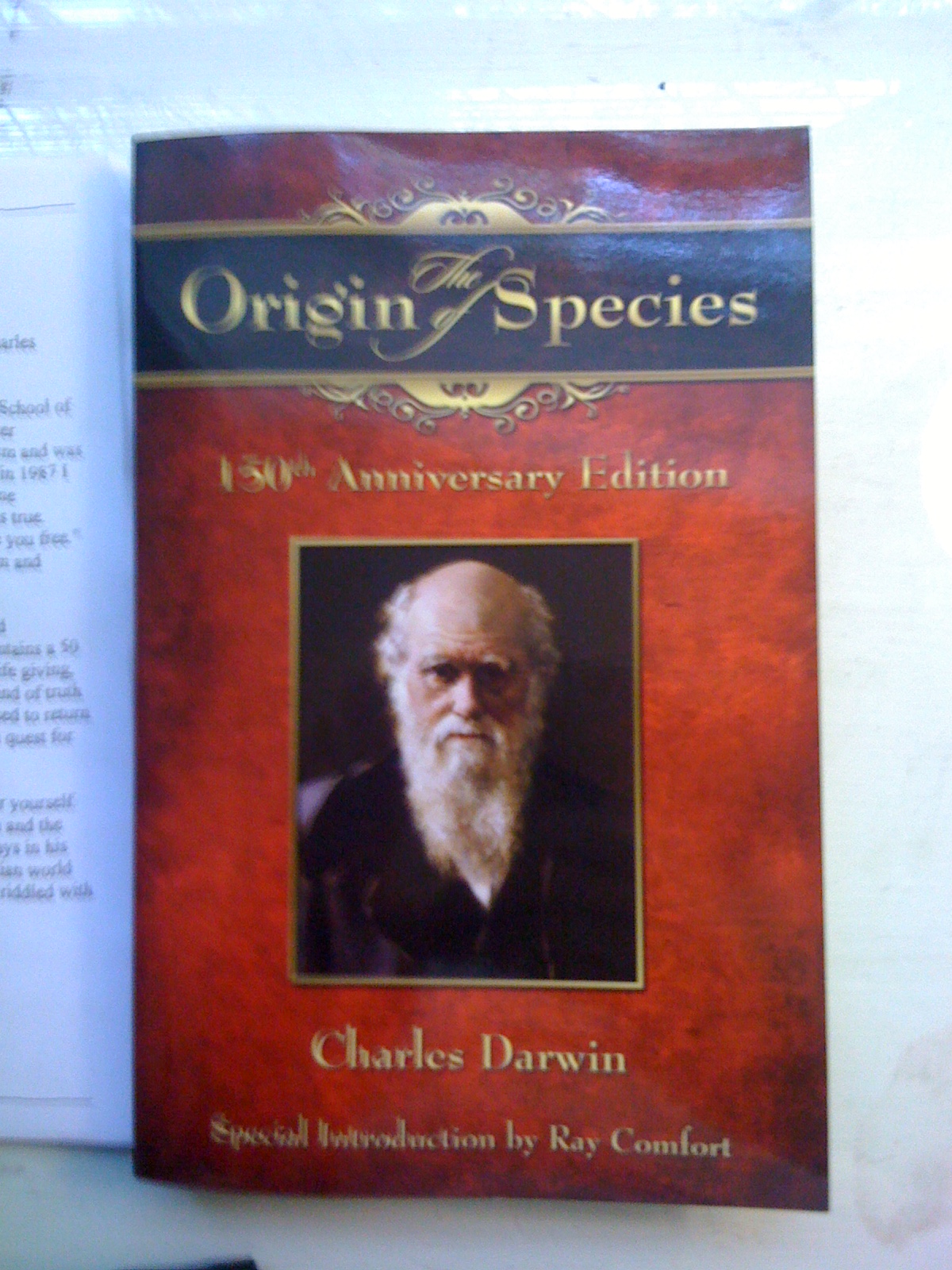
The Origin of Species, Ray Comfort, and profound ignorance


Ah, dishonesty!

The day has come.  We in the atheist and scientific communities have been waiting for it with mild amusement or annoyance.  And to our surprise it came a day early.  We almost missed it as a result.  But I didn’t.

For those of you who were not aware, Ray Comfort, from Living Waters and Way of the Master has recently been talking about passing out free copies of Charles Darwin’s The Origin of Species.  This pivotal book has been all the rage since it was first published in 1859, and it’s impact on science, religion, and culture cannot be denied.  This is a book that must be read by a person if they are to consider themselves a well-rounded, educated, and informed person in today’s culture.  One should at very least be familiar with what Darwin’s essential argument is, what evidence exists to back it up, and what science says about evolution today.

For that, here’s a few good places to start and to keep an eye on:

Why Evolution is True (WEIT)

PBS

Berkeley

But Ray Comfort is not a fan of evolution.  He rejects it and supports intelligent design, so why is Ray Comfort giving away this special 150th Anniversary Edition, precisely?

Well, first a bit about Ray Comfort.  He and his former Growing Pains star Kirk Cameron have been doing ministry about Jesus for some time now.  You may remember the debate that Ray Comfort and Kirk Cameron had with my friend Brian Sapient and the Rational Response Squad.  If you have not seen this debate, I’ll supply a link here.

It was this debate where the infamous crocoduck came from.  This has supplied many chuckles and full belly-laughs from sciency people ever since.  (I want a shirt with the crocoduck on it, btw, so I’ll accept gifts of this sort).

This is an image created by Ray Comfort to try and make the point that transitional fossils do not exist, and that if they did this is the type of thing one would expect to find.  The ignorance contained here is astounding.  I don’t even feel compelled to respond, because it has been done elsewhere with many more lulz attached.

But this is not the full act that these clowns have.  If you have not heard their routine, it is amusing.  Here’s an example that includes some rebuttal:

Now, the banana aside (which Ray Comfort admitted was a bad argument), this is utter tripe.  It is clear that Comfort, Cameron, and the others that are on board with this nonsense do not accept the overwhelming evidence for evolution, so why are they giving away copies of The Origin of Species? Well, it has a lot to do with the 50 page introduction that Ray Comfort includes in this ‘special’ edition.

Well, putting aside some obvious problems with the introduction, this is obviously an attempt to appear as if the creationist loons, like Comfort, have actually considered the evidence and are just coming up with another interpretation.  They simply see the evidence lacking, having studied the subject, and are confident to actually give people copies of this book.

But the fact is that evolution is not derived from the Origin like gospel.  It is derived from Darwin’s arguments, evidence, and observations and then is confirmed by all of the work in biology since.  That is, a hundred and fifty years of research, testing, DNA evidence, fossils, and other information  supports what Darwin wrote and expands on it in ways Darwin could not have predicted because he did not know about DNA or genetics, let alone the thousands of fossils we have uncovered that speak unequivocally for evolution by natural selection.

So, the deal was Comfort and his cronies were to hand out copies of the book all over the country, on college campuses, on November 19th, 2009.  The atheist and science blogosphere was all a-twitter about it and has been anticipating this.  Various responses, reactions, and condemnations have surfaced in various places with varying degrees of tone.  And so what happened when I got to my daily business today, one day before the planned give-away? That’s right folks, Comfort has tried to minimize the planned reactions by science enthusiasts and atheists by jumping the gun and doing it early.

But I managed to get out of the house and find a couple of friendly gentlemen who were passing out the books today anyway.  They were having some conversations with students, proselytizing the Christian message similar to Ray Comfort’s, and I took a copy and talked with them about my concerns for a little while.   And what did I find? Ignorance.

In my conversation with these two gentlemen, I found that not only were these two men ignorant of science, it’s methods, and the evidence for evolution, they displayed no interest in learning about science.  One of them actually said that he was not interested in science.  But he did say that he was interested in the truth.  And while he didn’t understand the basics of rational thinking, epistemology, or even what natural selection was, he maintained that he was interested in the truth.

And what is the truth? Jesus is the truth.  This was not merely claimed as a belief, but as knowledge, knowledge that was not doubted even a little.

Frustrating.  How can a person claim to be interested in the truth and not have any interest in the scientific method–the best method for determining how the world works–and have not even surface understanding of epistemology? his is an indefensible position.  It is irrational, illogical, and not worthy of the respect that some faitheists and moderate religionists say that these beliefs deserve. Their certainty in their beliefs is staggering considering they are not interested in evidence.  What’s worse is that they accused me of being absolutely certain that god does not exist and that evolution is true.  When I told them that neither was true and that I accept evolution only because of the overwhelming evidence for it.

I am a skeptic.  These people, Comfort included, are so removed from skepticism that they will not admit that they might be wrong.  They cannot even see that they don’t actually have evidence, only personal interpretations of experiences which people of other religions claim with equal authority.  I cannot respect Ray Comfort’s beliefs, his certainty, or the certainty of those who believe such absurd things.  And for them to try and pull a stunt like this,by trying to look like they are educated in the science behind evolution when they are not, is dishonest at very least.

“All you need is eyes that can see and a brain that works” is what Ray Comfort says quite often.  But it is clear, from all I have seen of his work, that he might have poor vision and a brain that works only just enough to sound like he’s saying something sensible to people who don’t see through his idiocy.

I’m glad I have a copy of this fine book to put on my shelf, but from what I have already seen, there is nothing in the introduction that is worth keeping.

God as a metaphor (part 3)


See parts one and two

Atheist v. Theist, part ∞

What distinguishes the worldviews of the believer from the non-believer? In many cases, nothing is the most likely answer. But there is a fundamental difference between methodologies, ways of figuring out the world, which leads to better conclusions. The methodology gives one a perspective that will either conform to our experience with the world or it will create cognitive dissonance with the world. The conclusions drawn from a worldview will, therefore, ultimately be the result of that methodology as it has been applied to the experiences and language game of any particular person.

The scientific method is a tool that leans on empiricism. It cannot rely on anything except that which can be observed, directly or indirectly, as having some relationship with the universe in which we live. That is, the objects of science’s gaze must exist within the natural universe, and not be anything, for example, supernatural. When a person utilizes this methodology of science to determine a way of interpreting the world, they are doing so in an attempt to check their conclusions thus far drawn with the world around them. If the scientist finds that what they have observed conflicts with some descriptive model of the world, then revision is necessary to either the experimental observation or to that larger description if the observation stands upon repetition.

This methodology uses the world itself as the foundation, the text from which we gain understanding. The letters of this text are the constituent parts of the world that interact in their subtle and often mysterious ways. The sentences are the various facts and simple objects that orbit our mind. Going further, the great chapters, books, and libraries range from the ideas, people, and cultures with which we interact and in which we swim. This, of course, is metaphorical language. And we all use metaphor as a tool for describing the world when we are unable—or unwilling—to be exact.

Metaphors are not exact enough to be the descriptions of the world we would need to be a exact scientific descriptions. And none of us, I believe, is a scientist through-and-through. None of us utilize the methodology of empiricism sufficiently or solely, as our minds cannot ascertain the world’s reality exact enough to create a sufficient map—a sufficient theory. Thus, we use inexact language to create a broad brush-stroke of a description. These insufficient models of the world can be beautiful, sublime, puzzling, or down-right terrifying. With the range of our languages and imaginations, we can create imagery that can contain important meaning, inspiration, or even fear.

But these descriptions will never satisfy the most rigorous of methodologies. Thus, the tension is realized. We cannot be exact enough, epistemologically, to live up to our most precise of methodologies; science. Does this mean that we simply stop using those methodologies? Does the fact that our minds cannot apprehend the world with sufficient precision imply that we give up on trying to become scientists—or the versuchen of Nietzsche’s ubermenschen?

This is one facet of the tension between science and religion. The mind thinks in inexact metaphors. The many doctrines and ideologies of religious traditions have saved the most beautiful, sublime, puzzling, and terrifying of metaphors from our past, and hold them in esteem. This is why they are so pernicious, because they contain images that we find beautiful and meaningful, not because they are necessarily true.

So, therefore, we should adhere our worldview to the true conclusions of science, right? Not exactly. Science very well may be the best tool humans have at their disposal to distinguish between better and worse descriptions of reality—theories. But telling the difference between two theories to see which conforms better to our empirical data is no better than our best description, which is admittedly dependent upon our inexact perceptual tools (the brain and our extended perceptual tools of technology). Our best theories do not necessarily exactly conform to the world, and thus science is a tool for getting closer to the truth through theory choice. This is why science is perpetually changing, which is a ubiquitous criticism of many of the faithful who misunderstand that this is, perhaps, what makes science so awesome.

Religion offers us no better an option. The descriptions of the world that comes from religion come from a different methodology. Religion has traditionally been the product of descriptions of gods and other proposed divine or natural forces envisioned not from the same process as science. They survived in lieu of or in ignorance of science, not as an equal alternative. Religion depends on the tools of metaphor, imagination, and story-telling that dominated human minds and cultures prior to or adjacently hidden from scientific process.

But religion persists because it clings to the human experience in some way. Humanity’s religious texts would not have survived if they had not contained something of value to human minds. They have undergone a sort of natural selection of their own, and have evolved into a form that adheres to human minds and cultures because human minds and cultures evolved with them. There is a sort of symbiosis involved. Religion speaks in the language of metaphor, and the human mind thinks and talks in metaphor. The relationship is, therefore, fundamentally linked.

So from whence comes atheism?

Atheism is nothing more than looking at the world, through use of some methodology, and finding that one does not—and really cannot—believe that a so-called ‘god’ exists in the world. One question is whether god does not exist literally or does not exist metaphorically. The former would imply that there is no being in the universe that can be associated with the term—there is no referent for the term in reality—and the latter would imply that the idea itself has no meaning or use in our description of the world, even in inexact metaphorical language.

The former, the literal lack of god in the world, is a question for the scientifically minded person. It is a question of what actually exists according to our best data to date. Someone who concludes that there is no god while using this method will most likely say something like ‘I see no evidence of such a being, and thus lack belief until sufficient evidence is presented.’ They are agnostic, in that they don’t ultimately know, but they lack belief, thus are atheists. This person cannot go very far with this without bumping into description, theory, and interpretation. It is at this point when metaphor takes over.

The latter, the person using his metaphorical toolbox, has a more subtle route to atheism. What does the term ‘god’ mean? What, from the data in the world gathered, can we put together into a cohesive concept that we can call ‘god’? Once the data is gathered, some way of making sense of it must develop in order to continue to inform a worldview. To make the connections between ideas that come from new information, we have to use association of concepts and comparisons of ideas to create the interconnected web of ideas in order to literally build a neural network responsible for thought patterns. In the mind, this is viewed as a connected coherent worldview or at least a concept that relates to other concepts—whether in dissonance or not.

If a person has a worldview that cannot find a place to put the term or concept of god that coheres with the rest, then that idea becomes nonsensical to them and they have no choice but to declare it as such—nonsense. From here one can construct many arguments of god being nonsensical, as god being no-thing, because the term doesn’t fit into the set of things that exist, or however they formulate the argument. In the worldview of this type of atheist, the term god does not refer to anything identifiable in their worldview. So what about the theist?

The theist can try to argue that they see evidence for god in the world—in the design, as a cause for, etc of the actual world. But they don’t see god itself, just its interpreted effects. Thus, on the level of data itself, a theist cannot place their idol and expect it to rest there. From a scientific point of view, the claim that god exists is only meaningful if it can be pointed at directly and unambiguously. This has never been done, and until it is done to the sufficiency of the empirical method, the claim is not even meaningful. The conclusion of god as designer or cause is an interpretation, an inexact description, of the data. God is never observed directly, but rather proposed as an explanation for or fundamental ground for the world which is observed. It is always, therefore in the realm of metaphor that god is talked about.

But cannot the same be said of the atheist? Cannot it be said that the atheist has an interpretation that god does not exist behind the world, and thus their lack of god is a metaphor? This is absurd; the lack of observing some object or being is not a metaphor—it is literally nothing. The atheist at this level simply states that a ‘god’ is not observed, and this belief in its existence is not justified. If someone proposes a description of the world that includes a god, the atheist can say that the theist is comparing how the data interacts with a concept they call ‘god,’ and thus god is a metaphor for either the world itself or the cause of or foundation of the world. If god is a metaphor, then one aspect of atheism is simply not accepting said metaphor, and thus being without an ultimate metaphorical description of all things by use of a being called ‘god.’

The distinction between most atheists and most theists is one of a use of metaphor. But since all humans use metaphors in descriptions due to the lack of exact descriptions for the world, it cannot be said simply that atheists lack metaphor altogether, but simply a class of metaphors. In a sense, the idea that the map is not the terrain is relevant, as it is as if the theist, in creating a map of reality, sees a pattern of intent, intelligence, etc that helps construct the map. If they call this fabric that they print their map on ‘god’, then it seems justified in claiming that the fabric of the world must be god too, and thus god exists. The mistake is carrying the role of metaphor that we use in describing the world unto the world itself, where metaphor has no place. Metaphor is a tool of the mind, and to project the language of the mind onto the world itself is to project the device of perception onto the perceived object. Even now I cannot help but use metaphor to describe my point, but what my point refers to is not a metaphor itself.

The scientific method is not completely deprived of metaphor. Even the best and most consistent theory is inexact, assuming a perfect theory is unattainable (whether this is the case is a question for the philosophers of science). But compare the foundations of science with that of religion. Note the degrees of usage of metaphor in each. And, further, note the difference in use of metaphor in the fundamental assumptions of an atheist and a theist. What metaphors underlie the assumptions of an atheist and what metaphors underlie the assumptions of a theist?

Atheists are people that don’t believe in god. Theists are people that believe in god. God is a metaphor to describe the world and how it operates, since it is never observed directly but always inferred from the world. Atheists are people that do not believe that such a specific metaphor is meaningful in describing the world, and a theist is a person that feels that that metaphor has meaning or, in some Platonic sense, that the metaphor is a shadow of some actual being.

But what meaning does god have? What is god? Perhaps god is whatever is meaningful to the theist. Whether a meaningful metaphor can be said to actually exist is not quite the right question in this regard. In this case the importance of god is in the usefulness and affect of the concept on the real world; almost as if the concept of god makes god real. Perhaps one thing which is meaningful to many atheists is not placing too much emphasis on metaphors, but rather to that which their metaphors point. And if the metaphor either points to nothing or to something that can be later named, then ‘god’ ceases to be a useful term.

Once one has used some metaphor of god to indicate what is truly meaningful, the atheist no longer has use for the metaphor of god to have meaning. The atheist then realizes that they never had need for the metaphor.

God as a metaphor (part 2)


See part 1

Metaphor

There is something that is common to all descriptions, something that is a potential stumbling block for many truth-seekers. The commonality is rooted in language, the implications of which have been a subject of philosophy, linguistics, and other fields. Neither an extensive nor exhaustive account of language’s role here is necessary. Rather, a specific relationship between the world and language is relevant; the relative exactitude of some description’s language to the referent itself; how precisely does the description convey what the universe is like?

Specifically, the key factor is that of comparison, analogy, language games, and metaphors. In this essay, I will use metaphor for a short-hand for all of these uses of language, as well as other related ideas that convey an inexact but useful description of our experiences with the world. A metaphor is a comparison of two things by use of description of one object which is intended to describe, analogously, something else. This concept encapsulates the central relationship I want to illuminate here between this tension between description and our quest for understanding. While ‘analogy’ or ‘language game’ might be more apt terms in some cases, I believe the use of one consistent term would serve the purpose not having to distinguish between these differing concepts and stray from my central thesis.

God is a metaphor

That having been said, it may peak the curiosity of my reader the nature of this thesis. Surely, it must have something to do with metaphors, and surely, something of a theological nature is at hand. More specifically, it must have something to do with this thing called ‘god,’ a concept that has presented many a thinker with a range of ideas, feelings, and conclusions. An apt question would be what we mean by such a ubiquitous term; in a world in which religion stakes a large claim of influence and divine presences are considered common, surely we must know what this ‘god’ concept refers to, right?

Quite frankly no, we don’t know what the term ‘god’ is supposed to mean. Theologians talk of the supernatural as being beyond nature or simply as unknowable. Negative theology can define what god is not, but in terms of what the supernatural might be, we cannot say. Anything we could say would be based upon experience with the natural, and thus could not hope to describe the supernatural. As a result, our descriptions of gods and other supernatural beings are nothing but metaphors to invoke a concept. But this concept is natural in origin, and thus cannot be a true description of something that is not natural.

Further, if ‘god’ were supposed to describe something natural, then the question is what it is supposed to represent is open. One could talk about the actions of god, the creative acts of god, etc. But all in all, this use of the term is, at best, a metaphor for natural processes or poorly misunderstood events ascribed to the unknown, where the metaphor of god is placed to fill a gap. The metaphor of god is placed as a quick fix to cover over the whole of mystery. That which we do not know is placed in the lap of a metaphor we call god by theists, rather than remaining a beautiful mystery. This epistemological, emotional, and cognitive band-aid is empty linguistic filler for the unknown spaces in our understanding. Further, saying that god is the beautiful mystery is committing the same fallacy of placing a metaphor over what is essentially a gap in our understanding. If we do not understand something, then filling it with “god” is meaningless.

As an atheist, I understand that I don’t understand; I know that I know nothing, as Socrates is reported to have said. As an intellectually honest person, I must admit that that which I do not know, I must not place a meaningless term like ‘god,’ but rather admit that our understanding is finite. And when we do understand, it’s usually metaphorical in nature.

What is interesting is that many theists seem to understand this too. It has been a tradition of much of Western theology to recognize the profound gulf between our understanding of the world and god’s understanding, or between our being and god’s being. Here, for example, is St. Augustine;

What then, brethren, shall we say of God? For if thou hast been able to understand what thou wouldest say, it is not God. If thou hast been able to comprehend it, thou hast comprehended something else instead of God. If thou hast been able to comprehend him as thou thinkest, by so thinking thou hast deceived thyself. This then is not God, if thou hast comprehended it; but if this be God, thou has not comprehended it.

Here, it seems as if the theological tradition that comes to us through Augustine demonstrates understanding that we don’t know, but yet persists in the belief nonetheless. This is the infamous faith, in which one believes despite this ignorance, this gap, this uncertainty. It is as if, somehow, this feeling of awe, mystery, and humility somehow translates into a kind of existential significance. It is as if the great lack comprehension which we try to simulate in thought cannot be conceived of, so the brain fills it with a pattern of firing neurons that creates, accidentally perhaps, a sensation of a kind of being or meaning that provides something of great value to them.

Surely, this feeling or concept that many attain through this ignorance is very common among humans. It seems that it has deep roots in human psychology, and is often very persistent. But it’s neither universal nor necessary, as many people have never experienced it, at least not as a “god.” Sure, the non-religious experience awe, mystery, and adoration of the world. But there is something that distinguishes between an atheist and theist and their experience of this set of emotions and thoughts.

Tomorrow: part three (Atheist v. Theist, part ∞)

God as a Metaphor (part 1)


The following is a longer article that I want to divide up into three parts.  For part two, and subsequently three, come back in the next couple of days.

Part 1:

Once one has used the finger to indicate the moon,

one no longer has use for the finger.

The elusiveness of Truth.

What is true? What is Truth? Any attempt to describe the nature of reality, of the universe, of our experience of the universe, or any attempt to describe the universe independent of human experience, must necessarily involve some type of language. Systematic descriptions of various levels of rigidity, whose goal it is to explain how the constituent parts of the universe interact and combine to create the complexity we see in the world, vary from person to person and group to group. These descriptions differ as a result of being derived from various points of views—perspectives—and have different sets of assumptions and thus different conclusions. When one doesn’t know where they are going, any road signs or markers along the path can be mistaken for the destination. Similarly, if one does not know the truth, the metaphors we use to dig part of it up can be mistaken for the truth itself.

People from various places, times, and with various cultural environments have tried to make sense of the world—to describe it systematically. In doing so, observers of this quest have found that there are limitations to our abilities to describe the world precisely and accurately. In addition, the experiences, traditions, and other factors that shape our view of the world will effect how our descriptions will be formed themselves. After all, the conclusions that we come up with are formed in the environment of our minds, which are formed in the environment of our cultures and personal experiences.

This situation leads one to wonder whether there is any sense of even asking about something objective or ultimately “True.” This is especially the case since we are steeped in contingent factors which depend on subjective and inter-subjective analyses rather than some hypothetical objective perspective (a concept that seems oxymoronic, to say the least). Plato and his many dualistic philosophical descendents have commented that there is a distinction between the Truth and those things which are mere shadows of that truth, things that are dependent upon circumstance and subjective perceptions. And while I don’t buy this dualism, I recognize that there seems to be a difference between the nature of how the world functions and our low-resolution simulation of it that our minds concoct. This difference has led some to postulate that the concept of truth in-itself is a fiction that has no meaning, or at least is beyond our epistemological capabilities.

The history of science reflects this tension between theory and some hypothetical Grand Unified Theory, and gravity is a prime example of how this tension plays out. We can predict to a good degree of precision, given sufficient information, where a ball will land if thrown or shot in some gravitational field. Newton’s success in describing the inverse square law of gravity was able to give us a relatively accurate mathematical relationship to make such predictions. But in the early decades of the 20th century, an ingenious and somewhat annoying discovery was made by the well-known, if not well-misunderstood, Albert Einstein. Our description of gravity was not precise enough to be considered exact, and we would find that the theory of general relativity would surpass Newton’s observations in descriptive power. But even general relativity proves not to be spot on, either. We are still grasping for the subtleties of quantum gravity with M-theory and loop quantum gravity, and there is no way to know, now, whether these ideas will be any more fruitful in ascertaining the truth of the matter of gravity. Only time and effort will tell.

Whether or not the true description of gravity will one day be found is not the point of this mental exercise. The point is that our relationship with the world is one where our words and the descriptions they formulate have an inexact relationship with their intended referents; the “true” descriptions of how the world actually works. Through our prodding, measuring, and calculating of the world around us, we refine our resolution of the world until we have a theory that can map the terrain sufficiently for our purposes. In terms of technology, our theories do not need to be exact to make objects that suit our purposes—the computer I am typing on is sufficient to demonstrate that. But it is a different project to determine what is True, and human beings from time immemorial have been playing with the questions of what is ultimately True, and there is no sign of this trend going out of fashion any time soon.

But what are of interest include the various methodologies of tackling this question of what is true. Surely, there may be many angles or perspectives from which we can attend to the problem, each using different specifics but describing the same universe, that depend upon the experiences and information accessible to the questioner. This does not imply that any methodology is equally valid or that different methods may be equally effective or efficient at gaining understanding. In fact, it seems quite clear that some methodologies have a clear advantage over others, gleaning more descriptive power than others and therefore having better descriptions than others.

Tomorrow: Part two (“metaphor”)

Atheist in the pews (part 2)


A little while back, I wrote an article about my experience in visiting a Presbyterian church.  I contacted the gentleman who gave that sermon that day, exchanged a few pleasantries, but never heard from him again after he read the article.  But I am not dissuaded!  I press on, and I visit other churches in the hope of maintaining some communication between people like myself and those with whom I share little in terms of metaphysical opinion.

But, as I discovered yesterday (Sunday, October 25th, 2009), I do have a fair amount in common in other areas besides my theological persuasion.  Yes, I might say that I found that I can agree quite closely with a worldview expressed at certain churches on certain days.  And with that, allow me to report what I found at a local Vinyard church yesterday…

A gathering of young, attractive, and slightly swaying people gathers under the chord-changes that seek to immitate the presence of a holy spirit.  Some sing along in praising the resurrection that supposedly brings them joy and peace.  One, standing before them, prays for all those who, assuredly still attached to the unseen powers of the real world, arrive late.  As they sit, a prayer of fear is offered.  It is that which should be learned; fear.  But wait, there’s more! See, God will come to the down-trodden and those in need.  No doubt pain, loss, and fear are felt here. No doubt they come to this place with this need.

One day, every knee will bow

one day, every tongue will confess

they sing.  An insecurity sits in this song which hovers over the crowd like a mist, almost visible it is so strong.  A vindication of their faith lives in these words.  Their belief is justified by that promise this time of all bowing and confessing  which cannot verified, but its hope is palpable here.  Their swaying continues with the new song.  Hope, genuine affection, a few hands raised as if to catch something unseen but certainly felt.  The evidence of things unseen? Perhaps.

Then they sit.  I have been sitting and jotting my impressions.  This has earned me some attention.  They seem to wonder what I am writing, and perhaps why I am writing.  Perhaps they wonder why I am not moved by the spirit as they are.  Perhaps I project.  Perhaps they are just not used to seeing this particular action in this particular place and time.

God comes close to us when we grieve

starts the pastor.  He talks of loss.  There are those that are no longer with us.  We must set aside time and space to grieve for those who are gone.  Do not be satisfied with the thought that they are in a better place. Well said.  But well said for different reasons than the ones I might give.

And this would be the theme for me throughout the next hour.  I, the atheist in the pew, will find myself in agreement with much of what is said in this sermon, but will wonder a recurring question throughout;

What does this have to do with any god?

The inspiration, as it were, for this sermon is Matthew 6: 25-33.  For those of you who don’t remember, it is the section where Jesus instructs us (supposedly) to “look at the birds of the air” and to “consider the lilies of the field.”  In fact, I’ll just quote the section that the sermon was derived from (NRSV):

‘Therefore I tell you, do not worry about your life, what you will eat or what you will drink,* or about your body, what you will wear. Is not life more than food, and the body more than clothing? 26Look at the birds of the air; they neither sow nor reap nor gather into barns, and yet your heavenly Father feeds them. Are you not of more value than they? 27And can any of you by worrying add a single hour to your span of life?* 28And why do you worry about clothing? Consider the lilies of the field, how they grow; they neither toil nor spin, 29yet I tell you, even Solomon in all his glory was not clothed like one of these. 30But if God so clothes the grass of the field, which is alive today and tomorrow is thrown into the oven, will he not much more clothe you—you of little faith? 31Therefore do not worry, saying, “What will we eat?” or “What will we drink?” or “What will we wear?” 32For it is the Gentiles who strive for all these things; and indeed your heavenly Father knows that you need all these things. 33But strive first for the kingdom of God* and his* righteousness, and all these things will be given to you as well.

This is a section that I am well aware of.  I remember a British sketch comedy bit about it that I found funny (I could not locate it to embed–sorry.  If you know of it email me a link).  I will tell you that I think that this passage is plagued with some problems, and as soon as the pastor began his discussion I wrote them down immediately.

But don’t the birds have to work for their food and shelter? The ones that could not died out and the ones that could are still here, so how is this supposed to be an inspirational analogy? Quite simply, I think Jesus is wrong here, and frankly looks quite ignorant of the life of birds and lilies.

The problem is that the passage states that the birds and lilies are taken care of.  The idea is that in a similar way, god takes care of us.  We should not become anxious over our lives because God will take care of things.  We need, says our fearless pastor, strive for peace and simplicity.

Simple enough, right? See, it isn’t up to us.  “We think that we are in charge,” but in fact God is in charge.  God wants us to buy into a discipline of not worrying so much; to live a life of simplicity.  We are complex, but Jesus preached simplicity.  And in this materialist culture where one can get distracted by gadgetry and so forth, we should live by some basic guidelines to simplify our lives.

In a world of competition, we need to avoid the temptations of power in an attempt to maintain a life of integrity and value.

OK, I’m with him so far, mostly.  So what does this have to do with God? What does this have to do with Christianity? I’m with you, my friend, but just because this idea was drawn from a passage from the New Testament, does that make this message a Christian one? Because as you continue to speak, dear pastor, the more I am reminded of Epicurus.

But there is more.  You see, children buy into things easier.

Richard Dawkins is shitting himself…but in a dignified, British way…

I’m being a little unfair, I suppose.  The idea is that we should try and maintain a child-like approach to learning and truth.  We should remain open-minded and receptive.  Perhaps, but not so open-minded that our brains fall out.  In my opinion we need to remain open yet skeptical.  Children are not always so skeptical.  They tend to believe what you tell them because they need to be so open in order to learn and to survive.  Had it been otherwise, those children thousands of years ago who didn’t believe their parents that the tiger didn’t want to be petted would not have survived and that particular trait of needing to verify everything they are told as a child would not have been passed down to the next generation. Simple natural selection.

Child-like, indeed.  It allows the theology to be swallowed easier if we don’t ask too many questions.  Child-like adults all gathered here listen intently, a few subtle motions and grunts of agreement can be pulled out of the quiet congregation.

I was partially with the pastor at this point.  I thought there was some value to the idea to not try and control everything and to try and simplify our lives.  I do not agree that we are not in charge and that God is, only that while we are in charge, there is no point in trying to control everything and to take a step back sometimes.  This will help with anxiety, I agree.  I strongly disagree with the idea that the responsibility is in a god’s hands.  I think this is antithetical to our responsibility, and it seeks to have people not take pride in their accomplishments or to take responsibility for their mistakes.  I do not believe the pastor would agree that this idea promotes irresponsibility, but this is precisely what the logical conclusion of this line of thought leads to, in my opinion.

But then he made a comment that stuck out to me even more.  “Because we lack a divine center, we seek materialism” (or something very similar to that statement).  This is the point where he lost me completely.  See, I’ve never been a man of any god.  I’ve never believed in Jesus, Allah, or any of those silly things, and yet I am in almost complete agreement with his essential message that he will deal with in the next section of his sermon.

He then discusses our insecurity (irony?)  We seek answers, community, etc and sometimes we reach in the wrong direction in life.  Amen, brother!  But what does this have to do with God? Oh, right…without a divine center (that is, without God) we don’t have a goal-post to strive for.  We don’t have s source of wisdom with which to make better decisions in our lives.  Thus the following pieces of advice are really based upon God.

There is a terse reply to such a claim; fucking bullshit.

I call bull on this because I know that I, who have never been a Christian and don’t believe in any gods, agree with the rest of the sermon (mostly).  I have come up with and learned the same pieces of wisdom from secular philosophers (such as the previously mentioned Epicurus), and many of them pre-date the Bible or are from non-Christian sources.  These are not Christian pearls, they are usurped wisdom taken from the real world and illegitimately associated with Jesus for Christians, partially in order to feel special and different in comparison with a materialistic amd power-driven world.

Then, there was a list of ten pieces of advice that was derived from a man whose name seemed familiar but that I could not place at the time; Richard Foster.  And the more the pastor went on and on, the more I kept thinking ‘this reminds me so much of my Quaker school and the stuff they talked about’ and thinking that this guy, this Foster, was ripping stuff off from the Quakers.  And then I remembered (later) that Foster was a Quaker theologian.  And I laughed.  I had simply found yet another liberal Christian church who had a message that was just like the one I had grown up with.  But I had never been a Christian.  I had just attended a Quaker school.  And the Quaker school I went to was dominated by Jews as much as Christians.

But I had learned these ideas not in relation to a god necessarily, but as good rules to live by in society.  These are liberal ideas which can also be found in the Bible (although perhaps not for some), although they are not the only messages contained therein.

Again, what does this have to do with god?

Nothing.  Nothing at all.  All of this God-talk is merely a metaphor (an excellent article, so read it) for these ideas to live by.  These things would be true whether or not thereis a god.  God is being given the credit for this wisdom just because a passage in Matthew happens to touch on the issue, and only sort of.  A better source for this discussion may have been Ecclesiastes, in my opinion. But this is what pastors do; they take a passage and associated with some cultural message and give the credit to their concept of god rather than to themselves.

The bottom line here is that in churches like these where God is talked about but only in ignoring the nasty stuff he has done according to that book, what is being preached is just sense.  It should be common sense (and perhaps it is) but as I watched people react to the sermon, I saw them inspired and in love with this concept of god not realizing that they are giving this god the credit rather than taking it themselves.

We are not the ones in charge, he had said.  God deserves the credit. I disagree as strongly as I can disagree with anything.  This is a disgusting and anti-human message.  It de-values us by making us puppets for a megalomaniacal bully (seriously, read the whole book some time).  It seeks to humble us in a way that not only does not cure the insecurity within us, but perpetuates it.  It is a slave morality, as Nietzsche called it.  It is a way to keep people down under the guise of worship.

And what’s worse is that they don’t realize it.  They don’t see that this message of allowing God to ‘take the wheel’ (as that awful song said) can take away anxiety, sure, but it also takes away the joy of accomplishment, the pride of success (it is not a sin to be proud–what kind of sick and twisted view would claim that out loud and call itself moral?), and the responsibility that we have for the world around us and within us because it takes away the credit of our effort.  It’s all gone to the glory of God.  That’s disgusting!

Do I sound angry? Well, I am a little.  I am angry that people go to these churches to receive mediocre advice that can be found in any number of places without having to prop up a belief in a god for which there is no evidence.  Further, these efforts continues to give credit for this mediocre wisdom to this imaginary being and circularly gives ‘evidence‘ for that god by actually sounding like it makes sense.  After all, things that make sense can only come from God, if you assume that God is the source of all wisdom.  Gotta love circular logic.

The bottom line is that I had a chance to hear a sermon that I agreed with a fair amount, but I didn’t see any reason to believe that it had anything to do with a god.  Modern liberal Christianity still seems to me to be nothing more than a group of young and progressive people who like hearing nice things, especially things that challenge the consumerist and materialistic capitialistic world they live in, and then attributing the ideas to Jesus who will take away their pain and let them live forever.  I wonder if they have really contemplated eternity.  That’s a scary concept.  But Jesus is magic, so he’ll take away that scariness too, I guess.

At least they aren’t Pagans;  man, they annoy the crap out of me.

The atheist conspiracy and secular culture


The_AtheistAtheists are distrusted more than any other group in the United States according to at least one poll. Things such as the “war against Christmas” and the culture wars in general help to create the perception that atheists and other secular thinkers are working together to destroy “traditional” values within American culture. “Family values” and Christianity are being discriminated against under the banner of the First Amendment. This secular goliath, led by academic elites, Liberals, and homosexuals, is threatening to destroy thousands of years of cherished, God-ordained, ideas.
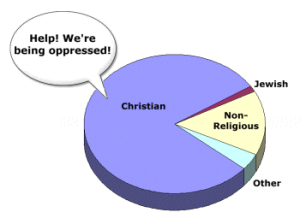
If you listen to such luminaries as Glenn Beck, Rush Limbaugh, etc, then you may be aware of a concerted, omnipresent, and culturally destructive power structure behind the media, schools, and the atheistic scientific community that threatens to take God out of the world. This conspiracy has been in motion for decades, if not centuries, and will continue to destroy traditional Christian America until we are all living in an Atheistic, Communistic, and permissive culture that will drag the world into the recesses of hell.

What makes this feat so amazing is that it is carried out by a small (yet growing) and largely politically impotent group of people made up of often fiercely individualistic people. The various organizations for atheists, agnostics, freethinkers, etc throughout the United States, despite their differences, splintering, and lack of cohesive voice, have somehow managed to take control of the culture.

Wait…. a relatively small, disorganized, and powerless minority without any more in common than a shared disbelief in a divine being (for which no evidence exists) has somehow managed to overpower a majority who follow an omnipotent, omniscient, and eternal creator of all that exists?That some serious undertaking.

If you’ve ever talked to more than one of two atheists at a time, you’ll find that it is often difficult to get them to agree to much more than said shared disbelief, let alone organize effectively. The organization and size of the various Christian communities, despite their differences, with their massive media presence and cultural acceptance are in a much better place to maintain influence than any group of atheists. Therefore, another theory must be presented to account for the secular threat that faces religion today.

To begin with, we need to define secular. Secularism is not anti-religious, but rather a-religious. A secular person is not, at least not necessarily, against or opposed to religion. A secular person is someone for whom religion is a minor concern or at least of vanishing concern in making decisions about their society and culture. Their decisions are not made with any religious notion in mind, whether it is to follow or intentionally rebel against one. Secularism, therefore, is not the same as atheism.

Most people believe in some kind of divine existence. For the most part this belief does not shape the entirety of a person’s worldview; people still believe in using critical thinking of some kind for most of their every day decisions. Rationality, logic, and science have won out the day for the vast majority for what kind of medical treatment to get, how to understand how our computers work, and roughly how much we should pay for groceries. These are the tools that the secular world uses. They answer questions about many things, and still leave us pondering over others. When questions about ethics, purpose, and origins of life come up, most people pull out some kind of god or religion, but for most things god is essentially irrelevant.

Most of our decisions in life are made based on the secular tools we all have available. Secular ideas are everywhere, and to an extent they do threaten many religious ideas. But these secular ideas are not the result of a conspiracy to implement them in society by atheists, humanists, or any other freethinkers; they are just ideas that work, which is why we use them. It just so happens that skeptics, which tend to be atheists, tend to accept ideas which work. Thus, when many theists see secular ideas pervading culture and they see atheists and their ilk promoting these ideas, it looks like the ideas are emanating from these people rather than the other way around.

That’s right, the secular ideas, technologies, etc that have been developed throughout history—whether they were created by secular people or not—and tend to impress the power of rational thought and scientific methods onto people. When these people apply these methods onto the world, many of them tend to move further away from religion (especially more fundamental versions of religion) and become more secular people in general.

It is no surprise that some people employ these tools with more effort and to more areas of concern. Some people are meticulous with reason when it comes to their finances but will not even touch their spiritual life with those same tools. Most atheists that I know have simply applied their secular tools to religious ideas and concluded that they don’t hold water.

What this means is that not all people will become atheists. Many will still believe in a God or gods, but will find a balance, reconciliation, or separation between science and religion in such a way that their worldview is not threatened by secular culture. This is partly because secular thinking does not threaten religion unless said religion is so anti-science and non-rational that it is incompatible with all of the stuff that those secular tools create. The problem is that many religious people—fundamentalist Christians especially—accept claims about the world that secular tools tend to break when applied to them. It is from this that some Christians conclude that they are being attacked, oppressed, or discriminated against.christian_oppression_pie1

These people are not being discriminated against; they are simply disagreed with by people who accept secular methods for figuring out how the world works. If they feel persecuted, it is because they accept ideas that are unacceptable by standards of rational thinking. They are allowed to believe whatever they want, but they have to accept that when they try to claim that their beliefs are a part of our tradition, law, and culture, they have the right to be mistaken. Christianity in general is indeed a part of our shared history and culture, but not a part of or laws. And as far as tradition is concerned, sometimes traditions need to change just as they have been doing throughout history.

The more that secular ideas are understood and internalized by people, the more culture will move away from religion and belief in gods. I don’t think either will ever fully disappear, and perhaps that is alright. Science, rational thinking, and logic do not support many religious claims, but they also do not disprove many others. But the more we process towards a more complete understanding of the world the less that religion is asked to explain. Further, the explanations that religions continue to offer are all pseudo-explanations or simply insufficient, at least for those who have applied their secular tools to them. The many good ideas of secular culture will tend to support the atheistic position rather than the theistic position.

So, many people may not like atheists, but in most cases atheism is the result of use of the best tools that humankind has yet developed. Our disbelief in deities is simply due to the fact that, despite it’s presence in history, culture, and human life, religion just doesn’t work, at least not when we apply those highly regarded methods. I see it as an optimistic sign that secular ideas are accepted widely. I hope that it means that the future will hold greater organization among atheists, skeptics, and freethinkers of all kinds. This will be a sign of brighter futures.

The pseudo-depth of religion


We, unfortunately, live in a largely anti-intellectual and unsophisticated culture.  There is not ample interest in things philosophical or subtle.  I will not lament this here for its own sake, but I will mention this as a pretext to address another issue.

We are pattern seeking beings that desire meaning and purpose in life, but we are rarely exposed to the various approaches to finding these things.  The depth of that search is often too terrifying to traverse, and so we try to find other ways to fulfill this need.  And, lucky for us, culture and its complex structure has supplied our history with just such a function.  The vast majority of people are usually exposed to one source of meaning and purpose; am ancient cultural tradition that still holds sway for many people.

I want to call it religion, but that is too simplistic in the end.  It is my view that religion is a natural expression of our desire to explore the world for meaning. It is a way to look inward and in many cases to project outward what we desire to find there, and to latch onto narratives, myths, and the illusion of ‘something more’ in order to add color, depth, and importance to a world that seems meaningless.

It is a kind of metaphysical or ‘spiritual’ impulse to explain the universe in terms of intent, intelligence, and often in love.  And the result of this impulse that we share are the many religions an spiritual pursuits of the world.  These are the vehicles of providing meaning, purpose, and intent into an otherwise meaningless existence.  And because we sense this meaninglessness often enough, we seek shelter from those cold winds of loneliness and purposelessness.

That is, people seek the part of our psychology that is responsible for the religious cultural impulse to find meaning.  The easiest way to do this is to take an atavistic glance back to the introduction to such feelings; the religion of our childhood.  And if not our childhood, the religion of our early attempts to look for meaning in the world.  For many, groups such as Campus Crusade for Christ (or some similar group) seek to fill the insecure holes that creep into our lives in a time of emotional upheaval and change of the early tastes of freedom that college provides.

In general, whenever the insecurities and fears of life emerge, the desire to see meaning and purpose weaved into the fabric of life and reality act as a sort of blanket against the coldness of the world.

But before I continue I must hark to the whisper of a ghost which has come my way.  A strange and somewhat lively sprite—lively for a dead man, anyway!  A moving of thoughts tussles its way to my mind’s ear and words resolve into a thought:

Mystical explanations are considered deep.  The truth is that they are not even superficial

And with such a deep strike into the heart the thought evaporates and the spirit haunts another.  Or perhaps it has sunk so deep into me that I can no longer distinguish between it and myself.  The difference—it is indifferent!  But the whisper of the name of “Nietzsche” reverberates throughout and my mind returns to the task at hand.

But this spiritual visit has had a purpose, I fathom.  Because in a largely unsophisticated world, the early reaching for meaning and purpose are mitigated by religion; they are softened for us by a pseudo-depth of assertions of truths that are always bolstered by nothing but faith—in other words by sheer preferential desire for them to be true.

It is common for people to scuttle through there youth while largely unconcerned with the ramblings of religious ideologies.  Yes, if pressed they parrot the memories of their early exposure, but they live secularly and leave to Sundays (or some other bequeathed holy day) the quandaries of any depth.  It is only to these holy days that purpose and the insecurities of meaning emerge into the sunlight of our thoughts.

We have not yet allowed the scab to form over such insecurities in order to have our fears heal.  And so we protect our raw minds from the exposure to the dangerous world and we often miss the sophistication and depth which lives there while distracted by this protective preoccupation.  Because we spend so much energy nursing our fears in public, we miss the true depth of the world.

And so what of true depth and subtlety?  What of philosophy? Why, upon the hardship of emotional turmoil, of loss, or of dissatisfaction do people turn to their lord, to the false depth of dogma and myth rather than to do the real, hard, and growth-inspiring work of looking deep within without the lenses of faith and childhood brainwashing?

We avoid the difficult in life and revert to looking at it through Christianity or some other absurd softening of our mortality and ultimate meaninglessness.  And in doing so we miss that it is our responsibility to lend meaning to our lives.  We must take responsibility for how we face death, loneliness, and dissatisfaction.

So often churches will remind us that in the pursuit of money, power, or otherwise transient things, happiness can only be temporary.  They cannot supply real meaning for us, which we crave.  But then they assert that a real happiness, a real and eternal answer may be found.  But this is only an assertion.  It is a promise that cannot be kept.  It is another distraction from the truth that mature and aware adults have to face.  It is a fantasy to cover a scary world.

The thing is that the churches who remind us of the ultimate meaninglessness of our earthly desires are correct.  They just fail to acknowledge that they are not offering anything different.  Their mystical explanations are only deep in an illusory way.  Their façade is not even willing to dip its little toe into the waters of the universe out of fear that the water is too cold.  And it is cold.

Warmth can only be found with one-another.  And so churches, in gathering communities, are creating a mirage; it is not the message of eternal life that provides meaning and purpose, it is the company that sits upon this superficial message that supplies the meaning.  It is the illusion of having eternal companions, covered by real but temporary ones, that perpetuates the illusion.

When we find meaning and purpose in shallow promises of eternity, we find not even a shallow pool in which to swim.  The universe is deeper than we can comprehend.  Its true beauty lies beyond the fear that is manipulated by religion which only thinks itself deep.  Come and join the universe and dive into fathoms unfathomable.  Rather than transcend this world, transcend your fears of it and come swim with us in oceans of reality.  And when you do, you will find true warmth in the company of the disillusioned and the free.

The cultural assumption of monogamy (and gods)


assumptionsIt is clearly true that most people believe in god and that, in the end, we should at least try to choose one life-partner.  Not everyone will like that term, conservatively preferring the more traditional ‘husband’ or ‘wife,’ but this seems to be the prevailing assumption among people in our culture.  Polyamory or some other form of non-monogamy (i.e. swinging, swapping, etc) is almost always seen as the exception to that rule.

So, how much of this is natural?  Well, strictly speaking I believe (being a  metaphysical naturalist) it is all natural because everything that happens in a natural universe is natural.  The artificial distinction between the natural and the artificial is, well, artificial (to be slightly ironical).  But I digress….

How much of this is due to our in-born behavior and how much of it is cultural? I am really not sure, to be honest.  There seems to be components of both nature and nurture going on here.  What I do know is that I’ve never believed in any gods, never actually believed in any supernatural powers or beings, insofar as I actually understood what those terms were supposed to refer to.  I have also felt, in my moderate experience with monogamy, a little unsure about the idea that neither my significant other nor I would date or maintain other relationships while maintaining our own.

What’s wrong with monogamy?

I certainly do not believe that monogamy is wrong.  Even for people within the polyamorous community (one among many), being committed to a relationship with only one person (even if for only temporarily, but sometimes for many years) happens and people are often quite happy with this arrangement.   But why is it the cultural ideal or goal to work towards?  Why, when we talk about the long term, do our minds assume monogamous relationships?

If I say that I am engaged and getting married soon, do you assume I mean that my partner and I will be monogamous (or at least attempt that ideal?).  If I were to say that I was just married and that my partner and I are monogamous, would that seem redundant?  Would it seem redundant or extraneous to say that I’m married and am not monogamous? How about if I said that I am in a committed relationship but not monogamous? Does relationship commitment imply monogamy? It does not to myself nor many polyamorous people.

well, maybe not to hell...

My view about how relationships should form and be maintained is through conversation about what each individual wants and what can be negotiated through open and honest communication.  But it seems that the assumed track, even now with our more promiscuous society, is that while we can date a number of people early on, there is a point after which one has to decide if they will initiate a “real” relationship with someone they have been seeing.  The assumption is that after some time and intimacy, it is time to get serious and to make a choice about commitment, marriage, etc.  And this, of course, implies the ideal of monogamy, if not its actual practice.

And that, of course, means that continuing to date other people or–*gasp*–maintain another loving and possibly sexual relationship cannot be permitted to continue.  This would be cheating, after all, right? A commitment is a commitment.  It is not possible to commit to two, three, or even four people, right?

But how often do people actually discuss the nature of and boundaries of their relationships? I do, and people who know how to maintain a healthy relationship do, but I wonder how prevalent this is.  How often is the question asked “do we want to be monogamous?” rather than merely assume it? Certainly, some couples with ostensively ask “do we want to be swingers?” or “when I’m away on business trips can I fool around with other people?” but it seems that these are the exceptions to the rule; the exceptions to the assumed monogamy.

But why assume that?

The work and the benefits

Many will argue that monogamy is more stable.  Possibly, but I don’t see why this is necessarily so.  They will also say it is less complicated.  That last part is very true.  But we have to balance that against the fact that when we love someone, we can’t really not love them.

So, why artificially create a rule that you can’t act on or express those feelings because you have a relationship with someone else? Why limit this love to one person unnecessarily and arbitrarily? Convention? Tradition? Because that is what people want? Well, if it is what a person wants then I have no problem with that, but what we want certainly does not always line up with convention or tradition.  But when people like myself want something else, allow them the same courtesy please, is all I ask.

The benefits of the work it takes to maintain a loving, communicative, and healthy relationship is worth it, and it will be worth it no matter how many people are involved, assuming those relationships are all desired to begin with.  What else would be worth work more than that?  And if people choose to love more than one person, share their lives with those people, and create a loving family not confined by the rules of monogamy, then why wouldn’t this be a goal worth working towards?  Why would our culture not widely sanction this?

Fear is part of it.  Insecurity, the daughter of fear, too.  We fear that our lover will love their other lover more than us, that we will not get enough attention, that they may leave us for them, etc.  But the bottom line is that these fears still exist within monogamy, and quite often they are not talked about between partners.  Our creating the rule that we don’t act on these potential state of affairs (*ahem*) will not necessarily make them unwarranted fears.  It’s not as if people in monogamous relationships don’t meet people they are attracted to, love, etc and act on it.

And when they do act on these feelings with the loving approval of those with whom we are in relationships, then we have one possible expression of a polyamorous lifestyle.  Polyamory is what we make of it, after all.  It is really just responsible non-monogamy.

Communication

Poly people quickly learn how to communicate with their partners well or quickly find their relationships failing.  People in relationships of all kinds will find that this failing is allowed to often stretch into long periods of resentment and hostility that will boil under the surface without the presence of triggers such as seeing the person you are resentful of loving their other partner.  The presence of such things don’t allow festering relationship sickness to hide under the surface for very long.   Thus, where in monogamy unhealthy relationships can often be maintained for long periods of unhappy time, having other people involved tends to magnify these problems and bring them to the surface more quickly.

Relationships succeed in the daylight of honesty, openness, and effective communication; whether polyamorous or monogamous.  The fact is that these skills are essential in being polyamorous while only being highly preferable in monogamy (unless you want an actually healthy monogamous relationship).  Poly people become adept at being good at communication, honesty, and openness or they don’t succeed at maintaining loving healthy relationships with people.  That seems to make sense to me. I wish the rest of the world would learn from this.

Polyamory is not for everyone…at least not yet at least

I sometimes have trouble understanding people who say that they could never be polyamorous.  I understand that some people recognize that the work necessary to be successfully polyamorous is too much and so they choose not to try, but not the fact that they would not even want to.  But other people want different things, and I recognize this.

But there are practical concerns too.  I understand the social pressure to conform in order to not make their life more difficult; people are, after all, judgmental pricks quite often.  I understand that from a practical point of view rocking the boat only makes things more difficult for you and your family.

But the above are more emotionally mature rejections of polyamory.  The prerequisite to successful polyamory is the ability to maintain a healthy relationship with one person first.  Only after this has been established can one even try to maintain a healthy relationship with other people, at least in some romantic and/or sexual way.  There are other people who do not recognize that polyamory requires difficult work, and so their desires for more partners will often fail because they will do so at the expense of the needs of those they are with.  This leads to cheating, broken marriages, jaded people, etc. To reject polyamory because one has not mastered first the -amory is not rational.

Isn’t polyamory just sanctioned cheating?

Embedded within the assumptions that many of us carry about relationships is that to allow your partner to develop loving and/or sexual relationships with other people is to just to allow cheating.  But within the paradigm of polyamory, the open loving relationships that we have are all legitimate, and so your other lover is not a sanctioned affair or someone with which we are cheating. It is truly a relationship paradigm-shift in many ways.

Cheating is possible within polyamory; for when there is a lack of honesty and openness, the intimacy and sex that happens with others is not always acceptable to everyone.  Polyamory is not a license to do whatever one wants to do.  It is a continuous negotiation and discussion with the people we love to decide, collectively, what structure the relationship will take.  A couple deciding that polyamory is a good idea is not license for either partner to go home with whomever they please automatically.  This needs to be agreed upon.  The rules of a relationship are for everyone involved to decide together.

The Goal

So, what is it that I want? I want to live in a world where monogamy is not assumed as the ideal for a relationship.  I would just like to get to the point where openly loving more than one person would not be stigmatized.

Let me emphasize that.  I just want the freedom, for everyone, to openly love more than one person and maintain relationships with them to not be socially stigmatizing for doing so. That’s the state of our culture; it is considered wrong to love and maintain a relationship with more than one person. That sounds completely absurd to me.  What a screwed up world we must live in!

And belief in god, especially the silly gods of the major world religions? Don’t even get me started….  That will be a rant for another day.

Most people believe some really silly things.  Here’s to a world of rational and loving consideration of our human conditions.  And here’s to real freedom of thought.

Love openly, love fully, and love well.

Atheist v. theistic arrogance


arroganceOne of the charges leveled against the so-called “new atheists” is that of arrogance.  This comes in more than one form, however.  The first can be exemplified by the recent book I Don’t Have Enough Faith to be an Atheist, which makes the attempt to argue not only to the strength of the Christian message but that it actually requires faith to be an atheist.  Similarly, some apologists have tried to argue that to say that there is no god would require knowledge of everything in the universe; without absolute knowledge such a claim would be absurd and arrogant.  This seeks to pin the burden of proof on the atheist for their claim that god does not exist rather than on the theist for the opposite claim.

Except this is not the atheist position; atheism is the lack of belief in any gods.  Period.  The subtle distinction between lacking belief in any gods and claiming that no gods exist–lacking belief rather than believing lack–is essential to understand here.  I do not claim that no gods exist.  I claim that I don’t see sufficient reason to believe that one does.

But this is not the only way that our arrogance is pointed out by critics of atheism.  In other cases, our arrogance is in the criticism itself; of our obnoxious tendency to actually criticize people’s beliefs.  Where do we get off thinking that we know more than they do?  What gives us the right?

Well, quite frankly, the first amendment gives us the right (at least in the United States).  But more generally, the freedom of thought, opinion, and of criticism is a human right that should be upheld everywhere.  Religion should get no free pass in the marketplace of ideas.  Supernatural and superstitious beliefs are, like any belief, open for criticism.  If you don’t want your beliefs open for such criticism, well then that’s too bad.

Further, concerning why atheists think we know more than others; we may not.  But in my experience, atheists, especially those that are active in the community, tend to be much more educated and knowledgeable about religion in general and various holy books (especially the Bible in the case of those that I know) specifically in comparison with those that claim them as their holy books.  It’s not that we all know more than believers, its that many of us tend to know more than most believers.

It has been said that the Bible is the best book to read if you want to become an atheist.  In a sense this is true.  I have read the Bible, annotated versions as well, and have read about its formation, history, and backgrounds for the various books it contains.  I cannot comprehend how anyone can view it as the word of a god.  I cannot comprehend how it isn’t seen as no different than fairy tales mixed with poetry, philosophy, and bits of history.

Is this arrogant of me to say?  It may be irreverent, but there is no special reverence to be had there in my opinion.  I do like Ecclesiastes and Job, among a few others.  But I also like The Bhagavad Gita and The Odyssey. It is no more arrogant of me to say than it would be for a Christian to say that the Koran or the Vedas are not the word of a god.

But let us step back again for a second and look at the general issue at hand.  Atheists are being called arrogant for criticism of belief in god.  There is a sort of irony here.  Atheists being called arrogant because we don’t believe in silly stories about Mohammad being taken up to heaven, Jesus resurrecting, or in the various incarnations of Vishnu.  And yet it is theists of various religious traditions, with no mental capabilities that I don’t have, claiming that they are certain that not only does god exist, but they know its name, knows what it wants, and that they have a relationship with that deity.

They just know that their religious experiences are real.  I don’t doubt they have teh experiences, I doubt their interpretation of them.  From the point of view of a believer, all of the other people who believe in other gods are, I suppose, delusional or incorrect, but not them.  This is arrogance.

Theists thinking of atheists as arrogant because they don’t believe in their god is real; that is arrogance.  My irony meter has been broken too many times by this charge, and so I am not sure how much this is supposed to bother me any more.  Theists, please examine the log in your eye before trying to point out the splinter in the eyes of atheists.  You are the ones claiming knowledge about the proposed creator of the universe.  I’m just saying that I don’t believe you actually have such knowledge.  You believe, and I believe that you belief is unjustified.

That’s why theists have faith.  Because if you had evidence or knowledge, you would not need faith anymore.  I do not have faith in any gods.  If this is arrogance then the definition of arrogance has been stretched to the point of language breaking down to mean whatever we want it to mean.

I want arrogance to mean what it is supposed to mean; an overbearing sense of self-importance or self-worth.  Thinking you know what the creator of the universe’s name and access to its truths is would put someone in such a position.

The further irony is that many theologies seek to diminish this arrogant position by telling people they are sinners, insignificant, and that the height of piety is humility.  This is why they think atheists are the arrogant ones, because the arrogance of their own position is cleverly hidden behind subjugation to that which they arrogantly believe exists.

What a mind-fuck!

Theology and science fiction


If you want to make a little money, write a book. If you want to make a lot of money, create a religion

L. Ron Hubbard (creator of Scientology)

I like science fiction. I wrote a science fiction novel (it has not yet been published).  But nonetheless, I know a little bit about the creative process that goes on in creating a story.  One has a world in mind, and that world has rules, social realities, etc that provide constraints for the writer.  And within those constraints one finds that they are able to create provocative and interesting stories that make the characters believable, problems understandable, and plots engaging.  The world becomes coherent.

More generally, we are able to construct stories and explanations about worlds–worldviews even–that are meaningful to us.  In an attempt to understand the real world outside of fantasy, were people that found themselves within a worldview that included deities, prophets, daemons, and even sons and daughters of gods doing something much different?

For thousands of years of human history, the model of how the world worked was not what it is today.  Pre-scientific models of the rules of the world we live in had ideas such as nature spirits, daemons, dragons, and so forth that sought to paint a picture of the world that contained magic, divine intervention, and even divine presence.  It was a dualistic worldview that dominated most of the world.  I have forgotten; that world has not disappeared for many people even still. The world as it is today does differ based upon ones understanding of the rules one accepts.

Science is not just another narrative among narratives to explain the world.  It is a shift in methodologies in how we explain the world that demands evidence.  And yet, still, there are multitudes of people that maintain older worldviews as still being relevant to us.  They still contain truths, even if the world it paints is itself not true.

That is the bottom of theology.  It is the attempt to make sense of the worldview one accepts in order to tell a meaningful story about the world we live in.  But in doing so the constraints don’t have to be what is true.  If one accepts that Mohammad was taken up to heaven in Jerusalem, that Jesus resurrected, or that Osiris was reassembled and thus resurrected by his wife/sister Isis after being dismembered by Set, then these are part of the basis for the rules for the story you will tell about the world.

Thus, a theology can be internally consistent.  It an proclaim meaningful ideas about the world within it’s constraints.  But this is because we are pattern-recognizing and meaning-creating beings.  We are able to find the raw materials for meaning in all sorts of places.  The fact that the things people find important seem coherent and important to them is certainly not to say that they are true.  Truth, at least not by itself, is not required to find meaning.

If we accept the basis of the Abrahamic God, the concept of sin, atonement, etc then the story of Jesus and his “sacrifice” makes sense within that world.  If someone had written a set of science fiction novels that told the essence of the story within the Old Testament, the New Testament story (assuming we could actually boil it down to a single coherent narrative) would be a sequel that would make sense within that universe.

This is not to say that the universe that it makes sense in is this real universe.  This is what the discussion about religion and society comes down to when we are dealing with the truth.  Religious ideologies are meaningful, important to the adherents, and interesting to many, but they are not true in the same sense that it is true that when a particle and an anti-particle meet, they annihilate each-other and a photon is emitted.

Nice costume! Is that from Babylon 5?

Good science fiction does not need to be strictly scientifically true to be good.  The reason is that we can tell meaningful stories within imaginary worlds that tell us things about ourselves.  Good science fiction is an expression of our humanity on a different canvass.  Theology is no different, except that those that read science fiction realize (at least I hope they do) that they are reading about imaginary worlds.  Imagination and creativity are great, and without them culture would be poorer.  But it is time for people to realize that fantasy and theology are akin in ways that seek to provide a space for people to guide their real lives by imagination.

A future female Pope's costume?

Both George Lucas and the Pope are very wealthy people who live very comfortably.  But we all admit that George Lucas tells stories.  From my point of view, the Pope simply became the new leader of an old story that people keep paying money to see and live within.  The Catholic church is one example of a never-ending convention of people pretending that the story of Jesus is true.  At least with science fiction, most of the convention people go home and put away the costume after a fun weekend.  And if they don’t, we think they are a little weird.

I think that people that think Osiris, Jesus, and Thor are all real are a little weird.