Philadelphia in Spring: reflections of youth and self


[Edit: this is a post composed by Gina, but I (Shaun) will be adding commentary in Green]


When I decided that I would take the week off to celebrate my birthday, I was impressed when several people (namely Shaun, Ginny and my best friend Peter) decided to take a day off during the week to spend with me.  I was quite glad because not only did I get to spend entire days with the people I adore, but I wasn’t lonely while Wes worked his long hours.  Peter took Monday off to take me guitar shopping.  Ginny and I spent the day together on Wednesday being ridiculously girly by getting pedicures and then having fru fru cocktails at a very trendy bar/restaurant in Center City.  I spent Thursday with Shaun, having no idea what we would be doing.  Shaun can be secretive sometimes…or perhaps it’s just him not knowing what he wants to do…whatever it is, I was looking forward to whatever he had in store.

I basically winged it.  OK, that’s not completely true.  I did research to see what was available to do that day, wrote down possibilities, and moved towards a specific direction.  I’m more spontaneous than itinerary-creating.

 —

So, we woke up and he cooked breakfast while I sat on the little love seat in their kitchen plucking away on his neglected guitar.  I make it a point to tune it up and play it a bit every time I’m there.  Guitars, and most instruments, need to be nurtured and played with as they age or they wither and die.  It’s true!  Playing them regularly keeps them youthful and spry and age translates into wisdom and beauty instead of bitterness and discord.

Get it?  Guitars are like people.  I’m so fucking poetic!

It’s true.  Her poesy is wikkid sick!

After eating a lovely meal, we set out and decided that Thursday was a day for walking.  It would ultimately be a warm 78 degrees and though it was overcast in the early hours of the morning, the sun was out in uninterrupted full force for the whole afternoon.  We wandered over to the art museum area, a place I haven’t walked around in years.  I have been to the art museum itself recently, but I haven’t partaken of the beauty of Fairmount Park in quite a while.  I used to go there a lot with an ex boyfriend of mine, an ex that I thought I was going to marry, an ex with whom things ended quite poorly.

It’s one of my favorite parts of the city to explore.  I have discovered old ruins, abandoned warehouses, and great concrete structures jutting into the Schuylkill (Philly native win; I didn’t need to look up how to spell that!) river accessible via the bike path near Manyunk.  We didn’t venture that far today, not having bikes with us.

Shaun and I both grew up in Philadelphia.  Neither of us grew up with a lot of money.  We went to school in approximately the same area around the same time.  While the circumstances of our upbringing were certainly different, there were various things that were parallel.  It was exciting to go around parts of town that had significance to both of us, to share points of view on the same places, to look at things again with older eyes, eyes that have changed perspectives multiple times since leaving many of these things behind years earlier.

Can you tell that I was getting a little sentimental?

We wandered along the river where both of us were getting sunburned (and didn’t know to the extent until that evening).  After hours of that, we decided that it was time for snacks and beer (or in my case wine.  It’s almost always wine. Something red and cheap.  Poifect!)  Being on the Parkway at the time, we decided that we should try out a pub across the street from Shaun’s old school, Friends Select.

Shaun and I have an ongoing joke about Friends Select.  I went to J.R. Masterman (a few blocks north of FS) and when I was in highschool many of my friends were obsessed with several people who went to FS.  To them, everyone at FS was deep and interesting (and totes hot) and it was my friends’ missions to appear cool enough to impress them.  It is unlikely that I ever actually saw Shaun there as he is 4 years older and shouldn’t be paying attention to 15 year olds anyway (RIGHT, SHAUN? Right.  I stopped that years ago.  At least 15 years ago. Probably longer.  I’m almost 35….)…although, when I was that age, everyone thought I was 25, so you never know.  I would pass FS regularly on my walk down to the El to get home and there would always be students loitering outside of the Subway sandwich place across the street from FS.  I used to sit on the ground and play Nirvana songs with this guy Leslie (we’d harmonize on “Rape Me”…classy!).

This same spot, as well as the nearby “triangle park,” is where I would play hacky sack.  No, really! 

So the joke is that I couldn’t stand FS kids.  They seemed so out of touch with everything but went on like they had some kind of unique perspective.  I recall one kid in particular was telling some people the story of how he spent the night wandering the streets with a homeless man and now he totally gets what it’s like to be homeless…as he replaced the batteries in his Walkman and ate a snack.  I was amazed that anyone took this guy seriously, but he had women eating out of his hands.  “Wow!  What a sacrifice you made that night!  you really understand things now, man.”  This how most of them came across to me.  Shaun insists there were many who weren’t like that.  I believe him, but, you know, I was 16 and bored to tears by 16 year olds.

So we arrived at the pub (although not Mace’s Crossong, the pub referred to above) and Shaun gets a gleam in his eye and says, “Oh man, we should go into Friends Select!  It would absolutely amuse me to bring you there.”  I figured it would be funny and it was true that I never actually had the opportunity to go in there before, so in we went.  Shaun thought about pretending to be prospective parents, but instead he introduced himself as a former student and the people in the office figured out who was still teaching there that Shaun may have known.  We got visitor badges and started wandering the halls.

It was a very nice place, with multiple halls winding around.  I was certainly amused being in Shaun’s old stomping grounds (and at how much nicer the place was than Masterman.  Oh, public schools).  We walked through the elementary school and then the middle school…and then found ourselves in the highschool.  Suddenly I was right back at 18.  There was a row of lockers and backpacks strewn in front of them and kids hanging around waiting to go home.  I saw a sign that said “Class of 2012” and I felt completely ancient.  So two very difficult sets of emotions came at me: memories of being 14 – 18 and miserable (followed by being relatively miserable in my 20’s too), and the realization that I had graduated highschool 13 years ago.  And that combined with all the memories of the ex that I used to walk around in Fairmount Park with.

Shaun ended up talking to one of his favorite math teachers (Ralph Reinwald, if anyone cares) who happened to be there.  I peeked into the chemistry lab (which was impressive) and steadily became overwhelmed by all of it.  Shaun’s teacher reminded me a lot of a teacher I had back then who had died on TWA Flight 800.  This teacher was also incredibly brilliant and I hadn’t remembered any of my teachers being that learned and smart.  They likely were and we just never talked about such things, but it was an amazing thing to see.

It was great seeing Ralph and talking for about 15 minutes.  I had considered asking him if he wanted to join us for dinner/drinks, since we were going, but it was Gina’s day, so I didn’t.  I might have to do that some other time.

We went to leave, but another teacher (administrator, actually.  Stuart Land, who is the director of alumni/ae programs) wanted to say hi. While we waited, I went into the auditorium (which was exceptional) and was completely overcome by emotion.  I discovered theater for myself in highschool and spent a great deal of time in the auditorium at Masterman and there was something about being in a highschool auditorium that brought everything back.  I fought back tears and floated off in my mind while Shaun caught up with the teacher.

We left finally and I fell apart in the courtyard in front of the school.  It was strange and I didn’t really understand it entirely at the time…but I was happy that Shaun was there because…well, because I want him to know these things about me.

How often we forget, or at least under appreciate, how fragile and emotional we can be when it comes to memory and youth.  I am so proud of the person Gina is today and I am honored to see that she is capable of showing vulnerability with me, for it shows great beauty, strength, and trust in her and our relationship.  I’m a lucky person to have her in my life.

When we meet people at various points in our lives, they don’t know anything about us right away.  There are the things that we can tell others over time, things we are conscious enough of that we feel that we can articulate them.  But there are so many things that we might not think to tell, or we might not realize are significant.  I most likely have talked about what highschool was like, how I felt about myself back then, what my friends were like, all of that, to him before, but perhaps even I had forgotten what it was really like to be in my own head then.  While I am a big fan of paying attention to initial emotions, figuring them out and choosing proper courses of action for dealing with them healthily, I also think it important to let these waves of memory and emotion be expressed to those close to me.  The more you show the people you love, the more they can learn to understand you and help you as relationships progressed.  Shaun wrote about exactly this today with some amazing literary skill and intellectual brilliance.

We quickly found a bar (or two) to while away the daylight hours and as I got drunker and more dehydrated (and a little unstable from all the memories of the day), I talked a lot, but my thoughts kept going back to how different life is now than it was then and that while I felt old for a moment, I wouldn’t want to go back for anything.  I feel younger now than I did then having shed a few pieces of baggage.  I would prefer to feel wise at 31 than wait until I’m 61 to figure anything out.  My life as it is now makes me incredibly happy.  Happiness was something that I thought was not something I would ever truly have.  When I think back to what I expected when I was 18, this is not what I envisioned and actual happiness wasn’t really part of it.  I always thought that I would be 75 and finally over everything and then, and only then, when I was old and theoretically wiser, I would be that old laughing lady.

Ah, wait until what your 75-year-old self says about the 31-year-old self! Hows that for humility! I would love to know what I will understand at that age (if I make it that far, of course), but know I cannot know now.  Stupid time-space continuum!

So, now I just get more decades of being an old laughing lady.  What an unexpected surprise!

I hope that I can go along for the ride, my old, wise lady.

Where polyamory is sometimes about you


It is often true that people in our lives are able to perceive aspects of who we are which we do not or cannot know.  Many of the processes which influence our behavior are unconscious to us, and through our facial expressions, body language, and even tone of voice people can pick up on patterns of our behavior and mood of which we are wholly or mostly ignorant.   This is how many of our close family, friends, or partners are able to predict, better than we can ourselves, what we are likely to do next under certain circumstances.

When we enter into relationships, part of the relationship is getting to know our partner(s).  And while it is true that we will never know them completely, it is true that if the relationship is base upon honesty, openness, and a meaningful and long-lasting intimacy develops, you will get to know your partner(s) fairly well and will learn to anticipate their needs, wants, etc.

But if you care enough to interact and learn about yourself, the other people we are involved with will have things to teach us which we will not find elsewhere.  Because even a highly observant, self-reflective, and introspective person will miss more about themselves than they knew existed.  There are other perspectives than our own conscious awareness, and those perspectives give angles to what we are which are not available to us without mirrors.

And while other people are not always the best mirrors, sometimes what they perceive about us is extremely valuable if we want to understand more about ourselves and how we interact with the world.

Seeing ourselves from the point of view of others is, therefore, invaluable.

For one, certain aspects of our personality only become relevant through interaction with other personalities.  And the more types of personalities we interact with, the more we will have experience with those behaviors, and thus to aspects of ourselves which would otherwise remain hidden.

Secondly, those other people will be able to observe things about us which we may not see even when they do surface.  They will likely have access to information that, due to biases, lack of a mirror, etc, we simply cannot see.  And by listening to what other people may say about us, even if they will sometimes be very wrong, we can get clues to aspects of ourselves about which we would otherwise remain ignorant.

The importance of relationships

The above is why it is important to have relationships with many people.  It does not mean these relationships need to all be sexual, romantic, or even always friendly (our enemies have many valuable things to teach us as well!), but they need to be transparent and honest, at least to some degree.

That is, simply having interactions with people is not always enough.  We need to say what we think, openly feel what we feel, and express our actual desires (when appropriate, of course).  If we keep communicating and being genuine and authentic people, those around us will give us opportunities to learn important things about ourselves, even when the conversation is not about us directly.

We need to be paying attention to how people react to us, how they initiate (or don’t initiate) interaction, or even to what type of language they use in response to something we say or do.  If and when the time is right, we may choose to interact with people about what they see in us, what we see in them, and both may gain perspective on who we they are.

Of course, you may not like or believe what you hear in all cases, but don’t simply reject what is said.  They may see something about ourselves that we don’t like but also may be true.  They may also see something about ourselves which we like but don’t believe, and it also may be true!  No matter how much we like what we hear, how much we believe it, or how true it is, something will be learned from such interactions.

They may be biased about us as well, after all.  And sometimes their biases draw them to us despite our imperfections, even if we should know that such a bias will eventually wear off and they will start noticing those imperfections, becoming a clearer mirror for our self-awareness.  So long as we keep being real, these types of relationships will give us more perspective, in the future, about how to improve ourselves for your sake, their sake…for everyone’s sake, perhaps.

And we can become better people, in better relationships, who can be better partners and friends to more people.


Polyamory as parallel processing

We are complex beings.  Our romantic, sexual, and day-to-day living wants and needs are complicated, diverse, and sometimes conflicted.  Figuring out how best to live, to love, and to lust is a life-long learning process.  The more relationships we have in our lives, the more we know about how to satisfy our desires and needs (while simultaneously learning ow to satisfy the needs of many types of other people, hopefully).

And while learning these lessons serially can give us plenty of information and perspective, there is no comparing serial to parallel processing.  Being able to see ourselves reflected in many multiple relationships simultaneously is a crash course not only in how to maintain relationships, but also in who we are as people, especially as we evolve socially, romantically, and sexually throughout stages in our lives.

If we care to be fully authentic and self-aware individuals, we need to start by being honest, first with ourselves and then the people close to us.  And then we need to listen to them, not only about themselves and their needs but how we tend to respond to such things, how they see our strengths and weaknesses, and what concerns they have about us.

Through such methods we can reach levels of self-knowledge unavailable to most.  It is a difficult and often emotionally destabilizing climb, one which takes courage and a willingness to look into the dark recesses of the soul (metaphorically speaking, of course), but it is worth it.  It is worth it even if we will never know all of ourselves.  In the same way that we can never fully know another person, we can never completely know ourselves.  But the process of trying reveals possibilities for happiness and satisfaction previously unavailable for our consideration.

Plus, it makes you look wise and shit.  Chicks (and dudes) of quality dig that.

Recommended reading: On being insecure


I follow a few blogs about polyamory.  I specifically like polytical.org, a group of poly people in the UK who often have many good things to say.

Today a post went up that deals with what Lola O, the author, thinks of as some contradictions in the polyamory community.  But, primarily the post is about the tension between the goal (or what might often be an expectation) of becoming a non-jealous super-partner in order to be poly and the reality of human emotion, struggles with said emotions, and the stubbornness of those twice-mentioned emotions in not simply disappearing at will.

In any case, the post there is long enough without my predilection to ramble on (and on, and on) adding to your reading.  So without further ado I will supply you woth the link:

On Being Insecure

Enjoy!


Desires, tentative goals, and polyamory


γνῶθι σεαυτόν (know thyself)

-Socrates

“All journeys have secret destinations of which the traveler is unaware.”

-Martin Buber

Goals are fine, but allow your destination to evolve in relation to the type of walking you like to do.  And don’t forget to experiment with many types of walking!

Most of us have goals for ourselves, which is good.  They give us direction, purpose, and something to use as a metric to measure success along the way.  But sometimes having a specific goal can be problematic, in that if it is too static and well-defined, what we learn along the way my fail to educate us towards re-defining our purpose based upon new information.

Monogamy is, for many people, a goal.  That is, while they may have any number of relationships of varying degrees of intimacy, they are seeking a partner with whom they can share a unique, meaningful, and long-term partnership.  The question is how to reach such a goal given how complicated people, and thus relationships, are.  In order to reach such a goal, many things need to be learned and practiced.

Having relationships throughout our lives gives us perspective on how we might improve ourselves in order to be ready to succeed in maintaining a healthy relationship when we meet the right person.  Or, at least, until we meet someone who we think might be the right person.  Most people go through a few trials before they find the right person.

But, by focusing on the goal–that of being in a meaningful, committed, exclusive relationship with a person with whom you are well matched–it is easy to be distracted from the skills one will need to reach the goal and be ready to maintain it well.   And if those skills are not taken in, then having a successful relationship of any kind is very unlikely.

The lessons that we could learn, if we are paying attention during those many trials, might seriously alter the shape of the goal we have in mind.  It might, in fact, change the very nature of that goal because those lessons may change us.

Starting with yourself

The foundation of being successful at relationships with other people is getting a good hold on your relationship with the many conflicting needs, desires, and emotional landscapes that lie within us.  We are a conglomeration of many unconscious drives, emotions, and thoughts which emerge into an illusory sense of singular identity.  Becoming comfortable with that complexity within ourselves in challenging, but essential, in communicating what we want and need.

We need to know what we want, and how important those desires are, before we can hope to effectively communicate those desires to anyone else.

Getting to know ourselves, finding out what we really want, and finding ways to satisfy these desires in healthy ways is an essential first step in relationships life.  We have to be completely and bluntly honest with ourselves, especially where our desires are in conflict with what is considered normal, expected, or even demanded by potential partners.

Why is this so important? Because they don’t go away.  Our needs and desires will stick with us, whether we repress them, seek to fulfill them in clandestine ways, or openly deal with them with people close to us.  It seems rational, therefore, to explore them openly with those close to us for the sake of our own contentment and because part of intimacy is sharing such desires with those we are close with.

Once you have a grip on yourself, ideally we should hope to find other people who have done the same thing.

The complexity of relationships: others

People are complicated.  When we meet someone who is complicated in ways that we like, we often want to learn more about them.  We probably want to find out what they learned in their own pursuit of self-understanding.  And if we think that who they are is compatible, to any sufficient degree, with what we need and want then we may pursue some sort of relationship with them.

I am forced to be vague here because the range of possibilities is vast.  I don’t know what you, or anyone else, will find in their own personal journey of self-understanding, and so I don’t know what compatibility with other people will entail.  If you find that you have a deep need and desire to be humiliated and beaten (with a safe word, obviously), then the kind of partner you will be attracted to will probably differ from another person’s need and desire to share quiet nights reading love poetry and having slow, sensual, nights of passion.  Of course, the same person might like both.

Like I said, people are complicated.

One of the complications that arises out of having feelings for someone, for most people anyway, is the feeling of possessiveness.  Intimacy makes the person with whom you are intimate feel like they are in some way part of you and your life.  The connections of shared needs, desires, and the satisfying of those things often binds you with them in wonderful ways.

For many people, this binding is conflated with exclusivity, especially in the presence of insecurity and jealousy.  Ideally, issues with jealousy and insecurity will have been dealt with in one’s pursuit of personal growth, but very often it is not.  The prevalence of opinion that jealousy is a sign of true love and intimacy is evidence for that.

The bonds we find with others through intimacy are unique, and may also be deeply important, meaningful, and irreplaceable.  But there is nothing about that intimacy which makes the possibility of intimacy with others impossible, nor does the presence of intimacy with other people make that intimacy less unique or meaningful, necessarily.

It is quite possible to have any kind of intimacy with more than one person, including sexual and romantic intimacy.  Your partner having another lover, partner, or even deeply close friend is no more threatening to your relationship with them than your insecurity and jealousy make it.  The only thing that can prevent true intimacy would be some emotional inability to be truly intimate (through fear of commitment, trust, etc), or your inability to share that intimacy (through those same insecurities and lack of trust).


Adjusting your goals

So, if your goal is monogamy, while going through the work to make yourself a better partner, you may miss the possibility that another goal might also fit your set of needs and desires.  The key is questioning your own biases, challenging your fears, and allowing yourself to trust yourself and your partners sufficiently to allow everyone, especially yourself, be honest, open, and pursuant of what they really want.

Love all the people you love, as you actually love them without artificially limiting or extending that love  Do not let the goals get in the way of what you really want.  You may find a plethora of people in your life with who you can have various kinds of intimacy, and a static goal—whether it be asexuality, swinging singleness, monogamy, or polyamory—may blind you to what it is that you really want.

Focus on what you want, what your partners want, and let destinations attend to themselves.  You may find yourself in a very different place than you would have reached for, had you allowed your true desires to not be defined by social expectation, fears, and lack of trust.

Polyamory Is About Us, All of Us


Wes and I have big plans to write a book about relationships someday.  We were at a wedding in October and we planned out the structure and such on a set of cocktail napkins like real classy writers.  Jessie, Shaun and Ginny will likely contribute to it as well, so this blog is starting to feel like a book in training. 

The structure of the book will take into account Wes’ and my strengths as writers.  Wes is analytical and straight to the point.  I am a meandering storyteller who likes the art of the personal essay.  I like to show how my own history has led to a particular understanding of the world.  In the book, Wes will present explanations of our philosophies and I will talk about how these philosophies are applied in our lives.  That way, it’s not just people spouting off about how things should be with no practical application.  We can show how we actually live and incorporate these ideas into reality.  Our philosophies about relationships are not simply lofty ideals.  They are things we thought about and then tested, again and again, and found them to be true for us.

Polyamory with a dose of skepticism properly applied.

So, today I want to talk about rules.  Specifically I want to address the points made in Wes’ recent post, Polyamory Isn’t All About You.  The post garnered quite a bit of attention and sparked a bit of controversy.  It was for good reason as he was presenting some pretty matter of fact ideas that thoroughly challenge the traditional ideals behind relationships.  I, of course, didn’t really see what he was saying as particularly shocking because this general philosophy has guided the structuring of our relationship, even before polyamory.  After pondering what he said and the response that it received, I thought it would be helpful and hopefully interesting to our readers to see how these ideas presented themselves in real life.

Wes and I have been together for 8 years and were monogamous for 5 years of it.  We were dating for only a few months before deciding that we wanted to live together.  It didn’t take particularly long for us to know that we wanted to spend our lives together.  Marriage was spoken about very early on and honestly, we were basically married (in terms of the level of commitment we had to each other) for almost all of the relationship.  People were shocked when we got together for some reason (a lot of people didn’t know Wes very well and really didn’t know me very well either and they made a lot of assumptions about who each of us were and had lots of opinions about how we shouldn’t be compatible), but soon it became clear that we are incredibly compatible.  Like whoa.  In the beginning of relationships you measure compatibility by the amount of interests you have in common, the kind of food you like, music, art, whatever.  The things you like are a superficial way to first see compatibility (and a lot of people likely put too much stock in these things) and having a lot of these types of things in common makes the getting to know each other part of new relationships fun and generally easier.  Wes and I share a love of The Who and Styx and have compatible senses of humor and like a fabulous steak and cheap wine and…well, I could go on.

But these are not the things that led us to marriage.  Sure, they helped.  It is certainly reasonable to want to have a life partner who is fun to spend time with.  In fact, I don’t really understand the number of relationships with this bizarre “We don’t really like hanging out together” thing.  It’s that kind of attitude that leads to the hilarious “War of the Sexes” and such (note: I don’t find this hilarious.  I find it tiresome and boring and wish that it wasn’t such a favorite topic of media), but that’s a whole other post.  So yes, Wes and I have a wonderful time together but beyond that there is a deep and profound compatibility between us that comes from sharing a similar world view, a similar outlook on the way the world is and the way it should be.  We are open-minded, inquisitive, skeptical, and both committed to personal growth and improvement.

These are the things that allow us to grow and evolve as a couple.  These are the things that allowed us to commit to the likelihood of “Forever”.   A common question we get about our choice to become polyamorous (and often with a good bit of venom behind it) is, “Well, why even get married if you’re going to live like that?  It sounds like you just want to have everything and screw around.”  The answer is that we got married because we are completely and utterly interwoven into the fabric that makes up who we each are.  I cannot imagine a life without him.  I cannot imagine being old and decrepit and not having him right there with me.  We committed to having a life together long before we chose to be non-monogamous.  Having the legal recognition allows us to easily proceed into big life things like taxes, house buying, car buying, health insurance needing, important decision making.  When we committed to each other, we committed to wanting to be able to do these things together.  It’s as simple as that. 

To talk about rules though, I think we need to start back before we introduced non-monogamy into our lives.   

I used to be an incredibly negative person.  I used to be a jealous person.  Both of these things can rear their ugly heads in many instances that have nothing at all to do with a partner looking at someone else.  For example, one time Wes told me, “Ooh, guess what!  I have the day off tomorrow!” I did not have the day off and I felt jealous that he got a day at home and I didn’t.  My response was then, “Huh, I wish I had the day off”.  Wes looked at me and said, “You should be happy for me, not jealous.”  The conversation was more complex than that, but it introduced a very important idea behind healthy longevity of relationships.  Relationships should not be transactional.  If something good happens for your partner, there is no guarantee that the same will happen for you at the same time.  Instead of wanting what your partner has and feeling bitter that you don’t have it (envy) or thinking that you somehow deserve it more and should have it instead of them (jealousy), you should simply be happy that your partner is happy.  This is an ideal existence.

This ended up being one of the most important conversations in my life.  It was so simple and about something so minor, but it illuminated a dark thing about me…a dark thing that I did not want to be part of me anymore.  It had never occurred to me how something so simple could be so damaging.  But when you think like this, it can so easily lead to resentment, which leads to unhealthiness in the relationship.  Resentment, much like insecurity, starts as a little seed in your mind and we all have a tendency to tend the growth of these things instead of nipping them in the bud.  Committing to nipping them (with self-introspection and a lot of communicating) is, in my opinion, a key to a happy, healthy relationship.

It was at this point that I started my own Happiness Project (based on a wonderful book and blog by Gretchen Rubin) and started to change my outlook on life.  She helped me to see the great number of things in everyday life that I allowed to bother me.  I learned to take control of my negativity and can honestly say that now, a couple of years later, I am a much more positive person.  Very little gets me down for long periods of time and when something does, I have the mental tools to process it healthily.

It was around this time also that Wes and I decided to open up our relationship.  As such, it was at this time that I also learned just how deep my jealousy and insecurities ran.  There were times when things were simply horrible.  I would have awful jealousy trips and in my mind I would wonder whether I was cut out for it. But here’s the thing: Wes and I agree that if at any time either of us doesn’t want to do this anymore, we will stop.

I take this INCREDIBLY seriously.  That is the trump card to end all trump cards.  When I say this I mean that once this card is played, there’s really no going back.  And the reason I feel that there is no going back for Wes and me is that if I decided that that I was simply incapable of working through issues, that Wes’ happiness was not worth enough to get over my insecurities and misconceptions, that simply giving up was preferable to honest and open communication, then there would have been something deeply wrong with our relationship itself.  Polyamory would be impossible for us if we were not so very compatible and so very committed to each other.

Even at my darkest moments processing through this, I could never bring myself to play the card.  I knew that the issues we were having were entirely about me and the problems in my head.  You can disagree.  You can say that somehow Wes was responsible or that poly was responsible but you would be 100% wrong.

Because I had made the decision in the beginning that the trump card would not be played (unless something monumental happened, which as I said above would likely be a bigger problem in the relationship than poly could ever be), it was important for me to envision the endgame.  I had to assume that Wes would meet someone that he would want to have an equivalent relationship with as he has with me.  I had to assume that there could be someone who would be in our lives in this capacity as forever. (Yes, I thought about it at the times in terms that I would likely not have a serious relationship…I was apparently quite wrong about that!)  Why?  Because I couldn’t imagine denying him the happiness of finding someone wonderful.  When I thought about the idea of specific rules of attachment, I couldn’t come up with anything that sounded reasonable.  Sometimes I would come up with something that sounded good in my head and then I would actually say the words.  When I would finish the sentence, I would say, “Um, that’s dumb.  Nevermind.” 

The idea of rules came up before we even talked about non-monogamy.  Wes started law school and made all these new friends and he wanted to hang out with them (as people do).  I had to be up for work early during the week, so I didn’t go out much with them.  Wes would often close the bar with them and wouldn’t get home until 3am.  I had two types of emotions about this.  First, I was jealous that he got to do this all the time.  The other was that I would worry if he was alright.  One of these is reasonable.  The other is not.  I was letting the jealousy get out of hand and I said, “I want you home by 3am”.  I gave him a curfew (barf).  I thought that by knowing that he would be home by then, I could sleep better.  What happened? I would stay up until 3am waiting for him.  I was still unable to sleep.

We talked about it and I admitted the failure of this particular decree.  After discussing the idea that Wes hanging out with his friends when I choose not to and then getting upset about it is stupid (I definitely got over that), I realized that I simply want to know when he’s heading home or if he’s going to be out later than usual or whatever.  I want to know if I should be calling the police.  I want to know that he’s alright and having a good time.  The solution was simple: Shoot me a text when you’re heading home or when your plans changed.  Just keep me informed.

He started doing that and we both do that today and nobody worries.  Once I knew he would do that, I could sleep and was happy that he was out having a good time and I was happy to be able to go to sleep knowing I wasn’t keeping him from something he wanted to do just because I was being insecure and negative.

When the subject of rules came up about our non-monogamous practices, as I said, I just couldn’t come up with anything.  It didn’t make sense to me to make rules that would inevitably be broken.  I knew that we, being human and passionate, would likely form major attachments to people we chose to date outside our relationship.  To attempt to put limitations on that is unrealistic for us.  “You can have sex with other people, but you can’t fall in love with them.” Yeah, I’m sure that works out well all of the time.   For me, it was all or nothing.  The endgame.  If we are at the point that we want to explore other relationships, we are at the point that we could potentially find other highly satisfying and amazing relationships.  Why on Earth would I want to limit that possibility?

Wes’ post seems to say that we don’t have rules, but that isn’t true.  We have three major rules (or really, guidelines): Be safe.  Be smart.  Be considerate.

These rules cover a whole array of decent human behavior.  These rules indicate that we trust the other to be considerate of the other person’s needs and to not be a jackass.  And if we happen to be a jackass, the jackassery is to be communicated immediately and worked through.

When we were first open, I had a lot of insecurity about Wes finding someone who was infinitely better for him than me.  I saw myself as deeply flawed and that Wes would get tired of dealing with all my bullshit, especially if he found someone without it (ha, right?).  What he told me was that he knew all of this about me when he fell in love with me and that it would take me becoming a completely different person for him to want to leave me.  This is how we feel about rules.  For either of us to break these three guidelines in an egregious way to warrant termination of the relationship would take either of us becoming completely different and ultimately completely incompatible people.  It would mean a break in our collective philosophical mind so great that we barely knew each other anymore.

To this end I will tell you a little story.  One time very early in my relationship with Shaun, he and I broke a rule that we each had in place with Wes and Ginny (for the sake of transparency, yes, it was the condom rule).  It seemed like a fine idea at the time, but then we both realized that we had done something wrong, that we had violated trust and felt terrible about it.  So, we both immediately told Wes and Ginny and Jessie.  They weren’t particularly happy with us, but we talked about it and though tensions were a little high for a while (mostly in my own mind.  I felt like a Grade A Asshole for quite a while and no one is quite as good at punishing me as I am myself), we got through it without any breakups or true terribleness.  Instead, I think it showed us all that while, yes, we are clearly imperfect, we could admit to our mistakes (there is really no other reasonable choice) and showed that though we made a mistake, it was not a mistake that we were proud of and cared very much for the other people that would be affected.

These are what “rules” mean for us.  We acknowledge that mistakes happen and we work through them if they occur.  In the realm of consideration, we all acknowledge that it is highly possible that we will hurt one another.  It is impossible not to do this once in a while.  Being considerate means considering how your choices might affect another and then weighing the pros and cons of getting what you want verses hurting someone else.  It is impossible to give everyone what they want all of the time.  In the course of a life with someone or many someones, you will be bothered by things the others do but you have to think about why these things bother you and whether it is something they need to change or something that you need to change about yourself.  This is how relationships evolve and grow together, instead of breaking apart.  When you are truly mutually committed to each other and each other’s happiness, it is imperative that you also commit to communicating your ideas, wants and needs, and also to making your household into an atmosphere of growth.

This is why those three guidelines are sufficient for us as things specifically stated.  Be safe, be smart and be considerate.  When specific scenarios arise, we talk about them, figure out our common ground and adjust as needed and, as a result, we learn more about each other and grow.

Certainly polyamory seems quite complicated, but it doesn’t really feel that way to me.  It feels no more complicated than any slice of any day on Planet Earth.  When you are at the point in your hierarchy of needs, life in and of itself takes on an amazing complexity.  We are always learning.  There is always room for improvement.  Perfect is asymptotic but fun to think about. 

In the end, love has no rules and incorporating more of it into a life requires thought and consideration and much work, but oh, is it ever worth it.

Polyamory Isn’t All About You


Editorial Note: This post was written by Wes Fenza, long before the falling out of our previous quint household and the subsequent illumination of his abusive behavior, sexual assault of several women, and removal from the Polyamory Leadership Network and banning from at least one conference. I have left Wes’ posts  here because I don’t believe it’s meaningful to simply remove them. You cannot remove the truth by hiding it; Wes and I used to collaborate, and his thoughts will remain here, with this notice attached.

—–

Hi there.  I’m Wes.  You might know me as Gina’s husband, or as Ginny’s boyfriend.  I probably won’t post very often, but I will when I find the time.  My posts will probably feature my personal philosophy, and possibly legal issues if anything interesting comes up.

Today, I want to talk about why anyone who is really in love ought to be polyamorous.  First, let’s clarify what I mean by “polyamory.”  When I talk about a polyamorous relationship, what I mean is a relationship that doesn’t have rules against either partner pursuing other sexual or romantic relationships.  You can be polyamorous without dating more than one person.  The important thing is that there is no formal or informal agreement between partners to be exclusive, and each partner enthusiastically consents to the other seeing other people.

I talk about polyamory a lot.  When I mention it, people generally say “I could never do that.  I’m too jealous.” or some variation thereof.  When pressed, it becomes clear that, generally, though people would like to be able to date more than one person in a vacuum, people don’t think it would be worth the emotional pain of having their partner be “unfaithful,” and the strain that it would put on the existing relationship, with resulting stress, animosity, fighting, etc.  All of which is a big pain in the ass.

This, I submit, is the wrong way to look at it.  The most convincing reason, to me, to be polyamorous, has nothing to do with what *I* want for myself.  The convincing argument is this: I love my partners.  For brevity’s sake, I’ll just talk about Gina, my wife, as she was the only one I was with when we decided to be polyamorous, but were I to rethink my decision today, all of this would apply equally to Jessie and Ginny.  To be monogamous would be to say to Gina “if you develop a sexual or romantic interest in someone other than me, I want you to ignore or suppress those feelings,” because exploring them would hurt me.  Put simpler, it would be saying “If you get what you want, that is bad for me.”  Monogamy, like all rules in a relationship, sets the two partners against each other.  For one to gain, the other must lose.

I wanted to be polyamorous because I wanted Gina to have the things that she wanted.  I wanted what makes her happy to also make me happy, even if it sometimes inflames my insecurities.  That’s what love is, to me.  So I don’t look the decision to be polyamorous in terms of what I’m getting out of it (though I’m getting a lot).   I look at it in terms of what it means to love someone.  I don’t understand how a person can claim to love his partner, but still seek to prevent his partner from gaining happiness in the “wrong” way.

To this, people often say “well, neither of us want to see anyone else.”  Which is great, if it’s true.  But if your partner isn’t interested in seeing anyone else, then you don’t need an exclusivity agreement.  It would be completely meaningless.  The only reason to agree to be monogamous by rule is because you anticipate the situation in which one of you wants to date someone else.  There are four possible scenarios:

Explicitly Monogamous Relationship:

1. Neither partner wants to see anyone else –> monogamy!

2. One or both partners want to see someone else –> forced monogamy, with all of the nasty implications described above

Polyamorous Relationship:

3. Neither partner wants to see anyone else –> monogamy!

4. One or both partners want to see someone else –> they do!

As you can see, if neither partner wants to see someone else, the results for an explicitly monogamous couple and a polyamorous couple are exactly the same, and no exclusivity agreement is required.

People (often people who aren’t in relationships yet) also often say “I want to meet someone who only wants me.  That’s a condition of my having an intimate relationship with someone.”  They tend to phrase this in terms of values or compatibility, as in “I only want to date people who share my values.”  And while people can set whatever goals they like, by explicitly agreeing to be monogamous, partners are still limiting each other’s future desires in the way I described.  Almost everyone feels desire for someone other than their primary partner at some point, and it’s a mug’s game to try to predict if you will or won’t, when you’re talking about a long-term relationship.  Also, If you really meet someone who doesn’t want anyone else, you don’t need the agreement.  The agreement only matters if one or both partners want to see someone else.

So next time you think about polyamory, and you’re tempted to say “I could never do that,” I urge you to think about why not.  If you truly love your partner (or will truly love your theoretical future partner), isn’t it the only thing that makes sense?

“Marital Zipcar”?


I don’t know how I feel about the idea, but it is basically slightly more organized partner-swapping.

In any case, the term “marital Zipcar” will likely stick with me for a while.

I think the basic idea already slapped your brain with either awesomeness or disgust (no middle ground is possible, I asset!), so the question is obviously whether it would be a concept worth discussing, as polyamorous people?

I am not sure, but it did make me think about it as swinging for poly people; as in, we have our little poly family over here, and so do you all, so let’s mix up and see who might be interested in swapping a partner or two here or there occasionally.  Rather than “monogamous swapping” (really, it’s not monogamy if there is sharing of sexual partners) among couples, it is swapping among groups of people who tend to be too busy to go out and look on their own for a little variety.

Sort of like a hybrid between polyamory and swinger communities.  Swingers tend to be couples who play with other singles or couples, polyamorous people tend to be more relationship oriented.  And, of course, some poly people do a fair amount of interconnecting between poly groups, but rarely do orgies break out (in fact, outside of specific parties which are designed to create such things, I have not seen this appear spontaneously).

So, would a “poly Zipcar” be a variation on polyamory, or would it just be swinging?

I guess the question depends on how we distinguish polyamory and swinging; as a qualitative difference or one simply of relationship versus sexual orientation.

Semantics.

In any case, one of these days Ginny and I will have to re-construct our attempt to graph the dimensions of differences between swingers and polyamorous people; it involved (if I remember correctly) at least three axes!


Poly 101 Lessons for life: Effective Communication


The skills we need to be successfully be polyamorous are nothing more than skills to be better people all around.  For a series on what polyamory has taught me about being a better person, I want to address how they are also important in non-poly circumstances.

One of the most essential things a person needs to do in order to successfully maintain a polyamorous set of relationships is to become better at communication.

This means not only saying what you think, communicating concerns and appreciation, and listening, but also making sure that you do these things effectively.  You need to do your best to not merely do enough, but to make sure that what it is you are communicating is understood by the hearer.  Otherwise why communicate at all?

And this goal of effective communication has obvious uses everywhere, although applying the necessary tools for such are different within relationships than they are in general. In an intimate relationship, for example, you know a fair bit (hopefully) about your interlocutor, and so this is easier than communicating with co-workers, aquaintences, or strangers.  Communicating with the public at large (like most of our readers!) is perhaps one of the hardest things to do with complete effectiveness due to our lack of familiarity with the audience and their points of view.

Obviously, we are not getting our message across...

When I compose my thoughts for a post, I have to consider the way many kinds of people will read the ideas I am trying to convey.  There are readers here who are monogamous skeptics, polyamorous spiritual-but-not-religious people, and even many people of faith who will disagree with just about everything I say.

As a result of these considerations, I have to try and make points in a way that will communicate the idea I want to be read for the largest possible audience, knowing that despite this effort many people will not quite understand my point of view no matter how clearly I try to communicate.

This problem of mis-communication has been a challenge for much of the atheist community over the last several years.  If I had known, back before the publication of The End of Faith or The God Delusion what types of challenges the small and young community would go through with issues such as new atheists/accommodationsts, privilege/minority atheists, and how many in-fighting splits would occur, perhaps we could have avoided some of the mis-communication snafus and be less divided now as a community.

Probably not, but it’s a nice thought.

In many cases I don’t think the ultimate points of disagreement which exist in the movement could be avoided, as they are endemic to the differences in people rather than mere points of confusion (accommodationism is, perhaps, a good example of this).  And in other cases, knowing how things turned out, there are people out there who might have avoided some comment, term, or line of argument had they known what would happen.  And undoubtedly some would change nothing of what they did.

And no, the attempt at constructing effective communication is not the same as accommodationism.  The goal is not to change wording to avoid offense or direct criticism for the sake of tone.  Rather, it means avoiding miscommunication of the strident and blunt points we wish to make by ensuring that the word choices we make do not get taken a completely different way than they are intended.

Because it sucks when you craft a message with the intent to make a harsh point, and have it backfire because something else was interpreted.

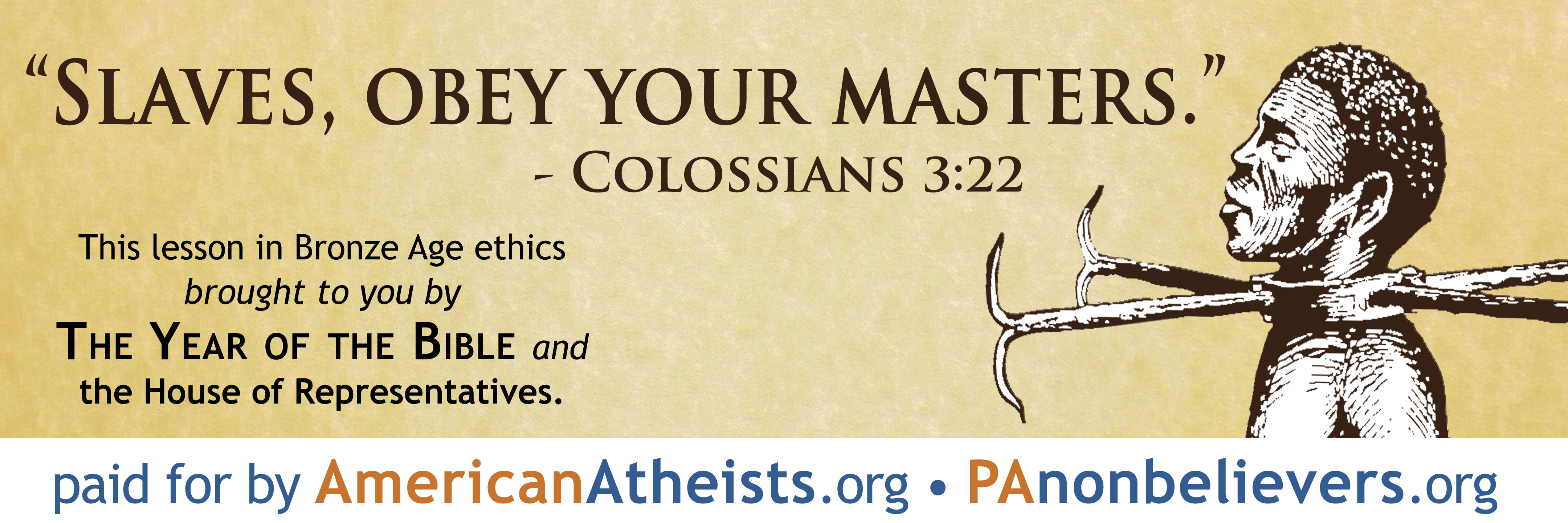
Consider the recent issue with the PA-Nonbelievers billboard (pictured above) which was taken to mean, by some, something very different than what it was intended to convey.  By all means, follow that link for the details of the issue, but essentially the question is whether the billboard, as it appeared (before it was vandalized after being up for one day), was racist.  And although it was not intended that way (I know quite a few of the people from PAN, and I have no indication of racism on the part of those who created the image), being that much of central Pennsylvania (Pennsyltucky, we sometimes call it) is pretty racist, the billboard could easily be mistaken for a very different intended purpose.

BTW, it’s purpose was to respond to the Year of the Bible legislation in PA by showing how immoral the Bible is, using its advocacy of slavery as the vehicle for such an observation.  It simply did not occur (I’m guessing.  I don’t know for sure) to those at PAN that it would be taken as an endorsement of slavery non-ironically.  Slavery is abhorrent (think most Christians), Christians loves their Bibles, and Bibles condone slavery.

Instead, some saw the billboard as racist, the ambiguity of the message left many people confused and irritated.

The fact that this snafu of miscommunication occurred demonstrates that the importance of effective communication is not only essential, but it is quite hard.  Just like, while having an argument with a loved one, sometimes the best-intended statement can be taken quite badly due to a different parsing of the words or even due to some semantic diversion by speaker and listener, the general public will often misunderstand what we atheist activists (or at least proponents) have to say about religion and faith.

Now, there are many sources, both online and otherwise, for learning about how to effectively communicate.  A simple Googling of the term will find you quite a bit about the many techniques and guidelines that can help, and so my outlining them for you here would be redundant.

But the general message I want to convey here to people of any persuasion is that in many cases our conversations, whether they are debates, disagreements, or shouting matches with people being wrong (on the internet or otherwise), we need to keep in mind how we are presenting our case and what pitfalls might interfere with our goals.

By all means, express your indignation for whatever idea you disagree with.  Don’t hold back your opinion, but make sure it is communicated in a way that will not be read as something that it is not.

And remember to listen.  Listening is perhaps the most important skills in effective communication, and it is clear that we need to listen to whatever feedback we receive.  In many cases, this does include keeping your eye on the general public’s views on what you will communicate about, which usually entails reading blogs of those who are theists or defenders of monogamy in many cases, for me.

That said, I want your feedback here at polyskeptic on any and all posts.  we want to know how well we are communicating with you.  If we can do a better job at communicating our point of view, we want to know how we can do so.


It Takes a Village, and Other Cliches


I am terrified of pregnancy and I’m terrified of having children.

This was a conditioned response to elements of my upbringing.  These terrors also had resulted in my being terrified of sex.  I’ve been doing a lot of work on all these things.

The idea of being pregnant terrifies me for various reasons.  First, it’s something that I have fought tooth and nail to avoid.  From a young age, I received the unfortunate message that having children requires you to give up everything you want, means probable abandonment…basically, it will likely ruin your life.  When I was a teen and a woman in my very early 20’s, this meant no sex.  After I got over that, it meant hyper safe sex.  And now that I am a woman in my 30’s, I finally have learned to trust the science of birth control.  I feel more relaxed about it.  Other than all this, the idea of being pregnant in a work place, in a culture that thinks it’s OK to invade the privacy and personal space of pregnant women because, well, everyone is just so happy for you or something, skeeves me out.  I don’t want my coworkers to throw me a baby shower.  I don’t want to have big conversations about it or know what they think about parenting.  My fear of this got so bad that at one point I figured I’d just quit when Wes and I were ready to have kids.  I have since abandoned that silly notion.

The idea of actually raising children is terrifying because I am quite scared that I will be a lousy mother, obviously.  What if I’m too lenient? Too harsh? What if I have tons of issues that I scar that poor kid with?

And yet now I find that when I think about it, I don’t immediately fall into a state of panic.  Don’t get me wrong…I still panic about it if I think too long.  But something changed and the idea of becoming a parent seems attractive.  It doesn’t seem so scary anymore.

What happened? Why, polyamory of course.

Making the change to a polyamorous lifestyle inspired me to work through a LOT of issues, to become more self-aware, to be more aware of others.  It is a continuing evolution.  I am learning more all the time and I have to stay vigilant to keep my old bad habits from coming back, but I have the skills to do so.  Polyamory inspired me to become a better, clearer communicator.  Polyamory inspired me to be more honest and open about, well, everything.  And these are the lessons that I can pass on to a child and hopefully keep my insecurities as mine only.  If I am unsuccessful at that, at least I can be understanding and hopefully helpful when my child’s own insecurities surface.

Polyamory inspired me to tackle my issues with sex and gender and all that.  I feel more comfortable with my body and more comfortable with what it wants and how it works.  I feel like actually going through a pregnancy would wipe away the last terrors I harbored for so many years.

But the biggest thing that polyamory has done is make me see that I am not alone.  Not only has the commitment Wes and I share grown stronger as a result, but now we have the beginnings of an established strong fabulous family.

When I found myself wanting Jessie to move in, I realized that this step was a step towards the “long haul”.  By asking Jessie to share our home, we were asking her to become officially part of our family.  As I have mentioned before, when that level of comfort occurred, anything seemed possible.  I realized, for instance, that the idea of Jessie having children with Wes didn’t bother me.  Even more so, the idea of Wes and I having a kid seemed more possible and less daunting because it wouldn’t just be us doing the raising.  If you’ve ever seen Jessie with young kids, you would know why having her present gives me a sense of calm about the whole thing.

We asked Jessie to move in right around the time that Shaun and Ginny came into our lives romantically.  After several months of dating, it started to seem plausible that they would become quite integrated into our family life as well (as in we’re talking about communal living possibly a few years down the road).  Talk about a network of support to raise a family!

Polyamory of this type really means never having to be alone, never having to take on the world by yourself.  When you feel overwhelmed, there are more people to help.  Out of the five of us, I am, by far, the least equipped to deal with kids and I know that I have a very high capacity for learning and adjustment.  It would likely be the case that people’s schedules would work out that we would have in house child care at all times.  It would be a bunch of people equally invested in the welfare of everyone in the household.

Last night, I talked to Wes for a while about when we would like to have kids and we realized that even though we are better off financially than we were a few months ago, our budget is still stretched pretty tight.  We made a deal that we wouldn’t have a child before we paid of the car.  And I figured that by then there is a high possibility that this whole communal living fantasy I have might be coming true.  He also said that we should simply not worry about me getting too old to have a kid because we can always adopt.  But if it happens that we do decide to have a child biologically, I can’t imagine a better group of people to help keep me sane and help me see the process for the kind of awesome thing that it is.

Yes, I know, I am still speaking in fantasies, but I think in this case that’s alright.  When we all talk about it, we tend to talk in relatively real terms…we seem to be sharing the same fantasy, at least for now.  And so I smile as I imagine our Big House, filled with loving relationships and galavanting kids with, as Ginny called it, Mix and Match Genetics.

I just simply love the idea of our own little village.

I want to call it “Frubble Farms”.  I want to get a sign made…but no one will let me.

Poly date night


People do polyamory in a plethora of possible ways.

Some people rarely if ever spend time with their partners’ partners, but keep their relationships separate.  Others, like us weird people, spend a fair amount of time together.  Date night is no exception. 

So, last night I came hone from work to find Ginny hard at work on dinner.  OK, that’s not quite true.  I found Ginny at her quite disorganized desk, in a bathrobe, watching something (probably dumb) on netflix.  Same difference.

In any case, I was sent to start water boiling (I am actually quite a good cook, so this is really under-using me in the kitchen, but nonetheless it was a necessary first step).  After a few minutes, Gina and Wes arrived, earlier than Ginny expected.  Ginny then appeared from upstairs to greet all and sundry and eventually she continued with dinner prep.

Chicken parm, a bottle of red wine (drank, by Gina and I, in orca wine glasses of course!), and some conversation was enjoyed by all four of us.  We followed that with adorable cupcakes that looked like monkeys which I bought from a bake sale at work. 

Then Ginny and Wes went out for bourbon while Gina and I stayed in for a while (Bible-reading, of course) for a couple of hours before going to get a beer (or two, in my case), at the Resurrection Ale House down the street (a theme might be deduced from this…but no, we are not becoming Christians).

Chemistry, cosmology, and quantum mechanics are discussed.  What do people usually talk about at bars? Stop looking at me like that! Whatever, we are smart…or pretentious.  One of those.

Finally, after some time (space, and dimension too!) Ginny and Wes met us at the Ale House as we finished our beers.  Our re-assembling into a four-some, with various affectionate greetings seemingly went unnoticed by the others at the bar (at least it seemed that way) and then Gina and Wes went home, dropping Ginny and I off on their way by the house.

In the end, I go to bed (with a touch of the drunk from two very good ales I had with Gina) with Ginny and the morning comes early. 

This all seems so normal to me.  I imagine this would seem rather abnormal to other people.  This was a pretty typical evening with the four of us (Jessie was elsewhere last night), and it does not seem odd at all.

Polyamory really is not very radical a practice, once you get yourself past the strange non-monogamy thing.