A couple of days ago, JT Eberhard wrote a post about the five best atheists. His nominations:
1. PZ Myers
2. Greta Christina
3. Hemant Mehta
4. Dave Silverman
5. Matt Dillahunty
All good choices, but he left out one of my favorite bloggers and activists:
JT Eberhard
Unapologetic, brave, honest, and compassionate, JT Eberhard is everything that we could hope for from the next generation of activists. If you meet him at an event, he’s one of the warmest, most sincere people you’ll ever meet. And if you can’t find him, just send him a tweet at @jteberhard and he’ll let you know where to meet up. Aside from his hobby of eviscerating theist arguments, JT donates spends countless hours of his time to working for the Secular Student Alliance, fighting for the rights of students to grow up in an environment that doesn’t make them feel ostracized for being atheists. Call him a role model. Call him humanity’s best chance in a zombie apocalypse. Call him a friend. Just don’t call him a hero.
Deborah Anapol is one of the founders of the polyamory movement. Her contributions to the movement cannot be overstated. She is the cofounder of Loving More magazine, and the author of Polyamory: The New Love Without Limits. She works tirelessly to promote acceptance of my lifestyle, and she is a truly valuable ally to have.
That said, I need to express my disagreement with her recent article in Psychology Today, where she argues that the sexual revolution has, after tallying up a remarkable number of achievements, stalled:
The architects of the Sexual Revolution intended to unleash the evolutionary energies of sex and love in service of human liberation. Instead, attempts at sexual r/evolution have been repeatedly sidetracked, hijacked, and eventually derailed by a combination of greed, lust, and immaturity. Sex and love are potent forces which can easily spiral out of control. While change always stirs fear in those who cling to the security of the familiar, the absence of a strong spiritual foundation at the heart of the sexual revolution aroused legitimate concerns for many. Ultimately, the lack of integrity in the movement for sexual freedom has prevented the unfolding of its full potential for transforming society. Furthermore, its failure to focus on the ecological consequences of colonizing our planet in the same way we have colonized our own bodies and genitals, has drastically curtailed its relevance.
She seems to be tracing the problems with our sexuality to two causes: (1) the lack of spirituality in the movement, and (2) the failure to merge the sexual revolution movement with the environmental movement.
The nicest term I can come up with for this is “bullshit.” Anapol does not define what she means by “spirituality,” so she may mean something different, but she’s writing in Psychology Today, which is a mainstream publication. The mainstream understanding of spirituality refers to religion. Religion, as will be obvious to most readers of this blog, is the main force holding back further progression of the sexual revolution. The fear of sex in our society is intrinsically linked to Christian values, which completely saturate American society. Furthermore, holding sex as “sacred,” as Anapol suggests, only encourages people to be as irrational about sex as they are about prayer. The way to move the sexual revolution forward is to encourage sober-minded rationalism about sex. That means more thinking rationally, less holding things sacred.
Secondly, I don’t see what sexual issues and environmental issues have to do with each other, except that right-wingers hate them both. Anapol seems to be arguing that respect for women’s bodies and respect for the Earth come from the same place. That idea has no rational basis. “Mother Earth” is not a real person. The rational basis for environmentalism is selfish. We need the environment. Destroying the environment is bad for us. Respecting women’s bodies is not about selfish goals. It’s about recognizing that all people deserve a minimum amount of respect and decency. There are selfish reasons to respect women’s bodies as well, but that doesn’t seem to be Anapol’s connection.
Also, I don’t really agree that the sexual revolution has stalled. Our society is becoming more comfortable about sex every day. Gay marriage is legal in six states, with many more expected in the near future, and polls show that it’s supported by a majority of Americans. Every major city has a kink scene. High-profile people are standing up for non-monogamy. No-fault divorce has largely put an end to the legal consequences of adultery. Comprehensive sex education is now available with a few clicks of a mouse. Pornography is now available for almost any sexual interest imaginable. Websites like Fetlife has created communities where nobody is shamed for their sexual desires. We still have a long way to go, but I think we’re on the right track. Change is happening. But, like all big changes, it’s happening slowly. I don’t know what Anapol thinks has gone so wrong.
“God damn it, you’ve got to be nice” sounds porous and gutless next to Kurt Vonnegut’s “God damn it, you’ve got to be kind.” And it reveals the inherent deceit of nice. If you’re “being nice” to someone, you’re not being honest. You’re humoring a person you don’t want to be with and I don’t think I can trust you. Especially when you’re flattering a person one minute and talking shit about that same person when they leave the room. But if you’re “being kind” to someone, you are legitimately trying to understand where another person is coming from and you are willing to change your mind. You are also willing to persuade the person who is so determined to hate.
I’m not interested in being nice. I’m interested in being kind. I’m interested in having conversations with people who have the confidence to walk down a two-way street built on respect.
In case anyone cares, Kristen Stewart (the vapid lump of clay from those bag-of-shit Twilight movies) cheated on her husband. Or boyfriend or something. Then apologized. Yawn. I only bring it up because this article brought up a good point:
What struck me about actress Kristen Stewart’s public apology for her infidelity wasn’t that it was a rare case of a famous female doing so — although that is notable. Nor was it the fact that celebrities are expected to issue public apologies about the most intimate aspects of their romantic and sexual lives – which is also remarkable. Instead, it was the language she used to explain the affair. She described it as a “momentary indiscretion,” which called up a host of post-affair cliches: “I made a mistake,” “It just happened,” “I wasn’t thinking,” “It was a lapse in judgment” – and so on….
“The chance to feel in love, to feel expanded in some way, to feel understood or intimate with another person, or to be sexual with another person, are powerful pulls for many people,” she says. But those pulls are harder to explain to the cheated partner. “Because of societal stigma around cheating and affairs, it’s also difficult for many people to say things out loud, and sometimes even to themselves, such as ‘I just really desired that person.’”
This is a really good point. The article also points out that cheating is very common, and is often due to the feelings described in the above quote. Those of us familiar with nonmonogamy are very familiar with those types of feelings. The difference is that we do say those things out loud, to ourselves and to our partners.
It’s sad that nonmonogamy is not accepted enough for it to be mentioned in an article of this type. It seems a glaringly obvious omission to anyone familiar with the idea. The assumption of monogamy is so strong that a person can say “it’s… difficult for many people to say things out loud” without suggesting that maybe a person ought to say things out loud, and have a conversation with hir partner about how best to handle each other’s feelings. The article makes it sound like feeling desire for someone outside of a relationship is an unsolvable situation. We know that it’s not.
Generally, I don’t like things that are good for me. I’m really envious of people who like exercise. I hate it. I like sports and games that involve physical activity, but I have real trouble motivating myself to do the exercise video that I do every morning. I’m only able to do it through a combination of bribing myself with television and discipline. Needless to say, I often fail.
One of the few things that’s good for me that I actually like is arguing. Arguing is good for you. Engaging in rational argument is one of the most important steps in rational thinking. We all have unconscious biases which may be completely invisible to us, but obvious to a third party. Submitting our ideas to criticism and rationally defending them is one of the only ways to expose biased thinking. It also has a chance of exposing us to new information or new perspectives that we hadn’t considered before.
I count myself lucky that I enjoy argument. Most people do not. Despite its virtues, engaging in argument, especially about things we consider important, can be daunting. Putting your ideas (especially controversial ideas) out into the world means exposing a vulnerability. Giving people access to your thoughts and feelings, especially when others are likely to disagree, is like giving someone a handbook on how to attack you. It’s scary.
It’s also scary because it puts you on the spot. Arguing about an idea means that you have to be able to articulate, in rational terms, why a certain idea is good, true, useful, etc. This, of course, is one of the reasons why argument is good for us. It’s a lot easier to justify something to ourselves than to articulate the justification to other people. Even if we get no pushback, just the process of saying it out loud often makes us look at our ideas from a new perspective. If we do get pushback, we’re forced to consider other people’s ideas, and answer their questions. It forces us to go outside of our own head and confront our ideas from another person’s perspective. If I can’t articulate a rational justification for an idea, I take that as an indication that my idea is flawed, or at least that I have some thinking to do about it.
Because I enjoy arguing, I do it a lot. I especially enjoy arguing about topics where my thinking is most outside the mainstream, as those are the topics where (a) it’s easiest to find people who disagree, and (b) I have the highest chances of being incorrect. The result is that I often find myself arguing about what honest communication really means, atheism, polyamory, and concepts like that.
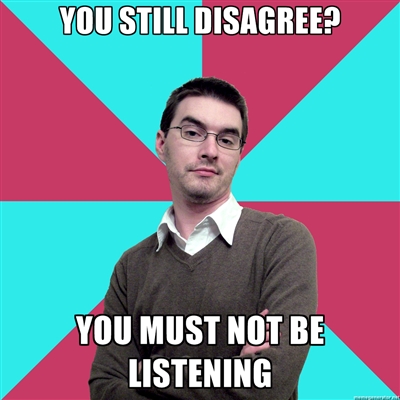
Recently, I was accused of “just trying to win the argument.” It was not the first time, and I’m sure it won’t be the last. However, I feel it’s a very unfair criticism. For one, it’s an ad hominem attack, and has nothing to do with any of the points being argued. This is all to common in discussions online. People tend to resort to this sort of thing early and often on the internet, as if the only reason that you could possibly disagree is because you have some sort of character flaw which prevents you from seeing the undeniability of the point being argued. Another issue is that I’ve never seen anyone actually make a rational argument attempting to prove that my motives are questionable. It’s always just been tossed out as a way of ending the argument while simultaneously blaming me for perpetuating the argument. Implicit in this statement is the subtext that “if you weren’t just trying to ‘win,’ you would have conceded defeat by now.” It’s implied that the other person’s argument is just so devastating that to continue to disagree merely shows my closed-mindedness.
In reality, if I’m perpetuating an argument, it’s because I disagree with my opponent. Like I said before, I enjoy arguing. But I do not enjoy it when I have substantial doubts about my own position. When I have such doubts, I tend to take a much less confrontational stance, and view the conversation less as an argument, and more as a joint venture, where we’re both trying to figure out how to properly think about a concept.
Most of the time, I’m rather confident in my positions. As I said previously, I argue a lot, and I’ve heard all of the counter-arguments that anyone is willing to make to me. Chances are, if you’re arguing with me on one of the topics I mentioned above, I’ve heard your argument before, and I have a counter-argument ready. Not because I want to be ready to win arguments, but because, if I didn’t have a convincing counter-argument, then I would probably not disagree with your position. The fact the I’m arguing against your position is evidence only of the fact that I disagree with you. If I wanted to win, there are better ways to do so than arguing rationally:
If I’m making a rational argument, it means not only that I disagree with you, but that I respect you enough to think that there’s a chance that you have something to teach me.
I’ve talked to a lot of people who say things like “Oh, i could never be polyamorous; I’m just a jealous person”–as if being a jealous person were some matter of genetics, something over which we all have no control, like being born with blond hair or…well, no, people actually think they have more control over their hair color than over their own conceptions about themselves, which is interesting.
Let’s say you went to a piano concert. Would you say that the pianist up on the stage was “just a good pianist,” as if that’s all there was to it? Hell, no–and if you did, she’d likely punch you. You get to be a good pianist by long, hard practice. A good pianist is made, not born.
The same is true of being a secure person–or an insecure person. People are accomplished at being insecure because they practice being insecure. They practice diligently, every day, for years; it’s no wonder they’re good at it.
As with most of Veaux’s writing that I’ve seen, this post is excellent.
When I was an undergrad I came across the saying that learning a little philosophy leads you away from God, but learning a lot of philosophy leads you back. As a young man who had learned a little philosophy, I scoffed. But in later years and at least in my own case, I would come to see that it’s true.
I know, it’s tempting. Finally, You’ll be saying to yourself, finally an intelligent person with an understanding of logic and reason is going to present an actual argument for god’s existence! Don’t bother. Purporting to be the story of how the author went from being an atheist to rejoining the Catholic church, it’s actually just a long-winded, obtuse, particularly serious case of verbal diarrhea, consisting of equal parts name-dropping of philosophers and smug dismissal of “new atheists.” Containing a staggering 6,918 words (that’s 11 pages in size 12 font), it contains not one single argument. It’s mostly just a list of philosophers and theologists, and the author’s naked judgment of the soundness of each. What a disappointing load of crap.
If you are polyamorous, you’re no doubt familiar with the argument that polyamory “cheapens” love and/or sex. That is, if you love multiple people, your love is somehow less valuable than if you only loved one person. From an economic perspective, this makes a certain sort of sense. It’s basic economics that the lower the supply of any given product, the higher the value. In order to increase the value of a product, sellers sometimes try to artificially create scarcity. This is most famously done with diamonds, and it is also the justification for many intellectual property rights, such as patent and copyright. Think about it: if anyone could make an iPhone, supply would dramatically increase, and the price would plummet. The government grants a patent (i.e. a temporary monopoly) in order to allow the creator to control the supply, thereby driving up the price, and allowing the creator to recoup its R&D cost.
Under this theory, if your love* is reserved for a single person, your love becomes an extremely scarce resource, and thus its value increases. By making a monogamous commitment, you are pledging to restrict your love only for a single person, thereby making your love more valuable. The person receiving your love in this transaction receives a much more valuable resource than zie had before, and will be understandably upset if you break your promise in the future. From this perspective it makes perfect sense that married men are more attractive than unmarried men – as demand increases, so does value.
Dave Chappelle understands this, in the context of sex:
Relevant quote starts at 49:37
If pussy was a stock, it would be plummeting right now because you flooded the market with it, you’re giving it away too easy. I’m just being truthful. I’m just talking. It would plummet. You’d be watching the news, “today, pussy plummeted again on the nasdaq.” …This is the practical application of what I’m talkin’ about.
Polyamory is a threat to this transactional view. If, as we keep insisting, loving or having sex with more than one person at a time does nothing to cheapen the value of love or sex, then the above analysis must be wrong.
The main reason why the economic model doesn’t work for me is that my love is not a commodity**. To me, love is a self-replicating resource. Love is something that a person can give and give, and never run out. I’m delighted that polyamorous community has chosen, as its symbol, the infinity heart. To me, the infinity heart encapsulates the polyamorous challenge to the economic model. Our*** view is that polyamory cannot decrease the value of love, because love is infinite.
The other way the economic model fails is that love’s value is not determined by the market. Love (at least in my experience) cannot be bought or sold, and thus the market value of any individual’s love is irrelevant. The economic analysis is only useful in determining the market value of a product, not its intrinsic value or it’s value to any individual. The value of a person’s love, to me, bears no relation to its value to others.
Granted, it’s certainly an ego boost to receive the favor of someone highly discriminating, but I attempt to resist this impulse, as it relies on the economic model. I view it as similar to resisting jealousy. It’s a way to attempt to align my emotions with my rational understanding of the world and with my view of what the ideal person would feel.
I don’t see any other justification for how poly could “cheapen” love and/or sex. Do you?
________________
*thoughout this post, the word “love” is used to refer to romantic love.
** sex sometimes is a commodity, and I have no problem with that. Sex work is a big industry. I’ve never participated in it myself, but I certainly haven’t ruled it out, especially if I visit Amsterdam again. However, sex is not usually a commodity for me, so the analysis of love mostly applies to sex as well.
*** this is my view and the view of many poly people that I know, though not all, and it is not meant to speak for everyone in the poly community. Many poly people still place artificial limits on the love they are allowed to feel, or reserve other things only for the primary relationship to keep it “special.”
The case eventually made its way to the U.S. Supreme Court. In 1957, the justices upheld Roth’s conviction, in a landmark ruling that obscenity is not entitled to First Amendment protection. The court said that the law had always assumed sexual material is not covered by the Constitution’s free speech provision, so its ruling merely codified that assumption. The Roth decision place d obscenity in the tiny category of exceptions to First Amendment freedom, along with incitement and fighting words.

 JT Eberhard



 Skepticism, Properly Applied