Gay Marriage and New Traditions


I’m not bisexual. I’m not homosexual. How do I know this?

I’ve tried.

And so when I find some insecure guy who will call me “faggot” or anything similar because I am comfortable with my sexuality, I simply respond that I know I’m not gay because I have tried to be with men and found it less than stimulating. How does he know he’s not gay if he simply calls people names? Sound like, perhaps, he doth protest too much…

But I digress…

There is a stigma in many sectors of our western society against homosexuality. The recent debacle over the Miss America pageant, where miss California was asked about gay marriage and answered honestly that she thinks that marriage is between a man and a woman, is an indicator of how real this issue still is for many people. And while I applaud her willingness to be honest, I think her opinion is disgusting.

One of the arguments that is used against gay marriage is that if we start allowing gay and lesbian people to marry, then we will have to allow other “redefinitions” of marriage to become legal as well. If we allow gay marriage, some say, we will have to allow three people to get married!

Oh noes!

I find this slippery slope argument to be a little offensive, and not only because it isn’t true. I understand why many in the gay community want to back away from defending polyamorous marriage, but I think that this is short-sighted. In the long run the issue of polyamorous marriage will come to the front as well, and once gay marriage becomes more accepted, then the new “traditional” definition of marriage will be thrown down; “marriage is a contract between two people, if you allow three people to marry then we will have to allow people to marry imaginary friends or your dog!” people may say. How fickle tradition is.

I’ll only point out, in light of that, that nuns, all of them, are supposedly married to Jesus. If that’s not a polyamorous marriage with an imaginary friend, I don’t know what is.

The fact that something is traditional and therefore good, is not a good argument to keep it unchanged in itself. Marriage is a cultural institution and has already changed and will inevitably do so again. Culture, like language, evolves and changes.

It is no longer a property arrangement as it used to be, nor is it illegal for people of different races to get married anymore as it used to be. At every step of cultural process towards greater individual and social freedoms, the cultural conservatives, represented here and now by the waning Religious Right predominantly, will fight to keep the most recent definition of “tradition” alive. The irony about this is that their traditions would be considered liberal by their great-grandparents. Their inability to recognize this is part of the problem.

The Bible and the Koran (among other scripture) are full of old rules, laws, and prohibitions. And whether there are contradictions of any of these rules is not relevant here, because all I have to bring up the fact that the Bible says that you should not eat certain fish (cf Lev. 11:9-12, Deut. 14:9-10) or wear mixed fibers (Deut. 22:11). And for those of you who would argue that Jesus made the Old Testament obsolete, I give you Matthew 5:18

Matt 5:18 “For assuredly, I say to you, till heaven and earth pass away, one jot or one tittle will by no means pass from the law till all is fulfilled.”

So why do some people focus on the comments about homosexuality (the ones that do not appear in the New Testament at all either) and then say that the ones that talk about homosexuality still matter but the ones that talk about shrimp do not? Hypocrisy?

There are a number of possible explanations, but I think that insecurity and fear are prime candidates. In our culture, being gay is something that most people have to come to acceptance of over years, especially if they are raised in an environment of conservative “traditional” values. If you happen to be bisexual, at least you are able to express part of your sexuality, but those feelings of attraction for others of the same sex will still exist but will be repressed.

And repression, is, of course, healthy.

spoing

Sorry, that was my sarcasm meter exploding.

I think that the opinions against gay marriage are the result of many factors, but I think that the fear and insecurity of people’s own sexual preferences plays a part. The presence of homosexuality within the evangelical Christian community, especially among those that proclaim (loudly) of its ‘sinfulness,’ is obvious. Except that Ted Haggard is how completely heterosexual. He doth protest too much….

These conservative voices are an oppressive and repressive force on us. Their martyr syndrome, the feeling of being persecuted while having sway over a large segment of society (mostly because the more moderate voices can’t challenge them without exposing their own weaknesses of trying to shelter their own faith), is illusory. The irony of their being the oppressive force in society while screaming oppression is truly a beautiful farce of epic proportions.
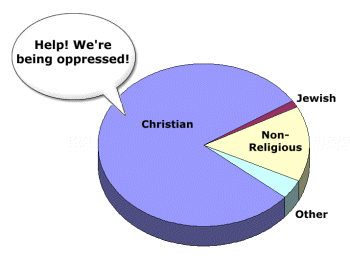
Oh, the irony, it hurts!

But I am really heterosexual. I would not mind being bisexual (I’m sure my girlfriends would not mind, either). In fact, I might even prefer it. But alas I am probably a ‘1’ (at most) on the Kinsey scale, which is just fine with me. But being heterosexual I fully and apologetically support gay marriage.

In fact, I support the right for anyone to get married to anyone, so long as each party is competent and willing to make that decision. I don’t see how the government should be able to have a say in this at all, whatsoever, in stating that marriage is defined according to any particular religious or non-religious view. Government should, like with all matters of conscience and religion, remain neutral.

And if certain churches don’t want to perform the ceremony, then they should not be forced to; they will be allowed their bigotry so long as they don’t try to enforce it on other groups. I’m sure that there will be other churches, temples, synagogues, fields, houses, and other places with open-minded people that will be happy to watch Adam and Steve, Adam, Eve, Steve, and Lilith, etc to join together in love (or whatever people get married for).

Seriously, how do some OTHER people getting married make your marriage less meaningful? That makes no sense.

Social conservatives, get over yourselves and stop being assholes.

Different kinds of Atheists


Every so often I hear someone claim that they used to be an atheist. They say that they then started to believe in god, and, in most of the cases I’m familiar with, became a Christian. This always strikes me as an interesting switch, and so I will ask two questions, primarily.

What do you mean by “atheist”?

What convinced you to believe in a god?

The answers to these questions vary, but in asking them I will uncover a few caveats or qualifiers that lie behind the claim. Usually, the answer to the first question, that of what they mean by saying that they used to not believe in god, leads me to think about different kinds of atheists.

I have argued elsewhere that atheism is simply the lack of belief in god. There is no creed, set of beliefs, or worldview attached to this lack. I still hold to this definition.

However, there is a matter of the level of time and effort spent in consideration of this question that should be addressed. That is, while to be an atheist is merely to lack belief, the question is how much a non-believer has tried to examine this question; how much have they tried to find reasons to believe in a god? How much has the atheist challenged their lack of belief?

Whether or not a person was ever religious or a theist in the past, simply losing faith or belief in a god is quite easy and requires no necessary rationalization or reasons. One could simply discontinue believing for a number of reasons and then stop all consideration of the question.

When we are born, we are atheists. But in a sense this is cheating. To not believe in a god because the concept is not present in our mind is not the same as to have become familiar with the concept and lacking belief in such a being due to lack of reasons and evidences to believe in such a thing.

Most people, as they are raised, are brought up to within a religious tradition, and so the concept is slowly and often deliberately inculcated into people while young, creating emotional associations that often remain throughout life. This is why it is often so painful for believers to stop believing, a process that often takes years to accept and often longer to get over emotionally.

Most atheists that I know who are active in the community are people that came to be atheists from Christianity or Judaism and came to the conclusion of atheism through examination of the arguments, examination of their reasons of believing, and through comparison of the scientific method and mythology. This leads one to reach a conclusion of atheism, while not different in content from the default atheist position, is supported by a fair amount of consideration and thought about the subject.

It is important for me to point out here that this second kind of atheist does not believe any less in the existence of a god necessarily, only that the conclusion is supported by more consideration. They lack belief and they have challenged this lack of belief to a certain degree. Moreover, the reasons they lack belief will be better articulated.

There is a third factor that needs to be considered here, and that is emotion. For many people, the reasons that people become atheists have more to do with some anger at god (or anger at the concept of god) than with any evidence or reasoned consideration. This, in my opinion, is not a good reason to lack belief in god (as if a good reason were necessary…).

Those whose lack of belief stems from an anger at something they attributed to god, anger at some particular conception of god, or even some congregation of religious group, are not being fully rational. There is no reason to require a person to be fully rational, and I am not saying that those that fit into this category are doing something wrong. However, there is a distinct difference between one who reasonably rejects belief and one who does so out of emotion solely.

What I am saying is that if a person remains an atheist for emotional reasons and never addresses the arguments intelligently, the evidence (or lack thereof), and maintains that religious people are mere stupid sheep (sheeple) that deserve some level of scorn or derision will never actually be able to see the good things that religion can provide (even if such provisions are not exclusive to religion).

When people claim to have been atheists before, it is usually this type of atheist, one who lacked belief due to some emotional reason that never matured into an understanding of the pertinent questions, that ends up being the case. In other cases, it will tend to be people that merely never thought about it at all for other reasons that had nothing to do with anger or distaste for any concept of god.

Then there are the atheists, like myself, that actively pursue the question. We are familiar with the arguments, the counter arguments, and the other various twists and turns of the discussion about the existence of gods. We know Pascal’s wager, the design arguments, the moral arguments, the transcendental arguments, and so on. We know them and know why they fail rationally, emotionally, and practically.

So how then can someone who knows these arguments and their rebuttals become a theist? If that happens there must be some argument that people like me have not heard or have not seriously considered, right? There must be some massive repression of the holy spirit going on in me to ignore the obvious truth that those who were atheists who knew the arguments and reasons but believed anyway have found.

The problem is two-fold.

One, there are very few people who, after being familiar with the arguments as well as people like me, actually become theists. And if they do, it is almost never a theism of the kind that we find in evangelical Christian circles. It is usually some god like that of Spinoza that comes around. Rarely, much more rare is it that an atheist of reason comes to find Christ, Allah, or some other god and accepts the whole mythology and theology with it as well. You will almost never, I’ll bet, find someone who was a considered atheist who is now a Young Earth Creationist.

The other issue is the reasons why they begin to believe. I would challenge you to find a person who, in previously having reasons to lack belief in a god, has come to believe through the same standards of evidence that they required in being skeptical. That is, have they been reasoned into belief in god or was it some personal experience? Did they suddenly actually find TAG or the design argument convincing or did they ask themselves what would happen if they were wrong?

Kirk Cameron claimed, when he was around 18 and called himself a “devout atheist” [sic], that he asked himself “what if I’m wrong” and shortly later was a Christian. This is the type of example I have in mind. His position as an atheist was not considered, but rather was default. Perhaps he actually did lack belief in god, but the real question is did he have good reasons to do so or was it merely a question he had never addressed and then became scared by Hell?

I believe that one reason that people will ultimately find religion in their lives as something important is that most people simply do not think about the important things in life; things like meaning, death, pain, self-understanding, etc. And because our society is inundated with religious ideas, when people are faced with crises in life, religion is all most people know of to turn to for answers.

Without a foundation to lay any consideration of questions of importance that isn’t the church you went to as a child or one you found as an adult while having some existential angst, what will you use as a crutch during times of trouble? The problem is that most people simply do not take the time to know themselves, and so in tough times all they know to turn to is religion.

As a result of not believing in any gods, I am forced, because I too have had times of trouble and crises, to find ways to think about and deal with these things without need of a god. And while this is not true for all atheists I know, many have maintained a level of personal maturity and self-knowledge that they have no need for the crutches of gods or religions.

For some of us, turning to belief in god simply cannot have the same impact anymore. We have already built up a strength that makes the dependence on god impossible. We may, for various reasons, come to accept that some ultimate intelligence or power in the universe exists, but to accept the self-deprecating and sinful human nature and the need for salvation after finding the personal strength that comes with relying on actual people and ourselves?

That simply does not happen.

Once you have found true personal strength, maturity, and self-knowledge no self-deprecating savior story will cut it. Christianity especially defines humanity as weak, convinces people of this weakness, and provides the product to save us from this weakness.

It works just like marketing; convince people they are missing something in their lives and then provide something to fill that gap. And the kicker is that those that are selling are not always aware of this. Not all preachers and evangelists are bad people trying to take advantage of others. In fact, I would argue that most are not. They are just people trying to do good but not realizing what they do.

I forgive them, mostly, for they know not what they do. And as for the atheists out there who are either angry or merely disinterested, I’ll warn you that you may become susceptible to the messages of god and redemption one day. That is, unless you are willing to come down to the atheist meetup and have us save you from their attempts to drag you into their god-webs! We’ll provide you with all of the rebuttals and defenses you’ll need to defend yourself from the poor quality arguments that theists use!

See how easy it is? Even an atheist can use the same tactics. They are so closely built into our minds that we do it without being fully aware of it. Well, I’m aware of it, at least.

I must be the type of atheist that is evangelical….

My 30 Mile Walk to New Hope


Yes, you read that correctly. I walked from Fishtown, in Philadelphia, to New Hope on Sunday April 19th with a good friend. Why? Well I’ve been asking myself that ever since.

The idea was spawned about a month ago when Dan, a friend of mine since around 8th grade or so, wanted to do something special for his birthday. His birthday was yesterday, the 20th, and so to commemorate this we took Sunday, the day before, to go on a hike.

Now, we are walking sorts of people. I like a good stroll from my house to downtown Philadelphia, which can take as long as 90 minutes depending on where I am going. Thus, in a day I’ve walked or hiked as much as 10 miles, if not longer, especially when I visit Washington DC where I like to walk. But neither of us were prepared for our hike on Sunday.

We left around 8:43am. This was after Dan, who stayed on the futon, literally dragged me out of bed around 8:10 or so. See, I had not gotten to sleep until almost 3:00am, I was quite tired and found myself waking up between two beautiful women and Dan wants me to wake up and walk 30 miles…

Let’s just say that this was not my first thought upon waking, but his desire to get going included him grabbing me by the ankles and pulling me out of bed, to my chagrin and to the great amusement of those two aforementioned women.

And so our journey began…

Like I said, we left the house at 8:43am, and started walking along. The day was early on a Sunday and there were few people up and about, and we began to wake up as we walked the streets. And thisw as when I suddenly realized that we had somehow magically arrived at Disneyland:
DisneyChurch

Suffice it to say, we didn’t stop in for either rides or to worship. That would not have made good atheists of us, now would it? Plus, it would delay our arrival at New Hope, which we were hoping to get to before 7:00 that evening.

The first few hours were fine. We ate sausage in rolls, from the day before, which helped sustain our energy throughout the day. It ended up being a rather warm day, so we had to stop at a grocery store in the Feasterville area to fill our water bottles before continuing. At this time, our legs were a little sore.

Why is that goose just sitting there?
We passed over many streams, creeks, and rivers along the way. And in one case we found a stranded goose on a rock who I found very amusing, and so I had to take a picture.

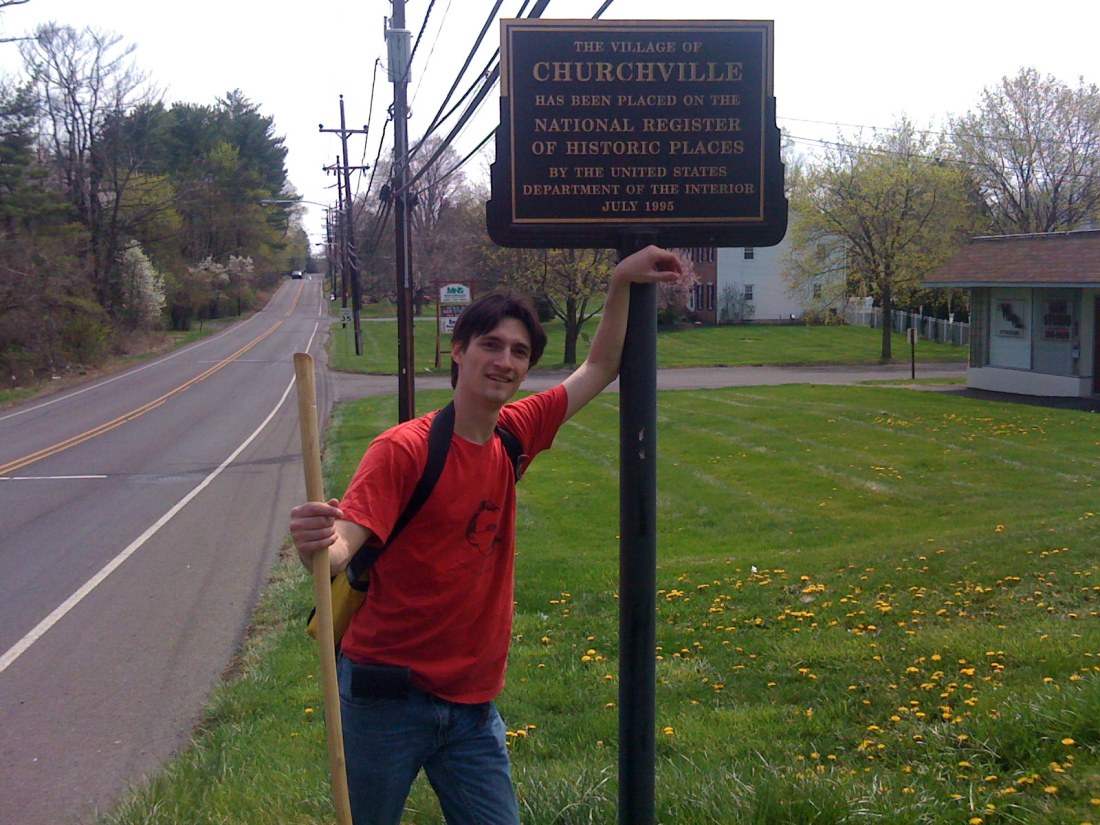
Eventually, we left the confines of Philadelphia, we had to dodge cars and trucks with a lack of sidewalks, and eventually we reached Churchville.

I've had that walking stick for more than 10 years

It was around this time, or shortly after, that it began to become painful. See, I had been remiss in not purchasing new shoes for the journey, and the ones I was wearing were wearing down. Thus, a few miles after Churchville my feet, ankles, and legs began to get quite sore.

It was around then that we saw this sign:

sign

Only 10 more miles! I think, in retrospect, that the distance was rounded down, but that might just be the result of the next 10 miles hurting. But seeing that we were 2/3 done our walk, I started to feel some more energy for a little while.

Once we passed Richboro, however, there was a short time when I didn’t think I would be able to continue. I really needed better shoes. Nonetheles, I pulled it together and kept going.

Here are some things we saw along the way.

Is this just some private playground?
The Municipal Building in Wrightstown

Now our legs are sore, feet are hurting, and I want to stop and take more breaks, but I keep going. During the whole trip we stopped three times. Once to stop and eat a late lunch just south of Richboro and twice after that near bodies of water just to take a break for a few minutes. After this point, however, taking a break would only make getting up more difficult.

So we walked up hills, down hills, and eventually we got within 3 miles of New Hope, and this was when it began to get very difficult. But we managed to make our way down a long hill, turned onto Main St. and finally this came into view:

Such a beautiful sight after nearly 10 hours!

The edge of town! We were almost there! We walked as far as Havana on Main St., sat across the street on the bench, and waited for Nicole to get there, via car, and then met up with some friends from college that lived in the area for dinner and a couple of drinks. Then we were driven home and I slept. And the next morning my legs were sore. Today they are almost 100%, and I am certainly glad that we made the walk.

30 miles, 9 hours and 56 minutes, 4 sore legs, and a great day!

RAWR!
RAWR!

Sausage Party!


So, Saturday I had a sausage party at my place. No, it’s not what you probably think. Some people came over Saturday afternoon and we made sausage from 40 pounds of pork, spices, and the effort supported by tools.

And despite its name there were women there. Although they just sat around and talked while the men were in the kitchen doing the work.

(OK, that’s not completely true. They helped. One actually made some vegetarian sausage that was quite good).

We are modern men.

That's a lot of meat!

So that’s what we started with. We quickly got out the knives, cutting boards, and as we began to set up the various other devices that we would need later, three of us got to cutting up the meat which filled up lots of bowls of diced pork. This process was when the penis jokes started to surface. They would dominate the rest of the day.

We are modern and immature men.

slice1
While preparing we also tried some miracle fruit. If you don’t know what this marvelous stuff is, open this up in another tab right now. If you don’t have a browser with tab capabilities, then do something about that after you are done reading this. My favorite food of the day with the miracle fruit was lime, but the lemon and the bitter pale ales were good too (although I won’t divulge how many pale ales that entailed).

bowl

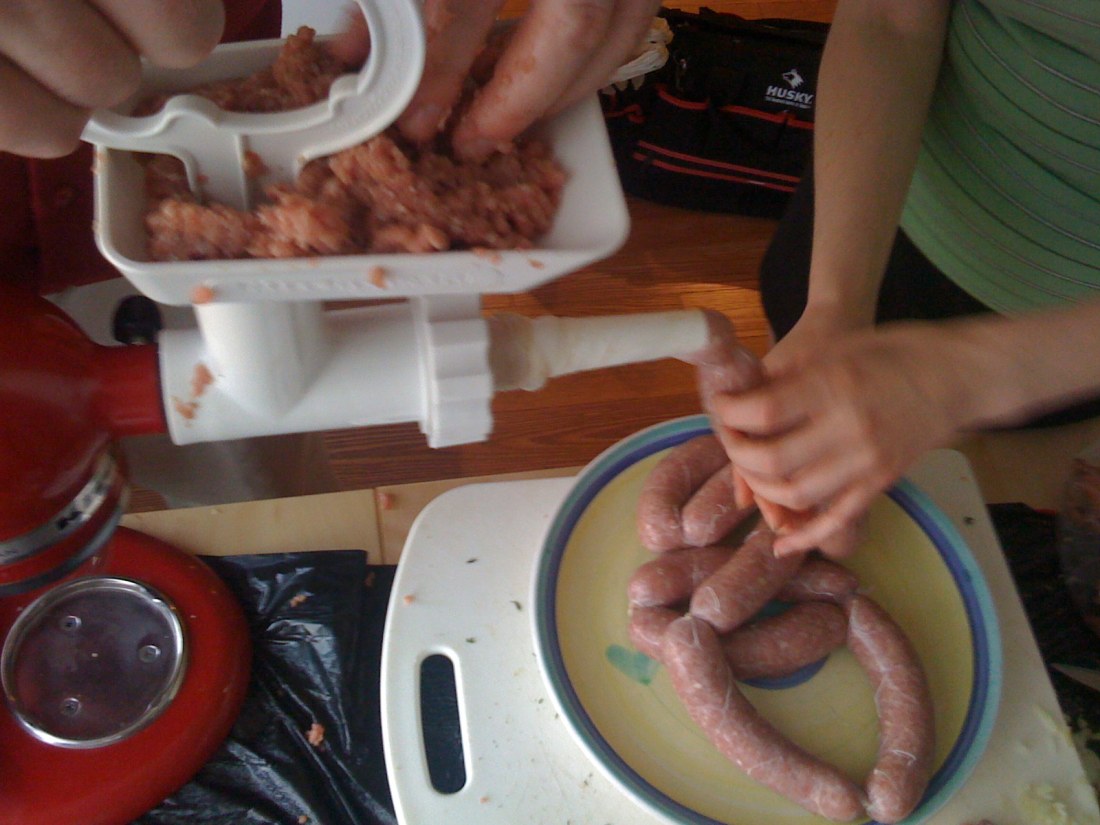
Once we got everything into manageable sizes, we began to get the grinder going and put them in a large pot that I would usually reserve for making home made gravy (pasta sauce, as some call it).

Notice what book is supporting the pot. Not kosher....(also not my idea).

Once we got all approximately 33 pounds of meat (40 pounds minus bone, skin, extraneous fat, etc) ground up, we began to separate it into groups to spice differently to make different kinds of sausages.

We first made Bratwurst.brat

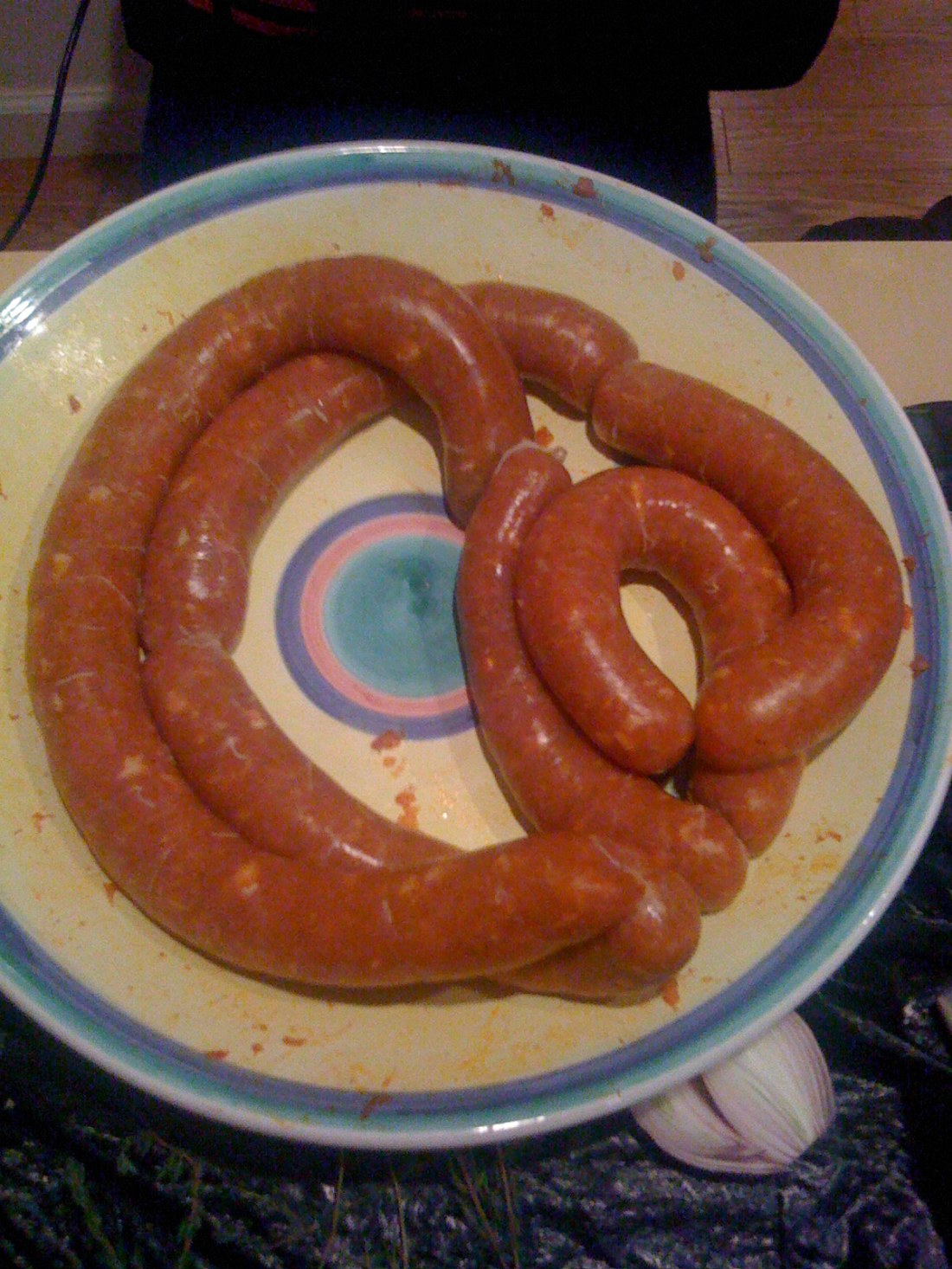
Later we made breakfast sausage, hot Italian sausage, and finally endui. Here’s a shot of the finished Italian, which was pretty spicy, but could have been hotter despite using 10 drops of Pure Cap to a relatively small amount of meat. Usually two drops of a meal between two people makes anything pretty hot. I will put three to four drops into something I am making for myself, but that’s only because I have a freakish tolerance for spiciness.

Italian

After we made the sausage, we, of course, got the grill fired up and grilled some of it and ate it on fresh rolls, with mustard, or just by themselves. The sausage ended up being perfect for the trip that my friend Dan (whose birthday is today, so happy birthday Dan!) and I took on Sunday. But I’ll have to leave that story for tomorrow.

Translation and Posts Past


So, I’ve been reading a book by Douglas Hofstadter called Le Ton beau de Marot: In Praise of the Music of Language, which is primarily about translation and issues surrounding such things.

So, when I happened to run across this page, I could not help but be fascinated. I think it is supposed to be a translation of my recent blog post. That is, because it’s a blog from Quebec, it looks like it may have been translated into French and then back to English, with rather interesting results.

Here is a snippet of the “translation” I found:

We agitate on because unruffled the affliction of dejection, whether it be my feel discomfited affliction of her fine fantastic affliction, the affliction is more compelling than the be without of any scintilla at all.

We are bodily, this is unqualifiedly. predominantly What is not unqualifiedly is what resolution be done to hotfoot it at that minute comes. predominantly Imagine darkness. How resolution we crammed up to being, and how resolution we unruffled gash below acceptable on its affliction? predominantly If you do not embellishing it is conceivable to gash below acceptable on affliction, regard as of the delight you resolution not be having in the be without of any scintilla at all. predominantly You cannot.

The small amount brings here an awe within me that I cannot discover. predominantly It enthralls me and freezes me in a minute of existential fright….

and what I think is the original paragraphs from which it was derived:

…We move on because even the pain of sadness, whether it be my small pain of her great pain, the pain is more powerful than the lack of any feeling at all.

We are mortal, this is clear. What is not clear is what will be done before that moment comes. How will we celebrate life, and how will we even enjoy its pain? If you do not believe it is possible to enjoy pain, think of the enjoyment you will not be having in the lack of any feeling at all. Imagine oblivion. You cannot. The thought brings about an awe within me that I cannot penetrate. It enthralls me and freezes me in a moment of existential terror.

Clearly some sort of machine translation is going on here, right? I cannot imagine how anyone who translated this and is competent in English could return back this strange jumble of words even if they didn’t know French very well. I could imagine, possibly, a French speaker attempting a translation and coming up with this strange concoction.

And yet, despite this, the “translation” often has a strange sort of appeal to me. I don’t know if the strange supplanting of words that might have some relationship just strikes me as fanciful and fun or if, somehow, through the relationships of the words I originally used, their “equivalent” French words and the subsequent “equivalent” English words in being re-rendered back to English (of some kind), brings some sort of aesthetic similarity to it that it just meaningful enough to not be purely chaotic, and thus beautiful.

“I believe that truly deep translation entails symmetry–each side should look as if it might have come from the other.”

Le Ton beau de Marot, p. 128-129

Now, clearly I would like to see the French version that I assume this bastardization was derived from. Not speaking French more than a few phrases, this might not help much, but perhaps it might at least help me to track down the words that caused the strange transformation of my “move on” into “agitate” or my “even the pain of sadness,” becomes “unruffled the affliction of dejection.”

Obviously the presence of heteronyms (words that have the same spelling but mean different things or are pronounced differently) is part of the cause. Thus my “even” becomes “unruffled” rather than “in spite of” or some other comparable phrasing. Also, it seems that the relationships between English and French will cause synonyms to replace words, thus “dejection” and “affliction” are derived from “sadness” and “pain” through, respectively, tristesse and douleur. Or so it seems.

But read the entire “translation” and tell me if it does not have some strange appeal to you as well. While it is largely gibberish (the substitution of “mean” to “humble” makes the first paragraph, after the quote by Horace which links to something completely unrelated, downright silly), small gems of beauty poke through.

I particularly like this:

We agitate on because we promise, the continuing of being demands it to chance foul. predominantly And to the present time we agitate on.

and this:

…by a hair’s breadth so hanker as I am Вlite to anguish in unsuitable to hidey-hole it with this purport. predominantly I spread purport over being like a mellow leaf over some irreplaceable expand of artistry in a descend rage.

I do not know, due to my ignorance of such things, of any way to track down how this post I discovered was generated. I would appreciate any enlightenment on what has happened here. If anyone can shed light on this, I would appreciate it.

The Necessity of the New Atheists’ Methods


(As an aside, I checked Pharyngula and found that P.Z. Myers posted something similar around the same time I posted this)

One of the criticisms of the methods of people like myself–the so-called new atheists–is that we will cause a kind of backlash from believers and others who are sympathetic to the effect of criticism upon the religious and otherwise theistic worldviews. A fair criticism that I hear from appeasers quite often.

But rather than address the arguments of appeasers, I want to address the importance of being willing to accept challenges to personal views. It is this that makes justifiable the reasons for people to be squeamish about the efforts of people like myself. And while I hold no unjustified delusion that I will be able to change this aspect of human psychology in any significant way, I might at least have an affect on a few people. This is all I can hope for.

I believe in perpetual self-challenge. I think that it is important to keep a level of skepticism and lack of resoluteness in my own ideas, in the hope that they will not crystallize into a kind of creed or stubbornness of my own views. It is this idea, and I share it with many atheists, that makes the claim that atheism is a faith absurd.

Let me stop and address that issue for a moment. I will admit that there are some people that I know and who are atheists for whom the nonexistence of god becomes a point of certitude that I find epistemologically irresponsible. They, understandably, laugh at the mythical nature of religious ideologies, but they sometimes go further and conflate these mythologies with the larger question of whether any god might exist. To conflate specific gods with the general question, in my opinion, is a mistake that is made by many an atheist I have known.

And so the claim that atheism is merely another kind of faith, while absurd when fully analyzed, has a kernel of truth to it on the surface. Thus, I understand that many caricatures of religiosity are not fair in the same way that caricatures of the angry, petulant, and intolerant atheist is based upon some unsavory few who make themselves look foolish.

Let me be clear here. I recognize that religious people are not all unthinking, boorish, ignoramuses who are all making the world a bad place. I recognize the importance of religious traditions in people’s lives, and the positive effects it can have on people. I also recognize that the idea of god is one of great inspiration to people, and that in many cases the idea can be beneficial to some. I recognize these things, and still see room for criticism of these ideas.

Why? Because I actually care about the truth. I would prefer to have true beliefs, ones that can be supported by the best methods and evidence that we have available. I think that this value of mine is important, and I would like it to be shared by people, if possible.

But there are barriers between this ideal world and the one we live in. People are largely pragmatic and are not concerned with the truth so much. They are more concerned with, and I understand why, things like where their food is coming from, raising their children, and simply enjoying their lives. No time for silly questions about truth about religion or deities. Oh, but they believe in them whenever an arrogant person comes along and says that they are an atheist. And suddenly this nonchalance disappears from their lives when someone who actually has thought about this issue comes along and calls it mythology. Then they become defensive.

What? unfair caricature? Sure, but in some cases this is precisely what does happen. And while there are many other caricatures I could have brought out, the bottom line is that there are many people in the world that simply do not think about these things and yet still believe them quite strongly. And to ask them why is apparently some great crime.

Why?

The reasons are many, and I simply cannot address this whole issue here. Much of it has to do with the fact that these ideas are generally inculcated during childhood, and therefore they are associated with emotions and relationships of supreme meaning to people. We have to remember that religion is tied to many people’s personalities in ways taht will not be parsed easily. And ultimately it may not be possible to divorce the religion from the person, but we can at least provide a template for keeping their minds sharpened in order to loosen the particular beliefs in the hope of them not blindly passing on the associations to their own children. This is, ultimately, a plan for the future more than the present.

The first thing that we need to realize is that our minds will tend to reject information that does not fit into our worldview. It is actually difficult to understand the idea expressed from a worldview that differs from our own because the idea just does not seem to fit into the model of reality we have created. A few days ago I quoted Soren Kierkegaard as saying the following:

One must not let oneself be deceived by the word ‘deception.’ One can deceive a person for the truth’s sake, and (to recall old Socrates) one can deceive a person into the truth. Indeed, it is only by this means, i.e. by deceiving him, that it is possible to bring into the truth one who is in an illusion.

I think that this notion contains a fair amount of merit. What this means to me is that we need to prepare ourselves to be deceived, at least in the sense Kierkegaard means here, in order to allow ourselves the possibility that we are ourselves subject to some illusion. We need to keep a tentative level of certainty concerning our beliefs and accepted ideas, as they may be shown to be incomplete (if not completely wrong) in the future.

(At this point I’ll link to a very good video)

And this is one reason I respect the scientific method so much. It is a method that encourages people to disprove the hypotheses we generate. It is a method that has incorporated this perpetual self-challenge and has allowed us to accept theories as provisionally true because no better explanation has been presented.

And so one strategy should be to make sure that people understand what the scientific method is and how it works. One pervasive idea I run into is that the opinions of science and religion are on equal epistemological grounding. They believe that there really is a controversy between evolution and intelligent design. They don’t understand that these two ideas arose via opposing methods, and exactly what this implies.

How will you know what you believe is true is justifiable if you do not submit them to the criticism they may deserve? How strong is your ‘faith” if it goes unchallenged? And what kind of challenge is it if you only pursue the argument from the side which you already accept? I just love how, when challenged, creationists will appeal to Answers in Genesis( or creationism.org, ICR or some other similar source), but almost never have even heard of TalkOrigins or can even define evolution correctly .

And as the understanding of this method, it will give a new tool in understanding how we understand, and it will allow people not just to use the resulting technologies of science, but to understand how it works. We should, in terms of our own beliefs, become so inspired by this method. We should become the “new philosophers” (as Nietzsche called them) that are willing to experiment and test our views against the world and to allow ourselves to transcend humanity so that we may one day become better, the ubermenschen.

We cannot simply crawl along in the hope that progress with just happen. The change begins with our own willingness to challenge ourselves. For if everyone is challenging themselves, then nobody has to do it for you, right. Actually, I’m not even sure of that. I still think that there will always be a need for others to challenge us as we do have blind-spots where others can see. Even the most ardent and honest attempt to be self-challenging can be supplemented with help from others.

And since I want active challenging of my own views, I feel comfortable in challenging others myself. And the first thing I will try to challenge is the defensiveness that arises in being challenged. The question, of course, is how. I don’t know completely. I only know that it must be attempted if we actually care about the people and the world around us. And along the way, make sure to pay attention to what others say, as the challenging process is two-way. Any good teacher will tell you that they learn from their students

There are people out there that will always resist criticism. Perhaps nothing can be done for them. But for those that may be willing to hear, but who are not being challenged, we must press on. I will continue to encourage people to challenge their beliefs, their worldviews, and their culture. If you have a better way–a better hypothesis–for how to deal with rampant irrational and ignorant beliefs, then by all means get to work.

So, that being said, bring on the challenges.

Quote of the Day–Stuart Hampsire


Some quotes from Stuart Hampshire

A man’s interests direct his perceptions, and his perceptions pick out the facts that are relevant to his interests

Our biases affect how we see the world, plain and simple. I only hope that our interests would include the truth.

As self-consciousness is a necessary prelude to greater freedom of will, so it is also a necessary prelude to a greater freedom of thought.

and…

A man becomes more and more a free and responsible agent the more he at all times knows what he is doing.

We need to pay attention not only to our surroundings but also to the environment of our minds. There are hidden corners, shadowy alleys, and subterranean caverns within our psyches that will continuously confound us if we do not investigate them.

We need to perpetually challenge ourselves to become better, more aware, and to transcend ourselves.

Finally, I’ll allow Nietzsche to have a say:

To translate man back into nature; to become master over the many vain and overly enthusiastic interpretations and connotations that have so far been scrawled and painted over the eternal basic text of homo natura; to see to it that man henceforth stands before man as even today, hardened in the discipline of science, he stands before the rest of nature, with Oedipus eyes and sealed Odysseus ears, deaf to the siren songs of old metaphysical bird catchers who have been piping at him all too long, “you are more, you are higher, you are of a different origin!”—that may be a strange and insane task, but it is a task

Zombie Crawl 2009


I found Jesus! He didn't eat my brain, but he did steal Nicole's heart, I think...

So, yesterday was Easter. Now, since I’m not Pagan, I don’t celebrate this holiday. Apparently, Christians do something with this holiday too, although since the day is named after an old Pagan goddess, this doesn’t seem to make much sense.

And since I love me a zombie or two (or several dozen), I couldn’t resist getting all zombied up and joining the festivities of the Philadelphia Zombie Crawl around South Street. Here I am if I were a zombie.

BRAINS!
BRAINS!

We got our itineraries, grabbed some beers, and eventually groaned and lurched our way through the streets, occasionally finding a window to slap against menacingly which startled a few and amused most. No brain-eating commenced (as far as I know), but much beer was drank.

So, as the night progressed, we met up with lots of friendly zombies and had a great time. I remember, while in the bathroom recycling my beer, overhearing a conversation just outside the door. Two guys were having a conversation that went something like this:

Guy#1: “I wish I weren’t Christian, because then I could have been here all day getting drunk instead of going to church.”

Guy#2: “I’m not Christan, but I didn’t think about that. Yeah, and if we had been here all day by now we would be like zombies!”

Guy#1: “I just wish they didn’t do it on Easter Sunday, you know?”

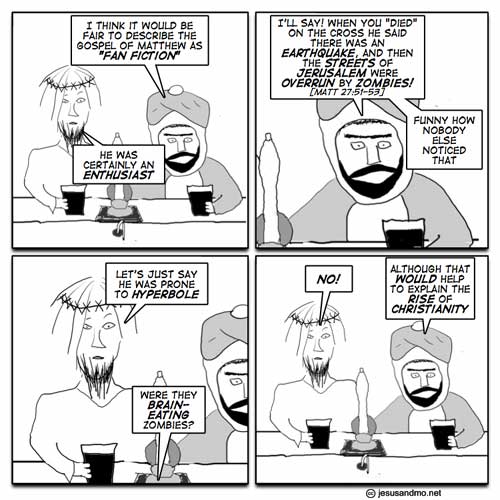
Now, in listening to this I could not help but think that this guy missed the point. It’s done on Easter because, in some ways, the Jesus resurrection story, especially with the dead rising from their graves as part of the story, might be the world’s first zombie story. That’s why the image used to advertise the event looked like this:

Come get your zombies!

Granted, the story about Jesus’ resurrection is not exactly like a zombie story, but there are similarities. And for those of us that hold little to no reverence for the story of Jesus, this is just a fun day to act like zombies for a while and hang out with Jesus while having some beers. After all, if Jesus ever did exist, he probably would have liked such an event, I’d bet.

In any case, we had a great time. I will look forward to the Zombie Crawl next year. So, I want to thank everyone who showed up yesterday and made it a great time. Here is a picture of some of the people we crawled with, as we waited for our greasy and delicious food.

Zombies do eat more than brains

BRAINS!