The atheist community


What types of atheist communities are there?

There are atheist meetups, local organizations, national organizations, conventions, podcasts, drinking skeptically (I think, I haven’t seen it for myself…), and a range of books and online sources. There is a community, and it is growing.

Humans are, after all, social beings. We tend to crave some sort of community, acceptance, and people to seek understanding and support from. And for many, probably most in many parts of the world, religion–whether it is church, temple, or whatever place one goes to worship–fills that need in our lives.

And there are religious congregations all over the map. There are snake-handling, tongue-speaking, and body-shaking congregations as well as gatherings of those who may not even share the same theistic beliefs who come together once a week to hear sermons on the various aspects of life, love, and death from the perspective of a more secular worldview.

But whether you are a Pentecostalist or a Unitarian Universalist (or anywhere in between or outside these ranges), you understand the importance of community.

Now, I’ve never liked church. When I was a kid, my parents tried to attend a Lutheran church once a week in order to…well, I really don’t know why, but they did. I never liked it. I didn’t believe the mythology, I didn’t like the songs, but the people were pretty nice, overall. And for a little while I got a glimpse of what it was like to be part of a community around where we lived. My mom was re-married in that same church, and I even attended Sunday school for a little while, but that was short-lived. Those who ask too many questions don’t end up fitting in for too long.

And that was the problem. I had problems with fitting in with communities. I asked too many of the “wrong” questions. I wondered why. And despite the genuine desire for understanding in some religious communities, to question the very basis of faith is often an ostracizing force, even if subtly so.

Where could I find people that were like me? Why couldn’t I find them? Well, eventually I did. Atheists are people like me. Atheists tend to be people who ask questions, the impertinent ones that people don’t tend to like.

Wait, did I get that backwards? Perhaps; maybe it is the people that ask the impertinent questions that become atheists? Maybe that’s the case, although I certainly know people that ask the questions but are not atheists…yet.

Come to an atheist meetup, a local nontheist group, or find a website with a discussion board that talks about religion and you’ll find places where atheists talk. And when we find communities of people like ourselves, we are able to stop biting our tongue, stop deferring to religious ubiquity, and we can allow ourselves to be ourselves.

And while we can find our own communities, we find that we tend to only have one thing in common, mostly; our lack of belief in any gods. Beyond this, finding similarities is accidental. Our opinions are all over the map. You will find socialists, bankers, engineers, writers, homosexuals, people married with children, people who hate kids, people that don’t drink alcohol, people that can’t wait for their next beer, and those that wish that the atheist meetup location had some good beer and can’t wait to get to the Belgian beer bar down the street after the meeting (that would be me).

We are a collection of individuals, having found our place in the world as non-believers in superstition early in life, after retirement, openly, or kept hidden from co-workers and family. But we find each other. We must because it is part of being human to do so. Even the shy, the quiet, and the introvert will end up finding their place, even if it is just to sit quietly and listen.

Because organizing atheists may be like herding cats, but we still seek each-other because we are human, just like the rest of you.

And if you are looking for a community near you, and can’t find one, start one. There many be others out there looking as well.

Ignorance of the religious…of their own religion


How well do you know your religion? What do you know about its history? I’ll bet not a lot.

Now, I’ve been an atheist all of my life. I’ve never accepted any theology or superstitious baloney, accept for the very early childhood ideas of Santa and possibly the Easter Bunny. I suppose I accepted god as real, but I had no idea what people meant by this thing they referred to. For all I knew it was the mayor of the city.

But at some relatively early age I became quite interested in the history of religion–Christianity in particular–and started to read about various beliefs. I found it fascinating what people believed, how those beliefs came to be, and how they had changed. And I was perpetually surprised, for a while anyway, that most people who accepted these beliefs had no idea about the history of their own religious traditions.

Which day is the Sabbath? Is is Sunday or Saturday? I”ll tell you that, in Spanish, sabado means Saturday and let you make an educated guess. What are the Ten Commandments? Are there really Ten? Which Bible are you using? And, in putting these questions together and if you are a Jew or a Christian, when was the last time you worked on a Saturday?

Ah, but why do I care? These are all made up ideas for me, right? Well, I’ll tell you why. I am bothered by hypocrisy. I’m bothered by people who insist that these stories are real, that belief in them is important to be a good person, to be moral, to avoid eternal Hellfire, or to even be considered a citizen.

I am bothered by people whose lives are shaped by a tradition that they don’t know much about. They believe it, but don’t know much about it. And, as I’ve discovered, atheists know more about religion than most of the religious do. That, in itself, should say something.

What happened in the year 325? Who was Arius? What about Athanasius? When was the Bible compiled and why did they choose the books they did? Why was the Gospel of John almost not included? How many non-canonical gospels are there? Have you ever read one? Why are they non-canonical?

I am picking on the history of Christianity here for two reasons. The first is that I know that history best. The other reason is that I am well aware that most of my readers will have come from a Christian background. But the point is true for all religions I’ve run into; people don’t know the history of their religions and yet they believe them. And for those that might imply that I’m not willing to criticize Islam out of fear or something; Islam is a superstitious and absurd set of beliefs and the Koran is often a violent and misguided book. I’ve read it. BTW, The Bible is violent and disgusting in many parts as well. I’ve read all of it. Twice. Have you ever read any of it?

So I’ll leave you with this; is it reasonable to accept a religious tradition, articles of faith, without at least knowing where they came from? Should every religious person–should every person–investigate the history of whatever they believe? And if they have not, how can it be said that they know what they believe?

The Atavism of Simple Religion


Note: Please view this article on my examiner page. I get paid that way.

‘Straight is the gate, and narrow is the way,…and few there be that find it.’ When a modern religion forgets this saying, it is suffering from an atavistic relapse into primitive barbarism. It is appealing to the psychology of the herd, away from the intuitions of the few.

This is a quote from the philosopher Alfred North Whitehead, from his Religion in the Making. To some it might sound like a promotional phrase from a local Christian organization, in that it might be interpreted such that it demonstrates how so many seem to miss God’s word, and only the few will accept it. But, knowing Whitehead a little better than that, I can say that it means something quite different.

Whitehead’s use of the term “few” is interesting and perhaps misleading. He does not mean that few will attain or choose this straight and narrow, but rather that few will comprehend the complexity in order to navigate it. The issue of religion in all of its philosophical, psychological, and sociological factors is much too complex to be comprehended in simplistic dogma handed to us as the “truth.” Thus any religious group that gives answers to the difficult questions of life in a way that hordes of everyday people can understand and try to follow has severely, I believe, oversimplified the matter, and acts as a stumbling block to true wisdom.

For those that would respond by saying that it is through belief that we will understand, I will call bullshit. Understanding does not come through belief, only rationalization comes through belief. That is, our creative and intelligent minds are capable of making sense of things believed even if they are not rational in themselves. We are wonderful pattern-seekers and pattern-creators.

Socrates is credited with saying “I know that I know nothing,” which made him wise in the eyes of many both ancient and contemporary. Many of those you will find preaching the “Word” today, in its various forms, might claim a similar ignorance in saying that we only have the wisdom of man, while there is a wisdom of God available to those who choose to accept it. But how is our “flawed” human wisdom to recognize divine wisdom without a divine point of view on our parts? This would not be a problem for a theoretical God-man, but it is a serious problem for any fully human receiver of that message to be able to recognize that the messenger or the message is legitimate without access to the divine wisdom in question. (Can anyone say circular reasoning?)

Our wisdom is indeed limited, and we each have much to learn in order to understand the vast universe. But this reasoning is not sufficient to conclude that our wisdom is so inferior that we should capitulate to dogmas and doctrines about the universe that offer a simplistic solution to difficult issues. The fact is that most people will never understand the world or themselves sufficiently in order to approach religious notions with serious comprehension. Yet some will. It is for the more rare mind that the social and psychological constructions of religion become clear. Many others, the “herd,” adhere to simplistic ideologies and beliefs in place of truly comprehensive understanding of religion.

Religion in our culture has become so watered down, so common, that even someone uneducated in critical thinking, religious history, and philosophy can claim the supremacy of the “Word.” This is not to say that religion is without merit or significance, as there is much to religious thinking that is wonderfully deep and philosophical. Unfortunately, most are unable to appreciate this. And when they do appreciate it they utilize religion’s philosophical depth in order to argue that the simplistic notions epiphenomenal to this depth to are valid in themselves. In other words, they use the wisdom hidden behind the superficial myths to validate the myth.

As a Zen master once said, once you have used the finger to point out the moon, you no longer have use for the finger. So, if you find something useful and wise in the depths of religious traditions, wonderful. My suggestion is to throw away the simplistic dogmas that are promulgated as a lure for the masses in order to truly understand what is important in religious thought for the pursuit and love of wisdom. After all, the few are so few only because the masses don’t try hard enough, don’t care, or are too defensive or stubborn about their beliefs to challenge them.

We, as human beings, need to start challenging ourselves, as well as stop whining when others do it for us when we refuse to. It is only then that we can hope to grow past our infancy as a species.

Beauty and ‘ungodliness’ in the world


Two examples of reasons why people believe in some sort of god don’t seem to jibe with each other so well. Let me put it this way; have you heard someone say that the world is so beautiful and awe-inspiring, so how could you not see their god’s presence? Later on someone else says that the ways of this world are so ugly and ungodly that they cannot wait to get to heaven?

OK, well, in any case I have. One runs into comments like these when you throw yourself into the asylums we call religious culture. In some ways I’m a masochist, but what really drives me to seek out such views is a genuine desire to understand what is going on inside the minds of believers. The two examples don’t seem to have much in common on the surface, but they are often derived from the same communities.

I, an agnostic-atheist metaphysical naturalist, do see beauty in the world. I do feel the awe that comes in the form of colorful sunsets, the stars at night, and the simple playfulness and curiosity of children. But I do not see a deity behind these things; rather, I see that our emotional states have been formed over millions of years of evolutionary forces and, for various reasons, some things cause emotions that we like to feel. That is, I see natural explanations for the existence and experience of beauty. Some will say, upon reading this, that to explain away the beauty of the world takes the mystery and miracle out of such things, but I disagree. To understand how things work does not make them less beautiful, it makes them more beautiful because there is natural beauty behind things as well.

And I also see the ugly—what some would call ungodly—in the world as well. But I don’t understand how it could be ungodly. After all, if god, the supposed creator of all things, is omniscient and omnipotent then all that exists is ultimately the responsibility of god, right? God would have had to know what would come to be and made it so anyway. And no matter what apologists will say about free will, there are still the ‘evil’ things in the world that are not the result of human decisions as well as the fact that god would have made us the way we are, knowing we would fall from grace.

Behind this is often an unwillingness to face the unpleasant in the world and to turn away and hope for a magical place where we will go when we die. That is, rather than actually work to make the world better (beginning with oneself, of course), many would rather pray that they be taken away now and not have to face the world. Don’t believe me? Check this out.

This is not to say that all religious persons react this way, but they will often attribute the beautiful to god’s while abhorring his creation. This especially Christian (but not exclusively so) concept of humanity being inherently sinful, which explains the ugly state of the world transfers the responsibility to humanity. The actual case is that some of the problems are our fault and others are simply blind nature at work (not for or against us). In any case, we need to stop hiding from the world and begin to re-create ourselves into something better. We need to transcend humanity as it exists and become better, starting with the stripping of old superstitious myths from our minds and replacing them with stories of hope for one-another, understanding based in reality,and towards actions that encourage beauty that starts from ourselves.

We must take a responsibility for the beauty and unpleasant in the world. We must start with ourselves, to identify our own insecurities, fears, and biases, in order to recognize how we can make improvements upon what we have the power to influence. Stop attributing beauty to something magic, and stop hiding from the unpleasant in hopes that this same magic will help you.


Martyrdom and Veracity of Belief


I’ve spoken to a number of people over the years about the veracity of religious claims. I’ve heard answers that appeal to personal experience, lack of answers altogether (usually due to the fact that most people don’t know why they believe what they believe, they just “believe in belief” as Daniel Dennett has said), etc. Occasionally, I’ll hear someone claim, indicating the various martyrs of the early Christian movement as recorded in the New Testament, that people died for their Christianity.

The basic argument is this; why would someone die for a lie? Good question, or so it seems at first. But in response I might ask them about martyrs who have died in the name of other religious beliefs. What about Moslem suicide bombers? Why would they die for a false belief? But more to the point, this response from believers overlooks something very simple. I’ll let Nietzsche make the point;

…people do not want to admit that all those things which men have defended with sacrifice of their lives and happiness in earlier centuries were nothing but errors…one thinks that if someone honestly believed in something and fought for his belief and died it would be too unfair if he had actually been inspired by a mere error.

Nietzsche, Human all too Human, aphorism 53

too unfair. There are things I would sacrifice my life for. Are they worth that sacrifice? I don’t know, but I believe that they are. It would be unfair if I were to sacrifice my life for a lie, an error, or even merely unnecessarily. I feel the emotional import of those people who, in prior times, have put their lives on the line for beliefs. I feel how this can move a believer.

Yet, at the same time, I have to wonder if the tragedy is too great to comprehend for some people, in the midst of these emotions. They believe, strongly, that those martyrs could not have died for anything except the truth. And it is not the genuineness of the belief I doubt, it is the truth of that belief which I hold to the light. Similarly, I don’t doubt the claims of personal experience taht they cite as reasons to believe, I doubt that the experience is what it is interpreted to be.

To consider that the personal spiritual experiences, martyrdom of believers, and lives lived in submission to the will of a god are in error would imply that the sacrifices that some make even now are for nothing. They are sacrifices to a lie. Why?

Because it is possible to believe in things that are not true.

When someone asks me why I don’t believe ‘just in case,’ I think about sacrifice. Pascal’s Wager, basically the idea that one should believe just in case because you have nothing to lose and everything to gain, is completely silly. Not only could the belief be the wrong belief, but what one loses in life by accepting ancient and out-dated ideas is the enjoyments that life can offer. The “sin” of life, if it is not actually wrong, could be a great source of enjoyment. What a sacrifice we make for our beliefs!

So I’ll leave you with another wager; why not take the risk and actually investigate the beliefs you have? What do you have to lose? If your beliefs are true, they will stand up to any scrutiny, so why not challenge them openly and honestly? Don’t make yourself a martyr to a belief you have not even challenged.

But to stand in the midst of this rerum concordia discors and of this whole marvelous uncertainty and rich ambiguity of existence without questioning, without trembling with the craving and the rapture of such questioning, without at least hating the person who questions, perhaps even finding him faintly amusing–that is what I feel to be contemptible…. Some folly keeps persuading me that every human being has this feeling, simply because he is human.

Nietzsche, The Gay Science, aphorism 2

Perspectives on Nietzsche, Part I


Man, rising to Titanic stature, gains culture by his own efforts and forces the gods to enter into an alliance with him because in his very own wisdom he holds their existence and their limitations in his hands.

Friedrich Nietzsche, from The Birth of Tragedy

I love reading Nietzsche. I think he is one of the most influential and yet misunderstood thinkers in recent philosophical history. This is just a bit of his earlier work that I find interesting. In the near future, I wold like to share some of my favorite quotes of Nietzsche and talk about them.

Today, however, I am trying to finish the rough draft of my manuscript for my book I’m writing, so I just wanted to give you a morsel to chew on. So, until later, I’ll leave you with another small chunk.

“What thinking person still needs the hypothesis of a God?”

(Human, all to Human, #28)

Discuss…

Blaming the Evils of the World on…


The imperfection of the world is the theme of every religion which offers a way of escape, and of every sceptic who deplores the prevailing superstition.

Alfred North Whitehead, from Process and Reality

Some would say that the Devil is the cause of the world’s imperfections. Perhaps it was the cause of the Fall. Various religious traditions will have their own explanations, but in many cases, as Whitehead observed, it is a theme that is present in many religious traditions.

And yet the other part of his observation is that the ‘sceptic,’ that would be people like me supposedly, will try to argue that the world is imperfect because of the beliefs of those pious ones. Perhaps it implies that the world would be better if the superstitions didn’t exist. And while there are many people who argue thus, I don’t completely agree.

I have argued elsewhere and previously that I think that the existence of religion is a net loss for culture, but that there are some things good about religion. However, I don’t think that this implies that the problem is caused by religion per se. Rather, I think that religion is one of the symptoms of the problem.

And I am not quite sure what the problem is. I know that part of it is that we have brains that evolved to deal with survival and not truth, complex moral questions, and other things hat we found as we processed towards greater understanding and consciousness. We are prone to irrational thinking, blind spots in perception and attention, and bias. We see intention and agency where there is none, become emotionally and psychologically attached to worldviews in opposition to challenging worldviews, and we vilify the other. All of these are subjects of interest to sociologists, anthropologists, psychologists, philosophers, etc.

Religion is simply one of the older, more complicated, and more pervasive developments of such behavior patterns. And, being somewhat aware of these problems, they absorb the awareness of them as part if there framework; they interweave the imperfections of the world into the descriptions generated by the same behavior patterns that create religions.

Ah, but I’m talking about our perception of the world, not the world itself, right? Well, that’s exactly it. It is our judgment of the world that finds it flawed. We compare it to better alternatives and judge it lacking. (Some intelligent designer, eh?)

In any case that’s tangential. What I want to comment on is the sometimes overemphasis that atheists and other non-religious people will put on religion. I think that they miss the fact that all of us are subject to the same flaws, and that the irony is that sometimes we bring the same behavior patterns to whatever we are, which is why some people will say that atheism is a religion; because some atheists act in the same way as the religious people they criticize.

The fact is that this is a god observation in many respects. What the atheist should say, and often does and it gets ignored or misunderstood, is that we are not only criticizing religion. Many of us are concerned with the general problem of superstitious thinking, faith in things without evidence or in the face of opposing evidence, and lack of a willingness to accept criticism of strongly held ideas. Religion just happens to be, for many people, the elephant in the room.

My advice for atheists would be to keep in mind how you are continuing certain patterns of behavior that helped create the dogmas of religious belief. Consider turning around whatever criticism you give to other to yourself as well.

My advice for theists is, surprise, the same thing. Be aware of the flaws within your own thinking, and not just the problems with the world. Question, well, what you hold dearest!

I’ll end with a seemingly unrelated quote from an older source. When asked by Phaedrus whether he believes in the myth of Boras seizing Orithyia from the river bank, Socrates replies that

I can’t as yet ‘know myself,’ as the inscription at Delphi enjoins, and so long as that ignorance remains it seems to me ridiculous to inquire into extraneous matters.

Perhaps these are wise words. In any case, I’ll say that part of my finding myself was to find that I am unable to accept the claims of faith around me. I simply share it because I think it’s important. If I am being ridiculous, then I’ll accept that charge. All is vanity….

γνωθι σεαυτόν

Philadelphia Equality Forum


FSGP Equality Forum
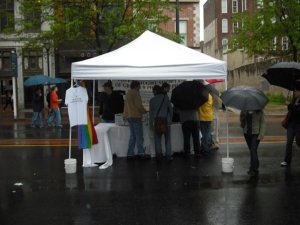
On Sunday, May 3, 2009, in the rain and cool Spring weather, The Freethought Society of Greater Philadelphia had a table at the Equality Forum, which was an event celebrating GLBT culture in the city.

Now, the question is why an organization for freethinkers (rationalists, secular humanists, atheists, etc) would set up a table at an event such as this? Two reasons; the first is that the vast majority of its members are support equal gay rights and (the second) is that there are many potential new members at such events.

Sally Cramer came to pick me up around 9:30am on Sunday morning. That’s too early, in my opinion, to be doing anything on a Sunday. Sally is the President of FSGP and a good friend of mine. We set up the tent, organized the tables, and as other volunteers slowly made their way to our location near 3rd and Market, we got things started.

The rain probably kept many people away, including many other groups with tables. The people next to our slot on the street had no tent and so spent much of the day huddled together under an umbrella at their table. They looked so cute huddled together, but they left after a couple of hours of this. I wasn’t surprised.

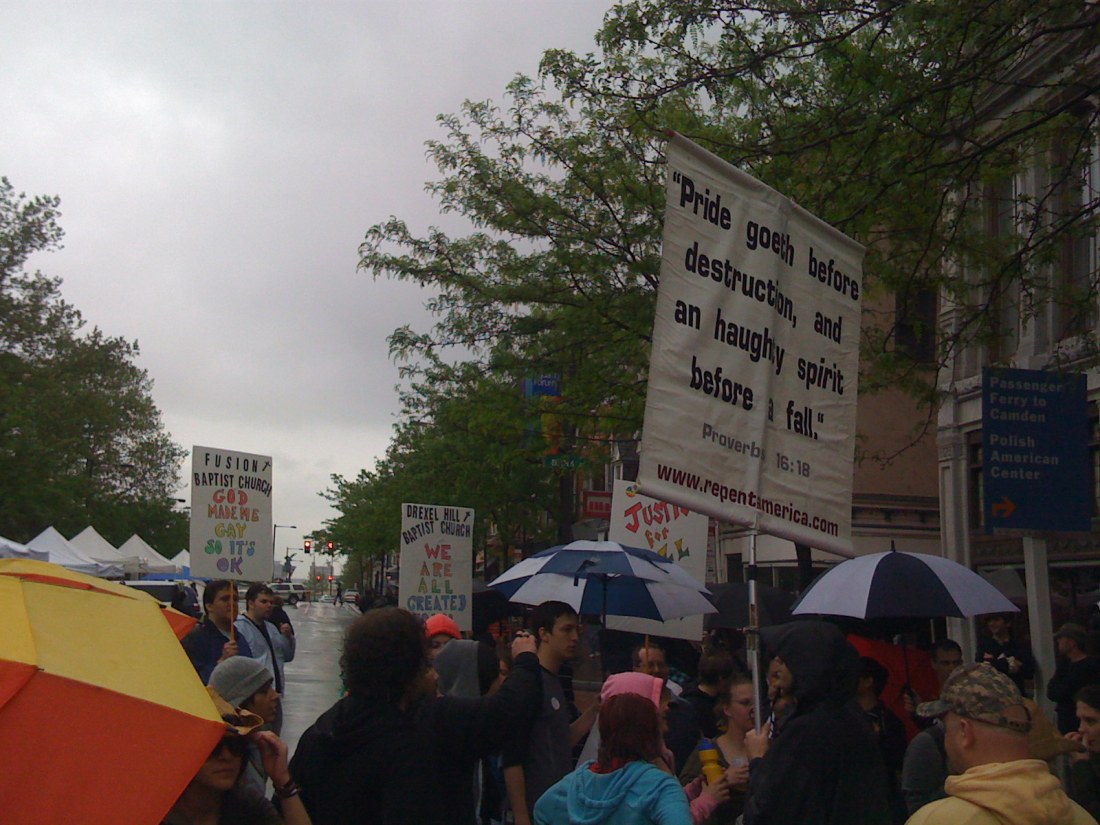
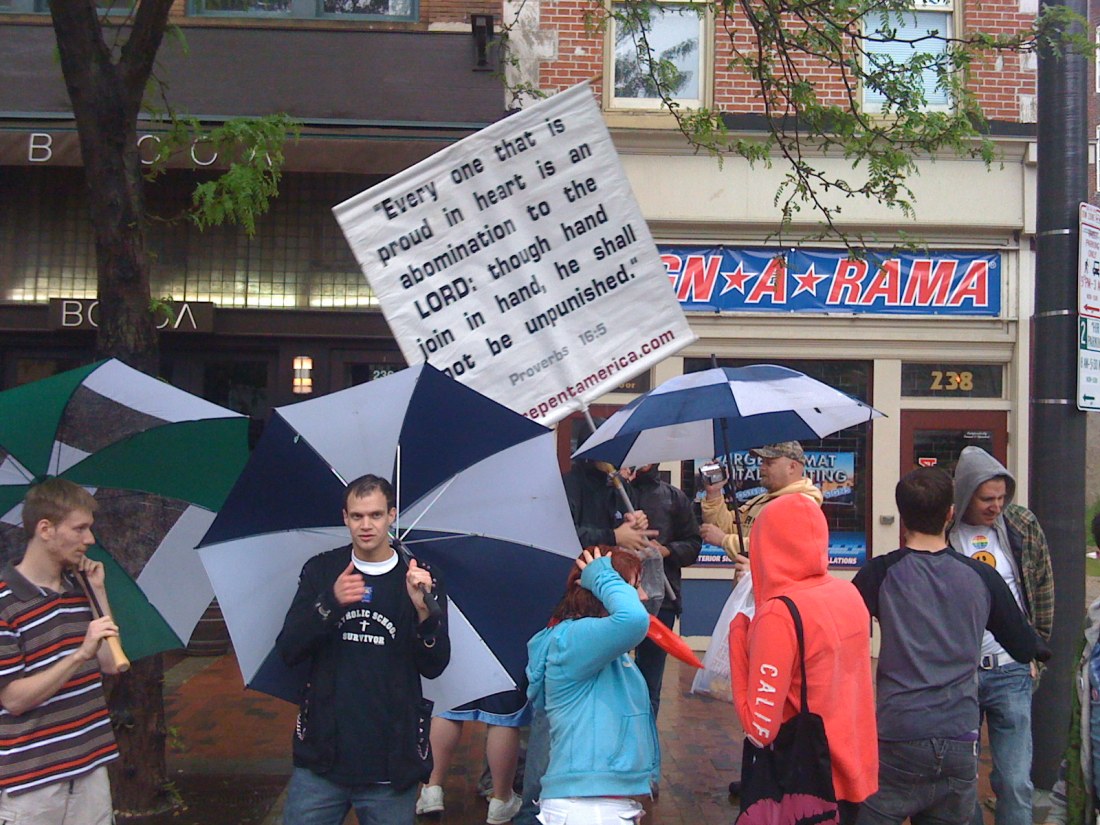
Repent America was there too. They are not quite Fred Phelps and his crew, but they are close enough. For most of the day, we ignored them, and so did most of the people there. I don’t think they liked being ignored.

There were a number of churches with booths there. There are many liberal churches that accept gay members, many of which have gay pastors, ministers, or whatever they call the people that give sermons and all that jazz. We talked with a few of them and had some nice discussions. They are good people, in general, and they didn’t seem to mind our presence much at all.

But we also met quite a few atheists, “agnostics,”, and other non-religious people who were happy to see us there, and who may become members in the near future. The fact that FSGP is having a meeting and lecture at the William Way Community Center (1315 Spruce St; right in the the “gayborhood”) this Friday at 7:00 with Susana Meyer speaking will probably mean we’ll have a few more people show up to our meeting this month. We advertised it at or table, of course.

Most of the day was relatively quiet. We talked with many people, got almost no comments that were not completely welcoming, and had a calm, rainy, and cool day with some fabulous people. That is, until Repent America marched right towards our booth, both followed and also even impeded by, some gay and lesbian folks that were preaching a more inclusive gospel message.

Yes, that’s right folks, the “burn in Hell” Christians and the “God loves all equally” Christians marched right to us, set up shop behind us, and had it out with each other while we, quite amused, watched. OK, some of the volunteers made some comments and we gave a few pamphlets away that were titled “On Religion and Being Gay…What Freethought Has to Offer!”, but mostly we stood nearby and watched.

Bible Wars! Repent America v. Liberal Christians

And as the “burn in Hell” Christians found a place to stand and condemn through a megaphone for a while, many of the local participants did something that I actually disagreed with; they blocked them and tried to shout over them.

Why block them? It just feeds their persecution complex.

We, vocal heathens that we are, had some shirts on. The one I wore said “Hi, I’m your friendly neighborhood atheist!” while some others wore the “Smile, there’s no Hell!” shirt with the smiley face on it. The people with the megaphones saw these and pretty much ignored us. We were for another day, I guess. They just wanted to make sure that everyone there knew that homosexuality is a sin and that they would all go to Hell. The rest kissed there partners, screamed gay pride slogans, and generally fed them everything they wanted to hear while they protested with more than 20 police officers nearby just in case.

In other words, there was no conversation (not that the people from Repent America were willing to talk anyway; they just ignored everything said to them). All I saw were two groups with different interpretations of a book of myths yelling alternative views at each other. All is vanity, I suppose. And while I prefer the “God loves everyone equally” people to be around, I found the whole thing quite silly, in all honesty.

Eventually they all went away, and with the yelling and the noise over, there was nothing left to do. The rain had slowed to a mere drizzle at most and so we took down the tent and went our ways (some of us went to Eulogy to get some dinner and fine Belgian ales). We’ll see how many show up on Friday for the lecture and if we see some more members sign up. All in all, I enjoyed the day.

So thanks to everyone who showed up to volunteer (Greg, Brian, Janice, Scotty, Glen and of course myself). A special thanks to Sally for setting up the event and having all of the materials ready.

What does ‘Moderately Religious’ Mean?


What does it mean to be moderately religious? What does it mean to, for example, be a Christian but to not accept the Bible as wholly and literally true? Or, perhaps more generally, what does it mean to accept a god but not all of what god is supposed to have said?

I’m wondering what it means to accept only some of the teachings of a religious tradition, some set of interpretations of scripture, and to accept them and to eschew the other interpretations. Does this not imply that the person who accepts only some of the points of their traditional theology is, in effect, a prophet themselves in some sense? Does it not imply that the scripture is secondary to the judgment of the person who accepts some of it?

One particular example would be to ask what it would mean to be Catholic and to accept the use of condoms or even abortion. Would you really still be a Catholic or would you instead automatically be a protestant of some sort?

There is a strain within many Christian communities that emphasizes the importance of the direct relationship with God. Many even argue that our sense of right and wrong are due to something that God put within us, and so it may not be a stretch, perhaps, that maybe God put within people the ability to determine what is true theology as opposed to man’s religion, right?

It is curious, however, that different people’s consciences are calibrated so differently. To be so sure, as some Christians are, that gay marriage is wrong while other Christians would disagree is a prime example of this . To agree that slavery is wrong despite the Bible’s condoning it (Lev. 25:44-46, Ex. 21.2, 7-11, etc), even in the New Testament (Ephesians 6:5, 1Tim. 6:1-2, Lk. 12:47-48), sounds like putting an awful lot of stock in the opinions of one’s self rather than scripture, to me. So what is to be done with these verses? Are they to be ignored, rationalized, or merely blindly followed?

I think there is a simpler solution to this problem. The idea of God, which seems so obvious to many people, is generally not in question. However, when people of various traditions are faced with aspects of the tradition, scripture, or faith that do not cohere with the rest of their experience, they will tend to eschew those verses that do not agree with what their experience and their own values tell them and attribute the tensions between scripture and conscience to the mistakes of man in expressing the deity’s teachings. The rejection of certain things that scripture says does not, as a result, throw out god. Instead, they throw out Biblical literalism.

But which verses are literal and which one are metaphorical, mythological, or simply wrong? The specific verses that are rejected are easy to toss out because they deal with issues which are directly related to experience. We see that stoning misbehaving children is not moral, thus people ignore the verse that tells us to do so (Deut. 21:18-21), possibly rationalizing this with some other verse or general idea that some older books are no longer valid, despite the fact that another verse invalidates this idea (Mat. 5:18).

We have every day experiences that show that, for example, the Bible’s condoning slavery is misguided, and thus likely the influence of man on God’s word and not true. And yet this one imperfection in God’s scripture is not sufficient to disqualify God existence, right? We have experiences that tell us that good people, whether they believe the right things or not, don’t deserve to be eternally tortured in Hell, but yet God is still real, right?

Doing this does not address the question of a god in general, but it does raise the question of the authority of the scriptures in general; if some of the verses are not true because they conflict with our experience, then why are the others still considered true, especially those that are taken on faith because they are in scripture? If the truth value of an idea in scripture is determined by them being in scripture, how do the other rejected verses avoid this same criterion?

The answer is what I call compartmentalization. We use certain types of standards and criteria when we evaluate the world but do not use these criteria for others. Generally, it is because there are some things, things like invisible yet ubiquitous and transcendent gods, which are necessarily beyond our direct empirical experience (yet are supposedly behind everything; we have to derive their existence using reason and logic, usually poorly).

We don’t have every day experiences, unless we search for them, that would challenge the core aspects of people’s faiths; things like the Trinity or the belief that a god exists. This is an idea that needs to be actively pursued to reject intelligently.

So, how can a person conclude atheism; the lack of belie in any gods? The simple fact is that there is no proof that gods don’t exist. But more to the point, there is no obvious experience in the world that a god is not necessary to explain anything at all, which would lead to the reasonable conclusion of not believing in any gods.

To find this to be the case you have to 1) be genuinely interested in the question to some degree, 2) have a fair understanding of the philosophical questions that are relevant, and 3) not be too emotionally attached to the idea that gods do exist.

Why #3? Because very smart people are very good at rationalizing reasons for ideas they already accept emotionally. That is, while people will not accept all ideas in their scriptures or religious traditions, they still will accept the general ideas and still associate themselves with the faith, even if they reject most of the ideas. They will find a way, mostly unconsciously, of making sense of the fact that they disagree with God’s word, but it’s still their God and it is still his word.

So what is moderate religiosity? To me it sounds like people who believe or need to believe in some god, but despite their lack of acceptance of the ideas in the books which tell them about their god, they still associate with the tradition which they largely disagree with because they are used to doing so. It is pure habit and intellectual laziness. And while many will seek out churches that share their values, this does not excuse the fact that most churches reject or simply ignore much of what their scriptures say in favor of a general idea that is supported by only some scripture.

If scripture is the true god’s words, then shouldn’t it all be considered equally true or suspect? And if they are all suspect, why accept the articles of faith that our experience with the world seems to make acceptable only through faith? After all, if their was evidence, faith would not be unnecessary. Moderate religious traditions sounds like a retreat from religious ideas while trying to hold onto the center. The problem is that the center is defined by the periphery, and so when the periphery is peeled away the onion of theology will reveal the hollow center.

Thus people are left with a vaguely defined, powerless, and useless idea of a god that no longer warrants the title. Moderate religion ultimately leads to a god that is indistinguishable from no god at all.

Destruction of Traditional Values Should be Legal, Safe, and Rare


It is my proposal for discussion that social progress must, necessarily, destroy some traditional values. It is my hope that this destruction will only take place where those traditional values are themselves causing destruction, hopefully unintentionally.

Is there anything wrong with being homosexual or bisexual? Is there anything wrong with being polyamorous? Is there anything wrong with being an atheist? Is there anything wrong with these things in themselves?

Is there anything wrong with a society that accepts homosexuals on equal terms? Is there anything wrong with a culture that accepts non-monogamy on equal terms with monogamy? Is there anything wrong with a world that does not care if a person does not believe in spurious metaphysical claims?

Society will change as the individuals that make it up change. And as we see the principles of moral behavior projected onto these new personal behaviors of people, we would be remiss…no, we would be hypocritical…not to apply the same values of fairness and justice upon the similar social structures.

Marriage, through most of history, has been defined as being between the opposing sexes. The reasons make sense, as in order to raise children it is the minimal requirement that one man and one woman get together and make babies. And as society began to complicate and settle, allowing people to explore more complicated relationships, it should be of no surprise that some would create situations, both unintended and eventually intended, that would forgo the status quo of what was done usually.

Question #1:

Is it the case that, purely on an interpersonal level, that relationships can be made to work between two people of the same sex, three people, and can people live fulfilling lives without religion or faith? More generally, can people live happy, productive, and moral lives not following the normal paths? Does eschewing traditional worldviews and values necessitate that life will become difficult, perverse, etc?

I think that the answer is quite clearly that casting off traditional values and lifestyles can often have its difficulties, but that it is very possible to live fulfilling lives. The success of the attempts will vary depending on other social considerations.

Question #2:

Is it reasonable to expect that individuals living their lives according to their values will not be noticed by, inspire, and inform other people of alternative possibilities of life? That is, even if these non-traditional people never write a blog, protest, try to pass legislation, run for office, etc in order to support their non-traditional lifestyle, will they simply go unnoticed?

I think the answer to this question is a mixed bag. I think that their are many things that people do that go unnoticed. The reasons are varied, but it is clear that there are many things that remain unseen, unspoken of at work or at parties (at least mixed parties), and so go largely unnoticed. I think that eventually the general awareness of such things happening is nearly impossible to contain, even if the specific people and places are not known.

Question#3:

When non-traditional ideas spread to so-called “mainstream” culture, what happens? That is, when the cat is out of the bag what do people say? Again mixed bag. Depending on how close to home, emotionally, religiously, and morally (yes, all of these things are related) these non-traditional ideas are. Thus things that challenge “normal” views which people have close emotional associations with such as religion, sexuality, family, etc, the more likely the challenge will be taken personally and thus cause a defensive reaction.

This means that the issue becomes of social consequence, but only because it is a strongly personal issue that challenge ideas of society.

Question#4

Does it make any sense to believe that changes at the personal level, things that individuals do, should not often change society eventually?

Any change that happens on the personal level has the potential to eventually transform social norms. Why? Personal transformations are the building blocks of social change. Thus as interpersonal relationships change in nature, it is only natural that those people will begin to redefine concepts which their relationships use. Concepts like ‘family,’ ‘marriage,’ and ‘even ‘love’ will take on different meanings in the context of their new experiences.

Atheists have been around for thousands of years. We didn’t always call ourselves that, but we were around. For most of human history, religion, politics, and economics were tied together in ways that they are not any longer in much of the world. One of the many factors of this change is the concept of separation of church and state, which was a radical change in the US Constitution but which was probably inevitable to happen. Thus, the personal changes of small numbers of people that didn’t believe in gods were able, eventually, to demand political representation that would have been nonsensical in prior eras.

Same sex marriage would have been a concept that made no sense hundreds of years ago. Even in times and places where gay sex was acceptable even if it was generally done behind closed doors, the concept of marriage had a meaning surrounded by family and property, and not so much with love, tax breaks, sharing of medical benefits, or simple interpersonal bonding as it does not for many people.

But as these concepts began to be associated with marriage, the institution itself began to change. This was not an intentional effort to change what marriage is, it is just part of the process of history and culture. Thus, when men who wanted to cohabit, adopt children, or just declare to the world their love for one another were able to say so in the open without excessive fear of social reprisal, of course they want to the same legal rights as straight people. It just followed by simply application of human rights to what the concept of marriage had become.

That is, it was not the homosexuals and lesbians that redefined marriage, it was the changing culture that had already done so through changes in women’s rights, economic shifts, and changes to sexual culture in general, and gays simply saw that it naturally applied to them because they were doing exactly what many straight couples were doing.

The fact that certain elements of society had not realized that this change had occurred, realized and disagreed with the changing tides of said change, or simply don’t want people not like them to have the same rights for simple bigotry is an unfortunate aspect of this slow social change.

There will inevitably be some people who are operating under a different set of assumptions, value different and sometimes older concepts, or for whom the older ideas are so important that to see them challenges is a personal, cultural, and possibly theological affront.

But the cultural change is not an attack against them. Rather, the reactionary elements of culture are an attack of a change already in process. And while the change that happens will actually destroy their values in many ways, it is not done in order to achieve this end.

It is somewhat like what happens when a man who has spent a lifetime collecting and adoring vinyl records finds that music is no longer produced in this form. It affects him personally and his offense is understood and we feel for his loss, but the world has moved on. He will still be able to find others who share this love, old stores that still have some left-over copies of a favorite album, but the time has passed. He can try to prevent it, but it is likely in vain.

And certainly there will be true losses, true beautiful tragedies in the loss of certain constraints, values, and of lost traditions, but this is part of the human condition. I lament these looses, but at the same time I celebrate the process of culture, as I hope it will lead to greater personal freedoms and move away from bigotry and fear that are often the result of clinging to traditions, even if said traditions contain their own beauty as well.

Within the lives of people who hold more traditional views are great points of beauty, love, and genuine humanity in its greatest forms. But sometimes to hold onto such ideas, despite their beauty, is to cause unseen and unintended harm that made necessary the change that threatens them.

Traditional concepts of marriage was not originally intended to discriminate against people, but it does. Traditional values of meaning, morality, and society was not, I don’t think, originally intended to create social and cultural difficulties for atheists, but they do. These institutions, with all of their beauty, were not intended to have the consequences they have, but they have those consequences.

By being socially conservative about many things, one is trying to hold onto to beautiful and meaningful things. These are things that define large segments of society in ways that may not be replaced easily, if at all. But as we pull back and look at the affects of traditional policies, definitions, and values, we find that they have consequences that many, and I would hope most, of social conservatives would not want to impose upon people if they understood the affects.

I will continue to hope that the intention behind people is to preserve what is important to them, and not to destroy what is important to others.

I say that because as a social liberal, I do not intend to destroy the values of conservatives, I must admit that this is an unintentional result of the struggle for fairness, liberty, and positive social change. We do not wish to destroy traditional values except where those values threaten greater liberty for all.

I do not challenge tradition blindly. I challenge it because tradition sometimes challenges my freedoms, as well as the freedoms of many others. I encourage people to keep all challenges in check, just in case we overstep our bounds. But I do believe that many traditions will have to be destroyed to make room for improved traditions that cannot live alongside the ones being protected by conservatives.