New atheists hate the sin, not the sinner


atheismI spend a fair amount of time writing about religion, atheism, and related matters.  Why do I care so much? Why do I bother? Why not just spend time doing something more constructive than writing articles?

Is it because, deep down, I know the truth about god (and monogamy) but I have to rebel publicly in order to convince myself that I’m doing the right thing or living the right way? Or is it because I’m so twisted up and confused inside, fearful and insecure that I am projecting all of my issues onto concepts of god and rejecting them? Or is it because I just have to be heard, that I have to be right, and I want as many people to know it as possible?

Now, I cannot speak for other atheists, at least not with authority.  I can only say that my motivation is genuine and considered.  I am of the opinion that a cultural discussion and sharing of ideas is crucial if we are to continue to grow and mature as not only a society but as individuals.  All too often the things we disagree with are left unsaid or said in the echo chambers of like-minded groups.  All too rare is the communication between those groups with differing worldviews.

Now, I’ve been accused of being unaware or uninterested in the perspective of those with faith.  Because I treat their views harshly and use strong language, I must, say some, have no interest in an honest evaluation of their arguments.  If I say, for example, that there is no good argument for Christianity, it implies a certain close-mindedness rather than an openness, right?

But what am I faced with? Virgin births, resurrection of a god-man, and little to no historical evidence that any of it happened and I am supposed to orient my life towards the teachings of this person, this god, that the “evidence” presented is chock full of bad arguments, logical fallacies, and outright lies.  If anyone were to present that type of evidence for anything outside of religion, the statement that there is no good reason to think it is true would not be found to be obnoxious, arrogant or unwarranted.

The simple fact is that the claims of much of contemporary theism are obnoxious and arrogant in themselves.  I am not arrogant for not believing them and saying so proudly, am I? Something like 45% of people in the United States believe in some form of creationism.  In other words, they deny evolution as some sort of mass conspiracy or lie; now that’s irony.  We are supposed to lie down for this and be respectful of these views?

I’ve said it before, but there is an important difference between respect for persons and respect for ideas.  There is no room for respect for certain ideas, creationism is perhaps prime among them in today’s world, but the respect for a person is still important.  This is the distinction between an ad hominem and an argument against an idea.  It is sort of like the idea of hating the sin and not the sinner.

I don’t hate religion and I don’t hate religious people.  In fact, I like quite a few religious people, even if they don’t think they are actually religious and call themselves ‘spiritual’ or something like that.  I think that many religious ideas are harmful, absurd, and can be shown to be so.  Some people, including atheists, think that efforts by myself and the big names in the so-called new atheist movement are making them look bad and are hurting their efforts.  With all due respect, atheist appeasers, what efforts?

Recently a bunch of people from the Secular Student Alliance visited the creation “museum” in Kentucky.  They did this for many reasons, one of which was because they wanted to get an up-close look at what people are being shown.  The bottom line is that Ken Ham and his AiG crew are using bad science and misleading hundreds of thousands of people with either poor science or bold-faced lying for Jesus.  What response should be taken besides what people like PZ Myers and Jerry Coyne are doing? Should we be more polite like Michael Ruse or Mooney and Kirshenbaum?

I get that people get defensive when they are challenged.  I get that there is room in the discussion for calm and measured responses.  But there is a point when the only reasonable reaction is laughter and mockery.  There comes a point when calm and respectful interlocution is only acting to legitimize a view that is not legitimate.  Thus, those that argue to “teach the controversy” have it all wrong; if we were to teach the real controversy we would be doing precisely what the new atheists are doing.  We would be showing precisely what is wrong with the arguments used by those who want to be part of the debate when, in fact, they are not.  They are trying to reorient the debate to include themselves.  They are trying to squirm their way in and we will mock them to where they belong, which is not even on the fringes.

We are not afraid of criticism.  We don’t avoid conflict with our worldview, we are just tired of people who are so obviously incorrect trying to pretend that they have a legitimate claim to make.  There is no longer room to tolerate absurdities in the discussion.  If you have a good criticism or question, present it to the discussion and if it is a valid concern it will be addressed.  And if it is dismissed because it has already been answered many times and refuted sufficiently, don’t whine about how you are being expelled.

There is a sort of cult of martyrdom and persecution complex within much of the conservative religious world.  When cartoons depicting Mohammed as violent surface, Moslems react violently.  When Christianity is legitimately criticized in the public discussion, they cry about being persecuted and that God is being kicked out of society.  This is silly.  If their god exists, there would be nothing one could ever do to kick it out.  Nobody is taking your private worship away, only preventing it from becoming public by mixing politics and religion.

The new atheists are here to challenge theism, whether it be Christianity, Islam, new age silliness, etc because religion (both organized and cult-like anarcho-personal religion) has held sway in ways that are damaging to our world.  They are propping up anti-science and anti-criticism that only seeks to defend itself from looking at itself honestly.

What about the liberal religionists?

I want to say a few words about those who are not part of the conservative movement in religion.  Those who accept evolution, science, support progressive ideas like same-sex marriage and who generally don’t have an issue with atheists and other skeptics.  How do you reconcile the fact that the books you base your beliefs about god also contain ideas that you reject? Why do you only accept part of the scripture? Is this not hypocritical?

We appreciate you not being Dark Ages backward.  But why do you compartmentalize your views such that you accept one thing on faith? Why is faith good?  Why isn’t faith considered backward?

And why aren’t you challenging your conservative cousins?

We don’t hate you, we hate that you are making us do your dirty work because you are too cowardly to do it yourself.  Cowardly, perhaps, because you realize deep-down that a challenge to them is also a challenge to yourself.  You cannot undercut their faith without undercutting your own.

There is a genuine conflict between tendencies in religious thinking and the scientific method.  One must compartmentalize one’s mind to believe in science and virgin births.  Recognize this conflict and deal with it.  Until you do that, many of us will continue to lack respect for your worldviews, but we will continue to respect your ethical and legal right to believe and express what you believe.

I just hope you respect my belief that your beliefs may be worthy of mockery.
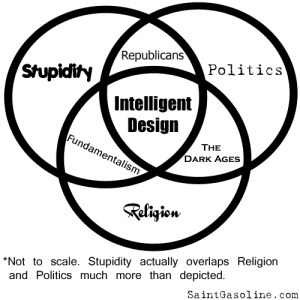
Intelligent design and special pleading


venn

All too often I hear from people that there is proof of god everywhere.  The trees and the birds, our hands and our feet, the flesh-eating bacteria and the natural disasters that destroy cities.  OK, those lasts two are not generally used to argue in favor of a loving god, but they are pretty complex, aren’t they?

And that’s the key here: complexity.  How could all of these things with their complex parts, elaborate interactions with the rest of nature, and our intricate brains that can think about it all just get here by chance? They could not have done it on their own, right? So there must have been some intelligence, some designer, to give the world it’s complexity.

It is unfortunate that there is such a deficiency of understanding of science and of critical thinking in our culture.  Science education may be partially to blame, but we must be willing to take the responsibility for ourselves as well.  And as a result of this there is a severe lack of understanding of the theory of natural selection (as well as the other evolutionary pressures) and thus a misunderstanding of the fact of evolution as they intersect with these questions of complexity.

There are great resources for learning about these things online, and so any person can go and find out what scientists say about evolution.  The key here is to understand that the process does not claim chaos or complete randomness.  The question about evolution is not a false dichotomy between an intelligent designer or random chance.  There are many believers in various gods that accept the fact of evolution (Ken Miller and Francis Collins being two prominent examples).  Natural selection is a definite process, is not random, and is well supported by physical evidence.

The major component of randomness in evolution is the mutation of genes.  But most of these mutations have no effect at all, and only sometimes do they have a harmful or helpful effect.  It takes environmental factors, lots of time, and other factors to make a mutation effect the population at large.  And it is the process of natural selection that does the actual work, not the random mutation.

But my point here is not to explain natural selection or to spell out the evidence for evolution.  That is the responsibility of each person to do on their own in conjunction with schools and museums.  Start with the link above, a trip to the museum, or even a recent biology textbook (and not one produced by the Discovery Institute such as Of Pandas and People, as they have been shown to be untrustworthy during the Kitzmiller case).

And so what about this claim that complexity requires intelligent design?  Well, even if we didn’t have a good scientific answer to the claim (which we do), there is another problem with it that can be shown without knowing anything about evolution.

Here is the argument as I have seen it:

  • The world (universe) is full of complex things
  • complex things need designers
  • therefore, a designer of the world (universe) exists.

Ray Comfort is known for arguing that if you see a painting we know there is a painter,  if their is a building there is a builder, etc.  It is certainly true that things we create have designers, and they certainly are intelligent.  But the analogy does not carry through to all things because not all things are constructed in a factory.  Other things reproduce biologically and are put together by very complex natural processes that we, admittedly, don’t fully understand.  And as far as universes go, I’ve never seen one made, so while I can go to the car factory, I can’t go to the universe factory.

But more importantly is the assumption that all things need intelligent designers to exist simply because they are complex.  We know that simple things can become complex through natural selection, but even if we don’t know this we can ask if all things that are complex need a designer, then wouldn’t the designer itself, being a complex thing, need its own designer?

In short, what created god?

Now, the common reply is to state that god is eternal and has always existed.  This is special pleading.  What that means is that the point is making a special exception of the rules for illegitimate reasons.  The question here is whether a god exists, and so in deciding this issue one cannot take as given a special exception for the thing that is in question.  One cannot simply define god into existence by saying that it is not subject to the rule that all complex things need a creator.  If one did, the results would be somewhat silly.

intelligent-design-posterThe bottom line for intelligent design, and whatever people are trying to disguise creationism as these days, is that there is no evidence to support it.  Despite Michael Behe’s best attempts, there is no irreducibly complex thing that cannot be explained without the need of an intelligent designer. Natural selection is sufficient to explain complexity in our biological world.



And further, even if it could be shown that an intelligent designer would be necessary, this would still be a far cry from associating this intelligence with any particular god.  An intelligent designer would not imply that it had anything to do with any theology or mythology (as if there were a difference) of any religion.  A Christian does not win any points for his beliefs even if intelligent design were true.  Because if it were true, the Moslem, Jew, Hindu, etc would step up and claim that it is their god that is the intelligent designer.

Luckily for us, that is not an issue because the proposal of an intelligent designer does not stand up to scrutiny.  The irony, perhaps, is that intelligent design needs people of lesser intelligence, or at least understanding, to propose it.

If complexity needs a creator, so does the complex creator.  God is nothing but a pseudo-answer to a non-problem when it comes to the complexities of the world and how to explain them.

Related: Counter to the Kalam Cosmological Argument.  A favorite of William Lane Craig, Christian apologist.

Projection: seeing ones own sins in others


blame

Many of us in the atheist and skeptical community have noticed this trend within many people.  It is certainly not unique to religious people nor is it ubiquitous within religious groups, but this particular force is quite strong with many believers.  It is projection, and it is a form of insecurity and lack of self awareness.

How does it work? Well, it is quite simple, actually.  Have you ever met a guy who is just a little too homophobic?  You know, the guy who even at the slightest accidental touch or slightly long eye-contact from another guy provokes some comment such as “hey, what are you a queer or something?”In other words, the reaction is to call the other person a homosexual.  Why would they do this? Now, in some cases it might just be because they are an ass, but it seems to me that in some cases this is the fear of their own homosexual feelings.  Perhaps they are bisexual, even if only a little.  Perhaps those impulses scare them because they don’t want to be teased by other people like them.

Thinking about it again, the better example is people like Mark Sanford, who promoted family values all the while involved in his own sex scandals. But theists can do the same type of thing.  A common example of this that I see is the accusations that certain people make of atheists.  We want to live a life of sin and so we ignore god’s rules.  We are ignorant and don’t know or want to know the truth.  There are other examples as well, but these should be sufficient for now.

How are these accusations projections? Well, maybe sometimes they aren’t.  But I have talked with people and have found that replies to atheists by theists come in this form when the theist is in denial about their own actions and thus hoists them onto their interlocutor.

Many Christian men come to their faith while young and after dealing with some issue; whether it be alcohol abuse, womanizing, excessive pornography use, etc.  I saw this in college and graduate school multiple times, and have heard similar stories from many people before and since.  In many cases it’s more than one thing, and they find, within the messages of Christianity, a way to be saved from these problems.  But their desire does not go away.  They still want to look at porn, drink, and have some casual sex but they have turned the corner and are living a life under their idea of god, changed (they claim) by their rebirth.

And so, when they see people like me who enjoys a couple of good beers in an evening, who has sexual experiences that I don’t feel guilty about, and can freely look at porn if I want to (I actually don’t have much interest in porn, but am certainly not offended by it), they project their unrequited desires onto me, seeing their former selves as me, hiding from god because I want to continue to live this sinful life.

They could not be more wrong.  I’m not living an immoral life;  I don’t go around having casual sex (I’m polyamorous and am interested in relationships primarily), I don’t drink to excess (I prefer quality to quantity), and I don’t go out of my way to see porn (although if it’s in front of me I might check it out). I don’t see these things as sinful or wrong in themselves.  They can be used in ways that can make the acts wrong, of course.

They have the problem that they are struggling with, and I sympathize with this because we all have issues we deal with as we try and improve ourselves.  They were using people or overdoing something they liked to do and went as far as to see the whole activity as wrong, rather than its misuse or excess as being the problem.  Instead of reading the Bible, perhaps they should have read Aristotle’s Nichomachean Ethics; as what they need is moderation, not prohibition.

The other reply I get frequently is sometimes more damning; ‘you atheists are irrational’ or ‘atheists are just afraid of the truth’ or something like that.  When I talk to them, I find that it is them that is ignorant and afraid of the truth.  They don’t know the history of their religion, its theology, nor have they read all of their scriptures.  They think I’m avoiding god but it is them who is over-focusing on god; they are missing other points of view because they have swapped one addiction (whether it be sex, porn, alcohol, etc) for another (god).

Especially if their theology has them reject evolution or the so-called big-bang theory, they almost never don’t understand the basic theories let alone the scientific method.  And when you bring these things up, you see fear, insecurity, and anger in them as you are picking apart the edifice of their reborn self.

And then what happens? They project that fear and anger onto us, and then we become the angry atheists of contemporary lore.  This, in my opinion, is the most common form of projection.  My passion for the subject, my confidence in tone in presenting my view,  causes fear, insecurity, and thus anger in those who are not so confident and they project their emotion onto me.

There is a lot of insecurity and fear within religious communities about their beliefs, especially the more fundamentalist groups.  And I will not deny that there are some angry and insecure atheists, as I know a few of them.  I am insecure in some ways myself, but not when it comes to my lacking belief in any gods.  In this I’m pretty sure and secure, and my breadth  of knowledge on the topic of religion began as an honest attempt to evaluate religion and led me to remain skeptical of religious claims.  I’ve not been convinced, am open to be convinced, and no matter how often I say this I still get comments that say that I’m claiming that god does not exist and I’m being dogmatic.

I’m sorry, but it is most theists who claim that god does exist and are dogmatic.  Stop projecting your behavior onto me.

Stop allowing your fears and insecurities to govern your behavior.  Recognize them as part of what you have to deal with, become conscious of how what scares you motivates you to not see things within yourself.

Finally, am I projecting? Possibly a little.  But I think that this is a common human psychological behavior pattern, and I do see it frequently.  I have had some Christians I’ve talked to admit that they are insecure, sometimes, about their beliefs and they think that others, including atheists, are guilty.  And so they sometimes are.  But being aware of it is a first step in finding a solution.  If we want to continue a mature and informed dialogue about these issues, everyone, including atheists, needs to be aware of how we use projection to tear down the other rather than admit our own flaws.

We all need to inspect the logs in our eyes before attending to the splinter in others’ eyes.

Is atheism a religion?


Is this the atheist version of the eucharist?

Many critics of atheism will comment that atheism is just another religion or that it requires faith.  So, is it a religion? Does it require faith to be an atheist?

Put simply; no, that is ludicrous. Atheism is a religion in the same way that baldness is a hair color. It requires faith in the same way as people who don’t believe in the Invisible Pink Unicorn requires faith; in other words it doesn’t.

But before I address the question in more depth, I would like to supply a quote of Einstein’s which I find to be thought provoking and relevant:

The most beautiful and deepest experience a man can have is the sense of the mysterious. It is the underlying principle of religion as well as all serious endeavor in art and science. He who never had this experience seems to me, if not dead, then at least blind. To sense that behind anything that can be experienced there is a something that our mind cannot grasp and whose beauty and sublimity reaches us only indirectly and as a feeble reflection, this is religiousness. In this sense I am religious. To me it suffices to wonder at these secrets and to attempt humbly to grasp with my mind a mere image of the lofty structure of all that there is.

It is in this sense that an atheist might be considered religious, and no other. Richard Dawkins has expressed a similar view, and agrees that he is religious in this sense. This deep awe of mystery is something that can be appreciated with or without a belief in any deity.

However, it seems disingenuous to equivocate this specific and unorthodox use of the word “religious” with it’s more common use; to conflate this sense of awe that atheists can feel with what we usually call “religion.” A universally accepted and universal definition of religion is a difficult task. That is, many definitions that we can refer to will seem to exclude some other things that we generally call religious as well as include others that seem like a stretch to include. If we say religion requires God, then we are leaving out religious traditions that often don’t require a god such as much of Buddhism. If we stretch the definition to something like ‘devotion’ to something or something equally vague, then we essentially define it to be meaningless; does my interest in hockey make hockey a religion? Is baseball a religion? How about stamp collecting?

Wikipedia defines religion as follows:

A religion is an organized approach to human spirituality which usually encompasses a set of narratives, symbols, beliefs and practices, often with a supernatural or transcendent quality, that give meaning to the practitioner’s experiences of life through reference to a higher power, God or gods, or ultimate truth.[1] It may be expressed through prayer, ritual, meditation, music and art, among other things. It may focus on specific supernatural, metaphysical, and moral claims about reality (the cosmos and human nature) which may yield a set of religious laws, ethics, and a particular lifestyle. Religion also encompasses ancestral or cultural traditions, writings, history, and mythology, as well as personal faith and religious experience.

The term “religion” refers to both the personal practices related to communal faith and to group rituals and communication stemming from shared conviction. “Religion” is sometimes used interchangeably with “faith” or “belief system,”[2] but it is more socially defined than personal convictions, and it entails specific behaviors, respectively.

This seems like a fair definition, thus I will use it as a guidepost for my attempt to answer the question at hand. It may not be the most accurate of definitions, but I believe it to be largely uncontroversial and it suffices for our use here.

So, what’s an atheist? My definition, a definition shared by many atheists within my radar, is that atheism is the lack of belief in god. Some will include those that say god does not exist (the so-called “strong” atheists), but I believe that the only necessary aspect of atheism is the lack of belief. The assertion that god does not exist is certainly sufficient for someone being an atheist, but said assertion is certainly not necessary but rather in addition to the lack of belief.

So, with these definitions in hand, let me address the relevant questions.

Is atheism the lack of religion?

I address this because some people try to answer the question of whether atheism is a religion by suggesting that atheism is simply the lack of religion. This does not hold up for a number of reasons. The first, as mentioned above, is that it would imply that non-theistic religions are actually not religions at all. Despite the fact that Zen Buddhism does not claim that gods do not exist (nor that they do!), I think that most of us would agree that Zen should be included as a religion. It has specific practices, is based on a person (the Buddha as well as other Buddhist teachers), and is shared by a common group (other Buddhists).

One might argue that Zen might not technically be atheistic, as it seems to be more of a position of doubt.  However, I argue that the distinction between atheism and theism is sharp; there is no middle ground. The proposed middle ground of agnosticism is incorrect, as agnosticism is an answer to what we know, not what we believe. I, for example am an agnostic atheist; I lack belief in gods, but ultimately I do not claim to know for sure. Thus without an active and conscious belief in god, one is an atheist. This includes people who reserve judgment. Further, if any Zen Buddhist could be found that did not believe in gods, this lack of belief would not be in contradiction with his or her being a Buddhist, and therefore someone could be both a Buddhist and an atheist.

Another reason is that the simple lack of belief in the gods does not necessarily make one anti-religious. There are many beautiful rituals, writings, and other aspects of religious practice that someone who did not accept the claims of gods can appreciate. Further, one might still remain as part of a theistic community and participate in the rituals, songs, etc without believing in the god of said religion. In this sense, we might call that person a religious atheist, just like the Buddhist above.  I’m sure that there are many people taht don’t believe in god but still particupate in religion, quietly.

The question of whether one believes in God has nothing to do with being religious; someone who is a theist is not necessarily religious. Simply believing gods exist does not mean that person is also a member of some religion or not. The point being that atheism is not simply the lack of religion, as a person’s atheism/theism does not have anything directly to do with being religious or irreligious. Theology does not imply religion, nor religion theology.

Does atheism require faith?

People, such as Ray Comfort from Way of the Master, have tried to argue that there are no atheists. His argument is that in order to prove that god does not exist; the atheist would have to know everything. Nobody knows everything, so nobody can know there is no god. Looking past Comfort’s misunderstanding of what an atheist is, the point he’s making is that when someone says they believe there is no god, they are making a faith claim; one that many apologists claim is a stronger claim than the theist makes. Atheists are, according to people that propose this argument, believing something extraordinary without being capable of knowing it for sure. This is simply not the case.

What is faith? The way I understand and use the term, it means a belief in something either despite the lack of evidence for it or evidence against it. If there were evidence, there would be no need for faith. Faith is not held for rational reasons, but rather outside of rationality. Atheism cannot require faith because atheism does not require any beliefs at all–rational or not.

To believe in the stories of the various religions which have little to no supporting evidence one must accept them despite this lack of evidence. Most Christians believes that Jesus Christ lived, preached, performed miracles, was crucified, and on the third day rose from the dead. They believe this person was God-incarnate. This is an article of faith, as no historical evidence could verify this. Even if the historical events that were supposed to have happened actually occurred, the belief that Jesus was God is something that must be accepted by faith. In short, faith has an object it believes in

Atheism does not require faith because it is simply a lack of a specific kind of belief. Atheism only exists because some people make claims; they claim there is a god, and it’s like this, that, or some otehr thing. The atheist simply rejects the claim. When someone comes along and says that the atheist has a belief–that god does not exist–they are incorrect because they misunderstand what atheism is. As I discussed above, this assertion that god does not exist, while held by many atheists, is not the definition of atheism itself but is an extension of the lack of belief.

Conclusion

So, what does all this amount to? Atheism is the lack of belief in any and all god concepts that particular theists propose. It is the responsibility of the theist, the one making a theological claim, to bear the burden of proof. Their religious conviction (whatever it may be), if it claims a god exists, is the proposal and the atheist hears that proposal and says “no, I don’t believe that.” The atheist is not making any claim at all. What the atheist does is reject the claim and lack belief in the gods the theists propose.

The only thing that ties atheists together is the shared lack of belief–and this is a very loose tie. Getting atheists to organize, agree, or in general share anything in addition to this lack of belief is like herding cats. There are no rituals, social coherence, or beliefs at all. There is a simple lack of belief. That’s it. If two atheists happen to share a belief, it is a coinidence and there is no significance to atheism at all.

Part of the confusion is, I think, based in the fact that atheism has the ‘-ism’ in it. This is because atheism comes from a-theist, not because it comes from athe-ism or anything like that. It’s not a positive assertion but a lack of acceptance of millions of assertions by theists. That is, atheism is the lack (a- means lack of, or ‘without’) of theism (belief in god).

And if particular atheists act in a religious way, either in awe of their beliefs (a la Einstein’s mysteries) or in some evangelical fervor to spread their atheism to the world, this is not evidence of them being religious necessarily. Their actions might share common characteristics of religious people, but that’s merely because these characteristics are part of human nature and have been understandably adopted by religion over the millennia. Religion is a human activity, so its attributes will be common to most humans, even the ones that happen to not believe in god. But atheism itself is a specific answer to a particular theological/philosophical question. Anything else the person who gives this answer does is strictly in addition to their being an atheist. It is not part of their atheism.

So, unless we are willing to call the lack of belief in god, which has no beliefs, rituals, etc at all, a religion, atheism does not qualify as a religion. Again, an atheist can be religious, and a theist can be non-religious, but this does not make atheism a religion any more than it makes theism a non-religion; theology and religion are separate issues. Anyone who claims atheism is a religion needs to be called on it and corrected.

Religion: circumventing critical thought one childhood at a time


Jesus loves the little children

At some point in our lives people will wonder about meaning, truth, and purpose.  Whether it is a time of plenty (and thus luxury of time to ponder these things) or of great struggle (and thus the seeming necessity of thinking of such things), people will find themselves considering what our purpose is, what the meaning of life is, and what is true.

Now, what matters, in my opinion, more than the answers to these questions is the method by which we get to them.  And one of the problems with our American culture is a lack of critical thinking skills as well as a terrible education system that focuses on answers rather than method.  Tens of millions of people in this country do not know how to think well, especially when it comes to questions of meaning, purpose, and truth.

So what do they do when they find themselves wondering what it is all about? What cultural factor comes to mind first when they wonder about why we are here, what we should do, etc? Religion.

Because most of us were exposed to going to church, synagogue, or temple (among other names for the places we go as a child to see religiousy stuff), this is the window through which many people begin to enter the realm of philosophical questions.  And there should be no doubt that philosophy and theology have been intertwined throughout history.  As the saying goes, “philosophy is the hand maiden of theology.”

Now, philosophy has certainly found new employment and has created a strong secular home for itself, but there is still much in our philosophical endeavors that look like theology to me.  It is precisely because we are exposed to religious ideas as a child and we rarely are exposed to much critical thinking or philosophy divorced from religious sources that this is the case.  What is that phrase? Oh, right; “Give me the child for seven years, and I will give you the man.”  Those Jesuits, they surely knew how to party.

After all, what other source can one turn to, especially when they reach adulthood, when questions of meaning come up? A person who has not been exposed to philosophy and critical thinking will surely remember the sermons on those early Sundays (or Friday evenings…whatever).  It is, thus, no surprise that when people look for meaning in their lives that they turn, or return, to religion. What other tool have they been given?

I’ve known a good number of people that could fit into the following description to varying degrees; A lack of interest in religion or god as a child, but exposure nonetheless.  As a teenager other things concern them as their hormonally raging bodies are distracting them towards boys or girls and other high school sort of things.  College; freedom, responsibility, parties, drinking, poor decisions, guilt, shame, boredom, unfulfilled, looking for something better.  Campus Crusade for Christ (or some other similar organization), Jesus loves you despite your “sins,” redemption, social support group, born again Christian, new life.

Credit goes to God.  They could not have done it without his grace.  No credit goes to them, for their decision to change, or even to the community of support that they surround themselves with.

Now, this is not my story, not by a long shot.  I was lucky enough to have been exposed to multiple religious traditions while young, an excellent education, and a strong mind. And in my travels I have met more than a few people who have described something very much like the previous paragraph as having been their experience.  Of course, there are other models for how people find their way back to religion.  They may even describe themselves as having been heathens, atheists, etc before their change.  Just look at Kirk Cameron.

No, people like that, in the vast majority of cases, just never took the time to really think about it.  And so when they were introduced to the message of the religion they return to, they were not equipped with the tools they needed to evaluate the claims made.  They were susceptible to a manipulative message because they felt like they needed something, some explanation, and they were approached by an evangelical at the right time.

And it is not that these people are completely bereft of critical thinking skills.  It is just that people have the ability to compartmentalize their minds such that they do not apply critical thinking skills to certain things that are accepted for emotional reasons.  Smart people are able to rationalize all sorts of things they accept to be true.

Our early exposure to religious ideas gives those types of ideas a kind of emotional association and import that sticks with us through our lives.  And so while for most of our childhood we may not think too much about these ideas, they remain assumed to some degree and our critical thinking slips right past them like they were cloaked in some invisible field that our intelligence just slides off of.  And when we, upon finding ourselves in need of answers, the evangelical message has a secret door to our mind held open by years of emotional associations and thus can circumvent the skeptical filters that we build up for just about everything else we evaluate.

This is one of the reasons that atheists are so vilified in culture; religion is a subject that causes emotional defensiveness when criticized.  Religion is held in our culture as an exception.  We are built to defend our religious beliefs and so they have a special place in the cultural conversation.

No more.  Stop making this exception.  It’s time for us to grow up and challenge our notions about religion, belief in god, and its role in our lives.  Learn critical thinking skills and apply them to your deeply held beliefs.  It will hurt.  It will be difficult.  But all growth involved the destruction of the ediface on which it is built.

Christianity; the McDonald’s of cultural ideas


What Would Jesus Eat?

It is commonly said that the United States is a Christian nation.  This is usually said in the context of a discussion about issues pertaining to the separation of church and state.  It is said mostly by Christians who wish to maintain this relationship between an old cultural institution and our culture.  It is both true and false.

There can be no doubt that our culture is certainly embalmed in Christian ideologies.  From common phrases to ritualistic behaviors, our language and culture are steeped in Christian concepts that enriches our art, entertainment, and beliefs in many ways.  In this sense, we are undoubtedly a nation that owes much of its identity to religion–specifically to Christianity in its many forms.

But at the same time those men who gathered together in the beautiful city of Philadelphia in the latter parts of the 18th century had an idea.  It was not an idea shared by all of them due to their many differences, but it was one that carried through in the final draft of the Constitution which is the legal basis for the United States.  This idea was to create a state that would not be mired by religious differences.  It was an attempt to make sure that the opinions of some men, or even the majority of them, could not create an official state position when it came to theology.

Conscience.  This was a key concept that underlay the discussion about what role religion would play in the states, as outlined in the Constitution.  A man whose personal beliefs differed from that of another man, a town, or even the rest of the nation was still entitled to the same rights as anyone else.  His conscience is not subject to legislation.  A state that proclaims any theological belief will, inevitably, find conflict with the conscience of some citizens.

The concept of separation of church and state was designed to not only protect atheists like myself (as well as Moslems, Hindus, etc) but also the many Christian sects that exist.  If this is a Christian nation, which sect of Christian is it?  This was precisely the concern that the Baptist church in Danbury had when Thomas Jefferson wrote them in 1802 (I write about this in more detail here). The separation was designed to prevent such absurdities from coming up in political conversations.

Ask the next person who says that this is a Christian nation which denomination or sect it is.  If they say that this is just a Christian nation, and not any particular sect, then ask them if the United States is works or faith based, Calvinsist or not, or if it might be unitarian (because they think they are Christians too) and watch them writhe out an answer.

The separation of church and state can be viewed as a protection of the general public from these divisive and sectarian issues that will only seek to slow down political processes.  Yes, this culture is predominantly Christian in many respects, but there is a difference between what we are culturally and what we are politically.  And thank all goodness for that, because if we allowed our culture to dictate our politics in all manners, think of how aweful our politics would be.  Oh, wait…I think I just had a epiphany; that’s why our political system is so screwed up!

Just compare the rules set down in the Ten Commandments and try to apply them to United States law, as so many in Congress have said proudly to their pious voters.  No, really, let’s do that.  Oh, wait, we have to decide which version of the Ten Commandments to use.  That will be too cumbersome.  I’ll just deal with one of them, from Exodus 20:3

3 Do not have any other gods before me.

Simple enough.  Oh, wait.

Congress shall make no law respecting an establishment of religion, or prohibiting the free exercise thereof…

Hmm, that’s the first part of the first Amendment, from the Bill of Rights.  So, if I have another god, say Allah, Vishnu, the Flying Spaghetti Monster, etc, then I am in violation of the first Commandment (and this a bad citizen of the Christian States of America) but am still protected by the first Amendment. And somehow this Christian nation overlooked this?

This is a complex issue with many parts, and I don’t intend to deal with it exhaustively here.  My intent is to look at Christianity’s status within our culture, and I admit that much of our culture is Christian.  It is unfortunate that this is the case, because Christianity is a sickness that is not making us better, more moral, or making our nation stronger. In fact, it’s popularity with people should be compared with what else is popular.

Much like the rest of our culture, the people in our nation are commonly held into habitual behaviors that are unhealthy for us.  We eat fast food, watch bad entertainment, and we believe bad ideas.  A Big Mac will cause you to have bad health, American Idol will limit your mind to a parochial worldview of beauty, music, and art, and Christianity will shield you from true profundity of thought about the world and limit us to iron-age beliefs that keep getting recycled with newer and newer hip words.

This is not to say that anyone who ever eats at McDonald’s is necessarily unhealthy, someone who enjoys American Idol has no musical taste, or that all Christians are dullards, but that these types of things can only serve to diminish us.  Sure, Big Macs taste great (it’s been so long since I’ve had one I’ll have to take others’ word for this), American Idol is entertaining and the people on it have talent, and Christianity has had some profound thinkers and has inspired beauty, but on a whole these things are more harmful to our culture than helpful.

Just like unhealthy food is packed with fats, sugars, and other nutritionally deficient ingredients, the worldview that Christianity promotes is most often bad for us psychologically and intellectually.  It asks us to “admit” that we are sinners, worthy of damnation.  It asks us to submit to the will of God (Islam is equally guilty of this, as ‘Islam’ means submission).  Christianity often asks us to submit our reason and rationality to faith; Martin Luther famously called reason a “whore ” and Augustine thought that understanding came after faith.  That is, don’t think rationally unless you already accept the message of Christianity, then think within that belief.

Theology is a tool by which we use our genius and creativity to make sense of what we emotionally, and not rationally, accept.  We like to eat unhealthy food and don’t like to think of how bad it is for us.  We like to believe in God and Jesus even though there is no reason to believe that either exists.  We are eating and believing ourselves into corners out of which we do not easily escape.

And so the genius of our American forefathers was that they understood that religion was divisive, and set up some protections from their sectarianism.  They set up regulations to make sure that no particular belief can have legislative sway over others.  And thank ‘god’ they did, because now we have a secular government that is set up to ensure that our fast food loving, American Idol loving, Christian nation does not destroy itself with it’s unhealthy habits.  OK, so it doesn’t do that.  In fact, all it really does it make sure that you cannot infuse your sectarian beliefs on the rest of us, and you are free to believe whatever silly things you want.

Oh, and I have the freedom of speech that allows me to criticize your silly ideas.

I’ll fight for a person’s right to speak so long as that person will, in return, fight to allow me to challenge their opinions and ridicule them as the content of their ideas merit.


Local Christian admits to excluding atheists in society


Doug Billings
Doug Billings

I ran into this article from a local Philadelphia writer today.  I must say that I was a bit flabbergasted by it.  What a disgusting piece of writing this was.  So full of hate, misinformation, and lack of compassion and love that I thought it was written by his straw-man atheist.

Let’s see where he starts:

Here we go again – another new political building and another new lawsuit brought about by atheists without anything better to do. Is being an atheist really so boring that for fun they spend thousands of dollars on frivolous lawsuits just to get their name(s) in the paper? How dreadfully pitiful. One almost feels sorry for them.

If you don’t know what he’s talking about, it is the issue of the lawsuit concerning the carving of the phrases “In God we trust” and “One nation under God” on the visitor center at the capital.  And right, we are just doing it because we are bored.  We are so lonesome and desperate for attention that we have to mess with him and his ilk.  We are so pathetic.

Oh, right.  They are the ones that are spending thousands of dollars to engrave their phrases on the building which we object to for legitimate reasons.  I’ll get to that.  But first, let’s see what our loving and compassionate Christian friend has to say further along in his article:

Did you know that “In God We Trust” is the official motto of the United States? It is.

This is correct.  However, it has not always been so.  The phrase did not appear on our money until 1864, and the motto was changed to this in 1956 in an act of Congress.  It was not right to do then, and it is still not right.  This is an issue of concern for atheists for two reasons; one is that it keeps on being used as an example of why atheists can be treated like second-class citizens.  The other is that it excludes us in the first place.  It is divisive of our citizens to have something official that does not represent all of us.

Oh wait, our loving Christian friend does not care about that:

First of all you’re correct that the engravings will exclude you. This is the intent. We want you excluded. Keeping idiocy out of the mainstream is a healthy goal.

Um…hmm.  I don’t know what to say to that.  He admits to wanting to exclude us.  Man, that really sounds like dislike, at very least.  Idiocy? Why are atheists idiots?  Isn’t that the cultural debate we are having now?  Has the government sided with you officially? When did this happen? And even if we were idiots, doesn’t the constitution protect our rights anyway?  I mean, even if there were clearly a god (there isn’t clearly a god), our rights as citizens are protected nonetheless.

Let me quote the holy Gospel according to the United Constitution:

The Senators and Representatives before mentioned, and the Members of the several State Legislatures, and all executive and judicial Officers, both of the United States and of the several States, shall be bound by Oath or Affirmation, to support this Constitution; but no religious test shall ever be required as a qualification to any office or public trust under the United States.

And then the Gospel according to Matthew (22:21):

Render unto Caesar the things which are Caesar’s, and unto God the things that are God’s

Ah, yes, this is indeed a Christian nation.  All that debate during the writing of the Constitution in this very city of Philadelphia, where many times a proposition to include Jesus in the document were rejected.  Jefferson’s idea of the wall between church and state, as he described in his letter to the Danbury Baptist church, indicate this:

Believing with you that religion is a matter which lies solely between Man & his God, that he owes account to none other for his faith or his worship, that the legitimate powers of government reach actions only, & not opinions, I contemplate with sovereign reverence that act of the whole American people which declared that their legislature should “make no law respecting an establishment of religion, or prohibiting the free exercise thereof,” thus building a wall of separation between Church & State.

What does our esteemed Christian Life examiner have to say about such things?

Because of the glorious and unique foundation of Christian principles, precepts and beliefs this country rests upon and due to the indelible imprint the founding fathers gave us by using them in our constitution and declaration of independence, these kinds of engravings and inscriptions will never be eliminated from our government.

Well, first of all the only use of anything god-like was either in the use of the dating system, references tosome vague ‘Creator’ and ‘providence’ in the Declaration of Independence (which has no legal implications for us anyway), and the things I just mentioned above which seek to create a secular nation.  Secular meaning without respect to any religious view, not without religion.

And that is precisely the point.  The reason that these phrases don’t belong on a government building is that they are not only divisive, but they are not in line with the founders of our nation as they agreed in the Constitution.  Those founders discussed these things and the only time religion and god are mentioned in the Constitution are in keeping a separation from the religious beliefs of individuals from the government which is supposed to represent them.

Doug adds the following:

In another gleaming example of her intellectual shortcomings, Gaylor said, “They want this engraving up there because they think God is the foundation of our government. Boy, are they misinformed.”

I could print hundreds of pages with quotes from our founding fathers to modern politicians proving her wrong, but why when she’s so obviously a lunatic? (Please cue up Lunatic Fringe by Red Rider)

Here’s the thing.  Many of the founders were Christian.  Many legislators and lawyers are today.  That does not matter.  The fact is that when it came to forging a document to create a basis for law in our society, what they came up with makes it very clear that not only no religious test will be permitted, but that Congress shall make no law respecting an establishment of religion, or prohibiting the free exercise thereof, which Jefferson was kind enough to elaborate on for us above.

And granted, Jefferson’s comments outside the constitution can be held with the same skepticism as the Christian fellow-founders that he disagreed with, but the fact is that nowhere in the Constitution is it made clear that the laws of our nation are derived from a god, but instead it says this:

We the People of the United States, in Order to form a more perfect Union, establish Justice, ensure domestic Tranquility, provide for the common defence, promote the general Welfare, and secure the Blessings of Liberty to ourselves and our Posterity, do ordain and establish this Constitution for the United States of America.

Nothing about God, but “we the people” instead.  What I think is going on is the people that argue God is behind this argue that EVERYTHING is from God.  But this question is precisely what different citizens disagree about.  And since the Constitution does not address this issue, government has to be neutral about the question, even if the people who are supposed to be the representatives are not neutral themselves.

Sure, culturally this nation is steeped in Christian ideas.  But this must be kept separate from the government.  I will never try to prevent a person from practicing whatever his conscience wills in his or her private life, but a government building is not that private life.  A government building is public, and I’m part of that public.  Excluding me because I disagree with the majority violates the essence of the Constitution.

And it does not matter how many of us are atheists, agnostics, etc.  It does not matter if it is 15%, 5%, or .5%.  The point is that by excluding us from our Constitutional rights, people like Doug Billings are invoking the same kind of thinking that allowed rights to be kept from minority races, women, and gays throughout our history.

But Doug isn’t done yet:

No American with any sense will stand for this attempt to whitewash our American religious heritage and Little Miss Annie and her FFRF will remain on the fringe of society because of their own choices, not because the mainstream puts them there. This is the thing about fringe groups – they choose to be on the fringe. No one forces them to be there.

Right, just like nobody forced you to be part of the mainstream (if you are in fact there).  What does that have to do with anything? So those on the fringe don’t matter? People with unpopular opinions are just SOL? That reminds me of groups like the Taliban.  I imagine if the phrase was “In Allah we trust” you may feel differently about this.  Then, perhaps, we would agree that this phrase doesn’t belong there.  But you fail to see, Dougy boy, that “In God is trust” is sectarian and divisive.

It’s time for the fringe groups to stop wasting money and time. They have a right to believe whatever they want and they can choose to remain on the fringe. They just don’t have the right to tie up our courts with frivolity and stupidity.

No, there is where you are wrong.  We all, including you Dougy, have the right to believe whatever stupidity we want to.  The fact is that the government has to be neutral on whether any of them are actually stupid.  We have every right to sue where we see a violation of rights, just as you would do if the phrase “In no gods we trust” were carved on a government building.

And if you did sue because of that, I’d sign on with you.  Because I believe in fighting for the rights of everyone, not only those with whom I agree.  And if you would not sue, then that’s also your right.  My view is that these legal issues are of minor concern…except that people like Doug will perpetually use the presence of such phrases on government buildings as support for their discrimination.


Burden of proof and the null hypothesis


Randal Rauser
Randal Rauser

Today I ran into the following article on cristianpost.com, written by Randal Rauser.  Here are a few excerpts:

One of my skeptical readers, EnoNomi, takes issue with my claim that atheists and agnostics shoulder an evidential burden to defend their belief just as much as the theist does. This is what EnoNomi writes:

“It’s not up to the Atheist or the Agnostic to prove anything because you can’t prove a negative. I can no more prove that your god doesn’t exist than you can prove Odin or Zeus doesn’t exist.”

This is an important comment because it reflects a commonly held, but also incorrect view.

Interesting.  It looks like, at this point, Randal is quite aware of the concept of burden of proof.  It looks like he will address this issue, and if he does it may be something I’ve not heard before.  I eagerly keep reading.

Rauser then discusses that there are different kinds of proof.  Logical and mathematical proof being the highest, and other kinds of proof being lesser, but still valid. While I may think that in situations like court proceedings, the word ‘proof’ may not be the best, I’ll accept the general premise that in other areas besides logic and mathematics, lesser degrees of certainty exist necessarily.

So now to God. What kind of standard of evidence is the atheist required to provide in order to justify disbelief in God? Logical certainty? Beyond a reasonable doubt? A preponderance of the evidence? Who decides?

It seems to me that there is no clear answer here. Rather, it seems most likely that the more evidence the atheist can provide, the stronger the justification for his/her belief.

This, I believe, is where the discussion goes all wrong.  This is where I saw that Rauser didn’t really understand the most important aspect of the burden of proof.  Atheists don’t have to disprove god, and he knows this as he quoted above.  This article of his is an attempt to address this issue, but so far he has not done so.

What he has done, so far, is state that atheists can provide evidence, and the strength of that evidence will either lend support for their belief or not.  But that is precisely the problem.  The atheist does not have to provide any evidence at all.  The atheist is not the one with any burden of proof.  The reason is simple: The null hypothesis.

The null hypothesis, in this context, is to assume that something does not exist until there is sufficient evidence to accept that it does.  That is the position that the word ‘atheist’ describes; a rejection of the claims about existing gods due to lack of evidence (or the lack of belief in any gods).  It is not the position or belief that a god does not exist.  This is the fundamental misunderstanding of Rauser and many other theists (and some atheists who call themselves agnostics) who try and analyze this issue; a misunderstanding of the atheist position.  Sure, some atheists will say that they believe that god does not exist, but this is saying something more than atheism per se.

Rauser confirms this misunderstanding of atheism/agnosticism in the parenthetical sentence that follows my last quotation of him;

(Conversely, the more doubt the agnostic — or weak atheist as some of my interlocutors prefer to say — can cast, the stronger the justification for his/her withholding of belief.)

Agnosticism is not withholding belief. One either believes or one does not.  If one is considering the question or withholding judgment, this is technically a position of being without belief.  Agnosticism is simply admitting one does not know with certainty.  Name me anyone that this does not apply to and I’ll show you a liar; everyone is, therefore, agnostic.  The question is what one believes.

This is a distinction I wish more people would be aware of.  And Rauser seems to be somewhat aware of the issues.  He addresses the question of certainty about other gods besides his own:

So back to EnoNomi’s claim. Can I prove that Odin or Zeus do not exist? It all depends. I cannot provide a logical proof. But could I provide a lesser proof? Beyond a reasonable doubt? Or a preponderance of the evidence? I suspect I could. Certainly EnoNomi cannot simply declare by fiat that I cannot.

She may, but I don’t know.  I think that it’s possible to do what Rauser claims; to prove to a great degree of certainty that gods such as Zeus do not exist.  But what about his god? Well, let’s see what he says:

And this is what many atheists in fact attempt when it comes to the Judeo-Christian God: they seek to provide a lesser proof to support the conclusion that God does not exist. For instance, Vic Stenger attempts this in his book God: The Failed Hypothesis where he argues that current science warrants the conclusion that God does not exist. I may disagree, but Stenger is right that belief in God is up for critical review.

Atheist Austin Dacey has referred to this lesser proof approach as the “look and see” method. Essentially we engage in an a posteriori (or empircal) enquiry, looking to see whether the universe evinces signs of God’s presence. If it does not then we can reasonably infer that God is absent or, to put it another way, that God does not exist.

But one can go further: it is also possible to develop a logical disproof for the existence of God. The way one would do so is by showing that there is a logical contradiction between certain attributes God possesses (e.g. a conflict between omnipotence and omnibenevolence) or between God’s attributes and certain indisputable characteristics of the world (e.g. omnipotence, omniscience, omnibenevolence and the existence of evil).

This is certainly a fair summary of some of the positions and points that atheists often make.  I commend Rauser for being aware of them and treating them fairly, as many apologists are not and do not.  I find it honestly refreshing to see analysis by a Christian theist that is aware of what atheists actually say.  So, when he states the following, I at least am not too frustrated…just a little frustrated.

As a committed Christian theist, I do not believe that the atheist has provided any of these proofs, though I do agree that there are certain lines of evidence which prima facie count against the existence of God as defined by the Christian theist.

Again, here is the problem.  Proof that any god does not exist is strictly epistemologically impossible.  He did gloss over the logical contradiction approach to attempting this “(e.g. a conflict between omnipotence and omnibenevolence),” and he is right to point out that the definition of god is slippery.

There is a remaining grumble that one hears: as soon as a purported disproof for God’s existence is provided, the definition of God is changed. Thus, theism is a target forever moving. For the moment I’ll concede that this is occurring (that is, that the concept of God has evolved because of the proffering of disproofs for earlier concepts).

Yes, indeed.  The definition of god changes every time we improve our understanding of the universe (I’ve written about this recently) and thus make another attribute of some god absurd.  Because of this process, the definition of god retreats once again to something more mysterious, ephemeral, and nonsensical.

But Rauser is not finished with the slippery god yet:

But even if true, is that a ground for complaint? From the atheist’s perspective it would just mean that he or she is guaranteed a job, forever knocking down new concepts of God like a centuries’ old game of metaphysical Wac-a-mole.

Yes.  And what you seem to be missing is that you are continuing the game of re-defining god every time we show more and more about why our lack of belief in your (or others’) god is justified.  That is, our skepticism, our lack of belief due to lack of sufficient reason to believe, is warranted.

Atheists like myself will continue to write and argue because you keep changing the rules.  We are reactionary, admittedly.  We see what you propose as a being that exists and that you call ‘god’ and we will continue to say “I don’t believe you” to which you will continue to insist that we can’t disprove god and we’ll continue to reply that this is not the point; we simply have no good reason to think your claim is correct.

It is your job to provide good reason to accept the claim, not ours to disprove it.  You say God exists, I say I don’t believe you.  I don’t believe you because it’s silly to accept such spurious claims with no good rational support.  You reject all the other gods, such as Zeus, Rama, or even Allah and I just reject yours for similar reasons.

But the main point here is that the atheist can in principle provide a weak or strong proof for God’s non-existence. And thus the atheist cannot protest that such a thing cannot be expected of him or her because it is impossible.

What is impossible? It’s impossible to present a weak or strong argument (not proof) for god’s non-existence? That can be done, but again that’s not the point.  I would like to see an alternate phrasing of this last quoted section, because I’m not quite sure what he is saying.

It’s a problem I have with many theists; I don’t know what they are saying, and so I leave thinking they are saying nonsense most of the time.  Tell me what you believe and why.  If I don’t understand what you mean then I can’t believe it, can I? And if I can understand it I can surely not believe it if I don’t see good reason to accept it, right?  That’s what I mean when I say I’m an atheist.

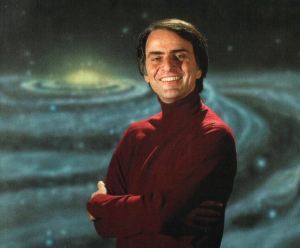
Carl Sagan is not Satanic


Is this the face of Satan?

Or did I mean to type ‘Carl Satan is not Saganic’?  Either way….

I was quite surprised when I was talking with a Christian relatively recently that told me that, within her experience of the Christian community, Carl Sagan was considered Satanic.  She had been told that she was advised to avoid anything by Sagan because his ideas were dangerous.

I grew up watching Cosmos.  I still think that it is a powerful piece of work that is important for our culture.  Carl Sagan’s calm and smiling countenance evoked a peacefulness and love for nature and science that surely influenced many people.  I can’t help but think that some of this influence settled onto the so-called “new atheists.”  There are certainly some, like Richard Dawkins, who invoke Sagan’s memory and influence upon their life and work.

But Sagan is not a “new atheist” in any way, right? Of course not; he died too long ago for that to be the case.  Or, perhaps he was just ahead of his time.

I don’t know what this term “new atheist” is supposed to refer to.  There have always been outspoken people for reason, evidence, and skepticism about religious claims around.  Epicurus might be the oldest such person, but certainly not the only critic who pre-dates the last several years.

And now as I think about it, perhaps the fact that some in the vast and differing Christian community think of Carl Sagan as Satanic were responding to a man who was ahead of his time.  Perhaps Carl Sagan, in many ways, was the cultural antecedent to Richard Dawkins, Sam Harris, Chris Hitchens, Daniel Dennett, PZ Myers, etc.  Perhaps, despite the fact that he was not precisely these personalities (as any of them is not another) he was the first of the new atheists.  And this is why the Christian community, or at least part of it, remembers him as Satanic.  I’m sure that many of those people think the same of people like me.

Perhaps I can offer this as some support for this view:

Purists will whine, I’m sure.  Sure, Carl Sagan had a deferential side at times.  His book, Contact (which is much better than the movie), surely plays fair with religious conviction, and is certainly no God Delusion or God is not Great in tone or content.  Nonetheless his personal views were that claims of religion were problematic and dangerous for society.  And while he kept an open mind–admitting that he doesn’t know–I don’t know many atheists who would not say the same thing.

All I will say is that those of us who are open about our criticism have been inspired by people such as Carl Sagan, and I hope that such cultural movements continue.  And even if we cannot consider Carl Sagan a member of our ever so sacred inner sanctum of future prophets of atheism, in the end it really doesn’t matter because this whole “new atheist”/”old atheist”divide is really quite silly.