The atheist conspiracy and secular culture


The_AtheistAtheists are distrusted more than any other group in the United States according to at least one poll. Things such as the “war against Christmas” and the culture wars in general help to create the perception that atheists and other secular thinkers are working together to destroy “traditional” values within American culture. “Family values” and Christianity are being discriminated against under the banner of the First Amendment. This secular goliath, led by academic elites, Liberals, and homosexuals, is threatening to destroy thousands of years of cherished, God-ordained, ideas.

If you listen to such luminaries as Glenn Beck, Rush Limbaugh, etc, then you may be aware of a concerted, omnipresent, and culturally destructive power structure behind the media, schools, and the atheistic scientific community that threatens to take God out of the world. This conspiracy has been in motion for decades, if not centuries, and will continue to destroy traditional Christian America until we are all living in an Atheistic, Communistic, and permissive culture that will drag the world into the recesses of hell.

What makes this feat so amazing is that it is carried out by a small (yet growing) and largely politically impotent group of people made up of often fiercely individualistic people. The various organizations for atheists, agnostics, freethinkers, etc throughout the United States, despite their differences, splintering, and lack of cohesive voice, have somehow managed to take control of the culture.

Wait…. a relatively small, disorganized, and powerless minority without any more in common than a shared disbelief in a divine being (for which no evidence exists) has somehow managed to overpower a majority who follow an omnipotent, omniscient, and eternal creator of all that exists?That some serious undertaking.

If you’ve ever talked to more than one of two atheists at a time, you’ll find that it is often difficult to get them to agree to much more than said shared disbelief, let alone organize effectively. The organization and size of the various Christian communities, despite their differences, with their massive media presence and cultural acceptance are in a much better place to maintain influence than any group of atheists. Therefore, another theory must be presented to account for the secular threat that faces religion today.

To begin with, we need to define secular. Secularism is not anti-religious, but rather a-religious. A secular person is not, at least not necessarily, against or opposed to religion. A secular person is someone for whom religion is a minor concern or at least of vanishing concern in making decisions about their society and culture. Their decisions are not made with any religious notion in mind, whether it is to follow or intentionally rebel against one. Secularism, therefore, is not the same as atheism.

Most people believe in some kind of divine existence. For the most part this belief does not shape the entirety of a person’s worldview; people still believe in using critical thinking of some kind for most of their every day decisions. Rationality, logic, and science have won out the day for the vast majority for what kind of medical treatment to get, how to understand how our computers work, and roughly how much we should pay for groceries. These are the tools that the secular world uses. They answer questions about many things, and still leave us pondering over others. When questions about ethics, purpose, and origins of life come up, most people pull out some kind of god or religion, but for most things god is essentially irrelevant.

Most of our decisions in life are made based on the secular tools we all have available. Secular ideas are everywhere, and to an extent they do threaten many religious ideas. But these secular ideas are not the result of a conspiracy to implement them in society by atheists, humanists, or any other freethinkers; they are just ideas that work, which is why we use them. It just so happens that skeptics, which tend to be atheists, tend to accept ideas which work. Thus, when many theists see secular ideas pervading culture and they see atheists and their ilk promoting these ideas, it looks like the ideas are emanating from these people rather than the other way around.

That’s right, the secular ideas, technologies, etc that have been developed throughout history—whether they were created by secular people or not—and tend to impress the power of rational thought and scientific methods onto people. When these people apply these methods onto the world, many of them tend to move further away from religion (especially more fundamental versions of religion) and become more secular people in general.

It is no surprise that some people employ these tools with more effort and to more areas of concern. Some people are meticulous with reason when it comes to their finances but will not even touch their spiritual life with those same tools. Most atheists that I know have simply applied their secular tools to religious ideas and concluded that they don’t hold water.

What this means is that not all people will become atheists. Many will still believe in a God or gods, but will find a balance, reconciliation, or separation between science and religion in such a way that their worldview is not threatened by secular culture. This is partly because secular thinking does not threaten religion unless said religion is so anti-science and non-rational that it is incompatible with all of the stuff that those secular tools create. The problem is that many religious people—fundamentalist Christians especially—accept claims about the world that secular tools tend to break when applied to them. It is from this that some Christians conclude that they are being attacked, oppressed, or discriminated against.christian_oppression_pie1
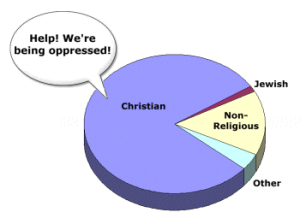
These people are not being discriminated against; they are simply disagreed with by people who accept secular methods for figuring out how the world works. If they feel persecuted, it is because they accept ideas that are unacceptable by standards of rational thinking. They are allowed to believe whatever they want, but they have to accept that when they try to claim that their beliefs are a part of our tradition, law, and culture, they have the right to be mistaken. Christianity in general is indeed a part of our shared history and culture, but not a part of or laws. And as far as tradition is concerned, sometimes traditions need to change just as they have been doing throughout history.

The more that secular ideas are understood and internalized by people, the more culture will move away from religion and belief in gods. I don’t think either will ever fully disappear, and perhaps that is alright. Science, rational thinking, and logic do not support many religious claims, but they also do not disprove many others. But the more we process towards a more complete understanding of the world the less that religion is asked to explain. Further, the explanations that religions continue to offer are all pseudo-explanations or simply insufficient, at least for those who have applied their secular tools to them. The many good ideas of secular culture will tend to support the atheistic position rather than the theistic position.

So, many people may not like atheists, but in most cases atheism is the result of use of the best tools that humankind has yet developed. Our disbelief in deities is simply due to the fact that, despite it’s presence in history, culture, and human life, religion just doesn’t work, at least not when we apply those highly regarded methods. I see it as an optimistic sign that secular ideas are accepted widely. I hope that it means that the future will hold greater organization among atheists, skeptics, and freethinkers of all kinds. This will be a sign of brighter futures.
The pseudo-depth of religion


We, unfortunately, live in a largely anti-intellectual and unsophisticated culture.  There is not ample interest in things philosophical or subtle.  I will not lament this here for its own sake, but I will mention this as a pretext to address another issue.

We are pattern seeking beings that desire meaning and purpose in life, but we are rarely exposed to the various approaches to finding these things.  The depth of that search is often too terrifying to traverse, and so we try to find other ways to fulfill this need.  And, lucky for us, culture and its complex structure has supplied our history with just such a function.  The vast majority of people are usually exposed to one source of meaning and purpose; am ancient cultural tradition that still holds sway for many people.

I want to call it religion, but that is too simplistic in the end.  It is my view that religion is a natural expression of our desire to explore the world for meaning. It is a way to look inward and in many cases to project outward what we desire to find there, and to latch onto narratives, myths, and the illusion of ‘something more’ in order to add color, depth, and importance to a world that seems meaningless.

It is a kind of metaphysical or ‘spiritual’ impulse to explain the universe in terms of intent, intelligence, and often in love.  And the result of this impulse that we share are the many religions an spiritual pursuits of the world.  These are the vehicles of providing meaning, purpose, and intent into an otherwise meaningless existence.  And because we sense this meaninglessness often enough, we seek shelter from those cold winds of loneliness and purposelessness.

That is, people seek the part of our psychology that is responsible for the religious cultural impulse to find meaning.  The easiest way to do this is to take an atavistic glance back to the introduction to such feelings; the religion of our childhood.  And if not our childhood, the religion of our early attempts to look for meaning in the world.  For many, groups such as Campus Crusade for Christ (or some similar group) seek to fill the insecure holes that creep into our lives in a time of emotional upheaval and change of the early tastes of freedom that college provides.

In general, whenever the insecurities and fears of life emerge, the desire to see meaning and purpose weaved into the fabric of life and reality act as a sort of blanket against the coldness of the world.

But before I continue I must hark to the whisper of a ghost which has come my way.  A strange and somewhat lively sprite—lively for a dead man, anyway!  A moving of thoughts tussles its way to my mind’s ear and words resolve into a thought:

Mystical explanations are considered deep.  The truth is that they are not even superficial

And with such a deep strike into the heart the thought evaporates and the spirit haunts another.  Or perhaps it has sunk so deep into me that I can no longer distinguish between it and myself.  The difference—it is indifferent!  But the whisper of the name of “Nietzsche” reverberates throughout and my mind returns to the task at hand.

But this spiritual visit has had a purpose, I fathom.  Because in a largely unsophisticated world, the early reaching for meaning and purpose are mitigated by religion; they are softened for us by a pseudo-depth of assertions of truths that are always bolstered by nothing but faith—in other words by sheer preferential desire for them to be true.

It is common for people to scuttle through there youth while largely unconcerned with the ramblings of religious ideologies.  Yes, if pressed they parrot the memories of their early exposure, but they live secularly and leave to Sundays (or some other bequeathed holy day) the quandaries of any depth.  It is only to these holy days that purpose and the insecurities of meaning emerge into the sunlight of our thoughts.

We have not yet allowed the scab to form over such insecurities in order to have our fears heal.  And so we protect our raw minds from the exposure to the dangerous world and we often miss the sophistication and depth which lives there while distracted by this protective preoccupation.  Because we spend so much energy nursing our fears in public, we miss the true depth of the world.

And so what of true depth and subtlety?  What of philosophy? Why, upon the hardship of emotional turmoil, of loss, or of dissatisfaction do people turn to their lord, to the false depth of dogma and myth rather than to do the real, hard, and growth-inspiring work of looking deep within without the lenses of faith and childhood brainwashing?

We avoid the difficult in life and revert to looking at it through Christianity or some other absurd softening of our mortality and ultimate meaninglessness.  And in doing so we miss that it is our responsibility to lend meaning to our lives.  We must take responsibility for how we face death, loneliness, and dissatisfaction.

So often churches will remind us that in the pursuit of money, power, or otherwise transient things, happiness can only be temporary.  They cannot supply real meaning for us, which we crave.  But then they assert that a real happiness, a real and eternal answer may be found.  But this is only an assertion.  It is a promise that cannot be kept.  It is another distraction from the truth that mature and aware adults have to face.  It is a fantasy to cover a scary world.

The thing is that the churches who remind us of the ultimate meaninglessness of our earthly desires are correct.  They just fail to acknowledge that they are not offering anything different.  Their mystical explanations are only deep in an illusory way.  Their façade is not even willing to dip its little toe into the waters of the universe out of fear that the water is too cold.  And it is cold.

Warmth can only be found with one-another.  And so churches, in gathering communities, are creating a mirage; it is not the message of eternal life that provides meaning and purpose, it is the company that sits upon this superficial message that supplies the meaning.  It is the illusion of having eternal companions, covered by real but temporary ones, that perpetuates the illusion.

When we find meaning and purpose in shallow promises of eternity, we find not even a shallow pool in which to swim.  The universe is deeper than we can comprehend.  Its true beauty lies beyond the fear that is manipulated by religion which only thinks itself deep.  Come and join the universe and dive into fathoms unfathomable.  Rather than transcend this world, transcend your fears of it and come swim with us in oceans of reality.  And when you do, you will find true warmth in the company of the disillusioned and the free.

The cultural assumption of monogamy (and gods)


assumptionsIt is clearly true that most people believe in god and that, in the end, we should at least try to choose one life-partner.  Not everyone will like that term, conservatively preferring the more traditional ‘husband’ or ‘wife,’ but this seems to be the prevailing assumption among people in our culture.  Polyamory or some other form of non-monogamy (i.e. swinging, swapping, etc) is almost always seen as the exception to that rule.

So, how much of this is natural?  Well, strictly speaking I believe (being a  metaphysical naturalist) it is all natural because everything that happens in a natural universe is natural.  The artificial distinction between the natural and the artificial is, well, artificial (to be slightly ironical).  But I digress….

How much of this is due to our in-born behavior and how much of it is cultural? I am really not sure, to be honest.  There seems to be components of both nature and nurture going on here.  What I do know is that I’ve never believed in any gods, never actually believed in any supernatural powers or beings, insofar as I actually understood what those terms were supposed to refer to.  I have also felt, in my moderate experience with monogamy, a little unsure about the idea that neither my significant other nor I would date or maintain other relationships while maintaining our own.

What’s wrong with monogamy?

I certainly do not believe that monogamy is wrong.  Even for people within the polyamorous community (one among many), being committed to a relationship with only one person (even if for only temporarily, but sometimes for many years) happens and people are often quite happy with this arrangement.   But why is it the cultural ideal or goal to work towards?  Why, when we talk about the long term, do our minds assume monogamous relationships?

If I say that I am engaged and getting married soon, do you assume I mean that my partner and I will be monogamous (or at least attempt that ideal?).  If I were to say that I was just married and that my partner and I are monogamous, would that seem redundant?  Would it seem redundant or extraneous to say that I’m married and am not monogamous? How about if I said that I am in a committed relationship but not monogamous? Does relationship commitment imply monogamy? It does not to myself nor many polyamorous people.

well, maybe not to hell...

My view about how relationships should form and be maintained is through conversation about what each individual wants and what can be negotiated through open and honest communication.  But it seems that the assumed track, even now with our more promiscuous society, is that while we can date a number of people early on, there is a point after which one has to decide if they will initiate a “real” relationship with someone they have been seeing.  The assumption is that after some time and intimacy, it is time to get serious and to make a choice about commitment, marriage, etc.  And this, of course, implies the ideal of monogamy, if not its actual practice.

And that, of course, means that continuing to date other people or–*gasp*–maintain another loving and possibly sexual relationship cannot be permitted to continue.  This would be cheating, after all, right? A commitment is a commitment.  It is not possible to commit to two, three, or even four people, right?

But how often do people actually discuss the nature of and boundaries of their relationships? I do, and people who know how to maintain a healthy relationship do, but I wonder how prevalent this is.  How often is the question asked “do we want to be monogamous?” rather than merely assume it? Certainly, some couples with ostensively ask “do we want to be swingers?” or “when I’m away on business trips can I fool around with other people?” but it seems that these are the exceptions to the rule; the exceptions to the assumed monogamy.

But why assume that?

The work and the benefits

Many will argue that monogamy is more stable.  Possibly, but I don’t see why this is necessarily so.  They will also say it is less complicated.  That last part is very true.  But we have to balance that against the fact that when we love someone, we can’t really not love them.

So, why artificially create a rule that you can’t act on or express those feelings because you have a relationship with someone else? Why limit this love to one person unnecessarily and arbitrarily? Convention? Tradition? Because that is what people want? Well, if it is what a person wants then I have no problem with that, but what we want certainly does not always line up with convention or tradition.  But when people like myself want something else, allow them the same courtesy please, is all I ask.

The benefits of the work it takes to maintain a loving, communicative, and healthy relationship is worth it, and it will be worth it no matter how many people are involved, assuming those relationships are all desired to begin with.  What else would be worth work more than that?  And if people choose to love more than one person, share their lives with those people, and create a loving family not confined by the rules of monogamy, then why wouldn’t this be a goal worth working towards?  Why would our culture not widely sanction this?

Fear is part of it.  Insecurity, the daughter of fear, too.  We fear that our lover will love their other lover more than us, that we will not get enough attention, that they may leave us for them, etc.  But the bottom line is that these fears still exist within monogamy, and quite often they are not talked about between partners.  Our creating the rule that we don’t act on these potential state of affairs (*ahem*) will not necessarily make them unwarranted fears.  It’s not as if people in monogamous relationships don’t meet people they are attracted to, love, etc and act on it.

And when they do act on these feelings with the loving approval of those with whom we are in relationships, then we have one possible expression of a polyamorous lifestyle.  Polyamory is what we make of it, after all.  It is really just responsible non-monogamy.

Communication

Poly people quickly learn how to communicate with their partners well or quickly find their relationships failing.  People in relationships of all kinds will find that this failing is allowed to often stretch into long periods of resentment and hostility that will boil under the surface without the presence of triggers such as seeing the person you are resentful of loving their other partner.  The presence of such things don’t allow festering relationship sickness to hide under the surface for very long.   Thus, where in monogamy unhealthy relationships can often be maintained for long periods of unhappy time, having other people involved tends to magnify these problems and bring them to the surface more quickly.

Relationships succeed in the daylight of honesty, openness, and effective communication; whether polyamorous or monogamous.  The fact is that these skills are essential in being polyamorous while only being highly preferable in monogamy (unless you want an actually healthy monogamous relationship).  Poly people become adept at being good at communication, honesty, and openness or they don’t succeed at maintaining loving healthy relationships with people.  That seems to make sense to me. I wish the rest of the world would learn from this.

Polyamory is not for everyone…at least not yet at least

I sometimes have trouble understanding people who say that they could never be polyamorous.  I understand that some people recognize that the work necessary to be successfully polyamorous is too much and so they choose not to try, but not the fact that they would not even want to.  But other people want different things, and I recognize this.

But there are practical concerns too.  I understand the social pressure to conform in order to not make their life more difficult; people are, after all, judgmental pricks quite often.  I understand that from a practical point of view rocking the boat only makes things more difficult for you and your family.

But the above are more emotionally mature rejections of polyamory.  The prerequisite to successful polyamory is the ability to maintain a healthy relationship with one person first.  Only after this has been established can one even try to maintain a healthy relationship with other people, at least in some romantic and/or sexual way.  There are other people who do not recognize that polyamory requires difficult work, and so their desires for more partners will often fail because they will do so at the expense of the needs of those they are with.  This leads to cheating, broken marriages, jaded people, etc. To reject polyamory because one has not mastered first the -amory is not rational.

Isn’t polyamory just sanctioned cheating?

Embedded within the assumptions that many of us carry about relationships is that to allow your partner to develop loving and/or sexual relationships with other people is to just to allow cheating.  But within the paradigm of polyamory, the open loving relationships that we have are all legitimate, and so your other lover is not a sanctioned affair or someone with which we are cheating. It is truly a relationship paradigm-shift in many ways.

Cheating is possible within polyamory; for when there is a lack of honesty and openness, the intimacy and sex that happens with others is not always acceptable to everyone.  Polyamory is not a license to do whatever one wants to do.  It is a continuous negotiation and discussion with the people we love to decide, collectively, what structure the relationship will take.  A couple deciding that polyamory is a good idea is not license for either partner to go home with whomever they please automatically.  This needs to be agreed upon.  The rules of a relationship are for everyone involved to decide together.

The Goal

So, what is it that I want? I want to live in a world where monogamy is not assumed as the ideal for a relationship.  I would just like to get to the point where openly loving more than one person would not be stigmatized.

Let me emphasize that.  I just want the freedom, for everyone, to openly love more than one person and maintain relationships with them to not be socially stigmatizing for doing so. That’s the state of our culture; it is considered wrong to love and maintain a relationship with more than one person. That sounds completely absurd to me.  What a screwed up world we must live in!

And belief in god, especially the silly gods of the major world religions? Don’t even get me started….  That will be a rant for another day.

Most people believe some really silly things.  Here’s to a world of rational and loving consideration of our human conditions.  And here’s to real freedom of thought.

Love openly, love fully, and love well.

Atheist v. theistic arrogance


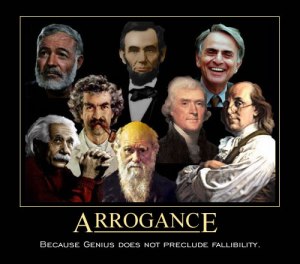
arroganceOne of the charges leveled against the so-called “new atheists” is that of arrogance.  This comes in more than one form, however.  The first can be exemplified by the recent book I Don’t Have Enough Faith to be an Atheist, which makes the attempt to argue not only to the strength of the Christian message but that it actually requires faith to be an atheist.  Similarly, some apologists have tried to argue that to say that there is no god would require knowledge of everything in the universe; without absolute knowledge such a claim would be absurd and arrogant.  This seeks to pin the burden of proof on the atheist for their claim that god does not exist rather than on the theist for the opposite claim.

Except this is not the atheist position; atheism is the lack of belief in any gods.  Period.  The subtle distinction between lacking belief in any gods and claiming that no gods exist–lacking belief rather than believing lack–is essential to understand here.  I do not claim that no gods exist.  I claim that I don’t see sufficient reason to believe that one does.

But this is not the only way that our arrogance is pointed out by critics of atheism.  In other cases, our arrogance is in the criticism itself; of our obnoxious tendency to actually criticize people’s beliefs.  Where do we get off thinking that we know more than they do?  What gives us the right?

Well, quite frankly, the first amendment gives us the right (at least in the United States).  But more generally, the freedom of thought, opinion, and of criticism is a human right that should be upheld everywhere.  Religion should get no free pass in the marketplace of ideas.  Supernatural and superstitious beliefs are, like any belief, open for criticism.  If you don’t want your beliefs open for such criticism, well then that’s too bad.

Further, concerning why atheists think we know more than others; we may not.  But in my experience, atheists, especially those that are active in the community, tend to be much more educated and knowledgeable about religion in general and various holy books (especially the Bible in the case of those that I know) specifically in comparison with those that claim them as their holy books.  It’s not that we all know more than believers, its that many of us tend to know more than most believers.

It has been said that the Bible is the best book to read if you want to become an atheist.  In a sense this is true.  I have read the Bible, annotated versions as well, and have read about its formation, history, and backgrounds for the various books it contains.  I cannot comprehend how anyone can view it as the word of a god.  I cannot comprehend how it isn’t seen as no different than fairy tales mixed with poetry, philosophy, and bits of history.

Is this arrogant of me to say?  It may be irreverent, but there is no special reverence to be had there in my opinion.  I do like Ecclesiastes and Job, among a few others.  But I also like The Bhagavad Gita and The Odyssey. It is no more arrogant of me to say than it would be for a Christian to say that the Koran or the Vedas are not the word of a god.

But let us step back again for a second and look at the general issue at hand.  Atheists are being called arrogant for criticism of belief in god.  There is a sort of irony here.  Atheists being called arrogant because we don’t believe in silly stories about Mohammad being taken up to heaven, Jesus resurrecting, or in the various incarnations of Vishnu.  And yet it is theists of various religious traditions, with no mental capabilities that I don’t have, claiming that they are certain that not only does god exist, but they know its name, knows what it wants, and that they have a relationship with that deity.

They just know that their religious experiences are real.  I don’t doubt they have teh experiences, I doubt their interpretation of them.  From the point of view of a believer, all of the other people who believe in other gods are, I suppose, delusional or incorrect, but not them.  This is arrogance.

Theists thinking of atheists as arrogant because they don’t believe in their god is real; that is arrogance.  My irony meter has been broken too many times by this charge, and so I am not sure how much this is supposed to bother me any more.  Theists, please examine the log in your eye before trying to point out the splinter in the eyes of atheists.  You are the ones claiming knowledge about the proposed creator of the universe.  I’m just saying that I don’t believe you actually have such knowledge.  You believe, and I believe that you belief is unjustified.

That’s why theists have faith.  Because if you had evidence or knowledge, you would not need faith anymore.  I do not have faith in any gods.  If this is arrogance then the definition of arrogance has been stretched to the point of language breaking down to mean whatever we want it to mean.

I want arrogance to mean what it is supposed to mean; an overbearing sense of self-importance or self-worth.  Thinking you know what the creator of the universe’s name and access to its truths is would put someone in such a position.

The further irony is that many theologies seek to diminish this arrogant position by telling people they are sinners, insignificant, and that the height of piety is humility.  This is why they think atheists are the arrogant ones, because the arrogance of their own position is cleverly hidden behind subjugation to that which they arrogantly believe exists.

What a mind-fuck!

Theology and science fiction


If you want to make a little money, write a book. If you want to make a lot of money, create a religion

L. Ron Hubbard (creator of Scientology)

I like science fiction. I wrote a science fiction novel (it has not yet been published).  But nonetheless, I know a little bit about the creative process that goes on in creating a story.  One has a world in mind, and that world has rules, social realities, etc that provide constraints for the writer.  And within those constraints one finds that they are able to create provocative and interesting stories that make the characters believable, problems understandable, and plots engaging.  The world becomes coherent.

More generally, we are able to construct stories and explanations about worlds–worldviews even–that are meaningful to us.  In an attempt to understand the real world outside of fantasy, were people that found themselves within a worldview that included deities, prophets, daemons, and even sons and daughters of gods doing something much different?

For thousands of years of human history, the model of how the world worked was not what it is today.  Pre-scientific models of the rules of the world we live in had ideas such as nature spirits, daemons, dragons, and so forth that sought to paint a picture of the world that contained magic, divine intervention, and even divine presence.  It was a dualistic worldview that dominated most of the world.  I have forgotten; that world has not disappeared for many people even still. The world as it is today does differ based upon ones understanding of the rules one accepts.

Science is not just another narrative among narratives to explain the world.  It is a shift in methodologies in how we explain the world that demands evidence.  And yet, still, there are multitudes of people that maintain older worldviews as still being relevant to us.  They still contain truths, even if the world it paints is itself not true.

That is the bottom of theology.  It is the attempt to make sense of the worldview one accepts in order to tell a meaningful story about the world we live in.  But in doing so the constraints don’t have to be what is true.  If one accepts that Mohammad was taken up to heaven in Jerusalem, that Jesus resurrected, or that Osiris was reassembled and thus resurrected by his wife/sister Isis after being dismembered by Set, then these are part of the basis for the rules for the story you will tell about the world.

Thus, a theology can be internally consistent.  It an proclaim meaningful ideas about the world within it’s constraints.  But this is because we are pattern-recognizing and meaning-creating beings.  We are able to find the raw materials for meaning in all sorts of places.  The fact that the things people find important seem coherent and important to them is certainly not to say that they are true.  Truth, at least not by itself, is not required to find meaning.

If we accept the basis of the Abrahamic God, the concept of sin, atonement, etc then the story of Jesus and his “sacrifice” makes sense within that world.  If someone had written a set of science fiction novels that told the essence of the story within the Old Testament, the New Testament story (assuming we could actually boil it down to a single coherent narrative) would be a sequel that would make sense within that universe.

This is not to say that the universe that it makes sense in is this real universe.  This is what the discussion about religion and society comes down to when we are dealing with the truth.  Religious ideologies are meaningful, important to the adherents, and interesting to many, but they are not true in the same sense that it is true that when a particle and an anti-particle meet, they annihilate each-other and a photon is emitted.

Nice costume! Is that from Babylon 5?

Good science fiction does not need to be strictly scientifically true to be good.  The reason is that we can tell meaningful stories within imaginary worlds that tell us things about ourselves.  Good science fiction is an expression of our humanity on a different canvass.  Theology is no different, except that those that read science fiction realize (at least I hope they do) that they are reading about imaginary worlds.  Imagination and creativity are great, and without them culture would be poorer.  But it is time for people to realize that fantasy and theology are akin in ways that seek to provide a space for people to guide their real lives by imagination.

A future female Pope's costume?

Both George Lucas and the Pope are very wealthy people who live very comfortably.  But we all admit that George Lucas tells stories.  From my point of view, the Pope simply became the new leader of an old story that people keep paying money to see and live within.  The Catholic church is one example of a never-ending convention of people pretending that the story of Jesus is true.  At least with science fiction, most of the convention people go home and put away the costume after a fun weekend.  And if they don’t, we think they are a little weird.

I think that people that think Osiris, Jesus, and Thor are all real are a little weird.

Dragon*Con provides synchronicity and skepticism


So, I attended Dragon*Con last weekend.  It was sort of a last minute thing, really.  See, my friend Margaret Downey was scheduled to speak there and needed an assistant.  I was in need to go to Atlanta to do some apartment hunting, and things fell together nicely.

Margaret Downey (left) with Eugenie Scott of the NCSE

If I were a less rational person, I might have thought some intelligent design was at work. But I’m a skeptic.  And luckily for me, there was a track at DC for people like me.  The skeptrack dragon can be seen to the right with two of it’s guests.

Margaret Downey has been doing a variety of characters over the years to deal with a number of issues related to skepticism, atheism, and freethought in general.  On Friday night, she did a presentation about anti-superstition parties, and superstition in general, at the Skeptrack section of Dragon*Con as the Friggatriskaidekaphobia Treatment Nurse.

After all, we know that there are lots of people who are into science fiction and fantasy who believe lots of silly woo things.  The skeptrack, organized by Derek of Skepticality, is focused on trying to introduce skeptical thinking into this culture, as a sort of outreach to the larger community of slightly nerdy, geeky, and sciency people.  The fact that Dragon*Con 2009 attracted more tha 45,000 people means that there are a lot of people to reach out to, and in future years they hope to become a larger and more significant part of the event. I’ll look forward to that.

I mean, we all like to meet some celebs, right?  I got a chance to meet some of the cast from Babylon 5, which was pretty sweet because it is among my favorite sci-fi shows.  I also got to see people from Stargate, Star Trek, and he recent Battlestar Galactica (don’t get me started on how annoying I thought the ending to that was…).

Those Skephicks love them some aliens.

On top of all that there were some pretty awesome costumes. In the picture to the left, Maria from the skepchicks is getting to know the local alien population a little better.

Of course, alcohol was involved, and hopefully she won’t have any little aliens popping out from her stomach anytime soon.

And what was great about the plethora of costumes, from a male heterosexual point of view, was how economical many girls can be with their costumes.  I mean, making a whole costume while using so few materials? Brilliant! I must say my head was turned on more than a few occasions, which distracted me sufficiently as to not get my camera out in time.  My lovely girlfriend, who stayed back in Philadelphia for work training, would have been thoroughly amused by this.  Actually, she would have likely done the same thing with the many guys who were not afraid to show off their various attributes.  We are quite a pair.  And speaking of great pairs…never mind.

And there certainly were a lot of people there.

Just one shot from one of the many hotels involved in the convention on Saturday night.

And I got a chance to meet some pretty cool people there as well as well as catch up with some friends I only tend to see at such events.  A few drinks, late night conversations, fun panel discussions, tens of thousands of people and science fiction.  What else does one want from a weekend?

And you read correctly above; I was looking for apartments.  My lovely lady and myself will be relocating to Atlanta come October 2009, just a few weeks away.  But there is a good set of communities down there so we will be able to make ourselves at home.  I’ve already been in communication with people from a skeptical community down there, I will be in contact with the atheist and polyamorous communities, and then I will have to find myself employment in Atlanta.  We are moving because of Seana’s new job, and I love her enough to relocate to be with her.

Philadelphia is a great city and I will miss living here.  What I won’t miss is cold winters with snow, slush, and ice.  A nice cool winter with occasional snowfall seems much preferable.  I will miss hot, fresh Philly pretzels off the conveyor late at night, however.

But I’ll still continue to be your friendly neighborhood atheist, polyamorous geek.

Religious hippies; why they annoy me.


criticismConservative fundamentalist Christians don’t like criticism of their worldview.  And there are all sorts of perspectives from which they receive such criticism; from atheists, other religions, and even other denominations.  Perhaps the other denominations don’t criticize as much as they at least share some absurdities in common, but nonetheless they do get some from that corner.


But I’ve noticed something about more liberal religious people; they are not used to being criticized.  After all, it is often their whole mantra of tolerance, acceptance, and bringing together of people that they emphasize. Hippies.  I’m talking about hippies, people.

And it isn’t only Christians…oh no, not in the least.  In my lifetime I have had very unhappy reactions to questions, challenges, and criticism of theology from liberal Christians, Pagans (especially one Wiccan woman who I thought was going to hunt me down and ritually murder me for asking about the 5 elements), and other ‘newage’ (yes, it rhymes with sewage) “spiritual but not religious” types who despise man-made religion but have created their own.  All religions start out as personal spiritual creations, people!

Having attended a very liberal and religious school for 13 years (A Quaker school in Philadelphia), I became very familiar with how people of this persuasion behave.  They are open and tolerant of others views (although for some this is a pretense), they want everyone to get along, and they absolutely hate when their view is not tolerated (although they may try to tolerate your intolerance).  They are being tolerant, after all; they should receive the same tolerance, right?

The fact is that liberal Christians, Pagans, and other new age people believe absurd things as much as any conservative nutjob.  They are simply different kinds of nuts.  So when I see people talking about things such as “The Secret,” “What the Bleep do We Know,” magick, crystals, Jesus as some all-loving hippy, or the fact that god is female, I just want to throw my hands up in a fit of frustration over the absurdity of it all.

Hey, liberal tolerance-driven ‘spiritual but not religious tolerance monkeys; you cannot expect to be left un-criticized just because you think that criticism is bad or disrespectful of people’s beliefs  Criticism can be very good, and saying one should not criticize is criticism.  Jesus was no hippy about peace.  In fact, he specifically says so in Matthew 10:

34 ‘Do not think that I have come to bring peace to the earth; I have not come to bring peace, but a sword.
35For I have come to set a man against his father,and a daughter against her mother, and a daughter-in-law against her mother-in-law;
36and one’s foes will be members of one’s own household.
37Whoever loves father or mother more than me is not worthy of me; and whoever loves son or daughter more than me is not worthy of me;

And Paganism is not older than Christianity.  I know that most of them say that it should be revered because it is ancient and they will whisper snidely to one-another that Christians are practicing some new religion in comparison, but that is total crap.  Paganism is based loosely on myths and legends that are quite old, but as it exists today it is less than 100 years old.  Pagans, you’ve been had.

The worst part is that people in these camps often have such vague and unspecified ideas that you can’t even pin them down.  It is as if they have some feeling that something in the universe loves them and so they attach a whole bunch of gobbledygook to it and think they are somehow more in tuned with nature and the universe while us metaphysical naturalists are just missing it.

No, I’m not missing anything.  Not missing your mamsey-pamsey crap at all….

So sure, you liberal religious people don’t discriminate against gays as much, you don’t try to enforce virulent views on the world through legislation, and you have more enlightened views about women (although some take it too far and try to elevate women above men, quite ironically) and you promote peace.  But the fact is that the bases for your spiritual and religious beliefs are as tenuous as those of conservative evangelicals. In fact, many of these vague and ultimately absurd and meaningless spiritual views are more annoying to me.

The major issue for me is the general view of science by many people that fall into the liberal side of the question.  Science is the best method we have to determine truth.  It is not just another narrative equal to any other.  Your crystals will not heal you, homeopathy is ridiculous, and your chi (or ki) is not blocked.  There are some things that show that acupuncture might have some helpful effects, but you cannot influence the universe directly with you thoughts because of quantum non-locality.

There is a culture war going on.  Part of it is between believers and non-believers, but really the more interesting battle is between believers of different things.  The mamsey pamsey ideas and the literalists (although both sides pick and choose verses and ideas from their various traditions) put on a cultural show of absurdity that people like myself–atheists mostly–sit back and just shake our heads at.

It is not completely unlike matter and anti-matter.  When they meet they anihilate each-other and we are left with not photons but skeptical disbelief, which sort of works because skepticism is a kind on illumination.

Crap, I may have accidentally just created another vague, mamsey pamsey, liberal theology with my analogy.  Man, being a ‘spiritual but not religious’ vague-theology-having, holier-than-thou tolerance monkey is easier than I thought; I think I just joined or created another version right here.

You are now required to tithe to me, your sacred prophet, in order to receive more wisdom.

Paypal at ShaunPhilly@gmail.com

Welcome to the church of Dionysus!

(he was always a favorite)

Oh, wait…the Pagans already claim him I think….

Never mind.

I am an atheist because God wants me to be an atheist


If God were a superhero, he'd wear this
This is what God wears

I don’t generally try and define God.  It is not my place to tell people what a god is.  I will generally ask what a person believes and why, and then deal with what I hear rather than attack straw-men.

And yet there are some attributes that are generally associated with God, especially in western culture.  When you press most people, they will define the omni-max god; the god they believe in to be omniscient, omnipotent, and maybe even omnipresent.  Sometimes, omni-benevolence even added, although that last one makes no logical sense in light of the previous three.

I refer, of course, to the famous question posed by Epicurus:

Is God willing to prevent evil, but not able?
Then he is not omnipotent.
Is he able, but not willing?
Then he is malevolent.
Is he both able and willing?
Then whence cometh evil?
Is he neither able nor willing?
Then why call him God?

This is, perhaps, one of the most eloquent ways of illuminating the problem of evil.  I shows two things; the first is that the skepticism about the nature of god in light of reality is ancient.  The second is that the logical problems of a god with all of the attributes listed above are of legitimate concern for anyone who takes such things seriously.

And many do take this issue seriously. There is a whole area of study within theology and apologetics called theodicy designed to respond to this problem of evil.  It is not my intention to evaluate theodicy here or to expound upon the problem of evil itself.  It is brought up because it lays tangentially next to an issue that brings up some of the same type of logical problems.

Free will.  Perhaps one of the most complicated philosophical problems to struggle with, and one I will not even attempt to solve here, is the question of how we can be free.  I’ll say, briefly, that I don’t think that the question is as simple as the dichotomy of determinism and free will.  One of the reasons is that I don’t think that the universe operates under circumstances that allow the question to be rationally parsed so simplistically.  Essentially, I tend to agree with compatibilists.

One of the issues is how free will is defined.  Obviously, our will is not absolutely free.  I cannot will impossible things, or even possible things that are beyond my cognitive or physical ability.  My will is limited to what is possible for me to accomplish.  The question is to what extent do the predictable laws (if they can actually be called laws) of nature determine what options an agent has at any point.  To what degree is cause and effect responsible for our decisions?

So what does this have to do with God? Well, if God is omniscient and omnipotent, does that not imply that God knows everything and has the power to make the universe any way that it wants? That’s what the words seem to imply to me, but perhaps my Latin is weak.  Would this not imply that every word I type here, the position you are in sitting or standing while reading it, and whether you are tapping your foot or not were all things known by God when it created the universe?  If so, in what sense did we choose these actions?

Apologists will insist that God gave us free will, and so we have the ability to choose our daily actions.  This way, our obedience or disobedience to god are our responsibility.  In fact, some apologists will argue that our belief is our responsibility (I disagree; belief is not subject to the will.  I believe or disbelieve because I have been convinced or not, not because I choose to).  But what does the deciding? Are our bodies not part of the so-called creation which is subject to the laws of nature? Is there a part of us that is not effected (and yet affects) the rest of us such that it is not subject to the same laws?

Pardon my skepticism–no, scratch that, I will not apologize for my skepticism–but I see no reason to believe that any such thing exists as part of us. From what we have been able to tell, our thoughts, feelings, decisions, and opinions are all housed in a biological machine of the brain and body which are part of the chain of cause and effect like everything else.  Our decision-making powers are all subject to being altered by states of emotions, how tired or intoxicated we are, etc that leaves little to no room for contra-causal free will, let alone a vehicle for such a thing.

But back to a deity; what sense does it make to say that a God who knows everything and is capable of creating the universe any way it wants to (perhaps within logical possibility, if this is in fact a limitation on God.  If so, then so much for the transcendental argument for God), at the same time is not responsible for any “choice” that anyone makes?  If I choose to type the word ‘poppycock’ right now, one question could be whether I could have chosen any other word, but the more pertinent question here is whether this was really my choice at all if God created the world exactly this way and knew that this word ‘poppycock’ would be the one I would choose at that time.  Otherwise God is not omniscient.

Poppycock?

A common apologetic is to argue that God chooses not to know certain things.  That in giving us free will, God gives us a gift of choice.  This is nice to assert, but it does not hold up to scrutiny.  “But God can do anything!” some will say.  Yes, but that is precisely the question at hand; does it make any sense for God to be omnipotent and omniscient (that, in itself may be redundant) and yet for people it created to be free to make choices? I don’t think so.

Something has to give here.  God’s nature will have to be reevaluated (and many theologians do just that, I am aware), our freedom will have to be reevaluated (and reformed theology deals with this), or we have to get rid of this concept of an omni-max god.  My interest here is to have people realize that the omni-max god has theological and philosophical issues that need to be dealt with.  One cannot simply say, and stand on rational foundations, that God is all-knowing and all-powerful and that you actually chose to submit your life to him and that because I have not I am damning myself.  That is absurd.

If God is truly omni-max, then I am exactly as God intended; an unrepentant non-believer who openly challenges the theology that it is solely responsible for.  I don’t do it out of hatred for any concepts of gods or even of those who follow it.  I do it because it is absurd.  And if this omni-max God is real, then it knows my reasons for not believing and has not seen fit to have made me any other way.

Faith v. Evidence


theistic ironic comedy?

All too often I will hear from theists (but not exclusively), that there is plenty of evidence for what they believe.  And sometimes there is.  In that case, well bravo! Now we have something to talk about.  But inevitably, somewhere along in many discussions, the dialog comes down to their faith.  That is, when the evidence that they demonstrate either has not convinced someone else or they are shown why the evidence is insufficient, they pull out the faith card.

But what is faith? It is the believe in things despite the lack of evidence.  It actually may be, in some cases, the belief in something despite contradictory evidence.  Creationism is a prime example.  Despite the overwhelming evidence for evolution by natural selection, some people still think that magic man done it.

And, of course, creationists don’t have any evidence of their own, just lame apologetics.  But the same goes for gods in general.  What’s worse is that the evidence pointed to, even if reasonable, points to some vague higher power rather than their very specific deity with all of its personality.  But they believe anyway.

There is a very short and quick response to such faith and the attempt to show such evidence.

If you had evidence, you would not need faith.

That’s right, folks, faith is what is pulled out because you have insufficient evidence.  The whole idea of faith is that one believes something despite the lack of evidence.  So if one actually did have evidence (as theists, creationists, birthers, etc do not) then their belief would never have to appeal to faith because they would have something demonstrable to point to and then we could all take a look at their evidence and deal with it.

Pulling out faith is akin to admitting that one has no rational reason to believe in what they believe.  They have admitted that they have no evidence to bring.  Sure, they will trot out apologetics, but these are only brought out either in some ironic sense (they are putting us on, perhaps?) or or because they don’t see the extreme irony of being people of faith trying to provide evidence.  It’s almost like saying that one does not need evidence (faith, after all, is better in many of their minds) but insisting that they show evidence anyway because they know, deep down, that evidence is how the rest of the world (including themselves for every other belief they hold) is how the world makes decisions.  It’s a beautiful little display of compartmentalization and irony, unfortunately not intended to be funny.

It’s quite adorable to watch.  It’s almost as adorable as watching a small child pour tea for their imaginary friends while introducing you to them.  It is play, so you say hello and drink some pretend tea (perhaps its supernatural or transcendent tea–what is the difference between the transcendent and the non-existent anyway?).

Except they are adults, which makes it a little weird.

So, the next time someone tell you that they have faith AND evidence, perhaps you could stifle your laughter at the joke, because they might not get the irony.

An atheist in the pews (part 1?)


I have not been to church in many years, at least outside of weddings and such.  I often think about dropping in for a sermon to see what people are hearing from the pulpit. But a few days ago my girlfriend, who has just recently become rather distant from the Christian message and theology from which she was raised, suggested that we go to the church at which she is still a member in order to get a closer look.  So, while I prefer to do other things of Sunday mornings. I agreed and we planned to attend the 11:00 service at a church in downtown Philadelphia.

I must say it was rather odd to walk into the building with the organ playing and people singing (we got there just a few minutes after the service started–parking issues).  I felt a bit like an ethnologist trying to blend in and not be noticed.  This necessitated no identifying atheist clothing as well as using her car to get there, as mine has a few bumper stickers that would give me away.

My goal was to observe quietly and not to draw attention to myself or disrupt their services.  I won’t name the church, but I will say that it is a Presbyterian church, a denomination which I had never previously attended services for.  Calvinists.  In other words had I talked to some of the people, they might have concluded that I was not one of the predestined to be saved.  Poor me.  Created to be absent from God in Hell for eternity.

I didn’t want to stand out, but I couldn’t exactly participate either.  I sat, quietly, while others stood and sang (nobody wants to hear me sing anyway) and watched as others bowed their heads in prayer.  I ended up making eye contact with a few people who were doing something similar, even if they very quickly snapped back to praying at being caught looking around.  There was a little girl next to me whom was playing the whole time, and she gave me a curious look once or twice as I sat and took notes.

JephthahMeetsHisDaughterThe sermon finally came.  The reading was from Hebrews, chapter 11:32-38.  The subject; strength through weakness; strength through faith.  Now, these verses mention such luminaries of faith and weakness as David and Jephthah.  The David of mass murdering, rape, and destruction and the Jephthah whom killed his own daughter, as attested to in Judges chapter 11.  These were given, among other similar characters, as people who found strength in weakness.

I’m must disagree. These were not men who knew weakness as much as they knew power and destruction, except the kind of weakness which allows one to commit mass murder.  This is usually the weakness of insecurity and fear that one uses to fuel the need to inflict their will upon the powerless.  The kind of insecurity that religion has often used for millennia to conquer its enemies.

The minister who gave the sermon said that faith is “not thinking you can” but rather “believing God can.”   He continued by saying that “this is not a gathering of strong people,” but of the weak and needy, those suffering in hard times and who need God.  When I heard this, I felt despair rise inside me.  I imagine I was not the only one.  But my dispair was one of feeling sickened at seeing open (if unconscious) emotional manipulation in front of me.

Marketing 101: Make your audience feel a lack of something in their lives.  Then present something to fill that gap. This will lead you to sell your product better.

He continued by saying that “this is not all that there is.”  Heaven.  This life is but a small step before eternity.  It does not matter as much, “now is a preparation,” so suffer through this struggle of life in faith and heaven awaits you.

But that wasn’t the worst.  The worst was when he pulled out the “enemy.”  This enemy was not named, but the enemy asks questions like “what has your faith gotten you?” and “why believe in God?” I’m sure that many in the congregation have a family member, a co-worker, or even a neighbor who is skeptical, an atheist, etc.  This part of the sermon is supposed to address the doubts that people have, the temptation of the enemy to become skeptical.  Those questioners are the enemy.  I am the enemy.

He went on to criticize the “despicable heroes of Western culture” who are interested in material things, money, and this life.  These are the “anti-heroes” not worthy of the respect we give them.  Instead, this minister holds up the aforementioned David and Jephthah as the heroes of faith we should look up to.  What a reversal! Nietzsche would have smiled before he scrawled something beautiful and corrosive in response.

Now, I’m not all about material wealth and status.  I agree, as I have discussed elsewhere, that there is a problem with our culture that needs addressing.  However this sermon creates a false dichotomy between faith and materialism.  This sermon overlooks people like myself who abhors faith and yet is critical of the petty materialism of our culture as well.  From the minister’s point of view, if one lacks faith one becomes subject to the fashions and tides of the world, it seems.

Faith and struggle.  These times, for many (including myself), are times of struggle.  And I will give credit for the sermon addressing and condemning the so-called prosperity gospels (there was an article about this in the New York Times a couple of days ago), as they only seek to feed off of people for the church’s prosperity.  But I think that the message of this church I attended is not that much better.  It tells people to not be too concerned with this life, because there is something better coming.  Slave mentality. Instead of robbing the congregation of its money (although they did ask for donations with the trays being passed around), the sermon robbed the people of their confidence, self-worth, and enjoyment of the now.

There was a teasing that came next.  “What does faith guarantee you?” he asked, pausing and making commentary before answering.  The anticipation mounted, the mind reeled in trying to anticipate an answer (heaven, happiness, love, what?), and for it to lead to the answer of “God” was akin to absurdities my mind could not be so self-destructive to think up without imploding in a fit of paradox.

“Faith guarantees you God.” guarantees? How? This is one of the most absurd things I could think of, although I should not have been surprised.  There is a sort of moment in the mind at the presentation of absurdities where the mind reaches a sort of impasse that can be beautiful.  I imagine that for many people this is not unlike the presence of God, lost in the mystery of the end of ones mind and seeking the abyss that lies beyond.  Yes, there is a certain beauty in paradox and absurdities, but this beauty is manipulated for the needs of a God-message here.

Now, the good minister was not kind enough to define faith, so I can only refer to the same book and chapter from which he drew his sermon (Hebrews 11, in case the absurdities above have wiped your memory):

1Now faith is being sure of what we hope for and certain of what we do not see. 2This is what the ancients were commended for.

So, belief in God which we hope for but cannot see gives us God? This is a very good example of epistemologically immature thinking.  This is what I addressed earlier in talking about the false hope of faith.  This faith does not guarantee anyone God, but it might guarantee the delusion of God.  Hope, “because God is.”  Faith attaches us to God.  This is the message that was left at the end of the sermon.  The hope of faith gives you God because faith guarantees you God.

This is what is wrong with much of the Christian community; circular thinking.  As a non-believer in the pews, all I could do was look around me with my figurative jaw gaping with disbelief as to how people can hear this message and not have fallacy-alarms blaring in their heads. Instead, many nodded, I heard a few amens, and there were hopeful smiles.

It is only a message of slave morality, of slave mentality, that could orient oneself to the unseen as the gift of believing in it.  It is philosophically no different than me believing I can fly like Superman because I believe that I can.  I simply cannot understand how this sermon does not cause people to walk out and never return.

But they will return, getting up on Sunday to come back for more.  I don’t know if I will, but I might.  I am perpetually fascinated by this thing called faith and what behavior it causes.  I find it despicable, pathetic, and sad overall, but fascinating nonetheless.

This was supposed to be a congregation of more educated and intelligent people.  And yet I find sophomoric platitudes that a freshman taking philosophy should be able to flatten. I find nothing challenging or inspiring.  I find nothing even beautiful in this (although the hymns are closer to this).  I find only ugliness called hope, as if the faith that this message is hopeful and beautiful makes it so.

It doesn’t.