Religion and Politics: Robert Benne getting it wrong


I occasionally peruse the local online news and commentary sites to see if there is anything interesting being said about religion in the Philadelphia area.  Most of the time there is little to nothing, and when there is it is not very interesting.  Today I found this article by Robert Benne, who is a lecturer at Roanoke College and who is the Director of the Center for Religion and Society there.  I have little doubt that Dr. Benne knows a lot about religion and society.  I have no doubt that I could learn many things from him about those topics and others.  But what is clear is that Dr. Benne has little to no understanding of the opinions and goals of the vast majority of the atheist community.  His claims in the article are based on a prevailing ignorance that I find from many people, even within religious departments of colleges and universities.  They should know better, but they so often disappoint.

Here is some of what he says in the beginning of his article:

Could you ever imagine that an American government would order the Rev. Dr. Martin Luther King Jr. not to use Christian rhetoric to fuel the civil rights movement of the 1950s and ’60s?

That is precisely what some militant atheists, secularists, and even some religious leaders want to have happen today. These folks are what I call “separationists,” those who believe that religiously based moral values ought to have no place in public discourse or policy-making. While most of them merely disapprove of such an interaction of religion and politics, others are so hostile to religion – especially conservative Christianity – that they would formally prohibit it.

Separationists come in different varieties, all of which provide examples of how not to think about the relation of Christianity to the political sphere.

There are the militant atheists – Richard Dawkins, Daniel Dennett, Sam Harris – who find religion so dangerous they seem to want it banished legally from public life.

[emphasis mine]

I cannot imagine any atheist leader asking Dr. King to do any such thing.  And if one did, they would receive a lot of flack from the atheist community, as they would deserve.  Dr. King is an inspiration to me growing up, despite his religious rhetoric, as was Malcolm X.  The US government would have no legal basis to ask Dr. King or any like him to stop using religious rhetoric for any reason, at all.

The term “separationist” seems to be a reference to the separation of church and state, the idea promoted by Thomas Jefferson and James Madison, coined in a letter by Jefferson to the Danbury Baptists in Connecticut, and implied in the first amendment to the constitution (especially in how it has been interpreted in  judicial precedent since).  But there is a drastic misunderstanding on the part of Benne concerning the goals of people such as Dawkins, Dennett, and Harris.  But perhaps even more drastic is his misunderstanding of the greater community fighting for the separation of church and state to be maintained, such as Americans United for the Separation of Church and State, led by the Christian Barry Lynn.

Despite the assertion, I see no evidence in anything that Dawkins, Dennett, or Harris (or other atheist leaders) has said or written which would imply that we “militant” atheists are people  “who find religion so dangerous they seem to want it banished legally from public life.”  We do not want religion banished from public.  What many of us ask for is that there be no official, that is government led, religious activities such as the National Day of Prayer, public school-led prayer (which is essentially the same thing), or to have specific religious doctrines act as the basis for discriminatory laws (whether they be about gay marriage or otherwise).  We are not trying to deny religion to the public sphere, we are trying to prevent it’s unconstitutional inter-mingling with a secular government.  The distinction is important, Benne’s mistake common, and this type of correction tiring.

Benne continues:

Others – not so militant – want religious people to drop their religiously based moral values when they enter the political sphere. They want only secular, rational, and purportedly universal values to enter the public square. They consider religion so parochial and irrational that it will likely lead to some form of theocracy if it has its way in the public sphere. For example, they are appalled that religious people have effectively supported policies that limit abortion and wrongly say such actions are a violation of the separation of church and state.

This is more slippery, but still wrong-headed.  It’s not that we want people to drop their beliefs when they enter the political sphere, it’s that we want them to remember that their religious beliefs are not necessarily shared by their fellow representatives, their constituents, or their society in general.  Their personal religious opinions, no matter how devout they are, may not reflect the culture effected by their legislation.  And yes, many of us, including myself, ask that secular and rational consideration is given to political and legislative decisions.  Why? Because that is the appropriate constitutional attitude to take in such a position.

I realize that a person’s convictions are going to inform their opinions, but they don’t have to compel their acts as representatives.  I, as an atheist, would not try to legislate atheism into law (whatever that could mean), even if I did believe it would be the better thing to do for society.  Why? Because that would be the legal thing to do as a representative!  I will continue to try and convince people that atheism is the more rational position while I am within the public sphere, as is the constitutional right of people of all beliefs.  But I cannot do so when acting as an elected representative of American citizens.  Individuals have rights that the government does not, and people’s religious beliefs need to be checked when making legislative decisions.  That is the ideal, even if it has logistical obstacles which often make it hard to draw exactly where that line is.

Benne continues:

The First Amendment does indeed prohibit the establishment of a specific institutional form of religion (separation of church and state), but it guarantees the free exercise of religion, which historically has led to the lively involvement of Christian individuals and organizations in political life. Separation of church and state is quite a different matter than interaction of religion and politics.

Moreover, limiting Christian activity to the private sphere violates serious Christian belief, which affirms that God is active in all facets of life and that Christians are obligated to follow his will in them. Separationism goes counter to the Constitution, American history, and serious Christian conviction.

If the separation of church and state does interfere with “serious Christian conviction,” then I’m sorry for Christians because their laws are not superior to the Constitution when we are talking about American law and rights.   I think that what is going on here is a failure to understand the distinction between the public sphere and government action.  Yes, in private life–within homes, churches, retreats, etc–religious people can make what rules they want.  If they are acting in the public, that is out in the streets of towns, on the internet, in publications, etc, they have all sorts of protected rights concerning actions and speech.  They can preach, damn people  to hell, or praise all they want so long as they remember that people with different religious views can do the same.  But this, so far, is not the issue of separation between church and state.  The public sphere is not the state.  I think this distinction is part of the cause of confusion here.

Benne’s discussion about “fusion” is interesting, and he makes some points.  However, I disagree that

there are some policies – for example, racist ones – that so obviously violate core values that they have to be ruled out as permissible policies for Christians to support.

While explicit racism, as we understand the word today, is not particularly common in the Bible (while a form of nationalism is), a thorough reading of the Old Testament might create some dissonance here;  Genocide, support for slavery, and misogyny are common in the Bible and this will create lots of tension between modern sensibilities and Biblical tradition.  But I don’t want to dig into that right now., as it is not the purpose of this post.  Instead, let’s get back to the narrative:

I argue that three concerns move with a relatively straight line from core to policy: protection of nascent life, decent support for those among us who cannot participate in the economy, and religious freedom. Most Christians ought to be able to support policies aligned with those concerns, but even then policy-making is ambiguous.

Obviously, Dr. Benne’s view of Christianity is idealistic, because even if he is trying to throw a bone to both anti-abortionists and liberal, socialist Christians, he is trying to build an ecumenical bridge that has way too many logistical hurdles to overcome.  But what I want to focus on here is the third concern; religious freedom.  I seem to remember the first commandment saying something about having no other gods before that one god, you know, YHWH (not Baal!).  It is a rule that exists within Jewish and Christian history, and it is directly incompatible with the concept of separation of church and state.  Anyone who claims this is a Christian nation needs to look no further than the first commandment and the first amendment to find their error.

Above, Benne talked about ” limiting Christian activity to the private sphere violates serious Christian belief.”  Yes, it does, but again nobody is doing that.  The constitutional requirement of keeping religious doctrines away from law-making, as understood by the precedent of American judicial history, is best exemplified by not allowing this first commandment (and many Christians love to hold up the 10 Commandments, even on state property!) to be a direct influence on American law.  But in general, so long as religious beliefs, doctrines, or worldviews are not being legislated without some rational explanation to why it should be is simply absurd.  The fact that most Americans might agree with some religious opinion is not the point.  There needs to be reasons why legislation is passed that are based upon good skeptical, rational, and yes secular criteria.  I can’t imagine that being a bad thing, because if the religious opinion is true, then the skeptical, rational, and secular criteria will illuminate that.  ‘Secular’ does not mean anti-religious, it means without respect for a particular religious view.  It means that it has to pass mustard on some criteria besides mere  tradition or scriptural assertion.

By all means, Christians, have no other gods before you.  But the rest of us, represented by those elected officials, can have all the gods we want.  Personally, I need none, but I wouldn’t mind Bacchus if I had a choice.  I will not take your gods away, I have no desire to make your public religiosity illegal, so long as you don’t try and legislate your parochial doctrines as an act of government.  By all means put up billboards, write books, and even knock on my door if you like.  I simply think you are delusional, and will tell you so if you do come to my door.

So, the religious factor in politics ought generally to be indirect yet important. I also propose that for the most part the church should act indirectly in the political sphere, for its own good. If the church really is the church, it will produce well-formed laypeople – as well as lay-led voluntary associations – who will make the journey from core to policy in their lives as individuals, voters, and politicians, and as participants in voluntary associations.

One serious Christian senator is worth a thousand statements by churches. Yet, there are times when churches must speak and act directly, but those should be well-considered and rare. Let them model good ways to involve themselves in political life.

I don’t mind Christian senators per se, but I do mind senators who legislate based upon doctrines that are Christian, Jewish, Muslim, Hindu, or atheist (if there are any atheist doctrines;  I don’t know of any.).  And yes, let them “model good ways to involve themselves in political life,” which to me means legislating based upon rational analysis, evidence, and consideration for their constituents.  If that happens to coincide with their particular religious views, then by all means let it be so.  But those “good ways” cannot be to base their political life on ideas that develop solely on religious criteria.  That’s divisive, illegal, and (perhaps most importantly) unwise.

Dr Benne has little comprehension of the atheist community and its goals, which is sad because he is supposed to be an educator on the subject.  I think he needs more schooling.

Perhaps he now considers himself schooled.
 

Atheist clones and “stock responses” in the evolution of the atheist community


Dawkins Clones?

In a conversation at another blog, especially the comments, a criticism I have seen before arose; we atheists are all repeating the same arguments that we hear from the arch-bishops of atheism make, and we are all Dawkins clones (or PZ clones, or whatever).  This got me thinking about how the atheist community has, over the last several years, started to coalesce.  I have seen the community start to come together in social, political, and memetic ways that may look like clones to the outside, but from the inside speaks of our growing unity, even among the various in-fighting about tone, strategy, etc.  Ultimately, I believe that our clone-like behavior is indicative of a strength, not in itself, but in that it is a symptom of that growing unity.

I remember back in the days of yahoo chat (does that still exist? I’m too lazy to find out right now…), while in the religion debate chat rooms, discovering the atheist community online (this was before the days of 9/11 or around the time of the start of the Infidel Guy show).  I remember how after a few weeks of listening to and talking with people who came in, I saw the same arguments occur again and again.  Christians (and sometimes Jews, Muslims, or even some pagans) would come in, make their arguments, and the atheists in the room would seemingly repeat what they said 5 minutes ago to another theist chatter.  What I began to realize was that these atheists who came in night after night were responding to a small set of claims, or set of related claims, made by theists of many different conclusions.  In other words, it didn’t matter what they believed, they had similar arguments, emotional appeals, and experiential anecdotes to present as proof.  There was very little actual difference between theistic claims in general.  It was around this time I discovered that I had always been an atheist, and that I just didn’t know it because I had misunderstood the term and its relation to religion and belief.

Once I started to become active in the IRL community (around early 2002), I saw a lot of the same thing happening.  And so finally, in around 2005-2006, the various atheist books started to be published by Sam Harris and so forth, I started to see, in print all over book stores, all the arguments I had been seeing for years.  Yes, the arguments were often a little different, sexed up, and given flare that they may not have had in yahoo chat and in my experience with the community at the Freethought Society of Greater Philadelphia (now just the Freethought Society).  But they were really essentially the same.

Since then, atheists will freely refer to a concept of Harris, a quip of Hitchens, or a witticism of Dawkins when at meetings or in conversation with theists.  They do so for a number of reasons, whether because they like the way that person said it, that was the first way they heard it put, or because they are trying to identify themselves as being familiar with the work of said person.  But in the end, these memes that have become part of the atheist community are evidence that we are really a community with our own language, developing history, and shared experiences.  In many ways we atheists are often fiercely independent and strong minded (hopefully not stubborn, because many people think they are strong minded when they are actually stubborn), but we have developed a community that has shared ideas.  We share them because they work.  We are not repeating them merely to copy other people, but because we find them useful in conversation or debate.  It is a kind of evolution of atheist arguments, where memes which have a better zing or are more affective remain as part of our shared language.

Does this make us clones? No.  Yes, there is some fanboy behavior that occurs around Richard Dawkins, PZ Myers, etc, but that is part of human behavior and is to be expected, even if it is silly.  Atheism, for good or ill, has celebrities, minor and major.  (As a side note, I was recently talking with a long time friend about the issue of science and morality, of which we share very differing opinions, and brought up Sam Harris to which he responded “I don’t know who that is.”  It just put things in perspective for me).  The fact that I may make a point in response to a theist that sounds like something Dawkins has said does not mean I am trying to emulate him or that I idolize or worship him.  It may mean I respect him and think the point which he has uttered is a good one, but that may be accidental;  remember that many of the counter-points to theists that Dawkins and others use in their books, lectures, or debates are not all original to them.  The fact that they made many of these ideas popular for the growing atheist community, as well as much of the general public, does not mean that when I use them I am a Dawkins clone.  The simple fact is that many of the points people like Dawkins make I knew of well before I knew Richard Dawkins was an atheist.  In fact, it is not impossible that the community I was a part of might have influenced Dawkins’ writing, or (more likely) the ideas were conceived independently or drawn from the many atheist books, communities, or internet resources from before the 21st century began (George H. Smith anyone?).

But, perhaps most interesting, the fact that our arguments are similar is possibly attributable to theism itself, at least n part.  After all, the atheist community is mostly a response to the largely theistic world in which we live.  Theology is old, complex, and erudite but in every day religious conversations the arguments foisted upon us (or invited) are simple and pretty similar themselves.  Sophisticated theology (which in my opinion is philosophical gobblygook, in most cases) is not exempt from this, but at least theologians make the attempt, in some cases, to dig into good intellectual soil.  And much of the popular atheist responses to theistic claims are mirroring the simplistic reasoning that we see day to day, which is largely poor reasoning or the simple lack of serious consideration of one’s beliefs.  Therefore, our clone-like memes and counters will seem repetitive…because the claims we are responding to are assertively repetitive.  What is worse is that when we try to engage with intelligent theists, their arguments are not much better; unsophisticated rationalization dressed up for the party, but essentially the same poor reasoning under the makeup.  They have good vocabularies, are educated, and present themselves well, but their reasons for belief are as weak as anyone else’s belief, but they have rationalized it by this dressing-up game they play with their explanations.  William Lane Craig is a great example of this.

We are not clones.  We are a community that is still evolving and finding our common voice in society.  Often, that voice will have focal points in people who use them and receive the most attention.   In many cases the atheist celebrities are channeling the larger community, sometimes the community channel the voice of individual leaders, but in most cases the distinction is irrelevant.  The question is whether the content of our voice is rational or not.  It does not matter who says it or how many people say it precisely some way.  It matters only a little how it is said, but the essential question is whether the idea is true. Responding to points made by atheists (or anyone else, for that matter) with anything except a criticism of the truth value of our claims is simply playing politics and rhetorical games.

I have little patience for those games.

Atheist Communities and ‘religious’ behavior


Over the weekend I had a conversation with some friends about what the atheist community might need to do in order to create an environment that would replace that of the world of religion.  The community, social activities, and even the rituals were mentioned, and it is clear that this is no easy question.  But what I hope is commonly accepted by the atheist community is that we are not replacing religion; we don’t want to emulate the cultural institution in all ways.  We are, I hope, trying to create activities and institutions to improve upon our culture, society, and ultimately the world.  We are not going to build atheist churches, but we are going to build a better world based upon skeptical and rational thinking, evidence, and science.

But how?

First, I would like to make a distinction about what makes up religion.  It is often said that if we are to get rid of religion (which is not the goal of most atheists, I don’t think), we would have to replace what religion does for people socially and so forth.  But what I think is missed here is that the social gathering, community, common purpose that happens when religious communities are done well (As opposed to in-group feeling churches of intolerance, judgmental propensities, and in-fighting, which also is relatively common) are not unique nor original to religion.  Just like how religion usurps the idea of morality as their own, religions often usurp the idea of community as their own idea.  We are not trying to take away people’s communities, we are trying to install reality into them.  There is no need to take away their group upon educating people, we just need to give them new visions of what their communities can be like.  Reality is a good start.

Humans naturally group into communities.  And while I want to see people of different views and opinions talking to each other more, it is clear that we seek out like-minds for most of our socializing.  And so obviously when people come up with strange opinions about the nature of reality, they will seek out others who will accept those views and create churches, temples, and so forth.  But the social grouping came first.  What I take from this is that the atheist community does not have to worry that much about creating alternative communities for people who leave their faith, as that will happen naturally.

However, I think that we, as the atheist community, will need to think about how we organize those communities when we do create them.  We do have to remember that there will be people who are scared, timid, and intimidated upon entering our community for the first time by those who are here and boisterous.  We will have to keep in mind that there are people with very strong opinions and loud voices who will annoy other people.  We have to keep in mind that there are genuine conflicts about definitions, tactics, and goals of the atheist community.  And if we are to try to create umbrella groups (such as UnitedCOR), we have to keep those things in mind.  But since I am not in a position of leadership of such an organization, I will not dwell on the details of how to do so.  Mostly because I really don’t know.

All I want to emphasize is that what we call  “religion” has aspects of it that are good.  Most of these things are natural behaviors of humans whether those humans believe in silly theological positions or not.  But much of what is natural in human groups are things we can leave behind, ideally.  If we are going to, in the long-term, replace the institutions of “religion” with activities that don’t include gods, we will have to be prepared for the reality that things such as tribalism (like what happens between liberals and conservatives) will exist.  In fact, with the arguments such as the one between gnu atheism and accommodationism, it is clear that this already exists.   Because while atheism per se cannot be a religion, the communities that atheists can create will start to emulate, in many ways, the activities of religious groups.  But the mistake that so many commentators make, in trying to argue that this implies that atheism is a religion, is that they forget that the group behaviors that they think of as “religious” are actually as secular as anything gets; they exist independent of religion. So the question is not whether atheism is a religion, but rather whether atheists will create groups like religious people, or whether they will improve upon the idea.

We need to be prepared, as atheists creating communities, that we are potentially subject to the same mistakes that we see in religious communities.  And while we are unlikely to create a system which allows continual abuse (of children or anyone else)  by our leaders, we are certainly capable of sectarian thinking and avoiding continual communication with people of differing opinions.  We must deal with this now, not later.  It’s not as important that we all agree on the definitions, tactics and goals of others (although it might be nice, ideally, to do so) so long as we are trying to comprehend those alternative definitions, tactics, and goals in order to work together when we need to, and set aside those debates for more appropriate times and places.

But we need to keep the lines of communication open, the enemization (rather than demonization) of those we disagree with to a realistic and appropriate minimum, and keep re-building our own views when they are presented with reasonable challenges.  It’s not about being correct, it’s about staying correct.


Harold Camping’s spiritual, or non-existent, judgment of May 21, 2011


I was paying some admittedly shadenfreudal attention to the non-events of the last weekend.  On Saturday, when Jesus was supposed to be coming back to judge the world in order to prepare us for the end of it all, I was enjoying a nice day with my beautiful girlfriend and enjoying a beer.

When nothing happened, as we expected, I was willing to just let it go.  I knew most Christians did not take it seriously, and those that did were feeling bad enough, most-likely.

But then today I wake up to this from Harold Camping:

“On May 21 this last weekend…God again brought Judgment on the world…We didn’t feel any difference,” he says, “but we know that God brought Judgment” on the world. “The whole world is under Judgment.”

and then, minutes later:

“May 21 Was A Spiritual Coming, Where We Had Thought It Was a Spiritual Coming.”

“It won’t be a five-month terrible difficulty…that we have learned,” said Camping. Instead, he says, the world will end quickly on Oct. 21 without any build up.

The Media is summing this up in this way: The real end will be October 21st (like he’s been saying all along), but Saturday was a “spiritual judgment.”  He said the same thing last night about 1994, in fact, which should tell you something in itself.  The bottom line is that we have been judged, but we feel no different.  It’s sort of like how having no soul feels like having a spiritual soul.

Spiritual and Nonexistent

A couple of years ago, on one of may favorite atheist productions out there, Tracie Harris made a comparison between 3 jars.

In the first, there were dice.  She talks about how we can demonstrate that they exist by seeing them, hearing hem, etc.  In the other two jars, no contents were visible, audible, or otherwise detectable.  A second one was referred to as filled with transcendent, supernatural dice, and ththird one as filled with nonexistent dice.  The point being that since there is no detectable difference between supernatural things and nonexistent things, there is no actual difference.

Harold Camping’s “spiritual” judgment is just like these transcendent and supernatural dice; we can’t tell the difference, and so it is the same as if it had not happened.  Camping has to demonstrate 1) That here is some being or force that could judge us and  2) that there is any way to determine that this has occurred.  So far, all I have seen are baseless assertions.

I think the time is well passed that we ignore Harold Camping.  Perhaps we should have done so before, but it is clear that he is either dishonest and therefore repugnant, or he is delusional and incapable of discerning truth from fiction.  In either case, this reinterpretation of October 21st as the real end is just becoming embarrassing, and any one who believes it really needs to reconsider their theological and epistemological bases for thinking so.  Anyone who still believes Harold Camping is long out of excuses

Please, can’t we just abandon this rapture concept, specifically dated or not, already?  Can’t we just realize that this project of Christianity has given up the ghost, and Christians are just necrophiliacs for the corpse of a doctrine that was, at best, a Frankenstein-esque monstrosity of a religion?

I hope so.

My scientific and spiritual atheism


As a ‘philosopher,’ by which I mean a person inclined toward reflection, I am prone to moments of space-gazing.  In fact, most ideas that I have, some of which spawn posts here, occur in moments of apparent wall-gawking.

I am hesitant to call these moments “being lost in rational thought.”  In such moments it is not words or linear propositions that I experience, but rather a sort of music of concepts, flowing in harmony, disharmony, and occasional crescendo of luminescence.  And upon further reflection I can often put these experiences to words (and often I cannot) and subject them to analysis.  I can’t help but think of Douglas Hofstadter in such moments, and anyone familiar with his work will probably understand what I mean.

In moments such as these I believe I understand the mystic, the “spiritual but not religious,” and perhaps most aptly, the meditative state which accompanies many a priest of various traditions.  It is moments like these that I experience a sort of transcendence, a fact that may not seem likely to many because I am a materialistic atheist.  It is here where I appreciate Sam Harris’ view about the usefulness and importance of many eastern traditions of meditation, where many other atheists do not.

Where I think many people go wrong in this ‘mystical’ or ‘spiritual’ experience is allowing oneself to live within this phenomenological experience without exterior context.  It is, after all, a subjective and internal experience, and its emotional and existential power is overwhelming.  But I urge people to not become completely distracted by this beauty (by all means allow yourself to enjoy it!), at least insofar as to become lost in the parochial halls of ones own mind.

There really is an external world out there.  And while the philosopher in me wants to proclaim some radically skeptical caveat there, I know that this hallway leads nowhere worth pursuing, having walked its path into the darkness and seeing no end or distant light.  And part of our experiences, as a brain prone to illusion, delusion, and terrible fallacy, is that we have to take whatever steps we can to not become enchanted by the magicians within us.  Because just like a con-man or mentalist, our own mental attributes will fool us and we may become convinced that there must be magic behind the slight-of-mind that is our consciousness. And just like those con-men or mentalists, there is always a rational explanation.

It has been a long road to get here, historically, to a time when we have access to the methodologies employed by skeptics; logic, rational analysis, and the empiricism native to science.  These are the best tools we have to look at ourselves from the outside.  Not quite an objective experience, as that is impossible by definition, but a way to extend our subjective experience to include the filter of, well, reality.

This is why science is so important.  It’s not that it makes the whole of what religious traditions have left us irrelevant, but it allows us to distinguish between what is is real and what is the illusion inherent to our perceptual attributes.  Much of philosophy, mysticism, and even our common sense thinking is mired in these illusions, and without at least the unconscious use of skeptical thinking we are doomed to become entranced by them.  The stronger the skeptical toolbox we have, the better we become at seeing around corners and avoiding our phenomenological pitfalls.

(Makes me want to say “the skepticism is strong in this one.”  But hat would be nerdy)

There is no incompatibility between science and spirituality, if by spirituality we mean the phenomenological experience of transcendent thought which raises us above what we already understood or experienced.  Nietzsche used the term “spirit” to refer to many things about us, none of the supernatural, and I would like to keep such company and continue this tradition, while making sure not to be confused with the supernatural-laced spirituality that pervades our culture like a cancer.  If you have another word for what I mean, I have no quarrel with you, as I understand how many connotations the term ‘spiritual’ has, most which are inconsistent with a naturalistic worldview.

These types of experiences are not the domain of religion, but religion has usurped them in the same way that religion has usurped morality, social activity, and ritual.  Part of the coming struggle for the atheist community will be finding ways to express these human needs (and they are needs for many, but not all) in a secular way.

And no, not every aspect of religious life will need a secular analog, as many of the aspects of theological and teleological thinking are fundamentally absurd and broken.  But that which is natural, human, and worth keeping such as the moments of beauty that we, even as atheists, have can be found without the silly theological baggage which weighs us down and holds us back.

Disproving god?


I maintain the position that we cannot disprove ‘god’ as a generic idea, but usually because the concept is not defined sufficiently.  When it comes to specific proposed concepts of god, we can (and have) disprove the proposition by use of scientific and/or logical analysis.  Basically, the more clearly a person defines a god, the easier it is to disprove its existence.  The more vague, the harder it is to do so.

Of course, at the same time, the more vague a definition proposed, the less powerful and useful the god.  The “eternal ground of being” of Paul Tillich and many of his liberal theologian followers have a concept of god that is impotent, and not the god described in the Bible, Koran, etc.  One could call their teapot god, and I would be compelled to agree that this thing exists if presented (empirical evidence), but I am not compelled to consider it’s powers sufficient to call it ‘god’.

When pushed, many theists will resort to a god not unlike this teapot in power, except even then they cannot demonstrate its existence, but rather define it such that its existence is beyond our ability to test, at least until neural scanning improves considerably.

‘God’, in most cases, is an incomprehensible being, whether due to logical incoherence or semantic conflation.

I believe the most epistemologically sound position is something like this; the lack of evidence for supernatural beings, in conjunction with the logical incoherence of major concepts of deities, leads us to conclude that belief in concepts such as gods are unjustified.  Science can indeed disprove many concepts of god, but the rest will be left to the dustbin of impotence or uselessness.  There is no room in this universe for a sufficiently strong deity that exists, in order to call it ‘god’.

Hey Christians, can I have your house on May 21st?


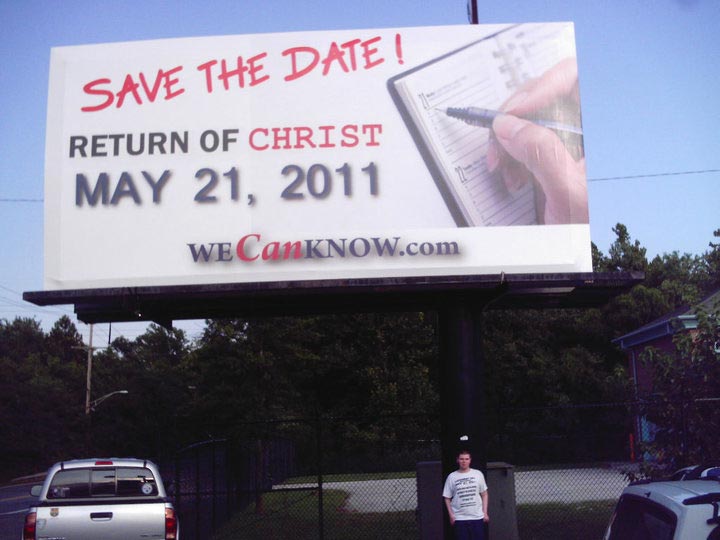
In case you have not seen the billboards, bumper stickers, literature being passed out in the street, or any of the news coverage, Jesus is coming back this Saturday, May 21st, 2011.  No specific time of day was given.

This campaign was initiated by Harold Camping, who has some experience with predicting the date of Jesus’ return (see below)

And what’s even more impressive about this knowledge that Harold Camping acquired is that not even Jesus knew:

24:36 But of that day and that hour knoweth no man, no, not the angels of heaven, but my Father only.

and further in the same chapter:

24:43 But know this, that if the goodman of the house had known in what watch the thief would come, he would have watched, and would not have suffered his house to be broken up.

24:44 Therefore be ye also ready: for in such an hour as ye think not the Son of man cometh.

In other words, the book of Matthew, as well as a few other New Testament books, claim that we can’t know when this ‘prophecy’ will happen.  It’s amazing that some academic or priest did not discover this 1500 years ago, or even 200 years ago.  It always seem that when some discovery like this is made, it is coming soon.  The cynic in me thinks that Bible ‘scholars’ have a bunch of interpretable dates saved up which they drag out a year or so before they come around.

A modest proposal (No, not that one Swift!)

But, in any case, I have a proposal for any Christians out there.  See, I’ve been unemployed for some time, and don’t have a lot to speak of financially these days.  I’ll bet there are a few real Christians out there (the ones who accept this looming date, of course) who have a few bucks, a house, etc which they will not need come rapture, so I figured they could help me out.  See, this prediction is about the return of Christ, not the end of the world (that is not until October!), so for those who will be going up to heaven on Saturday, you will not need all those nice things for the next few months, but struggling people out there, like myself, might.

This may even be a boon for our economic issues.  With all those good Christians leaving (and of course God makes sure that those good Christians are employed and comfortable, right?), there will be jobs available to fill their vacancies.  With our new found jobs (for as long as they last; remember October…) there will be less unemployment, more to go around, and less Christians, at that.  Sounds like paradise, and I can’t wait!

See, once Jesus really does come back and I am left with the tribulation of the last months of existence, I might as well have money so that I can…help other people prepare for the end? And while I’m helping, I’m sure that 55-inch plasma TV I have coming will allow me to watch the news coverage as well as keep up on my new favorite televangelist (I assume some will remain behind).  Plus, why not enjoy the last months I will have, whether it is heaven, hell, or oblivion which follows?

What do you need with your money after Friday anyway?  This guy has the idea right.

If you really believed, you would not be worried about losing anything, so why not give all of your money and valuables to people like me?

Thanks, in advance.

Oh, right, Harold Camping.  He predicted the return of Jesus in 1994.  Here’s some video.  Man I love the internet!

(BTW, real Christians don’t watch this until after you give me your stuff.  Thanks)

Faith and accidental true belief


What is faith, except belief in something that you have no evidence for? Some might say that it is hope for things to be true, but that seems dishonest. When people resort to faith, they are falling back into a corner of belief despite the fact that your skeptical questions have not been sufficiently answered. They don’t have an actual reason, based on facts of any kind, to believe what they do, but they believe it anyway.

In re-reading Plato’s Theaetatus just recently, I was thinking about the idea of faith in light of justification. Are people of faith justified in believing what they do? More specifically, is an article of faith something that can be intellectually respectable?

No.

A proposition given without any rational basis, whether from logical argument or empirical evidence, is not a belief that has merit.  And despite what apologists say, the arguments for god, especially the specific gods of religions like Christianity, don’t have merit.  Why would anyone take such a proposition seriously, except for the fact that they were exposed to accept it under youth or emotional upheaval, as well as the subsequent emotional association with the idea. It may actually be held as an idea and accepted as a fact, but without a reason to accept it, it’s just credulity.

And further, it would not be justifiable even if it happened to be true. Why not? Because the criteria to consider a belief justified is whether there is justification (yes, it’s that obvious) for the belief.

To be correct about a belief by accident, that is to say to accept it without rational justification, and have it be true anyway is merely a stroke of luck.  To take pride in being right by accident is no better than thinking that the lottery numbers you chose were right before the drawing.  And faith, being a belief without rational justification, due to the fact that the belief lacks evidence, is therefore at best accidental true belief.  At worst, it is a false belief held for no reason.

This is just one of the reasons why Pascal’s wager (the idea that we should believe just in case it is true) is so absurd.

If you cannot supply good reasons to believe something, then you cannot be surprised when other people do not accept your belief as intellectually respectable. Further, you may not have any justification for believing it yourself, in which case your credulity may be a reason to wonder about whether you are a person worthy of respect as a rational person

Rational is as rational does, or something.

Gnus: Is it too accommodating toward accommodationists to strive for a balance of values in this “war”?


My post the other day about facts and values got me thinking about another issue that I have done some thinking about concerning values.  Generally, there is little controversy about saying that someone can have the wrong facts.  The controversy is usually which facts are right or when to say so, not whether that a fact can be wrong.  Only in the deepest fringes of postmodern philosophy can one say that a fact cannot be wrong, and among the straw-man of the uber-accommodationist that they can never be stated.  But there is a more subtle question embedded in this issue.   What about values? Can the principles you accept as important or essential be wrong to have?

One value I have is honesty.  I believe that honesty is an important attribute to practice because it leads to interactions with people which engenders trust, which is a thing I have an interest in creating.  When I am trusted, and trust others, I live in a world of lesser anxiety.  And that, I think, is a good thing.  Yes, sometimes the truth is painful, and in times of emotional upheaval it can be put off or at least put in the background, but there must come a time when the truth has to be dealt with or live a life of denial and possible delusion.  I’m just sayin’….

My value of honesty, being a good means towards creating a more trusting and less anxious environment (assuming this is actually the case), is a good thing if trust and lesser anxiety are good things.  And, in general, the values I have are right to have iff the effects they have are worth striving for.  But for Thor’s sake what kind of world are we trying to create?  What would be good effects for us to evaluate our values?  Upon what criteria do we ultimately judge a value by? I don’t know.  Further, this is not a question that I am particularly interested in solving at the moment (although you may guess what kinds of answers I might give, if pressed).  I am more concerned with a related question.

Is criticizing a person’s values wrong?

This question is similar in many ways to the question of whether it is appropriate to question or criticize a person’s religious beliefs. In the same way that a religious belief is an integral aspect of a person’s life, so are their values.  And in many cases one’s values are tied to their religious beliefs, and vice-versa.  Values are also, like religious beliefs, shared things.  We tend to identify ourselves in terms of our values and use them to tie ourselves to others.  The people we associate with, call allies, and like will often have similar values as ourselves.   Often, when talking with someone you fervently disagree with, it is the difference of values which causes the inability to comprehend how they managed to come to a certain conclusion, way of life, or perspective.

One value,which I have seen in both religious and non-religious people, is what I will call self-deprecation.  This can take the form of depriving oneself on specific pleasures, causing oneself specific harm, etc.  By this I do NOT mean sado-masochism, which is a different animal (although perhaps not completely unrelated, but that’s a topic for another blog).   Within the evangelical and conservative Christian community this is somewhat common, especially when it comes to one’s sexuality.  Part of the problem in those types of cases is the putting off of pleasures in the belief that something greater comes in the future; whether it be the idealized bliss of the marriage bed or the eternal one of heaven (which are, from what I understand, associated in order to maintain the conservative view of sexuality).

Depriving of oneself of the pleasures of the world is, from the point of view of this hedonist, materialist, atheist, a waste of time and harmful to a healthy lifestyle.  This does not imply that we should never miss out on an opportunity to experience pleasure, just that the so-called “family values” espoused by social conservatism are, in my opinion, harmful and possibly unethical.  The values of “family values” are, in my oh-so humble opinion, the wrong values to have.

I am willing to say this because I think the universe is such-and -such a way, and the reasons for adopting such values are based upon an alternative and delusional worldview which is not supported by the facts.  As I said in my post about facts and values the other day, values are a kind of fact.  They are supported by beliefs about the world, and are things we believe to be true and important.  But if the worldview one holds is not justified, then the values dependent upon that worldview may be wrong, or at least not ideal.  They may, in fact, be detrimental to emotional, intellectual, and physical growth.  Take for example what happens when you believe that sickness and injury should be dealt with by prayer.  The values that are derived from such a worldview will often have direct consequences upon the health and welfare of such people.

Closer to home for me is the balance of two values that I have, but in different proportion from other atheists.  And many people will notice that these values have similar effects on different issues of political, social, and cultural importance.  They are what I will call truth and diplomacy.  I value more strongly the value of dealing with whether something is true or not over whether the answer I give will win me friends, votes, etc.  Others are more concerned with building metaphorical bridges when trying to reach out to people who are not already in agreement with their worldview.  Because of the shift in balance of these values they shift the tone, often resulting in a shift in consistency with what they may believe, in order not to alienate people.  And while I don’t think they see it as preferring politics over truth, that is often what it seems like from my point of view.  Surely the fact that many people simply accept that politicians lie tells us something about this phenomenon; diplomacy works, and truth is often an obstacle to achieving goals.  I know, I’m cynical.

Now, I do not think that there is some absolute right way to go about this balance.  I do not think that my honesty-oriented value is always better than the values of diplomacy, but I think that in some cases it is.  This implies, I think, that there are indeed some times when diplomacy is warranted, and even I, an unabashed and unapologetic gnu atheist, measure and hold my tongue depending on circumstances.  I never lie about my beliefs concerning religion, but there are times when I might soften a quip into a question or observation, suggest rather than blatantly criticize, but I never coddle or demonstrate faux respect for an idea which I do not respect.

That is, I think there is a point in the balance of truth and diplomacy where the scale simply falls over.  Those ‘accommodationsists’ of whom I am critical seem to me to be overly concerned with appearing respectful (or actually respecting an idea which I think they should not) and the straw-man new atheists they demonize go too far in not knowing the time and place, and the appropriate level of criticism therein.  The problem there is finding actual people, especially among the leaders of the atheist community, who are the analogs to these straw-men.  Are there people who are invited to speak at atheist conventions (if that is the appropriate criteria) who ferociously and incessantly attack beliefs, believers, or institutions without regard for what anyone has said, done, or supported?  In other words, are their criticisms unjustified?  You may think they should tone it down, but do you think the actual content is wrong?

And yes, there will be wiggle room in where that balance rests, as well as the extremity of their opinions*.  Certainly I am likely to be somewhat more or less confrontational than someone else, but the important thing, from my point of view, is honesty.  I am concerned that in striving to appear friendly, I don’t also appear dishonest or contradictory.  I don’t want to be seen as someone who says nice things about faith here, but elsewhere say how I think it’s ultimately delusional (even if I didn’t want to use that word, because it might offend someone).

People such a Chris Mooney argue that we should watch how we communicate so as to not chase moderate believers towards the sanctums of fundamentalism, while he  does not seem to comprehend that it is our lack of faith itself which alienates us from people, not the belief that their doctrines are inconsistent with science.  Does Mooney believe that the doctrines of religious groups, specifically Christianity on one case, are consistent with scientific theories like natural selection?  He might, but he seems uninterested in the truth of this question, which bothers me.  It is not that people like Mooney have to say, in every circumstance, that the doctrines of this and that faith are inconsistent with science (or whatever he believes personally).  Rather, the issue is that he does not have to be afraid to give an opinion he has if he actually believes it.

What I often see from many accommodationists, whether in anti-atheist or anti-gnu articles or in comments on various blogs, is a lack of shyness in terms of telling other atheists what they think about them, without regard for what the gnu atheist has said.  They do not appreciate the fact that there is a difference in balance between the values of truthfulness (I almost wrote “truthiness”) and the diplomacy which they find so important…except when talking to or about the gnus.  For people like myself, who actually believe that there is a fundamental incoherence about faith, religious doctrine, etc in relation to what we know about the universe, we simply want to be able to say so whenever we feel it is appropriate to do so.  My value is truth over diplomacy, but diplomacy is a value I have, even if it is secondary.

And, of course, the opinions of when it is appropriate will vary.  So long as it is to not ever say it unless you are talking with people you agree with (how would you know if you can’t say so?), I think we have room to talk.  So my question for those people whose balance is more accommodating than mine is this; are there times when I can say that things like faith and religious doctrines are incoherent or wrong?  And if so, when? Are there times when I can say these things to people who are religious?

And, to go meta, is there an appropriate time and place to say that your value of diplomacy might not be, if not outright wrong, overbalanced?

Is it going to far to say that the tone of accommodationists, in saying that our gnu beliefs are incompatible with their goals of effective communication,  is going to push gnus away from a moderate position towards atheist extremism?

___

*What we have here are two separate dimensions; 1) The strength of one’s views, and 2) the willingness or unwillingness to be confrontational about the beliefs one has.