Experiencing John Dewey


I have not read much John Dewey.  Over the years, I have run into quotes, references, and the occasional summary of some idea of his by another writer.  But in my academic and personal reading, I have never dove in.  So a while back I was at a used book store and found an old clothbound copy of a collection of his work, edited by Joseph Ratner.  And while I bought it some time ago, it has since sat on my shelf unmolested, until today.

Over the last few days, after finishing one of my books about the Revolutionary War (I have been reading about that time period a lot in the last year or so), I looked through my library for a new book to read.  I started on another history book about the Revolutionary war, but within a few pages I knew something was not right.  I just was not in the mood for history.  I wanted some philosophy!  So after a short hiatus on philosophy-reading, I scanned my philosophy section and the John Dewey tome stuck out to me, so I reached for it and thumbed my way past the prologue and right to the meat.

It is an odd thing, trying to familiarize yourself with a thinker who is relatively unknown, both to me and society at large.  I remember how I felt first reading Nietzsche; it felt like walking into a room full of people I don’t know, speaking in an accent that I sometimes could not make out.  But the more I read, Nietzsche started to feel sort of like a nice summer home, not quite home but it became mine.  Now that I’m getting acquainted with John Dewey, I wonder if I will experience the same thing or if I might feel like I did upon becoming acquainted with Kant.  Kant, for me, feels like being in the home of someone who has plastic on their furniture.  Everything is in the right place, they are being good hosts, offering me a drink, but I just can’t relax.  The furniture is not comfortable (it might be, if it were not covered so), and so you can’t just let go and enjoy the time there.  It’s an effort to enjoy, not because the company does not have anything of value to offer, but just because they are trying so hard. It’s a little like that bit from Mr. Bean (it’s the one where he has a couple of guys over for New Year’s eve, if you are familiar with the show).

So far, Dewey not like Nietzsche or Kant.  It’s more like reading Spinoza, if I had to compare it to anyone, thus far.  The language is a little dated, the terms sometimes out of context, but you sort of get what he’s trying to say.  Also, like Spinoza, you can see that he’s trying to get you out of your head.  He’s trying to use the words we see every day to express an idea that is not thought every day (at least by people who are not John Dewey).  It’s like walking into a room full of people who speak your language, and well, but who have all lived in another part of the world for some time and are talking of things that you have to experience the context of over time in order to get the full picture.  I think, in fact, Dewey might have liked that analogy.

I don’t want to say much more myself.  I want to leave you with a “summary” of the introductory chapter, because it says some things that are pertinent to some of the issues I discuss on this blog, if only tangentially.  In any case, I’ll shut up and quote:

All philosophies employ empirical subject-matter, even the most transcendental; there is nothing else for them to go by.  But in ignoring the kind of empirical situation to which their themes pertain and in failing to supply directions for experimental pointing and searching they become non-empirical.  Hence it may be asserted that the final issue of empirical method is whether the guide and standard of beliefs and conduct lies within or without the shareable situations of life.  The ultimate accusation levelled against professedly non-empirical philosophies is that in casting aspersion upon the events and objects of experience, they deny the power of common life to develop its own regulative methods and to furnish from within itself adequate goals, ideals, and criteria.  Thus in effect they claim a private access to truth and deprive the things of common experience of the enlightenment and guidance that philosophy might otherwise derive from them.  The transcendentalist has conspired with his arch-enemy, the sensualist, to narrow the acknowledged subject-matter of experience and to lessen its potencies for a wider and directed reflective choice.  Respect for experience is respect for its possibilities in thought and knowledge as well as an enforced attention to its joys and sorrows.  Intellectual piety toward experience is a precondition of the direction of life and the tolerant and generous cooperation among men.  Respect for the things of experience alone brings with it such a respect for others, the centres of experience, as is free from patronage, domination and the will to impose.


I feel like he’s saying something here that is relevant to the recent discussions in the atheist community.  He is, of course, not necessarily talking about atheism at all, but about the relationship of empiricism, rationalism, and our ideas about the world.  I feel like I want to read more of his views to say much more more, however. I will point out that his comment that the “ultimate accusation levelled against professedly non-empirical philosophies is that in casting aspersion upon the events and objects of experience, they deny the power of common life to develop its own regulative methods and to furnish from within itself adequate goals, ideals, and criteria” is reminiscent of the issue about “sophisticated theology.”  It is a world that does indeed furnish itself with goals, ideals, and criteria, but I am not sure about the adjective “adequate” in that case.  Perhaps there are things to be learned within such realms, for such heathens as I.  Perhaps Dewey will give me reason to consider that more deeply.

What I can say now is that I find a mind, in Dewey, that has an insight that is interesting, borne of a curiosity and apparent honesty.  From what I have read, including the above, I cannot say if I agree with him more often than not, only that I want to read more.  To me, that is the higher criteria; do I want to hear more of what a person says, not whether I necessarily agree with it.  The sad truth is that I don’t, more often than not, want to read more.  “Sophisticated theology” comes to mind again.
 

Skepticism, Secularism, and Public Policy


Recent conversations (and subsequent private email correspondence I have not published) with Dr. Robert Benne have gotten me thinking about the relationship between skepticism, secularism, and public policy.  It is a subject of interest to me, and one I think will be interesting for the atheist community, and governments everywhere, in coming decades.

Today, I don’t want to try and address this issue in any detail, but I want to throw out a few questions I have been considering.

What is the relationship between skepticism and secularism? Does a skeptical analysis necessarily result in a secular worldview?  To me, this is a similar question to whether skepticism, especially when properly applied, necessarily leads to atheism (I say yes).  So, does skepticism, when applied to how we make decisions for the public, result in a secular process necessarily? I am leaning towards yes, and  I think this is why I am so interested in the issue of Jeffersonian separation of church and state (or separation of religion and government, which might be a better phrasing) and the role of secular thinking in public affairs.

Further, skepticism is a set of methods which relies on scientific analysis in addition to logic.  If skepticism leads to people being secular, does that mean that if we are to ask those who create public policy to use skeptical analysis in their decision-making, we are asking them to be secular? I think the answer is yes.  I also think this is a good thing.  For too long have we tolerated Congressmen making arguments based upon scripture, personal belief, etc.

I don’t know how religious opinion can survive such an environment, and I don’t know how to reconcile the issue of religious liberty with this.  I am not interested in encroaching upon personal rights of belief.  However, when those personal beliefs are to be implemented as policy or effect policy, they have to be vetted.  I don’t want parochial views to be influential, without some secular support for them, upon public policy.  In other words, I want public policy to remain secular.  Allow people to choose how to live their lives, unhindered by scripture or parochial moral views which they do not subscribe to.

Those who try and argue that this is a Christian nation, or who want to apply sharia law to places like Britain, must demonstrate reasons why the ideas which emanate from their worldview should be prescribed to society at large.  I don’t envy them that task, because I think it is fruitless.  In the long-term, perhaps the very long-term, those religious opinions may disappear.  Until then, we need to make sure that those opinions don’t work their tendrils into the lives of the rest of us.


Robert Benne responds


A few weeks back, long before the events of this last weekend, I posted a response to Dr. Robert Benne’s article in a local paper.  I didn’t hear from him for a while, so i assumed I would not hear from him.  Today, he wrote back.

Today’s post is a response to the vast majority of what he wrote to me.

He starts, after some initial introductory comments, by complimenting my civility.  Wait, I thought I was one of those gnu atheists who are uncivil…

I appreciate your civility and attempt at fair-mindedness in your response.  Those virtues were not present in many of the vitriolic and contemptuous responses from what you call “the atheist community.”  I doubt if there is such a thing as an “atheist community” because there are atheists of all stripes, running from open-minded, classical liberals to those as dogmatic and nasty as any hide-bound fundamentalist Christian.  I received a lot of responses from the latter group, so I appreciate your reasonableness.

This is a problem that our community (and it is a community) is dealing with.  We argue amongst ourselves more than we argue with the religious world, I’d bet, over issues such as tone, accommodationism, new/gnu atheism, etc.  A recent issue with how to behave towards women has sparked an upsurge in conversations about feminism and the atheist community just in the last week.  We, as a community, only share a lack of belief in any gods.  Outside of that we disagree about any potential subject (including what to call ourselves, in many cases).  But we are a growing community, evidenced by the various groups, umbrella organizations, and online discussions which are interconnected.  We have a while to go before we are more solidified, assuming that will ever happen.


I think there is still a confusion in your response between the separation of church and state and the interaction of religion and politics, which was the main topic of my op ed.  When you inveigh against those Christians who want to exercise their religiously-based moral values in the political process—as in the restraint on abortion or resistance to gay marriage—you use separation of church and state language  (and suggest that the efforts are somehow illegitimate) when in fact it is an interaction between religion and politics.

One of the reasons for this is that for those of us fighting for the separation of church and state, the distinction between that and the separation between religion and politics is nonexistent, or at least insignificant.  And while the strict legal church/state (or religion/politics) fight is a little different than the issue of keeping parochial religious opinions out of public policy, they are part of the same basic concern.  For many of us, church/state and religion/politics (or government, more often) are interchangeable sets of terms.  This is one of the points of disagreement within our community, but many of us view the separation of parochial religious opinions and public policy to be paramount. Many of us,, in fact, are opposed to religious people imposing their religious views on public policy because there simply is no secular reason to support said views.  Where the courts and precedent will end up on this, I cannot say.  However I believe that trying to keep public policy based upon secular reasons as much as possible is the best way to go about this issue for the sake of everyone, including religious people.

I, for example, am strongly opposed to the government defining marriage based upon religious ideas.  For me, the definition of marriage (as an example) is NOT the union of ne man and one woman.  That definition is only accepted by many because religion has usurped the cultural phenomenon of legalized santioning of people merging their lives for reasons of property, financial advantage, love (that is a recent historical reason for marriage, and not traditional in any way) etc.  The conservative definition, ironically, is relatively new and culturally unsupported by actual practice in the world.

Christians, like others who have deeply held moral values, have every right to push for those values in the legislative and legal processes.  You may disagree with them and will have to contend with them in many ways—arguments, political organization, etc.   It will be in the rough and ready democratic process that these things will be worked out. That sort of democratic process is being worked out on the issues mentioned above. Sometimes it is also worked out in the judicial realm, though it is dangerous for judges to legislate and usurp the legislative process.  That is what has been happening too often, and that overreach makes the courts look too politicized.

I don’t want to address the issue of “activist judges” here, because that’s a rabbit hole too deep for this conversation at the moment.  I will ask you to consider this from another point of view; would you be comfortable with Muslim representatives implementing something like sharia law into our policy?  Are you paying attention to what is happening in Europe concerning this issue?  Is it sufficient that the majority may accept something to make it policy that effects the whole, especially when many are discriminated against as a result?


I agree that Christians should argue the case for their preferred public policies on as common ground as they can, but sometimes it may have to be on more particular religious grounds.  It is a question of prudence and effectiveness.  But as the Norwegian bishops put it when the Nazis tried to compel them to announce racist policies in their country, “we have to obey God rather than man in this case.”

But if there is no god, then the Norwegian bishops were just saying that they must obey their man-made laws over those of another set of men.  That is part of the problem with this issue from an atheist’s point of view.  There is no reason to appeal to God at all because we do have real reasons to reject such policies.  This leads me to the most important aspect of our disagreement here:

Actually, Shaun, there may not be universal rational grounds for anything.  Once reason was spelled with a capital R and purportedly could discern the Good, the True, and the Beautiful on autonomous grounds.  But postmodernism has pretty much finished that.  Reason is much tamed now, mainly being instrumental in character.

I am not a postmodernist.  I reject the postmodernist, relativist, “all-perspectives are valid” view.  I agree with Sam Harris, who in his most recent book tells us that science is the best (no, the only) tool that gives us real effective answers.  Postmodernism has put a hiccup in the liberal worldview that I hope it transcends soon, because it is philosophically sophomoric, politically problematic, and just plain incorrect.  Reason is not tamed; reason is tempered by the realization that we cannot have absolute certainty about our answers, and we must remember that all conclusions are tentative (even things like general relativity, the current explanation of gravity).  Science is a empirical and probabilistic enterprise, but it is effective and achieves results.  The skeptical methods utilized by science and rational thinkers is the best tool we have yet devised to determine truth.  Methods of revelation, pure insight, and even pure philosophy (my field) are all problematic and inferior to science in every way.  This is why I don’t want religious opinions being pushed towards public policy; it is based upon bad methodology, poor reasoning, and is not supported by skeptical inquiry.  When it is shown to the light, it dies.

Reason in this more modest sense draws upon cultural streams that have been dramatically shaped by religious traditions.  You are indebted to the Western Judeo-Christian tradition for your values.  Your “universal” rationality would not work so well in other societies—Islamic, Hindu, Confucian, Communist.

No.  religion usurps our values and calls them their own, while at the same time adding an other-worldly orientation that not only de-values reality, but poisons our ability to think clearly about this world.  In fact, Eric MacDonald, a favorite blogger of mine, wrote about this subject just today.  Here’s the link: http://choiceindying.com/2011/07/07/on-the-web-and-forgetfulness-or-how-the-poison-of-religion-poisons-everything/.  I encourage you to read it, as it says with more eloquence what I would like to say in response to your above comment.

I am not claiming that we know or have some universal rationality necessarily, I’m claiming that if one is to be found, we must use skeptical analysis to find it.  Religion, and the vast majority of its conclusions, simply fail at this.  Therefore, we need to keep it away from public policy.  This is not precisely what Jefferson had in mind, and in defending church/state the argument is somewhat more nuanced, but as a rationalist, atheist, skeptic I am arguing that religion would be better to be grown out of.  The fact that so many representatives pander to religion tells me that either they are lying to us for sustained power or are not the pinnacle of intellectual and emotional maturity.  In other words, they are indeed representatives of our current society.

That concludes my reply.  I will be interested to see if this conversation continues, and what will come of it.  I still think it is good to keep open dialogue with people with whom we disagree.  I hope my civility was sufficient still.


More thoughts on creepiness and sex-positivity


I was responding to a comment from my post yesterday about elevatorgate, just now, and realized part of what put a twist in my panties about this issue originally.  And while I think that I am in agreement with Rebecca Watson almost completely, and thank her for her consciousness raising (assuming she won’t mind the continual use of that term associated with her new BFF Richard Dawkins), I also think that there is a tangential issue that all of these conversations touch on that have been meaningful for me for a long time.

So, while trying to slowly put behind us the specific issue of Rebecca Watson and her elevator friend, I want to address the general issue of being creepy in a sex-positive world full of happy, horny, sluts.

It is essentially this: There is nothing wrong with asking for sex.

I have read, in the last few days, so many comments about proper ways to hit on women that don’t sexualize them, that respect them, and that will not creep them out.  I get it; make sure you are in a safe context, speak to them respectfully, and and don’t just proposition them, but talk to them first.  The last part throws me off a little.  There is nothing inherently wrong with asking a person, in a safe environment and with appropriate words, to have sex with you.  You just have to be prepared to hear and accept a no, because that is likely what will happen in most (but not all) cases.

Before this issue arose, I would have not done what elevator guy did, but mostly for pragmatic reasons.  Whether this makes me privileged, insensitive, or whatever, the fact is that I realize that it just would not work, and is therefore a waste of my time.  I would have not understood the fear that many women would feel in that situation because I, as has been pointed out, have some blinders on.

Fair enough.  Blinders partially removed, trying to understand better, but I still have concerns for how this privilege of mine interacts with a world of happy, horny, sluts.


The world I want to live in; a slut-friendly world.

Many commenters, on Pharyngula and elsewhere, pointed out that men do not have the right to assume that any interaction with a woman gives them the right to assume the possibility of sexual encounters.  That’s right, we should not assume anything.  But this is different than saying they don’t have the right to ask, so long as they are willing to accept a no without feeling rejected.  This distinction is critical, because it highlights where he rub here is.  Asking is not assuming.  In fact, it is perfectly flush with skepticism; you don’t know something so you investigate.  I think that many so-called “elevator guy apologists” are probably trying to articulate this, while still often missing the factor of context.  People talking past one-another on the internet, once again.

The issue is this; what would be acceptable for one woman would be creepy for another.  In other words, just like with the Schroedinger’s rapist issue, we have what I call the similar problem of Schroedinger’s slut; we don’t know (in most cases) when the proposition will be acceptable or creepy for another person.  So, once you find the appropriate place and time, it’s carpe diem time.  Life is too short to live life in fear.  So, if you meet a girl or a guy (or both) at a party, a bar, a club, or elsewhere where they are not physically trapped, then ask what you desire! If you are respectful, open, honest, and so forth and are still seen as creepy, there is nothing you could have done to not be creepy.  That person might just have issues with their sexuality, if you did in fact ask respectfully and in a safe space.

I’m extending this issue into the realm of sex-positivity and sluthood, not common bar/party meetings of people where the normal vanilla rules apply.  In my ideal world, a proposition of sex between relative strangers is morally and socially acceptable, even if it is unlikely to succeed.  I still don’t do it often, because I am often in vanilla circles and realize that many people are sex negative and view sluthood as a bad thing.  But at a kink club, polyamory meetup, or a swing club?

Different rules.

But creepiness is still an issue, and that is what I am curious about.  See for us, one thing we have to learn is how to hear “no.” And how to say no without feeling bad about it.  That is difficult as well.


A Memorable Lesson from Polyamory 101

A few years back I was at a polyamory meeting where had this exercise which has stuck with me ever since.  We stood up and walked around the room asking anyone and everyone for permission to kiss them.  Male, female, old, young, etc.  Everyone had to say “no” (even if you wanted to say “yes!”) so that we could get accustomed to hearing and saying no.  The reason for this is that we learn that there is no harm in asking.  Hearing no is not so bad, and neither is saying it.  Some people may think there is harm in asking, and others feel bad saying no.  That’s just immaturity and prudishness.  By all means be a prude if that makes you happy.  But even in that case you can still say no without it being an issue.

I have been to a few conferences over the years.  Financial struggles make it hard to do so more, especially now.  And while at a conference among godless heathens and (often) libertines, I sometimes meet more freaky people, and the only way I found this out was by asking.  Just not while in an elevator and alone.  But I will not be shamed by my admitted privilege into not asking at all, as some voices in the last few days seem to imply.  That is a form of sex-negativity, and is not a step towards health for our community or for any individuals.

Bottom line: We all need to try and be aware of contexts that present potential dangers and violations of respect, but there is a distinction between the context and the request for sex.  We all, as a culture, need to be able to ask for what we want, be prepared to hear a no (or a yes), and we need to remember that people have different boundaries that we cannot predict upon sight.  When we cross other people’s boundaries, we can apologize; and when someone crosses ours we can realize that they may have meant no disrespect.

And when people do act disrespectfully without concern for our discomfort or boundaries, we have the right to call them out on it.  I am in full support of people who cross boundaries being educated, especially if they display no concern for having done so.  Let’s hope that Rebecca Watson’s education of us will be a prevention of potential harm that could happen.  Let’s hope that nothing more serious than what she experienced ever happens at a conference.

And let’s also hope that the sluts in our community have some hot sex with each-other.

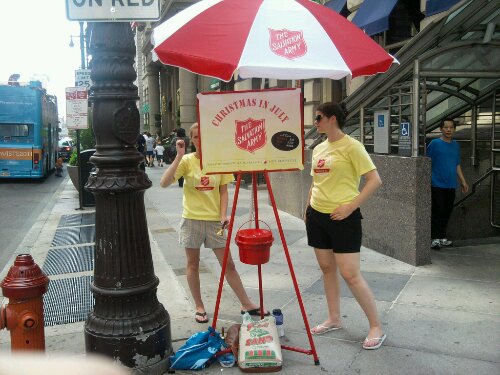
Christmas in July!


image

While downtown today, I ran into this.  Now, most of you out there have probably seen the Salvation Army people ringing bells around Christmas time.  But this was the first time I have seen one in July.

Now, I have heard the cultural meme of Christmas in July, and really don’t care one way or the other about it.  I don’t generally enjoy Christmas and have not celebrated it for many years, but I know many atheists still enjoy the holiday. 

But the Salvation Army…

I don’t have easy access to statistics while mobile, but their charity organization is not exactly altruistic.  Much of what they do with the money they bring in is proselytize their Christian message.  I mean, just look at what they call themselves; Salvation Army.  This is not an organization which is friendly to secular worldviews, and is not an organizagion I would give a penny to.

If you want a better charity, look up Foundation Beyond Belief.  Why are they not on street corners ringing bells? Would people give to an overt secular or non-religious charity?

In any case, I didn’t talk to them because I had somewhere to be, but now that I’m done, perhaps I will ask them what they know about the organization and if they are christians themselves.  Very likely they are.

Elevatorgate: frustrations with creepiness as a man-slut


Another male perspective on something I cannot comprehend, I know.  But I have a few frustrations I want to vent, understanding that many feminists (and I count myself among them) will view my comments as just not getting it.

I will not recap the events over the last weekend about the Elevatorgate issue that arose from Rebecca Watson’s recent video and subsequent kerfuffle.  If you don’t know, then simply skip this (or catch up and come back).  I had a long conversation with Ginny about this yesterday, one that made it clear that I’m not completely understanding Watson’s (and many other women’s) experience with this, but nonetheless an issue I have thought a lot about the last few days.

During that conversation with Ginny, I said something that was better articulated in a comment by a “Marty” on Phil Plait’s blog today (#31)

Just as it would be insulting for me to assume that every moment I spend with other women is a possible sexual encounter, it’s also insulting to treat every moment a woman spends around any man as a potential sexual assault.

This gets to the heart of part of this issue for me.  Now, I recognize that there is no comparing the issue of me being around a woman and feeling like I want to be sexual with her and the fear a woman might feel in an enclosed space, especially if he is hitting on her.  But what I think has been overlooked in the conversations about this issue in the last few days (and I have read many, not nearly half however, of the comments on the various blogs that have brought this up) is the fact that their is a two-sided responsibility here and that there are frustrations that are valid for people in elevator guy’s place.

What I have learned

I have learned that many women would feel uncomfortable, and not in just some socially anxious way, if they were in an elevator with me, alone, and I propositioned her.  Even if I used respectful words.  Even if I didn’t physically touch, or even get close to, her.  Even if (as one commenter on Pharyngula said) it were at noon.  This teaches me that it is just a thing not to do if only for the fact that it will not work.  That is, even if I was convinced there was nothing wrong with doing so per se, as many commenters still uphold, the fact is that it is not pragmatically wise.  I accept that it causes women discomfort, and I want to avoid that.

I have learned that many women think a lot about how to avoid sexual assault day to day.  I have learned that the fear of such things is prominent for many people.  I knew previously that the statistics for rape and sexual assault are astoundingly high, but I learned that an elevator is one of the places where the anxiety is a little higher.

I will not be propositioning women in elevators, ever.  Even if I see one smiling at me and giving me bedroom eyes as we ascend (or descend), I’ll wait until she is off the elevator to say anything.  Certainly, if I see Rebecca Watson in an elevator, I will wait until another time to compliment her, just in case it comes across as flirting.  Let’s just say when I’m interested in someone I don’t hide it well (And no, that was not a crude reference…).

Also, I’ll certainly never look at this song the same again:

Essentially, I understand that as a male in our culture, I have a responsibility to be aware of how my “privilege” blinds me to how I can use sexuality in ways that make women uncomfortable.  I accept that some things I may do, even while trying to be respectful of women as people, will come across as creepy and inappropriate.  I will keep trying to expand my understanding of this problem.

What I want others to understand

For clarification, much of the following is NOT directed towards Rebecca Watson per se.  this issue has grown larger than the initial encounter that spawned it.  It’s mostly a rant.

Just because statistics of rape are ridiculously high, and the vast majority of them are committed by men to women, does not mean that women are rationally justified to live their lives in fear of men, even in elevators.  I know that most women do not, but the comments in recent days concerning this issue tells me that many do.  I am an advocate of not allowing fear to dominate a person’s behavior or thinking.  Fear is a tool of oppression as much as patriarchy, white/male privilege, or wealth disparity.  When you encounter a guy hitting on you in an elevator, you need to keep in mind that even though the statistics of assault are really really high, probability states that he’s just clueless at best, overly aggressive at worst.  He’s probably just drunk.

I want women to be cautious, aware, and safe, but I don’t want them to be afraid of men without justification.  And women do have the right to request that a certain kind of behavior is not done (like hitting on women in elevators), however you have to keep in mind that you are responsible for how you are interpreting people’s actions based upon statistics.  I think it is fair to request that women do not assumes that violence is likely, even while being aware of its possibility.  I think the distinction is important.

I do not believe Rebecca Watson did anything wrong in that elevator or in her subsequent video.  The guy was probably clueless, and her advice to not do that was good advice.  Whatever increases well-being, as Sam Harris says, right?   I like Rebecca Watson.  I think she is intelligent, thoughtful, funny, and eloquent.  I have met her a few times, although we have never spoken more than a word or few to each other because she is usually inundated with fans and friends, as a person of her abilities warrants.  I happen to also think she is an attractive woman, and under the right circumstances I would like to get to know her better (both intellectually and otherwise).  Is that sexist? Am I sexualizing her? Perhaps, but I am not merely sexualizing her.  I think that creates a distinction which matters as well.

Luckily for her, I don’t drink coffee.  I would also not use this euphemism to proposition someone anyway, nor would I do so without any existing familiarity at very least.  I also don’t think that coldly propositioning anyone is wrong or creepy in all cases, just not pragmatic in most cases.

If I were to find myself  talking to Rebecca Watson and got any indication that she might be interested in getting to know me, I would probably ask her if she’d like to get a drink and talk alone (but still in public, to start).  And I would let things take their natural course from there.   I doubt I’d have that opportunity, as I have no reason to think she would be interested in me (despite the fact that I’m brilliant and beautiful, that is…).  Of course, my guess is that most men will certainly avoid, if they have been paying attention, hitting on her at any conferences from now on, and I am no exception to this.  Perhaps that was what she wanted, I don’t know.

But could I imagine a situation where I would say or do something that would set off a woman’s creeper-meter? Oh for sure! I have no doubt that if actually faced with a women I was interested in romantically or sexually, I could (and certainly have in the past) creep said woman out.  The best intentions and the utmost respect can’t always avoid that, as sometimes it is just a look in the eye, bad choice of words, or awful timing to do so.

And that sucks, because it’s very very frustrating to know this fact looms over interpersonal interactions where sexuality is a factor.  As a man who wants to be sex-positive, likes casual sex on occasion, and meets attractive women while out and about, the fact that no matter my intentions I am more likely to creep a woman out than gain her interest is frustrating.  And it’s not that I assume I have the possibility of a sexual encounter with any women for whom I have interest, its just that when I would like some sexual contact with a woman I just met or don’t know well, my asking may come across as inappropriate even while presented respectfully.

I often find myself asking myself, after hearing of stories where men are perceived as creepy, questions like ‘is there a way he could have asked which would not have been creepy?’  And, if not, was it really creepy or was she just not attracted to him in particular? Also, is it sometimes the case that people are creeped out without justification?  I think these questions expose important distinctions as well.

There seems to be a tension, here, between the ideal sex-positive world that I strive for and one described by those talking about privilege of which men are usually blind.  I have no desire to be a pick up artist (PUA), but I do desire to live in a world where sexual interest in a woman, expressed openly, honestly, and respectfully, is not called sexist.   I, as a man, simply don’t know how to approach women I am attracted to, preferably in an at-least partially public area, without being pegged as suffering from privilege-blindness. I hope there is a realistic answer to this tension, because I want to be respectful while enjoying sex with others who want the same thing.  And just like women can’t tell the good men from the bad ones (the Schrodinger’s rapist problem), I can’t always tell the sluts (not a derogatory term) from the women who will view my proposition as creepy.  Let’s call that the Schroedinger’s slut problem.

I, as a slut, just want to be able to be a slut in a feminist world.  I know there are others out there too who feel this way, but now I’m anxious about being the next elevator guy because I crossed someone’s boundaries without knowing it.  Yes, I won’t hit on a woman in an elevator now (my consciousness has been raised, thank you Rebecca), but I might do it while she’s alone at the end of the bar, while at a party where she knows nobody, or some other situation that is uncomfortable or creepy for her.   And then I’ll have to be told that this is also unacceptable, and many people will agree and see me as sexist, and I’ll be just as confused as I was when I first read about what elevator guy did.

At bottom, I want women to give us men a little more leeway concerning creepiness, and I want men to treat women better so that men can stop being feared as sexual predators.  It will be so much better for everyone, men, to stop being predators.  And it would be some improvement if women would give us a little lenience about perceived creepiness.

This is more of a rant borne of frustration than anything else.  Thanks for listening.

So, Rebecca Watson, would you like to come over to Philly for a drink?  I promise; no elevators!

(that wasn’t creepy, was it?)

The Tea Party does not want America to change: I do


Today I am going to do something which I rarely do, especially here.  I am going to talk about politics.

More specifically, I want to address an idea that has taken root in the Tea Party.  It is probably not universal among them, nor do I expect it to be the most important aspect of the Tea Party movement.  However, when I ran into a rally at Independence Mall, near Independence Hall, on Independence Day, it was a theme that was mentioned more than a few times, especially by Presidential hopeful Herman Cain, who spoke among others.  The key note speaker was John Bolton, who has no chance as a candidate, and whose speech I found silly and uninspiring.

It seems as if one of the problems that the Tea Party is trying to combat is the ‘liberal’ desire to change America.  This was said in context of the “ripping up of the Constitution” (supposedly by people like me).  Herman Cain said several times that there are people who want to change America, and many said that this is the greatest country in the world.  Perhaps.

So, what is wrong with changing America? And why is ripping up the Constitution associated with this, as if one could not change America and follow the Constritution?  Best nation? In what way; culturally, economically, politically, or some other way?

And yes, I do want America to change.  I would like to be part of what changes it, as well.  But I do not want to rip up, either literally or metaphorically, the US Constitution.  I have read the Constitution and  appreciate my rights as well as defend the rights of others even if I disagree with them. Further, my understanding of the process by which we create Constitutional amendments implies that change is an inherent part of our Constitution and therefore our country.  It just seems that this idea is empty rhetoric without real substance.

Despite the empty rhetoric of many of the speakers and apologists I heard from there yesterday, I (as a liberal, at least in most political senses), am not trying to destroy our Constitution.  I am trying to use my constitutional rights to influence the public towards a better America, by use of speech, protest, and litigation in some cases.  Our nation is ripe with cultural problems from sex negativity, poor education, and political naivete which helps cripple our growth to a better nation and a better world.

Me talking with one Ron Paul supporter

I want citizens who are more educated, mature, and willing to challenge their own worldviews.  I want the legality of gay marriage and polyamorous marriage.  I want better healthcare, whether through a single-payer system or some other option.  I want the divide between the rich and the poor to be addressed in a meaningful way.  I want discrimination, breaches in the wall between government and religion, and other effects of poor education and indoctrination to disappear.  All of these goals, and many others, can only be reached by changing America.

The idea that we should not change America is conservative by definition.  And as one conservative-minded person I know told me, there is a difference between wanting to retain traditional ideas per se and simply opposing progressive ideals.  Granted.   However, whether you want to conserve traditional ideas per se or not is not the point.  The point is that our culture, and therefore many governmental policies, need to change if we are going to improve.  Arguing that America should not change sounds a lot like a person telling there therapist that they don’t need help.

In other words, this ideal within at least some Tea Partiers that we should not change, and we should fight change, is a sign of denial of real problems within.  We, as a culture and as a nation, are sick in many ways.   We need to change, if we want to survive and thrive.  Right now, we are not thriving, and more of the same will not help.

So, in 4 years will "2016" be over the "2012"?

Finally, concerning what one Ron Paul supporter told me, which was that the Tea Party movement was started in 2007 to protest the corporate ownership of the two major parties, and that it is trying to remain independent from such influences.  But the recent motions of people associating with the Tea Party, such as Sarah Palin, have taken the name brand and changed it.  My prediction is that what remnants of the Ron Paul revolution that want to stray from corporate interests will die out completely, having been over-taken by the interests of those who have the money to make more noise.  And while I don’t support Ron Paul, I appreciate the attempt by some of his supporters  to remain unaffected by corporate interests.

I just don’t believe that changing (or restoring, as they call it) our government will make the corruption disappear.  I’m too much of a cynic, I suppose.

So, yes, Tea Party leaders, some of us do want to change America.  The fact that you don’t see anything worth changing is one of the many reasons I cannot get behind your cause.


The Israelite Church of God in Jesus Christ


image

I have seen these guys on the street in philadelphia for many years.  I usually ignore them, but I found myself near city hall today and decided to sit and eat a cheesesteak while I listened to their public sermon.

Because I am mobile, I will keep this very brief (and I will write more later).  Their basic message seems to be that many of the non-white people of the world (all in the western hemisphere) are the 12 lost tribes of Israel, and that they are the people of (the biblical) God. 

They also argue that Jesus was black, which has gained some traction in segments of culture in recent years (for me, this idea first appeared in the music of KRS-ONE).  On top of that, they have a generally dis-favorable view of white people.  At one point a few years ago, one of them referred to me as a white devil (this may remind you of the Nation of Islam).

Their sign lists two verses from the Old Testament:

Gen 49:1-28
Deut 33:1-29

I don’t know them off-hand, but I will look them up later for further comment.  I will listen for a little while longer.

(BTW, when I tried to take the picture, one of them tried to block me with his clipboard.  I had to explain to him the concept of public space and the first ammendment, of which they are now protected under.)

Youtube atheists invade Philadelphia


I spent last night hanging out with a bunch of heathens, many of whom you may have seen on the youtube trying to steal your faith away.  Of course, we got rowdy, drunk, and an orgy commenced (ok, not so much), but there was a fair amount of arguing about all sorts of things with some quanity of alcohol involved.

In any case, it looks like the revelry will continue this evening.  Luckly for me an old co-worker, Pat McHugh of Grubstake, will be playing at Fergie’s tonight (10pm, no cover), which is right near the Marriott where the atheist action is.  I had planned to see him play, now it looks lie I will be able to do both, and maybe drag a few heathens with me to one of my favorite bars downtown.

So, I will be on my way out soon to see these hell-bound videographers in an attempt to further damn my soul.  If any video of all of this pops up, I’ll post it so long as it’s not embarrassing…who am I kidding, I’d still post it..

For now, I’ll leave ths video, which includes some of the people I talked with last night.


The scientific method is not indebted to religion


Over at Why Evolution is True (which I read religiously!), Jerry Coyne has tackled an article aimed at him on BioLogos…again. I generally agree with the perspective on science and religion espoused by Coyne, and this post was not an exception.  What I want to address is a point made in the BioLogos article Coyne quotes, written by Robert C. Bishop:

Finally, Coyne completely misunderstands the force of the historical examples I gave of science/faith engagement (the Scientific Revolution and 20th century debates about steady state cosmology). They aren’t just points about the religious faith of some scientists in the past. Rather, the scientific methods these scientists created and used were intimately tied up with and motivated by their faith.

He goes on from there, explicating the old canard about how since many early scientists were religiously motivated, therefore the methods of science themselves were motivated by religion.  For example:

Galileo, Boyle and Newton among others developed methods for studying created things on their own terms in such a way that their natures could be revealed to investigators as accurately as possible. This means that they didn’t treat created things as divine or as fronts for the real activity of God, or as shadows behind which genuine reality is working. Instead, they treated pendula, animals, planets and stars as having genuine natures and properties, as responding to and contributing to order, and sought to put themselves in the best methodological and epistemological position to receive all that created things had to teach about themselves.

This all sounds good enough, I suppose.  It is generally true that scientists of the age used terms like “created things” and so forth, and viewed the universe as having a discoverable order, usually attributed to some intelligent force, AKA God.  But watch were Bishop goes next, after the claim that western intellectual culture is dominated by concepts of hierarchical levels of order in reality.

…biblical revelation stands unique historically in recognizing only one distinction and no hierarchy in nature: There is only the Creator and what is created. Everything that is created is of the same ontological order of being. In other words, the being of everything created–terrestrial and celestial–is homogenous in being.

This sounds almost Spinoza-esque in flavor (perhaps with a dash of Leibniz), as if the universe is simply all one thing, including its creator and intelligent force.  If the creator is separate, does that not imply hierarchy? Perhaps I’m splitting hairs.  What makes this more interesting is that Coyne, in his post, is addressing is the fact that the scientific method, specifically concerning evolution, makes the proposition of the supernatural unnecessary towards explaining anything. If there is no hierarchy, and all the universe is subject to the same laws, then why the perpetual appeal to an intelligent designer by BioLogos’ articles, including this one?

But I’m being led away from my point.

In any case, Bishop’s assertion of this unique “ontological homogeneity” derived from Biblical theology (which is not unique to the Bible nor even really actually Biblical, in my opinion) implies that

once the likes of Galileo, Kepler, Boyle, Descartes and Newton grasped hold of ontological homogeneity, the exploration of nature was never the same. The doctrine provided the seeds motivating Galileo, Kepler and the other scientific revolutionaries to see celestial and terrestrial regions as of the same order of being: finite, composed of the same material, operating by the same laws and secondary causes.

The assertion that this ontological worldview was derived from Biblical revelation and theology needs to be justified.  But even if it were true, the implication that the Christian worldview in which these scientists grew was the cause of the scientific method they employed is still dubious.  This is because the scientific method, especially as it is used now, is not based upon the need for revelation, gods, or any creators.  The method is simply the intellectual continuation of the proto-scientific methods that existed before Christian revelation, and was in fact put on hold by Christian history (Library of Alexandria, anyone?).  The fact that these scientists held onto the linguistic conventions of creators, universal order, etc is no more to the point than today’s scientists, even secular or overtly atheist ones, use metaphors from the Christian worldview the West is still mired in. Kepler, Newton, and the rest did hold onto religious belief to some extent, but they also were not subject to the facts that Darwin brought about which tossed away the need for much of what a creator offered to them.  Paley’s argument  still held sway for them because they had not lived at a time when science, and its method, had swept away enough of the theological riff-raff to make them useless.  That is not so anymore, and it has not been for some time.

Imagine some time in the future, say a few hundred years or so from now, where this issue is being discussed.  Imagine some debate between future intellectuals about this era and its scientific community concerning religious belief.  I could imagine some individual quoting Richard Dawkins, Sam Harris, Jerry Coyne, or PZ Myers (who will, at that time, be remembered at the first man to get tentacle implants in an attempt to take over the world) where they use Biblical imagery, metaphors, or even quote some scripture directly because the verse happens to make a point they agree with.  In a world which has moved on from religion as we know it today, where Biblical language has disappeared from common use, this would look like religion to them.  In the same way that Newton’s reference to a creator (or Thomas Jefferson’s for that matter) sounds like a religious reference today, the use of religious metaphors in the future will be strange and sound antiquated (in one possible future, of course).

This is not to say that Newton was not religious, only that relative to his time, his worldview and methods for finding truth were more secular and skeptical (even if he did believe in silly things like astrology).  I might go as far as to say that  Galileo might be on the atheist speaking tour if he were alive today (perhaps the same for Jefferson or Paine).  But what is essential here is that he methods that scientists used by these people were an improvement of methods of finding truth.  They were a step up towards a more perfect method that allows us to see, today, that ideas such as natural selection do not need a god to explain the state of life on Earth.  Even if some of the concepts that allowed this method to develop came from Western religious traditions, this does not imply that those methods are congruent with the worldview that preceded the method’s application to the natural world.

In a sense, that would be tantamount to claiming that because the logical and rational methods used by atheists in debates with theists, atheism owes its existence to Christian revelation and tehology.  When in fact atheism is the recognition that this theology is essentially nonsense, even if the  tools we use to show this was originally developed by people trying to apologize for theology in the past.  It’s an accidental relationship, one that demonstrates a growing up, transcending even, of our species’ adolescent eras.

The tools of rational thought, utilized by theology, are not enough in themselves.  When built upon the foundations of empirical and skeptical methods, they can help us achieve greater insights into the workings of the universe towards a more efficient and powerful understanding of our world.  But when they are used only in conjunction with speculation (AKA revelation) the conclusions are likely to be dubious.  And where those conclusions are occasionally true they will be so only accidentally, as even Paley’s watch, when broken, is rights twice a day.   Where theology helped developed to create the rules of logic, which is to say when it has worked to shape and sharpen the tools scientists use, it wasn’t until these tools reached the hands of people dedicated to testing their hypotheses against the world that we actually saw real progress towards the better understanding of the universe which we have today.  And the longer people like Robert C. Bishop attempt to tie this method to parochial anachronisms of theology, the slower we can reach that future when religion is relegated to linguistic devices and imagery to be used for literary effect by future scientists.