Praying for College Students? 10-10-10


So, apparently there is this thing called 10-10-10.  On August 10th, 2012, at 10AM, for 10 minutes, people are supposed to pray for all of the students headed off to college in a few weeks.

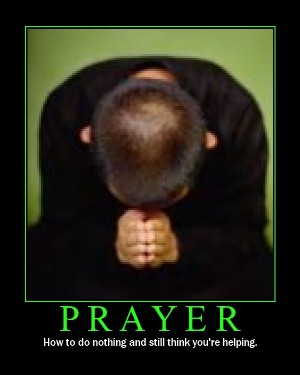
I never understood things like this.  I mean, I don’t believe prayer works, but even if I were to lend some legitimacy to prayer as an idea, are prayers which are done at a certain time, by many people, about a particular thing supposed to be more powerful?

Is this akin to getting a bunch of people to sign a petition to the president? (please sign that, BTW,if you already have not.)

Well, let’s take a look at Matthew 18:19 (ISV):

Furthermore, I tell you with certainty that if two of you agree on earth about anything you request, it will be done for you by my Father in heaven,

So, the book of Matthew claims that any two people who get together for a cause, and pray (appeal?) to sweet baby Jesus (or perhaps in his grown up avatar of old-bearded-white-guy.  Sort of like The Dude, but not as cool) then he shall do your bidding.  Something like that.  I personally never gave much thought to mentally controlling the universe through imaginary friends.

Image from the TV show ‘God, the Devil, and Bob.’ Apparently God (right) is an old hippie and Satan (left) was me in grad school. Except I drink beer. And I don’t have horns. Maybe.

What is clear here is that such a thing as 10-10-10 is not intended primary as a petition to the lord and creator of the universe.  It is intended as social media.  It is intended as a media campaign to get people to think about something.

Just not to do anything.

Because there is no reason, empirical, logical, etc, to think that prayer can accomplish anything.  Rather than waste time praying, we need to do.

And there are things we can do to help freshmen starting in college.  Hopefully, we have already worked towards giving them the best high school education we could, including excellent intellectual foundations in science, writing, and study habits.  Hopefully their parents, friends, and the world around them generally have given them good models for rational thinking, self-challenging, and emotional strength.

But now that there are people going off to be more independent, most for the first time, we can begin trusting them now.  We have to start thinking of them as adults, treating them as adults, and give them the wisdom of adult understanding of the world.

This means a healthy scientifically-based understanding of sexuality and safety.  It means at least a basic understanding of personal finances.  This means expectation of leaving your likely-parochial worldview; a preparedness to meet and interact with people with vastly different worldviews than they know.  It means these and many more things.

But in general, if we are concerned with students and young people in general, we need to be working, not praying, to make the world around us better.  We need to be educating ourselves, challenging our sacred or merely closely-held beliefs, and we need to address real problems head-on.

No god is going to help us.  Because if a god exists, it is clearly not interested in getting its ‘hands’ dirty.  The paltry, megalomaniacal, jealous god of many scriptures is not one I would depend on, even if I thought ‘He’ existed.  All evidence points to the only way we are going to get through this life is through mutual effort.

If I were the type of person to try and liberalize scripture to some warm-fuzzy interpretation, I would take Mt. 18:19, quoted above, as an ecumenical, almost secular message about working together.  It would mean that our actions, working together, would be the hand of some god, rather than our own effort.  But that is simply overly-metaphorical and ultimately anti-humanistic.

So, the next time I have a beer in my hand I will tip it in salute to all the new freshmen out there, as well as those getting ready to enter the “real world” at the end of the year.  Remember to challenge yourself, question your assumptions from time to time, and to get out and actually experience the world and other people.

Go out and have some (or a lot of) consensual sex, learn new things, develop a quirky hobby, listen to new music, read something not assigned by a professor, and occasionally have all night sessions of philosophical or personal discussions. In short I think students should learn, enjoy life, and transcend what they currently are.

Don’t take advice from conservative-minded people who seem afraid of “temptation” and leaving your confines of a tiny, religious, worldview.  More and more young people are leaving religion.  Let’s help that trend accelerate.  With the SSA around, I know that there are excellent people already doing so.

What do you think we can do to help students prepare for college or for life-after-college?

Poly culture is a two-way street with a memory


We here ay PolySkeptic have written about how polyamory is about figuring out what you really want and finding ways to get what you want.  We’ve also written about how it isn’t all about you.

Our little polycule–that is, those closest to me and with whom I spend most of my time–think a lot about the right way to do relationships.  We slip up, now and then, and certainly have a lot to learn, but we aren’t douchebags.  We know that not only other people have the same types of needs, desires, etc as we do, but also that when we don’t act this way the poly community around us has a memory.

You know, because we understand the basic idea of ethics and social dynamics.

Figuring out that you are actually attracted to, want to date, or are in love with more than one person is great.  Pursuing relationships with multiple people is great too, so long as you communicate and remember that they are people.  But the poly world is pretty small, and if you act like a dick it will eventually come to pass that potential partners will find out.

And eventually you will have trouble finding a date within the poly community, except, perhaps, with the other douchebags.  This inevitably leads to sub-cultures, within polyamory, of various kinds of people.  This would be a fascinating study for anthropologists.  Behavior-patterns tend to clump people into types of groups, and those who make the same kinds of mistakes will end up, in the long run, with similar people.

Because bad-behavior is co-reinforcing, I suppose.


What kinds of behaviors will get you in trouble?

Not wanting your partners to have other partners is not good poly etiquette.  For example, a guy wanting to collect a ‘harem’ of girlfriends, but making relationships those women have with others difficult via manipulation or some combination of rules or veto.  Veto rules really are not good, people, and this is one example of how and why.

Breaking up badly.  Ideally, when a relationship isn’t working, you should have a conversation and find a way to remain as amiable as possible.  Communication is critical when breaking up, unless some egregious harm was done by the other, in which case you can just walk away.  In the case of many break-ups, you may find that you just need to change the nature of the relationship.  We need to be able to be mature enough to face the harsh realities of love, sex, and friendship and have hard conversations.  People in the poly community around you will find out, eventually, about your bad breakup tendencies.

How do you treat your partners’ partners and their friends.  You don’t have to be friends with everyone.  You don’t have to like them.  Hell, you don’t have to pretend to like them if you don’t.  But are you honest with them? Do you give them an opportunity to impress you or do you keep a distance through some combination of intimidation, fear, and jealousy?  Do you talk badly about them to your partner? And if so, are you aware that your opinion is valid, wanted, and possibly completely wrong?

There are many more ways I could articulate, but it comes down to this; are you being a douche-nozzle? Or are you making an effort to be open, communicative, honest, and are you making an effort to understand other people involved so that your conclusions, actions, etc are informed and mature? In short, are you trying to be an adult?

In the mono world, there is enough room to treat a few people like crap and get away with it for a while, even though you should not do so.  You can simply hang out in a new crowd, move to a new part of town, etc.  But the poly world is small (but growing), and being an idiot will get around faster.  In order to have happy and healthy relationships for years to come, and be able to add new people to your life as they come around, you want to be surrounded by good people and have them respect you.  They only way to do that well is to treat your partners, friends, and acquaintances well and to strive to keep getting better.

It will not always work.  Some people simply are not ready to be adults and they will not wish to be around you anymore and they will be stuck in their world with similar people.  But in the long run they will suffer the result of that, and we can only continue to maintain our life, struggling with what we carry and remembering that the good people we meet along the way help with the heavier stuff from time to time.

And in the long run those who make worse choices will find themselves older, not wiser, and stuck in the beds they have made.  All of you out there who know people who get to the point later in life who still struggle with basic life and relationship problems know what I’m talking about.  People hide, when younger, their issues they have not dealt with and they are able to carry on without significant notice.  Those that struggle earlier with self-improvement will struggle less later, and it will show because the resulting adeptness/ineptness will become apparent.

This life is a struggle with the interaction of our issues with the issues of those around us.  There are better ways to deal with these things, and their are worse ways.  That is, there is actually an objective component to figuring out how to live well.  The test is the real world; what works.  Open and honest communication works better than lack of it.  Facing problems directly works better than avoiding them.  Treating people as complicated and real sentient beings works better than treating them as mere objects of your own desires.  The truth works better than delusions.

Now, if only the delusional could grasp that….


Because I’m polyamorous…


Ian Cromwell has been running a series of essays submitted to him entitled “Because I’m an atheist…” and I have been reading them for a while.  Today, my answer went up, which caused me to think about the implications of being polyamorous.

Because I’m polyamorous, I don’t have to pretend to be anything other than what I am.  I live such that if I meet someone I’m interested in, no matter how I’m interested in, I don’t have to nudge that interest into “appropriate” directions.  I don’t have to avoid friendships with people to whom I am attracted, nor do I have to suppress feelings of attraction, which in the long run often leads to feelings of resentment and often clandestine sexual relationships which destroy relationships when they don’t have to.

I get to love each person according, not to some pre-scripted appropriate way, but to how I actually do want to love them.  All I need is them to have mutual desires, open communication about said desires to my other partners, and the time and inclination to pursue them.

It also means that I get to be who I am, completely.  My wife and girlfriend both know I find other women attractive, but because they know this they know that the affection I show to them is genuine and authentic.  I’m not in a situation where all of my affection is tunneled towards one person, and they have to wonder if I’m only doing it because I have to;  because I have nowhere else to act on such feelings.

As such, because I’m polyamorous there is more grounds for security on my relationships.  See, rather than threaten my relationships, my (as well as my partners’) ability to pursue other people for friendship, hookups, or possibly a new relationships means that if I stay with someone, I really want to be with them.  With (serial, especially) monogamy, it is too easy just to keep holding onto a relationship because you are not sure if you will have another one available(which, of course, is not a good reason to stay in a relationship!).

The big threat for monogamy is often other people.  With polyamory, other people is the rule and so that threat is made mostly impotent.  Of course, interpersonal issues may still arise (as they do with monogamy), but ideally when that other person comes around and draws your partner’s eye, you know they will still come back to you again and again.

Because I’m polyamorous I have been forced to mature emotionally (specifically concerning jealousy), develop better communication skills, and think more about the differences between what we actually want and what we decide is good for us.  It is clear to me that most people want to be with more than one person sexually, romantically, etc.  What is not clear to me is why so many people are monogamous.

Because I’m polyamorous, I have developed a keener eye about how we, as a culture, think about relationships, love, and sex.  So, because I’m polyamorous, I have a better perspective on romance, sex, and relationships than most monogamous people.

Ultimately, because I’m polyamorous, I write about polyamory so that more people can understand why this lifestyle is so wonderful, challenging, and worth every ounce of effort.

‘Alain de Botton’ and ‘sex’ should never be in the same sentence!


…oops!

So, PZ Myers’ blog just alerted me to Alain de Botton’s new book How to Think More About SexNow, regular readers very well know I am no fan of Alain de Botton.  I find him to be an example of everything that is wrong about intellectual society, and would gladly play his arch-nemesis in any movie or real life.  I cannot articulate how much I dislike this man.
In any case, PZ’s post links to some reviews of the book, and they are worth looking at.  All I feel the need to say is that nobody needs to take de Botton seriously anymore.  If you liked his previous work or see him as insightful and often right, perhaps you should re-evaluate your worldview because you are probably wrong.

Taking Offense


I have spent a lot of time over the last two or three decades thinking about things such as emotion.  I am, I think, more aware of how emotion works on the mind, behavior, and beliefs than most.  I have much that I could still learn, but I feel like I have some understanding (dare I say ‘wisdom’?) worth paying attention to on the subject.

In the times when I have been most offended, defensive, and have pulled (or ran) away from something I did not like or want to hear, I have found that all that resulted was an overall loss.  The times when my inability, unwillingness, and fear of facing a challenge and trying to find out why I was offended was never a victory.

There are certainly times when an offending action leaves you with the wise course of simply walking away.  There are times when offense has nothing to teach us.  But there are other times when offense can be a great teacher, and we need to practice in order to tell the difference between the two.  And it is quite easy to be wrong, so I tend to lean towards introspection in all cases of offense, disagreement, or even dislike of another idea or person.

If you are offended, even if you must walk away (if only temporarily), make sure to at least reflect on it.  Be sure that the cause of the offense is not something rubbing against a fear, insecurity, or where you may simply be wrong.

In short, running or walking away from offense can be a way to hide from your potential to learn about yourself.  Others, when they offend you, may have something to offer you.  Be not deceived by offense; for it can often be a gateway to self-knowledge.

The Bachelorette and Polyamory? (via Respectful Atheist)


As I have said, I read a bunch of blogs.  Many of them are related to polyamory, but most are atheist-oriented.  And while some have some overlap, most are largely unaware or at least unconcerned with the other issue most of the time.

Somewhat recently, I started following the blog called “Respectful Atheist,” which I discovered via another blogger.  And it seems that the Respectful Atheist may follow this blog as well, because he at least links to us.

So, today a post went up about the Bachelorette.  I have never seen the show (as I have no interest in the majority of “reality” TV shows), but often such shows give us things to talk about, as it did in this case.

Now, I know that today’s post is not about polyamory, at least that was not the primary focus, but I think that it demonstrates how much our species has attributes which are conducive to polyamory and how enlightening a non-monogamous view of relationships can often be in exposing our assumptions.

In the post, Respectful Atheist (RA) says:

The other thing I find interesting is the way in which The Bachelor/Bachelorette, in this case Emily Maynard, goes about making their decision as to who they will pick in the end.  In nearly every season, the given star of the show comments on how they are falling (or have fallen) in love with more than one person at the same time.  This always seems to come as a total shock to their system, the implication being that there must be something terribly unnatural about having feelings of love for several people simultaneously. [emphasis in original]

Isn’t that fascinating? People who actually are falling in love with more than one person, rather than just deal with that as a reality and thinking rationally about the consequences of that reality (I know, perish the thought!), tend to conclude something is wrong, rather than consider that the premise of their quest for “the one” is fundamentally flawed.

I have said on this blog before that part of the problem with our culture is that monogamy is assumed, rather than chosen.  This circumstance from this TV show is one type of example of what I mean.  RA continues, describing their interpretation of the Bachelorette’s circumstance;

In Emily’s case, the cognitive dissonance that results leads her straight into a period of deep confusion, during which time she considers the idea these conflicted feelings may themselves serve as proof that both of her top two guys are in fact wrong for her.  In other words, as the thinking goes, if one candidate is not very clearly better, than each of the others, something just must not be right (because it’s not supposed to feel this way).  Sadly, there are others, close to Emily, who encourage this type of thinking, which only ads to her confusion for a time.  She *should* feel much more strongly for the guy she is *supposed* to choose, because that is the one guy she is *meant* to be with…right?

Ah, social sanctioning of ignoring the truth (how she actually feels) for a cultural ideal which does not fit with the actual facts.  Isn’t our culture grand?

Bizarre scenarios and love as a choice?

Respectful Atheist’s post is about the concept of a “soul mate” and continues a criticism of this idea in light of this reality show.  I have touched on this issue myself in the past, and largely agree with that part of RA’s post.  But later in the post, RA says this;

It IS possible to fall in love with more than one person, at the exact same time, and we should expect nothing less when we engineer such bizarre scenarios.  In our culture, it’s not considered normal to date 30 people at once (in fact, it’s generally frowned upon!), so it’s just that we don’t often see these dynamics in action….

Perhaps RA doesn’t often see such dynamics in action, but I do see similar things play out all the time (and not only in the poly world, but elsewhere; I notice it because I’m sensitive to it).  And I think it is more common than we, as a culture, are always aware of, perhaps because we are distracted by the ideal of monogamy? Who knows….

So, I’m assuming that the set-up of the show allows the bachelorette to interact, date, etc with 30 people, who over time get eliminated until eventually there is just one left? The deliberateness of it and the presence of producers and cameras certainly make it “bizarre,” but is the fundamental set-up really that strange? Perhaps it is more quantitatively exaggerated, but is it qualitatively bizarre?

Many people, even in the monogomously-inclined world, date multiple people simultaneously (not usually 30…), most with the goal of eventually choosing one.  That is the ideal of our culture; we have the freedom to interact with, date, etc a number of people to find “the one” who, while we are not meant (by god, gods, or any cosmic forces) to be with, we choose to be with.

RA’s criticism here falls on the idea of “the one” being fated, not with the concept of there being just one.

…The truth is there is no one person who is *meant* to be with you or I forever.  I know this all sounds terribly unromantic of me to say….

The criticism is of the concept of a “soul mate,” while not taking the next step and being overtly skeptical about the ideal of their being one person we choose.  But like I said, this was a post about the role of deities in finding our one person, not polyamory.

RA continues;

Please understand that I say it as a guy who is very happily married, and plans to remain so until the day that he dies.  But isn’t this more romantic anyway?  I’d much rather marry someone who promises to stick with me, through thick and thin, even when their feelings wax and wane. [emphasis original]

RA does not say so explicitly, and I would like to hear his thoughts on this later, but this sounds like “stick with me, through thick and thin” means that they will remain monogamous, committed, etc.  Well, I’m married as well and I am committed to both Ginny (my wife) and Gina (my beloved girlfriend).  I chose to be with both of them (and I may meet another person I wish to commit to as well, but perhaps not), and I love both of them and will remain with them through thick and thin.

The juxtaposition of this with RA’s comments about the bachelorette’s position of being in love with two people seems to indicate that I’m not particularly romantic.

What I mean is that RA’s commentary seems to assume that the monogamous circumstance RA has chosen is “more romantic,” and possibly more legitimate, than being in love with more than one person as Emily found herself in the show.  I don’t think that he would have meant to imply that my choice (if it is a choice…we’ll get to that…) is somehow not romantic or meaningful, but that seems to be the logical implication.  I think this may be a blind spot for monogamous people.  A privilege, if you would.

RA finishes that last paragraph with the following.

You can’t “fall out of love”, because love is not a feeling to begin with…it’s a choice.  I realize that choice is driven by feelings, and I wouldn’t have it any other way, but it’s still a choice at the end of the day.

This is probably a semantic disagreement, but I do disagree.  As I use the terms, one chooses (insofar as choice is meaningful in a deterministic universe) to commit to another person, but we don’t choose to love them.  I think this may be what RA means, so I will not quibble about this more than I already have.

But in the context of the criticism of the concept of a “soul mate” in the context of actually having feelings for more than one person, I find it very interesting that an intelligent, thoughtful, and aware person, as RA seems to be, misses the implication here.  It is possible that he is quite aware of it and is setting it aside because the post is about something else, but the language used seems to imply a view consistent with monogamy being somehow more romantic, meaningful, etc.

While the point about there not being a person “meant” for you is spot on, how does RA miss the fact that circumstances, such as the bachelorette’s having love-feelings for multiple people, are examples of how we truly can love more than one person and that perhaps this tells us something about the choices we should and could make?

Why monogamy (reprise)

Why should we choose one person? Why do so many people tend to (perhaps unconsciously) associate commitment with monogamy (or at least monoamory)? Why is one special person more “romantic” than two, three, or possibly more? The fact is that we don’t choose who we love, but we (as a culture) do choose to ignore or set aside some other loves in order to compromise to have another.  We choose to direct our feelings towards one person, even though we do, or potentially do, love other people.

Why?

I have no reason to doubt that RA is happy being married and (as is implied) monogamous.  And if they are in fact monogamous, I have no doubt that their relationship is potentially healthy, happy, and worth the effort for both of them.

That isn’t the point.

The point is why did they choose that path? Why do we, as a culture, choose to be monogamous so often?  If we recognize that we can love more than one person (whether or not the circumstances are bizarre or not), why would we not? Why would we artificially limit ourselves to one person?

It’s not necessarily more romantic, meaningful, or intimate to be monogamous.  These are myths about relationships in our culture, and our actual feelings and experience with actually loving and committing to multiple people (either serially or in parallel) attests to that.  And when we are faced with that reality, as the bachelorette apparently was, it is fascinating that many people assume something is wrong rather than step back and apply that experience to our assumptions like a good skeptic should.

So not only is there not one “soul mate” out there for you, there may not only be one person.  RA adds some thoughts that are encouraging to this polyamorous, atheist, skeptic;

We tend not to give ourselves enough credit; Maynard included.  She need not deny, or be in any way embarrassed, about the fact that she fell for more than one guy on the show.  Sometimes there is no *one* right way to go, even in cases where there is a choice that clearly needs to be made.  This is my larger point.  I think we all hope that she will make her choice (as spoilers would indicate that she does) and live happily ever after.  And those people who would have had Emily doubt herself, simply because her love has not been directed at one man exclusively, are clearly well meaning but misguided.  What Emily needs to do instead is make a rational choice….based on her feelings, yes, but also based on her head.

And while I think RA is talking about the fact that with the options given perhaps neither is right, I think that it can be read to mean that perhaps the choice could be both.  If we make a rational choice using both our hearts and our heads, we will find that we are capable of sharing ourselves and our beloveds, and recognizing that not all choices are exclusive, but some are inclusive.

And while the bachelorette will almost certainly choose to exclude one or more people in order to choose one, as RA may have also done, this is not the only option.  We can choose to love and commit to each person as we actually desire to and allow those we love to do the same.

That’s using our hearts and heads rationally.

Thinking about “the OTHER side” with friends


OK, so I don’t know why I have not been reading Dan Fincke’s blog, Camels with Hammers, for longer than that last month or so.  I don’t always agree with him, but he and I share a number of things, including graduate degrees in philosophy, a love of Nietzsche, and being atheist bloggers.  It’s too bad he’s not poly or I might have to have a man-crush or something.

This is what Patrick Stewart does after reading the beginning of this post

OK, not that last part.  I’m totes hetero.  Except for Patrick Stewart during the days of Star Trek: TNG.

Anyway, I’m getting off-topic (already), so I’ll just leave my Kinsey rating to the side for a moment and get to what I want to talk about today.

I had a long conversation with some friends last week about atheism, polyamory, privilege, etc that was rather frustrating all-around.  In an email exchange, a friend wrote to me, and this was my response.

I think I address some issues which are interesting to readers here, so enjoy.

[I’ve changed names of people involved for the sake of anonymity or someshit]

I find it interesting that you read that post and got this from it:

I’m not sure which viewpoint you meant to espouse here – doesn’t this stand for the proposition that any prominent view can be blindingly pervasive?

I find it interesting because this may be a related tangent to the post, but it is not what Dan Fincke was talking about (as I understand it).  For me, the core of the post was this section (Quoted only to highlight it, not to have you read it again, necessarily):

And this is not because they are either brainwashed or intemperate, but rather because they know what you think already and are sick of it. They too were systematically enculturated to internalize the same values, beliefs, practices, and assumptions that you were. What you are about to say to them was drilled into their heads, quite often to their own detriment, with both words and consequences. And sometimes those words and consequences were extremely harsh in order that the point you want to make to them might sink deep into their little, obtuse heads. Whatever you are going to say, they have heard it already from their parents, their lovers, their religious leaders, their friends, their coaches, their colleagues, their teachers, and/or their employers. The assumptions you want to make explicitly clear to them, in order that they finally “get it”, have already determined the course of their lives in ways you can hardly imagine.

They have met you before. They have thought your way before, they have felt your way before, and they have valued things your way before. They have lived in your world their whole lives. They walk around with you already in their head.

They have struggled through hard experiences, wrestled with challenging educators, and engaged in a whole lot of personal reflection in order to learn  how to think differently, in order that they might successfully think and feel at cross-currents with not only explicit sociopolitical pressures but implicit ones embedded in language, social norms, religious practices, and, even, what are taken to be moral assumptions.

People who come from your own culture and yet think so wildly differently from what you think you know to be common sense do not just wind up that way because they are stupid or emotional or have mysteriously not been presented with basic information or arguments yet. They have, in all likelihood, had some bad experiences and been exposed to challenging ideas that you have not seriously had to contend with yet. They have, in all likelihood, thought through the issues at hand in intricately complex ways that you have not even begun to take seriously.

Of course this does not mean that they have necessarily come to correct conclusions in all, or even in most, matters. Their radical reeducation may be mistaken. They may have drawn the wrong conclusions from their experiences in any number of areas or in any number of ways. They may have something to learn from a dialogue or a debate with you.

But neither you nor they will learn anything if you just dismiss them as someone who needs you to explain to them the obvious that they might overcome their apparent obtuseness. Nothing is going to be learned if you condescend to them by telling them they haven’t heard out the “other side” and that they are just some sort of extremist who does not get basic facts about the world. Nothing is going to be learned if you strawman what is strange and unfamiliar in what they are saying so that you never give it the slightest chance to prove itself to you and to expand your horizons. You are not going to grow if you look for their most obvious mistakes, interpret their views to have the worst possible implications, or try to attack their personal failings as a convenient excuse to shut them down without listening to them.

This is not talking about how persuasive or prominent an idea is, at least not directly. As I understand it, Fincke is talking about how worldviews skew how we approach topics.  It’s talking about how a person can get at a problem from a view that others, who have not dove into the intricacies, simply don’t see.  The simplistic view that those people, who have not dove in, is often paired with an untested certainty about their view.

I say “untested” because they have not dealt with the subject deeply and seriously, so they are incapable of understanding it in the way that the expert (or even non-expert activist) does.  It does not mean they are lacking in intelligence or anything like that, just that they currently lack the relevant experience to comprehend the various subtleties of the problems.

As an example, let me address your question about self-doubting ideologies, where you said

So it would cut against any ideology which isn’t self-doubting, including atheism?

I’m curious why you see atheism as not being self-doubting.  Granted, there are atheists who may not doubt (as there are theists who do not doubt), but this is either a false claim to cover up insecurity or a semantic problem. Atheism per se is nothing more than the lack of belief in any “gods” (whatever those are supposed to be).  Atheism is a tentative conclusion based upon rational thinking, logic, and empiricism; in short, it’s due to skepticism; the lack of supporting evidence leads to the lack of belief in supernatural entities.

Any intelligent and mature thinker knows that their opinions, conclusions, etc are always tentative.  The strength of their certainty is dependent upon the strength of the evidence in support for a position, ideally.  My certainty that there are no theistic gods is very high (for deistic gods, not as high), and if I am given sufficient reason or evidence to doubt this certainty, that lack of belief is subject to change.  If there is good reason to think there are any gods, I want to know and am willing to change my mind.

But my experience with theology, science, philosophy, etc have led my certainty to grow quite strong, and the area for possible evidence for such beings is vanishingly small.  That is, the gaps for “the god of the gaps” grows smaller the more we learn about the universe.  But in the end I will always concede that I might be wrong, that there may be a god, gods, or something supernatural.  I simply see no reason to suspect that I am wrong, currently.

So in other words atheism is always tentative and thus, in a sense, self-doubting.  An atheist should always doubt (everyone should).  If I were to be precise, I would point out that because atheism proposes nothing about the world at all (it is a negative position; a- + theism=atheism), it is not even categorically meaningful for it to not be subject to doubt because it proposes nothing to doubt or not.  Theism is the position, the claim, and atheism is the rejection of the claim and logically implies nothing else, directly.  The only way to meaningfully doubt atheism is to be exposed to evidence or good reason to believe in a god.  And an atheist should be open to the possibility of such (And there are atheists, like PZ Myers, who [seem to] disagree with that statement…for reasons too complicated to get into here).

The point of the post, as I understand it, is to show that ideas, whether popular, mainstream, etc (or not) are subject to a kind of bias, often called privilege, which creates a problem in communication.  The Christian talking to me, for example, talks as if I have never heard the story of Christ.  Or at least that if I know the words, I have failed to comprehend the meaning and significance of the story.  But not only do I know the story, but I know the history, theology, etc better than they do (quite likely; studies have shown that atheists know more about religion than practitioners of those religions do, in most cases).

I know it more because I have spent years studying the subject.  I have superior experience, so when I talk with people with other specialties (say, the law or robot-building), I run into ideas about the subject which fail to demonstrate sufficient understanding, let alone expertise.  And the arguments that I hear are attempts to show a narrative which I not only understand (and better than the arguer), but which I have transcended, rejected, and have replaced with a superior narrative.

Like I said before; I would not try and argue a legal position with you (or anyone else who has studied such things) without understanding that my views on the subject are sophomoric (at best), and I would lend more weight on what you would say, even though I am aware that you may not actually be correct.  But I hear people add their views about religion, atheism, philosophy, etc frequently who have little idea about what they’re talking about, because they are intelligent people and these are mere matters of critical thinking (or whatever their justification may be).

There seems to be a view in our culture that subjects such as religion and the complex issues surrounding “new atheism” are accessible to any educated person (and, I suppose it is if they do the work), and so many people feel (whether atheist or theist) like they can just confidently explain to me the popular narrative and I’ll simply get that I’m making it more complicated, extreme, etc than it has to be.  When [name redacted] referred to me as “one-dimensional,” I wanted to say I saw him as sophomoric and simplistic, but I realized that wouldn’t help conversation.  When I hear that, I feel like I’m talking to the freshman in philosophy class who thinks he knows everything because he read ahead and knows what the next reading offers as an answer.  But that freshman doesn’t have a grasp on the problem at hand, and just looks stupid from the point of view of the expert.

There exists a (privileged) narrative about religion, faith, atheism, science etc in our culture which is largely nonsensical and flatly wrong.  It sounds sensible at first hearing (that is, it’s compelling and persuasive and thus hard to respond to easily without explaining the underlying narrative), but it’s dubious and has been shown to be so by people such as myself for years.  And yet this narrative drives the mainstream cultural opinion where the mass media, most of the middle class, and even educated people swim and pass around the memes which we, the experts in the field, know to be absurd.  And so we get frustrated, labeled as angry, irrational, and “one-dimensional.”

The reason we seem one-dimensional is that whenever we talk to people like [name redacted], in the role he played during that conversation, we are viscerally reminded of the narrative we find so ridiculous, and have to confront it again.  It seems like was are reactionary and combative, but we are defending ourselves against the dominant narrative.  We are combating a privilege you have, can’t see, and everyone walks away frustrated.  We have to explain the basics of the problem, for the thousandth time, to someone who thinks their opinion is intelligent when it isn’t.

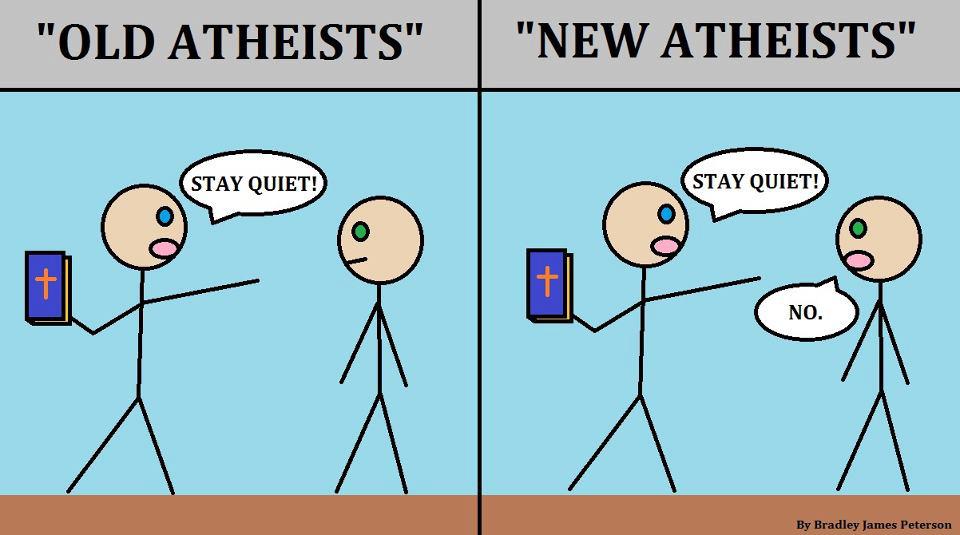
So yes, we come across as angry, repetitive, and one dimensional.  We have the choice of that, or shutting up.

This image sums that up for me, perfectly:

Secularism v. religious privilege


QualiaSoup is among my favorite YouTubers (others include Evid3nc3, The Thinking Atheist, Darkmatter2525, NonStampCollector, and of course the vlogbrothers).  His analyses of various issues are coupled with helpful visual components which make his arguments powerful and compelling.  Here’s the latest:

And while this video focuses on the United Kingdom, the principles are pretty universal, and thus apply to the United States as well.

I have worked with Separation of Church/State groups and have done activism on this front, along side my atheist activism, for a long time.  Because I live in a relatively liberal part of the country (and world), I tend to not feel the cultural necessity to keep the pressure on such issues as strongly, and local groups here are not as active as they are elsewhere (like they are in the Midwest, the South, and specifically Austin, TX).  But keeping secularism as a goal and ideal is important to me, and I think we need to remember that there is a fight right now against religious privilege, who are framing it as the right to their religious freedom.

It’s not religious freedom that is being fought for by conservatives and their religious allies; it’s religious privilege.  Secularism is the solution to religious privilege, and does not threaten religious freedom at all.

All Apologies


Considering recent discussions about apologies, I think it is fair to ask what apologies are all about.  The word itself comes from the Greek apologia, which means a justification, defense, or argument. Obviously, the term has transformed a fair bit, and an apology is now defined as “An acknowledgment expressing regret or asking pardon for a fault or offense.”

If you look at some ways to say “I’m sorry” in various languages it is clear that the concept of an apology is more basic than a mere regret or asking for pardon.  For example, the Spanish ‘lo siento,’ while translated as “I’m sorry,” means something more like ‘I feel it.’  Thus, I would argue that the basic idea of an apology is sympathy, and can specifically lead to an attempt at atonement due to that sympathy.

Ok, so is it possible to have sympathy for some offense given, especially if it was not intended, and not feel culpability? In other words, can we sympathize with some offense without having the responsibility to make amends, atone, etc?

Alex does not seem to think so:

Glickman also suggests that if we hurt someone, regardless of our intent, we should be willing to “apologize and make amends,” and I think this is good advice as well.

OK, so we should be willing to do so, perhaps, but I don’t think we have any moral or ethical responsibility to do so, necessarily.  Not all offenses require amends.  Sometimes offense is purely the responsibility of the offended.  To explain why I think so, let’s get back to Alex’s post, especially to something else that Alex quoted of Charlie Glickman:

  • Some event happens, whether by a person’s actions or chance.
  • We filter it through our experience and decide what we think it means.
  • We have an emotional response based on our interpretation of that meaning.
  • Our feelings shape how we respond to the event.

When I read this, my pet-peeve alert went off and I had to control my urge to throw my phone (on which I was reading the post) across the room.  Let’s track what’s wrong with this series above with my response to reading it as an example.

  1. I read Alex’s post, getting as far as this feeling like he was making some fair points.  Then I read the above sequence.  That’s the event.
  2. My ability to perceive and understand the information contained within said event led to parts of my mind, of which I am mostly unaware, to create an emotional response which flavored and colored any cognitive ideas and decisions I was capable of subsequently considering.
  3. I considered the rational and logical implications of the ideas, flavored unconsciously by my background emotions for which I have no conscious control but which I am responsible for reacting to.
  4. I decided I disagreed with Glickman’s sequence, making sure that my emotional considerations were not over-riding my rational capabilities (knowing that I may still be wrong).
  5. I felt frustration, disagreement, and began to compose rational reasons why I disagreed, fueled by the emotional frustration and disagreement.
  6. Here I am

The point of this is to illuminate that where the offense occurs here is at the pre-concious emotional level.  I am responsible for how I react to this, not the source of the offense.  Alex or Glickman should no more apologize for making me feel frustrated than should the phone on which I read the post.  The result is that I’m not mad at Alex (or Glickman), my phone was not thrown, and I made the rational decision to respond to the post with a rational critique rather than dell in the frustration..

We are responsible for how we respond to our emotions, including offense.  We are not consciously responsible for our emotions, since they pre-exist our conscious awareness, and offense is simply an emotion.  If we are offended, we need to consider why we are offended and what we should do about it.  Blaming the source, rather than take responsibility for our mind, is not always the best option.

There are many things to consider when it comes to offense.

Is the act or idea which we found offensive true or does it reveal a truth? Then why be offended by the truth?

Was it an act that harms me directly, physically? Was it done intentionally? Was it done via negligence?

There are many other questions which I will not try and enumerate here.

In the case of an unintentional harm, I wold hope that the person who acted and caused the offense should at least sympathize (I should not expect it, but I should hope for it), but I don’t think they have any responsibility for atonement or to make amends.  So for them to say they are sorry, we have to wonder what they mean.  If they simply mean that they sympathize with the offense (like the Spanish ‘lo siento’), then I’ll agree that it is a sign of a sensitive and caring person, but what of atonement?  Sympathy can help solidify social bonds, but this is not the same as an attempt to make amends.

Should the offender try and make amends? Sure, if they want to, but in many cases this would be silly.  If I were to make a statement such as “faith is irrational and harmful” (which I am wont to do) and another takes offense at this, I certainly sympathize with their feeling but I don’t think I owe any amends for this.  I have done nothing wrong in stating an opinion, one which I hold for what I see as good reasons.  Hell, even if I’m wrong I owe no amends, I just have to be shown that I’m wrong.

What could it mean to owe amends for an opinion which is seen as offensive? Does it mean I change my opinion? Does it mean that I don’t say my opinion? This is the basis for the charge that religious people crying ” that’s offensive” as being an attempt to shut up criticism.  There is nothing to atone for in an opinion spoken, even if it does lead to offense.  So if an apology means that we sympathize, then fine, but I think that’s a weak use of ‘apology’ and I think apologies (in the sense of making amends) should be reserved for when we do something wrong, not merely when offense occurs.

Offense is not the criteria for apologies; doing something wrong, harmful, etc is the criteria for an apology.  Offense can happen for bad reasons, good reasons, or no reason at all.  This is the case because offense happens before we are even conscious of the idea we find offensive, so it pre-exists reason.  it is arational.

In short, there is no right to not be offended, and if we are offended then we are responsible for dealing with it.  It is only when someone actually wrongs us, not merely offends us, that they have any moral culpability which might lead to an apology.


Shaming and jealousy (via polytical.org)


Yesterday, Dan Jasper over at Polytical posted some thoughts about shaming and respectful dialogue. As anyone who knows me will guess, I think about the issue of respect and criticism a lot, so this was a subject which grabbed my interest.

I put up a comment (currently awaiting moderation) and wanted to put that comment up here:

Breast milk IS better. The patriarchy IS alive and well. The veto rule IS dangerous. Biblical inerrancy IS illogical. These ideas might be inferior to their counterparts, yet couldn’t that be demonstrated through respectful dialogue, as opposed to shaming?

Sometimes, yes.  But not always.

Christopher Hitchens, a personal favorite of mine actually, personally used shame as a tool against representatives of the Catholic Church (during debates with them, in some cases) in addition to rational points.  He did not respect the Church, and so why would he act as if he did?  In my opinion, Catholic doctrine and actions throughout the world are shameful, and in some cases the people in charge SHOULD be ashamed of what they have done, represent, etc.  We should not merely shame them, but sometimes emotion is the key to rational action.

Your seeming dichotomy between respectful dialogue and shaming is problematic, I think.  For me, respect is based upon honesty, truth, and a willingness to challenge and be challenged, not merely being nice.  Pure rational approaches (if this is what you mean by “respectful dialogue) are not always effective (or affective–HA!).  Unless we are to become straw-Vulcans, we have to recognize the relationship between emotions and intelligence, and that people don’t get to conclusions through purely respectful (especially if only rational) dialogue.  Sometimes the only way to get through to us is to show us how ridiculous our ideas are by playful mockery, pointing to moral failings in our ideals, etc.  In many other cases such tactics are not useful or helpful, but I don’t think shame is never appropriate.

Jealousy is a problem for many, not so much for others.  It is not a moral failing, but it is an unfortunate reality for many people.  I don’t think anyone should be shamed because they are jealous.  I think people should have compassion for the struggle with jealousy.  But if someone is not struggling–not trying to improve their relationship with–jealousy (or other emotional realities), then perhaps they are not working as hard as they could to make themselves emotionally healthy people.  Is that worthy of being ashamed? No, I don’t think so.

But the measure of a person is not so much what you are given, but what you do with it.  If a person who suffers from bouts of jealousy does not confront that problem as best they can, openly and with a desire to actually change it, then perhaps shaming is not appropriate but perhaps transparent disappointment and constructive criticism are appropriate.  And the unfortunate reality is that disappointment and criticism cause shame in people–because they actually are ashamed of being ridden with something.  That is, sometimes shame is the cause even when it is not the tactic used.  So, should we avoid any sort of interactions which might trigger shame, or should we only not intentionally shame?

And if someone is shamed by our attempts at respectful dialogue, should we be ashamed of doing so?  This is more complicated than respect/shaming dichotomies.  Just some thoughts I had after reading this yesterday.  While I agree with many of your points, I think that I disagree with what I perceive as some background assumptions which I see here.

I think that people feel shame quite often not because they were shamed, but because they are ashamed. Thus, it seems that this question of whether we should use shame, while interesting, is not the whole story. Criticism is not using shame, and the post at polytical seems to create ideas which could conflate criticism with shaming, which is problematic.

(sorry for my lack of activity recently. I’ve been feeling sort of depressed recently and am doing what I can to get out of it. Apparently reading polytical.org helps…)