What’s your poly personality?


The poly community has sects just like any other community. (Go ahead and enjoy the aural pun, I’ll wait.) If you hang out in a poly discussion group, you’ll see words like “polyfidelity,” “polyfuckery,” “closed triad,” “relationship anarchy” pop up, and alongside them you will often see hackles rise. We’re a pretty liberal, tolerant bunch, so most of the time cries of “Everybody needs to do what works for them! Let’s all just accept each other’s differences!” will shut down an argument before it gets rolling, but underneath it the differences are still bubbling. Those of us who call ourselves poly do poly really differently, and there can be a lot of tension around your way vs. my way, and whether I think my way is superior, or whether I think you think your way is superior, or whether I’m unintentionally erasing your way altogether because I have a hard time conceiving that anyone could construct their life like that.

Personality typing systems, especially Myers-Briggs (but I’m a fan of several others too!), have been really important to me in how I relate to others. While I don’t view them as hard and fast categories, and some people have a hard time fitting themselves into a particular model, they’re incredibly useful ways of identifying trends of difference between people, in a way that doesn’t position one way as superior to another. They give us a way of talking about our different personalities, preferences, and approaches to life that is easily intelligible and judgement-neutral.

I wasn’t aware of it until today, but the writers over at polytripod (who were featured, along with us, in the Our America documentary!) came up with a similar schema for poly personality differences. I think it’s really great. Because there are many more variables, it doesn’t lend itself to easy acronyms the way Myers-Briggs does (I’m told people who didn’t grow up on Myers-Briggs don’t find those acronyms so easy either), but it is at the very least a terrific jumping-off place for discussions about what style of poly a person prefers, and why. A lot of the axes point to things that I hadn’t consciously noted as big, stable differences between people, but which I immediately recognized as being important and relevant.

I kind of like that the system, as it stands, doesn’t lend itself to a simple identifier the way you can say, “I’m an INFP.” It more requires you to go down the list, check the box that applies to you, and then compare lists and discuss. Requiring a more deliberate discussion rather than a simple verbal tag… that’s so poly it’s gross. (I kid, I kid. If I wasn’t into obsessive discussion and overanalysis I probably wouldn’t be poly.)

Scanning down the list, here’s where I line up (and some thoughts on the category in general):

“Speed” axis: How quickly do you form connections/relationships in general?
 Fluid- more rapid in forming emotional and/or sexual connections.
 Growth- deliberate in forming emotional and/or sexual connections.
 Static- slow moving in forming emotional and/or sexual connections.

I find it really interesting, and cool, that “growth” and “static” are two different categories rather than just sorting speed into fast and slow. It makes a lot of sense to me. I’m slow to connect (in most cases) but I’m also not inclined to pick out someone and deliberately work to build a relationship. I prefer to be guided by my feelings in the moment, rather than a deliberate decision that I want to pursue a relationship with a particular person. But I’ve talked to others who felt differently.

“Structure” axis: How would you describe your ideal poly relationship structure?
 Open- People come and go at will forming “polycules” which consist of individual dyadic relationships.
 Network- People often connect socially with metamours. Some sort of “get to know you” is usually requested or offered early on in becoming part of the extended group.
 Closed- Approval of existing members needed before new member is allowed to join.

I’m very comfortable in this “connections with metamours are encouraged and pursued, but not required” spot.

“Attitude” axis: What level of entanglement is desired with partners and/or metamours?
 Independent- Prefers to do their own thing with their own partner .
 Community- Enjoys being part of socially connected groups some of the time.
 Family- Actively prioritizes shared time and/or space with partners and metamours.

Ditto. If one were trying to simplify this system, I could see folding this and the Structure axis together, but as discussed, I don’t feel simplification is necessary.

“Intimacy Style” axis: How is romantic closeness with others achieved? More than one may apply.
 Sexual – Connects with others via sharing physical intimacy.
 Emotional – Connects with others via sharing feelings.
 Activities and Shared Experience- Connects with others via sharing experience and spending time together.

Definitely important that more than one can apply.

Prioritization Axis:
 Hierarchical- priority is given to preservation of existing primary relationship/s.
 Weighted- some relationships are prioritized over others, but open to changes, adding an additional primary, etc.
 Egalitarian-committed to not prioritizing some relationships over others.

Here’s another one where I’m thankful to have a middle ground. In truth, my relationship with Shaun is de facto primary to me, and I do prioritize it over others, but it’s not hard-and-fast.

Relationship Saturation Axis: What would your ideal relationship concentration look like?
 Full-boat- completely satisfied with current relationship(s). Prefer relationships to dating.
 Open to opportunities to connect-neither closed off to forming new relationships, nor actively looking, but being closed to possibilities would feel restrictive.
 Actively seeking new partner(s)? Looking for new connections regardless of current partner status. Consistently open to dating and exploration.

This is one that I hadn’t fully conceptualized, but I think is really useful. These questions often get framed as, “How many partners is enough to you?” but to me it makes much more sense to look at it as a dispositional thing. Some people just really enjoy the dynamics of new connections and pursuit, and it’s not necessarily about how many people they’re already dating. It’s also important to note that this category is about an ideal situation, not one’s current situation. I think it’s hard for people whose ideal life involves a continual stream of new partners, and people whose ideal life includes a stable set of partners without new relationships, to understand each other, and this should be helpful.

Nature or Nurture Axis:
 Born Poly- Came out of the womb hardwired for multiple relationships. Being monogamous would feel unnatural.
 Poly by Choice- Poly makes sense, and is a desired style of relationship for a myriad of reasons. Unlikely to get into a monogamous relationship.
 Mono or Poly- Happy being open to either poly or mono, depending on circumstances in life, if current partner is open to poly, etcetera.

I’d be inclined to frame this not as Nature or Nurture, but just as “how flexible are you in your poly orientation?” But that’s because phrases like “born this way” and “hardwired” make me twitchy.

Flow of Information Axis:
 Confidential- No desire to hear about other partners/activities with and/or have information about the relationship they are involved in shared with metamours, unless explicitly approved in advance.
 Pertinent- Don’t need to have all the details, but want to have personally relevant information shared.
 Transparency- Desire the free flow of information about all relationships partners are involved in, and are comfortable with partner sharing that with metamours.

HUGELY important and something that should be discussed in every new poly relationship.

Formality Axis:
 Detailed- extensive agreements/contracts covering every eventuality.
 General- conscious agreements about a few major subjects.
 Short-term- temporary agreements only.

I feel like this category could be tweaked a little more, or maybe a second rule-related category be added, but it’s definitely a key part of poly style.

Thinking about my partners and metamours, I can guess how they’d answer these questions similarly and differently to me. But it’s definitely a useful tool for discussions (and it’s making me itch to run a poly/open relationship workshop to use it!)

Thanks, Regina, for taking the time to develop this! I’d love to see it shared and used more in the online poly community.
How Sherlock surprised me in season 3


I’ve just finished watching Sherlock season 3… yay for another lengthy wait before the next season. For those who haven’t watched it yet, I won’t be spoiling any major events or revelations, but I will be discussing character dynamics quite a bit. Read at your own risk.

Ever since I heard they’d cast Mary Morstan, I was anxious about how they’d handle a serious love interest for John. All Sherlock stories rest on the love between Holmes and Watson to some extent, but the current BBC series it is the overt and unquestionable core of the show. The clever deductions, the rise and fall of public opinion, the tension between Sherlock’s narcissism (I contend that he is much more a narcissist than a sociopath) and his chosen life of fighting evil… all of these are secondary thematic players to the mutual love and mutual need between John and Sherlock. (I have no stake in the shipping vs. non-shipping game. I don’t care if you want to interpret their love as homoerotic, homoromantic, or just platonic devotion, and everything I’m going to write here works just fine however you like to spin it.)

Because the John/Sherlock relationship is so much more essential to this adaptation than to many others, the presence of a Mary Morstan was much more dangerous to it. I was honestly surprised they included her character… if you’re writing a love story about two characters, why bring a third in? Nobody in the audience would take her seriously as a rival for John’s affections, nor would they tolerate her if she was. I was prepared for, at best, a passive background figure who we’d only see in the corners of John’s life with Sherlock, and at worst, a source of irritating tension who everybody couldn’t wait to get rid of. A Mary who fought Sherlock for her place in John’s life, who complained about his being out late and fretted about the danger he put himself in, would have been a disaster. All of those concerns would be completely justified, but because they interfere with the relationship that we, the audience, really care about, that kind of Mary Morstan could only have been unlikeable.

Instead, the writers did what I didn’t expect: they gave us the nearest thing to a poly relationship I’ve seen on mainstream TV. Within hours of Sherlock’s return, John, Sherlock, and Mary have slid into what is essentially a quite functional polyamorous V. It’s Mary who sets the tone: she gets what Sherlock means to John. It’s clear from her reaction when she realizes who Sherlock is that she’s seen all of John’s grief and all of his love for his dead friend. It would be understandable if she’d become threatened and territorial, but instead she sees an opportunity for the man she loves to be happy, and she goes for it. She positions herself very clearly as an ally to their relationship.

And it’s her doing this that allows Sherlock to do the same. He’s not mature enough to make the same move on his own, and if Mary had positioned herself as a rival in a zero-sum game for John’s affection, he would have fallen to her level. Instead, he rises, and puts as much work into supporting her relationship with John as she does into supporting his. For me, it was an almost unbelievable level of character development, but I’m willing to buy that the Moriarty affair was humbling enough to effect a bit of genuine growth (his behavior toward Mycroft and others in this season bears that out as well.)

For a really good metamour relationship, both people have to truly value the good things the other brings to their mutual love’s life. They have to be willing to step aside at times to let the other relationship flourish, and to advocate for the health of the other relationship whenever necessary. It helps if they like each other, too, as Sherlock and Mary clearly do. So many little dynamics were familiar to me, like the back-channel communication for and about the mutual partner.

Again, you don’t have to put a sexual or romantic interpretation to John/Sherlock for this to work: plenty of stories involve bitter rivalry and jealousy between a best friend and a lover. In today’s culture, it is just assumed that only one person can be The Most Important, and that everyone close to a central character must be vying for the position. I can count on my fingers the number of movies or TV shows where the characters are allowed to rise above that, to go beyond open competition and even beyond silent insecurity, and to actively support the important relationships of those close to them. To act from the position of, “This person makes the person I love happy, and therefore, I want them in our lives as much as possible.” Sherlock, John, and Mary are all deeply damaged people, but they get this one thing stunningly, incredibly right.

Masters of Sex – Pilot


Tonight is the second episode of Masters of Sex, and just in the nick of time I’m here to review the pilot!

As I said in my introduction to this series, I’ll be going through each episode, partly talking about the story and characters, but largely giving some insight into the truths and untruths about Masters and Johnson, their work together, and human sexuality in general.

For starters, I liked it a lot. I think the actors and characterizations are great, and the show gave signs of digging into all the great issues that make this such a fascinating story: the prudish medical and scientific climate that view sex as a scandalous subject unworthy of research; the strange, somewhat bittersweet contrast of being an expert in sexuality but having just as much confusion and difficulty in one’s personal sexual life as anyone else (something I can relate to); the complex dynamics of gender and power, and especially the way a woman without formal scientific education makes a name for herself as one of the most important sexuality researchers in history. I’m looking forward to seeing all these themes explored in greater depth over the course of the series.

Fact-checking:

To my mind the most consequential departure from reality was the timeline of Gini Johnson’s hiring and interest in the work. After her second divorce, with two young children to support, Johnson set a goal for herself to go back to college and finish her degree. She was interested in studying social anthropology and the difference between nature and nurture. To help pay tuition, she sought a work assistantship at the school’s associated medical hospital.

Meanwhile Bill Masters was looking for a female assistant to help with his work — the story about one of his early sex-worker subjects telling him he needed a woman on the team is quite true. He interviewed Johnson and saw great potential in her. He hired her without telling her he was studying sex; at the time he was a world-renowned infertility specialist, and she was given to understand that she was assisting him with his studies in that area. A few months into the job, she found out by accident, and her comfort with the idea cemented her place as the right woman for the job.

I say this is a consequential departure only because I’m a little irritated that the show portrayed Johnson as becoming fascinated by Masters first, and seeking a job with him presumably just to bask in his light (and only seeking a college degree after talking with him.) In truth, she was always motivated on her own account and had her own plans and ambitions. Working with Masters derailed those plans, but also gave her the opportunity for influence and fame that she likely would never have achieved otherwise. It’s a complicated story, and one of the most fascinating things to me about the whole Masters-Johnson partnership is how inextricable the threads of exploitation and achievement are. That’s probably true for most people who have attained success while holding a marginalized status, and I look forward to seeing it played out more deeply.

The Ethan Haas character is, as far as I can tell, entirely fictional. There were rumors that Gini Johnson was having affairs with some of the medical men she worked around, but given that she was an attractive divorceé, those rumors would likely have existed whether true or not. She did have strong views on the difference between sex and love, and how one could exist without the other. At the time she was just beginning work with Bill Masters, she was dating a judge named Noah Weinstein. I’ll be interested to see if he comes up later in the show.

One of the moments I liked best from the show, although I’m afraid it was too subtle for some, was the interchange between Haas and Masters when Haas is agonizing trying to figure out what Johnson wants in their relationship, and Masters replies, “What does the woman you’re sleeping with want? The wisdom of the universe can’t come close to the unfathomable mystery of that question.” (I transcribed that on the fly so some of the wording may be off.) ‘Waaah, we can’t tell what women want!’ is a lament that’s as tired as it is irritating, but what I love here is that the context exposes its foolishness. Gini in fact told Ethan exactly what she wanted, quite plainly. She wanted to be friends, she wanted to have sex, she didn’t want a romantic entanglement. The reason he can’t figure out what she wants is because he wants something different. He can’t wrap his brain around the idea that her wants and his are fundamentally incompatible.

Bill Masters doesn’t have the excuse of being clouded by emotion and desire, but his ego and general attitude toward women as instrumental satellites to important male life lead him to the same conclusion. In most cases, listening, paying attention, and creating a space that’s safe for an honest answer will clear that whole “what does she want” problem right up. But in the 50s, and often still today, that solution seems foreign to the person asking the question.

The other departure that irked me slightly was Johnson explaining to their coupled research subjects that anything they did together was fine as long as they moved through all four stages of sexual response. I get that it was a good excuse to throw in a little sexuality info, but the four stages of response were developed through these very studies, and probably were not codified at the time their first couple got onto the lab bed. Even if they were, it would be terrible research practice to inform your subjects of what you were looking for ahead of time. And, in fact, the couples who had sex in the lab weren’t required to adhere to any particular pattern, and they didn’t all have orgasms.

(Also on the subject of best practices in research, couples were given masks to wear in the lab, though some opted to remove them. One adorable story that probably won’t come up in the show is that Masters’ mother, when she heard about the study, decided to make nice silk masks for their research subjects to wear, instead of the pillowcases and paper bags they’d been using before. Now that is a supportive mum.)

Incredible but true:

Masters did, in fact, watch prostitutes through peepholes as the beginning stage of his sex research. He also conducted extensive interviews with both male and female prostitutes. He recognized that sex workers were the only existing experts on the subject, and he learned a lot from them.

Masters, the great infertility expert, did indeed have fertility struggles of his own, and he did lie about the cause, presumably to protect his ego. Libby was fitted with the cervical cap, a technology Bill had devised, and the result was… well, you’ll just have to wait and see.

“Why would a woman fake an orgasm?” was the question that prompted the prostitute he was interviewing (with, I like to imagine, a slightly pitying “oh, honey” attitude) to suggest that he bring a woman on board.

Gini and Libby were indeed good friends. The show gave us a little moment where Gini’s friendship with Libby and her position as Bill’s assistant caused some internal conflict for Gini. I’m looking forward to seeing that played out more, too.

“We should have sex with each other… for science!” Yup. I like how the show keeps it pretty ambiguous whether Bill was playing an angle to get into bed with a pretty lady, or whether he was completely sincere.

Episode 2 tonight, and I’ll see you back here within the next week to talk about it!

Coming soon: Masters of Sex! And reviews!


There are three new shows coming up this fall that I’m super-excited about. Agents of SHIELD, because Whedon! Blacklist, because Spader! And Masters of Sex, because duh, I’m a sexologist and Masters and Johnson were two of the most influential sexuality researchers of the 20th century.

The history of sexuality research is almost as fascinating as the study of sexuality itself. Pioneers in the field cannot help but wrestle with both personal and social implications of their chosen field of study — and in a field that’s less than two centuries old, in some ways every sex researcher is a pioneer, even to this day. The movie Kinsey gave a great look into the complicated interpersonal, social, and professional issues connected to choosing to be a sexuality researcher in a profoundly anti-sex world. I’m excited to see Masters and Johnson getting the same treatment.

I know a lot of people are curious about how accurate the show will be, and to help with that, I’m planning to review each episode weekly. (I’m notoriously bad at keeping this kind of regular writing commitment, but I’m hoping between my passion for the subject and the nagging of my housemates, I’ll get it done.) Most of my knowledge about the lives of William Masters and Virginia Johnson comes from Thomas Maier’s biography (also called Masters of Sex), which the show is also supposed to be based on. There aren’t a lot of other sources out there, particularly when it comes to Johnson, as I discovered when I was writing a paper on her last year. (I feel a strong natural affinity towards her for some reason.) As far as I’m aware the biography is pretty reliable: it draws from a wide range of sources, and while it gives a central interpretation of the characters, their personalities, thoughts, and motivations, it also includes other people’s differing perspectives and interpretations at many points. (It’s also a great read, if you enjoy biographies or are interested in sex research, and you should be!) So my accuracy commentaries will mostly be based on how true the show stays to the biography, with any additional information I happen to have thrown in.

To get you started, here’s a little basic info about Masters and Johnson (without giving away anything that will likely become plot points in the show.) They worked primarily in the 50s and 60s, a decade or so after Kinsey’s groundbreaking sociological research into human sexuality. Unlike Kinsey, they took a laboratory approach, using medical facilities and sometimes technology they’d developed themselves to measure physiological responses during sex in both male and female volunteers. Most of what we know about physical sexual response (apart from what’s obvious from the outside) comes from their work. Unsurprisingly, there was all kinds of secrecy, controversy, and scandal surrounding their work at various points. Their first and second books, Human Sexual Response and Human Sexual Inadequacy, are hugely important works in the history of sexuality research. (Their later books are increasingly less validated and less important.)

It’s a bad idea to make a hero of anyone, and Masters and Johnson are no exception. We owe them a tremendous debt in terms of our knowledge and understanding of sex, and they helped normalize many, many aspects of human sexuality that were previously stigmatized (like clitoral orgasm.) But they had a number of problematic areas as well, which I hope to see explored in the show. Their work on homosexuality was frankly terrible. And the entire working dynamic and balance of power between William Masters and Virginia Johnson is complex and often troubling. I hope the show digs deeply into the issues of feminism, research ethics, and power in the workplace that are entwined through their story.

So far, everything I’ve heard about the show tells me it’ll be great. I feel good about the casting, although of course both characters (especially Masters) have gotten the Hollywood Looks Upgrade. Stay tuned for more!

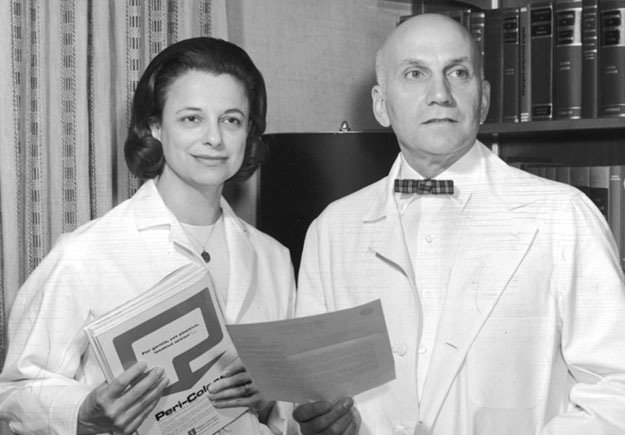
black-and-white photo of Masters and Johnson
William Masters and Virginia Johnson

Criticizing polyamory and gender equality


I really hate when someone has the core of a good point, but expresses it in such a petty and slapdash way as to almost entirely obscure it. Such is the case with Julie Bindel’s Guardian commentary on polyamory and gender equality. To get my points of agreement out of the way: yes, polyamory needs to be conscious of gendered power dynamics. Yes, it’s not enough to give lip service to equality, but we need to critically consider the way gender impacts our actual relationships. Yes, when we push for legal recognition of multiple partnership, we need to be wary of paving the way for the return of oppressive polygyny in other communities.

But instead of an insightful discussion of the different ways gendered power dynamics actually do play out in polyamorous relationships, Bindel gives us a string of lazy jabs at how rich and white and trendy polyamorous folk are. Instead of inquiring how polyamorous people can advocate for greater acceptance of their lifestyle without bringing in oppressive polygyny as collateral, she throws in a couple of pictures of how much it sucks for women when men get to sleep around with as many partners as they want while the women have to stay home and bicker.

Bindel mentions both at the beginning and the end that she doesn’t care how many partners a person has, which leaves me wondering what exactly she wants polyamorous people to do. As a lesbian, surely she knows how the attitude “I don’t care what you do sexually, but I don’t want to hear about it” is a cover for continually denying rights and recognition to people who are just trying to live and love openly. And yet that’s the best message I can take away from her piece: “Go ahead and have all the partners you want, but don’t go pushing for greater recognition and acceptance, because you’re nothing special.” She objects to polyamory in different places, on the one hand as co-opting and rebranding traditional patriarchal polygamy, and on the other hand as stealing the term “ethical non-monogamy” from the real ethical non-monogamists, lesbian radical feminists of the 70s. She doesn’t leave a lot of semantic space that she’s willing to let modern polyamory occupy, so it seems like she’d rather just have us shut up and not call ourselves anything.

I’ve said it before and I’ll say it again: we would be thrilled if our lifestyle was so accepted and boring to the mainstream that nobody paid us any attention. I would never claim that polyamorous people in general face anything like the oppression that gays and lesbians have historically faced (and still do in many countries and communities.) I’ve never heard of anyone being physically assaulted for being polyamorous, just for a start. But that doesn’t mean our lifestyle is accepted or that we don’t have work to do. It may come as a shock to Julie Bindel, but most of US culture (and UK culture as far as I can tell) views honest intentional non-monogamy as perverted, foolish, immoral, or just plain weird. Many of us fear losing our jobs or custody of children if the truth becomes known. Being public about our lifestyle isn’t something we do for kicks, or because it lets us participate in the cool new flavor-of-the-month subversion; we do it because we want more people to understand that this is a perfectly acceptable way to live, that we can love and commit deeply even though it’s not exclusively. We do it so that people can be open about their multiple loves without threatening their jobs and families.

And yes, we do it because we want to criticize mainstream traditional assumptions about love and relationships. Non-monogamy is certainly not anywhere close to a sufficient condition for gender equality… but I would argue that eliminating compulsory monogamy may be a necessary one. Polyamory has its pitfalls, to be sure, but I do think there’s more room for true gender equality in a world where monogamy is incidental, not assumed as the norm. Compulsory monogamy demands of both men and women that they restrict their sexual interests to a single person, which for most people involves a lot of denial and repression and strategic boundaries around cross-sex friendships — friendships which can help shatter gender barriers when they are allowed to grow freely and deeply. Compulsory monogamy legitimizes and often exalts jealousy, which is hugely toxic to gender equality. Compulsory monogamy ratchets up the power stakes in a relationship, making each partner solely dependent on the other for sexual companionship, and for the emotional and economic support that comes from a long-term commitment. That sole dependency leaves room on all sides for coercion and manipulation, which is often viewed as a healthy and normal mode of operation in mainstream monogamous culture.

Of course polyamory isn’t going to singlehandedly solve the problem of sexual inequality. Of course there are strains within polyamory that enshrine gendered power dynamics rather than eroding them (Highlander Penis being one of the most notable.) As far as I’m aware, no one has claimed otherwise. But please, writers everywhere, if you’re going to criticize gender dynamics within polyamory, do it with cogent arguments and insightful observation, rather than suggesting that you’re irritated with us simply for existing.

Anger doesn’t help me, but it’s not about me


This week in the blogosphere, we get a little breather from sexual harassment and the conversation is once again about anger and styles of activism. We have the twitter hashtag #fuckcispeople and some discussion about that. We have JT Eberhard’s post scolding Bria Crutchfield for scolding another woman who asked a racist question, and plenty discussion about that too. And that has me thinking about the use of anger in social justice activism.

When this conversation comes up, a few people always speak up to say, “I’m glad people got angry with me when I fucked up. They yelled at me until I got it through my thick head that I was wrong and they were right. I’d never have been convinced otherwise.” Angry activists, clearly, have been effective at getting people to change their minds, to listen, to see where they’re wrong. But that’s not the whole story.

Anger is not a helpful learning tool for me. When someone is angry in my direction, when someone is hostile or declares contempt or enmity for me, I shrink into a little ball of social terror. At those moments, everything in my brain is reacting with panic, with the need to make it stop. And my two default ways of making it stop are 1) to give in, to totally accept and go along with everything they’re saying because it’s the fastest way to end the assault, and 2) to harden myself against them and draw a big sharp line of not-caring between myself and them. Both options are bad. The first one might look like what the angry activist wants, but it’s not an honest change of heart from my perspective: it’s a terrified capitulation, an impulse to go along with what the other person says so that they’ll stop hurting me… and then subsequent rationalizations to convince myself and others that of course I genuinely, sincerely agree and came to that place of agreement through rational thought. Although it comes from a different source, internally it feels very similar to the way I accepted and rationalized my past religion: not from sincere consideration and self-examination, but because I knew the social consequences of not doing so would be too dire to contemplate.

On the other hand, I am eager to understand other people’s perspectives, to consider where I might be wrong and where I might be missing something. If someone sits me down and explains to me why X thing is harmful to Y group, I will listen. I will consider it. If it doesn’t make sense to me, I won’t argue back; I’ll hold onto it, chew on it, observe the world and listen to other people until I understand it. That’s me. That’s how I learn. Anger: very unhelpful and counterproductive. Calm explanation: very helpful and productive.

So from a personal standpoint, I much prefer the Professor X approach. But I also recognize laurelai’s point that I’m not typical, and that for many people the Magneto approach is the only thing that will get them to listen. I’ve heard enough people tell stories of being convinced by angry activists that I’ll accept that it’s effective in many cases, and that just like anger doesn’t work on me, calm explanations don’t work on many others. In light of that, I’m working on developing my own coping tools to be less raw and reactive in the face of anger, and I bow out of discussions when they’re headed toward a shouting match.

But all of that is about anger as a tactic, anger as a tool for change, and that’s only part of the story. The other piece of it is anger as simple self-expression: oppressed people have many, many reasons to be angry, and telling them to curb their anger and express themselves in a way that’s polite and acceptable to those who are profiting from the system that oppresses them — well, many words have been written on how wrong that is, and I agree with them. Anger is only sometimes, and only partly, about creating social change; it’s also about letting the damage be real, and be heard. It’s not about me at all; it’s about letting someone who’s been hurt just fucking react honestly to that hurt.

Now, of course I don’t think that pure, spontaneous emotional response is always and everywhere a good decision. There are plenty of times we need to rein it in because we know expressing ourselves fully will do damage we don’t want to inflict or incur. For many of us, it’s also worth taking a critical look at our overall emotional palette: is anger becoming a crutch, is it masking something, is it controlling my life in ways I don’t want? BUT. It is 100% not my business to go around making these inquiries of other people’s anger, especially people I don’t know, people whose specific source of anger I don’t experience. Balancing emotional expression, personal growth, and social change tactics is a complicated enough equation for me as an individual. I don’t have nearly enough information to weigh in on how someone else with a radically different position in the world should balance the same factors. Conversations about, “Will expressing this anger bring about results that we want? Is the way I’m processing anger damaging to me internally?” should definitely happen, but they’re conversations I only have with people whose anger I profoundly understand, whether because I know them intimately or because I share its specific sources.

So. We need to remember that anger is a useful and necessary tactic for some people. That it’s a harmful and counterproductive tactic for other people. And that much of the time, it’s not about tactics at all, but about expressing pain, and if we’re not part of the pain we need to shut the hell up about how it’s expressed.

On red flags and the benefit of the doubt


We seem to have breached a new wall in the “sexual harassment in skepticism” war: names are being named, stories are being told. If you haven’t been following it, Greta Christina has a good rundown on the news to date here. (If you haven’t been following it, and would rather look at pictures of a baby elephant playing on a beach, those are here, and I don’t blame you.)

Essentially, these stories implicate a couple of big skeptic organizations, specifically JREF and CFI, in severely underreacting to accusations and confirmed incidents of sexual harassment by various of their employees and speakers. This is not the first time JREF and CFI have been at odds with feminists in the skeptic and atheist movement — for CFI, it’s not even the first time this summer. Both organizations (and individuals like DJ Grothe, the current president of JREF) have said and done offensive things and been called out. But, to people like me who are not on the inside track, this is the first we’ve heard about this level of unacceptable behavior, this level of sweeping things under the rug and prioritizing keeping popular male leaders over creating a safe and welcoming environment for women.

And one thing I’ve heard a couple times, in reading over blogs and comments on this subject, is “We shouldn’t have been so forgiving before. We shouldn’t have given the benefit of the doubt.” And that’s disturbing to me, because it suggests that the next time someone behaves in moderately assholeish ways, we should go ahead and assume they’re full-blown rotten scumbags. Which, I think we’d all agree when looking at it coolly, is not a rational approach to take.

Anger here is justified. I know some people have a much hotter response when angry than I do, and say things they don’t actually think and mean. (How this works I don’t fully understand, but I recognize that it does.) I want to be sure, though, that when the dust settles and the anger loosens its grip, we don’t actually go around upgrading offenses and declining forgiveness (that we’d otherwise have granted) because a different organization or person screwed us over in the past. I think there’s this fear of being a fool, of granting someone the benefit of the doubt — in a case where it was fair to do so — and then being shown later that they didn’t deserve it. Ironically, there’s something victim-blamey about that very notion that it’s foolish to give someone the benefit of the doubt if they later prove to be a thorough jerkass. It suggests that if we fail to fully intuit or extrapolate the depth of someone’s rottenness from a few initial red flags, we’re the ones who have messed up. Not true. It is always meritorious to judge someone based on what you know of their actions at the time. Failure to act on the basis of information you didn’t have is not a mark of foolishness.

Now, pattern recognition is a thing, which is why the “red flag” concept exists in the first place. If we’ve observed that the people who publicly belittle women’s concerns frequently turn out to also be privately harassing and assaulting individual women, it’s not wrong to keep that data point in mind when making a judgment about another person who publicly belittles women’s concerns. That’s different from concluding that that person must also be a sexual predator. (Also take into account confirmation bias and the availability heuristic and all that.) It’s even okay to say, “You know what, I’ve been burned before by people who acted in ways that you’re acting, and even though you might not go on to do what they did, I’m not willing to take the risk of trusting you.” That’s a personal call that everybody has every right to make. What I’m not okay with is people saying, “I’ve been burned before by people who acted in ways that you’re acting, so I am going to assume you’re also guilty of everything they were.” It’s okay to hold a little cognitive dissonance around “they might not be guilty / I still don’t trust them.”

Let your anger burn, my fellow feminist skeptics. But don’t blame yourself for forgiving in the past, or giving the benefit of the doubt when it seemed merited. We judged then based on what we knew then. Now we know more.

Baby elephant says that’s ok.

baby elephant face looking up from the surf

See Ginny tonight! Coming live to a computer screen near you!


Today is the kickoff of the very first Freethought Blogs online conference! This online conference concept is a brilliant idea that I’m pretty sure will change the world forever… panels and presentations will be conducted through Google Hangout and viewable through hangouts and livestreams to anyone with internet access. I love so much about this. I love that new technology is leading to new and creative ways to form community. I love that this conference will be accessible to people who can’t afford travel and housing costs. I love that the low low price of hosting (pretty much free) and the relatively low time and planning investment (although I’m sure Miri and the other organizers will still be slightly out of their minds by the time the weekend’s over) mean that there’s an incredible diversity and flexibility around topics and presenters. Realize at the last minute that there should be a panel on skepticism and mental illness? Put out a call over social media and throw one together right-quick! I love that attending from home means I can tune in to the sessions I’m most interested in and do my homework the rest of the time. Or pull up the stream of a panel I’m maybe interested in but have the option of doing my homework if it turns out to be not that compelling. (This will almost certainly not happen.)

Oh yeah, I also love that I’ll be speaking at it. The Sex and Skepticism panel is the very first panel after Dave Silverman’s welcome, and it’s going live at 6pm CST, and I’m totally on it, along with Miri, Greta Christina, Franklin Veax, Sophie Hirschfeld, and Benny of Queereka. Since the panel was put together I’ve been debating with myself whether to openly squee about a couple of those names — writers I’ve followed and admired for years — or to play it totally cool, like yeah man, we’re all just sexuality professionals here. (Evidently I chose… neither?) Anyway, I’m pretty sure it’s going to be one of the awesomest panels ever, and you should totally tune in. (The FtBCon main site gives instructions for finding the stream. When it goes up I will try to remember to tweet a link from @polyskeptic.)

For those who have other plans tonight, the entire panel will be uploaded to youtube for your later watching convenience!

Seriously. So excited. This is gonna rock, y’all.

High political drama with stakes I actually care about


I am currently watching the most riveting television I’ve seen in weeks. State Sen. Wendy Davis of Texas is filibustering SB5, which would effectively shut down nearly all of the state’s abortion clinics and ban abortion after 20 weeks. She has been standing at her podium without food, water, or bathroom breaks for nine and a half hours, and she’s got three and a half more to go.

I wasn’t following the story closely before today, but I was vaguely aware of it. More background can be found here. The most poignant part of the story, for me, is that earlier in the week masses of Texans assembled to share their testimony against this bill, but they were denied the opportunity to speak. Sen. Davis is speaking for them. For going on ten hours. It’s a beautiful thing.

I tuned in to the live stream (viewable here  if you’re reading this before midnight CST) around 6:15 CST. I was in time to catch the hour-long point of order discussion around whether Davis violated the rules of a filibuster by accepting a back brace from another senator. After 45 minutes of discussion, it was voted that she had, and she was given her second warning. One more warning and the senators can vote to remove her from the floor. (Which they will, because the majority supports the bill.) It was a nail-biter that ended disappointingly, but at least it ate up nearly an hour of time (and the questions immediately following about whether she could be penalized for receiving questions that were non-germane took up the rest of that hour). A handful of allies stood up at every opportunity for questions, clarifications, and occasionally actual arguments.

These points of order and parliamentary inquiries are where the whole thing is really just like watching any sport match: each side endeavors to introduce formalities, raise questions, and contend technicalities. For the pro-bill side, the goal is simply to find a reason to remove Sen. Davis from the floor. For the anti-bill side, it’s a little more fun, because they have to both combat their opponents’ efforts, and take up as much time as possible doing it. Asking for clarification, repeating questions, pointing out anachronisms in a bill’s wording… it all helps, because it’s one more minute Sen. Davis doesn’t have to fill by speaking. Key players in this fight have been Senators Rodney Ellis and Judith Zaffirini, to whom I want to give ALL the hugs. (For Senator Davis herself, ALL the drinks and maybe a weekend spa retreat.)

But then there are the other parts, where Davis herself is holding the floor. And unlike the West Wing episode from which I got most of my knowledge about filibustering, she can’t just say anything. Everything she says has to be germane to the bill — straying into a discussion of Roe v. Wade was what got her her first warning. So for about an hour I just heard her talking through a bill analysis, including a lengthy discussion of fetal pain, with lots of scientific evidence to back it up. Many people on facebook and twitter made the obvious joke that that was the most science that’s ever been read in the Texas senate. She went on to talk about the hardships that this bill puts on doctors and patients alike. She’s making real arguments, good arguments. At some point earlier, she was reading the personal testimonies of many women (and perhaps men) about the hardships that would be created by the passing of this bill. She’s speaking for the people and she’s making good arguments, and at the same time there’s a sort of bitter irony, because it doesn’t matter how good her arguments are. The game is not to convince the opponent, because she knows they won’t be convinced. The game is to hold the floor, and keep talking till they can no longer do the damage they’re intending to do. If the parliamentary games are a sport match, Davis’s extended solo sessions are a mountain ascent, an epic feat of endurance where one misstep could lead to disaster.

As I’ve been writing we’re down to 2 hours and 50 minutes, and Senator Zaffirini brought up another bill that needs to be voted on before the close of the session at midnight. I don’t think I can possibly go to sleep until I know what happens. Regardless of the outcome, I am more inspired than I’ve been by a politician in — possibly years. It’s so rare that we get to see one person, doing one thing, that will have a definitive outcome. I accept the complexity of most real-life political and social problem-solving, but this human heart loves a good story of a lone hero standing up to fight for what they believe in. And I’m watching one now.

Edited to update: The end was just as good, and just as dramatic, as the rest. Seriously, if they make a movie out of this they won’t have to tweak the material far at the climax. With less than 2 hours to go, a third warning was laid against Davis for talking about a sonogram bill which opposing senators claim was not “germane.” Senators Watson, Van de Putte, West, and Whitmire fought hard for the next hour and a half, arguing that there should be a debate, arguing that previous rulings didn’t warrant the ending of a filibuster with only two warnings on germaneness and one on something else. Meanwhile the opposing senators were working to fast-track this, end any debates, and shut things down. There were so many motions, points of order, and parliamentary inquiries raised in rapid succession that I think everybody got a little confused, to the point where it wasn’t just a delaying tactic when a senator asked to clarify what, precisely, was being voted on now. (At least, I think it wasn’t; perhaps they were following better than me.)

With only half an hour to go, Sen. Kirk Watson held the floor with a lengthy protest of the recent proceedings, arguing that opposing senators were not giving proper respect to parliamentary process and the right to filibuster by shutting Davis down on the flimsiest excuses. When he paused too long, an opposing senator put forward a motion to vote (not on SB5 but on whether to take back the earlier warning that took the vote from Davis.)  The vote was taken, despite protests, and the warning stood. Remember: in this environment, every vote is bad for the Democrats.

Sen. Leticia Van de Putte, who had been away earlier in the day to attend her father’s funeral, took the final leg of this endurance race. She stood up saying she had raised a motion to adjourn before that vote had been taken, but had been ignored by the chair, who claimed he hadn’t seen her. (Shouts from the crowd of “We saw her!” rose up, and Van de Putte stated that she had been seen by many in the senate.) She then voted against her party (again, not on SB5 but on one of the motions about proceedings) in order to have the standing to call some measure into question. She was essentially ignored again. With just ten minutes to go, she stood and said, “At what point must a female senator raise her hand or her voice to be heard over the male colleagues in the room?”

And the crowd went wild. Shouting, chanting, yelling, clapping. At first I believe it was a spontaneous, passionate response to Sen. Van de Putte’s comment and the building frustration many of us watching about the silencing of women that was going on on multiple levels here. But then it became clear that noise in the gallery was, perhaps, the only way left to stop the bill. Van de Putte took the final leg, but the crowd brought it home, shouting, chanting, and cheering for ten solid minutes so that the vote couldn’t be taken. (A vote was taken, somewhere in there, but it was a procedural thing, I have no idea what.)

After midnight the shouts died down, although there was still noise. Nobody was quite sure what had happened — was that vote taken in the last few minutes the bill or something else? Then the senators gathered around the dais and voted on SB5. Whether they thought they still had time or were just hoping to get away with it is unclear. Reports on what had happened divided along party lines, with Republican senators declaring that the bill had passed and Democratic senators declaring that the vote was invalid. At that point I went to bed, fearing that this was only going to be resolved with a lawsuit.

Happily, I woke to see that after 3 am a ruling was finally given that the vote wasn’t valid and that SB5 had failed to pass. They did it.

Women can be creepy and invasive too!


This is the kind of story Gina tells best, but I’ll do what I can.

After Gina and Wes got back from the color run a little before noon, we all went out to a local diner. This is a common Saturday activity for the Fenzorselli side of the household, but Shaun and I usually don’t go for whatever reason — usually some combination of being still in bed, being out of money, or having other plans. Today, however, we went, and I was greatly looking forward to indulging in some delicious breakfast starches of the kind I eat only sparingly under our new diet. (Have we talked about the new diet here yet? I’m sure it’ll come up at some point.)

While looking at the menu and deciding whether I was going to have hash browns, French toast, or Belgian waffles (I know, I know, a lot of you are “and” people and will suggest all three, but my stomach really isn’t big enough for that), I was dimly aware that there was a cluster of people standing sort of behind me and to my left. I was sitting right next to a waiter station, so presumably they were all waiters who had something to do there. Now, when I say, “dimly aware,” what I mean is this: I had no idea who the people were, I couldn’t tell you now if they had walked past us to get to the station or come up from behind, and if nothing had happened then their presence would probably never have fully registered on my consciousness, and I would be honestly oblivious if someone (probably Shaun) made reference to “those three waiters that were standing behind you and talking before we ordered.”

They were brought to my active attention when I heard a woman’s voice directly over my left ear say, “Can I look at your tattoo?” I made some sort of uninvolved affirmative answer like “Sure,” or “Uh huh,” and then immediately cringed because I realized I was about to have that conversation again. The one where someone says, “Oh, that’s so pretty! What do W and A stand for?” and then I have to figure out how to say, “The names we gave to the twins my mom miscarried when I was six” in a way that doesn’t create that record-scratch Unexpected Sad Story moment.

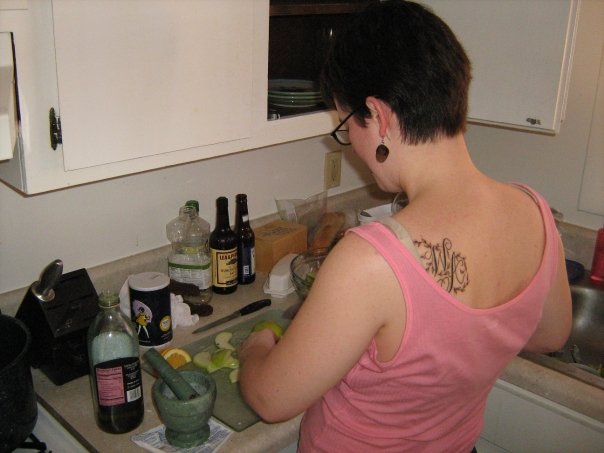
Me cooking with my shoulder tattoo showing: a large capital W and A surrounded by decorative vines.

(I imagine people who have lost someone close to them and find it coming up in response to casual social questions know this dynamic well, although it’s much easier for me since I’m not really sad about the twins anymore.) It’s my fault for only getting tattoos with emotionally heavy significance (the others are even worse!), but I do try to avoid or forestall that conversation in most situations if I possibly can. However, my mind drifts much too slowly from Dimly Aware to Actively Aware and Engaged with the Situation, and by the time it was there, I’d already said “sure.” Fortunately, what actually happened was much less expected and more hilarious.

Mind you, I still haven’t turned around, so I have no idea who the woman is who’s asked me to look at my tattoo, except I think maybe she’s a waitress? The next thing I know she’s pulling the strap of my wide-strapped tank top to the side, then lifting it away from my shoulder so she can peer underneath. I sort of freeze at that point, thinking, “Whoa, this lady is manhandling my shoulder and my clothing in a way I was not prepared for and am not really happy about.” My typical response to Unexpected Weirdness is freeze and detach, so I just went slightly rigid in the shoulders and kept staring at the menu like nothing was happening. Then one of the other people in the cluster, a man, said, “Dude, she didn’t say you could look down her shirt.” And she responded, “It’s just the shoulder, it’s not like I’m looking down the front of her shirt,” and then she added, “I just really like tattoos,” and maybe he said something else, I’m not sure, because I was just sitting there staring fixedly at the menu and thinking, “Why is this person touching me what is going on i don’t even know.” But something the guy said, or maybe just the way I was sitting there rigidly instead of turning around to engage in friendly conversation made the woman realize she was maybe being a tad inappropriate, so she let go of my clothes and patted me soothingly on the arm and said some half-apologetic patter. To which I didn’t really respond because I was still in my “I am so weirded out right now and your soothing pat is STILL YOU TOUCHING ME” frozen zone. And I think by this point she got that I was really uncomfortable, so she broke out the magic words to make it all better: “It’s okay honey, I didn’t mean anything by it, I mean, I like men, ha ha.”

And that was the moment that twisted my reaction from weird and awkward to GODDAMN HILARIOUS. She moved away and I turned to the rest of the table and made a giant :-O face, and they all cracked up. And then I had to recount it a few minutes later for Shaun, who hadn’t really been paying attention, and we all cracked up again. And then it was super-awkward every time that waitress walked by us, (which of course happened quite often) because I didn’t want to give her a friendly smile or anything that would make her think what she did was anything but Way Inappropriate, but I also didn’t want her to think I thought she was the scum of the earth. Or worse, that I thought she was a LESBIAN making LESBIAN ADVANCES. If I was the kind of person who addressed near-strangers with frankness and a desire to improve the world, I’d have stopped her at some point and said, “Listen, lady, I wasn’t weirded out because I thought you were hitting on me. I date women. I was weirded out because you were tugging my clothes around and peering underneath them, and even in such an innocuous area as the shoulder that’s not really okay to do to someone you don’t know. Keep that in mind for future reference, and also keep in mind that just because someone has a tattoo doesn’t mean it’s okay to touch them or put your face right up close to their body unless they invite you to. And also don’t touch pregnant women’s bellies unless they invite you to, because I’m 90% sure you probably do that too. In fact, in general don’t go around touching strangers and very casual acquaintances without their consent. Some of us really don’t like that, but we’re conditioned by social norms not to say anything about it and just to let it happen. And by the way, have you heard of rape culture?”

Okay, I probably would have ended my PSA somewhere before “rape culture.” But of course I didn’t give her any kind of PSA, because when someone is invasive and makes me uncomfortable the last thing I want to do is prolong my interaction with them by carefully explaining why what they did was wrong. I’m pretty sure it was an awkward experience for her too, so hopefully she’ll avoid manhandling inked appendages in the future, even if the story she tells herself is, “Some people are so uptight about their personal space, I just like tattoos!”

I’m just glad she didn’t glimpse the tattoo on my thigh.