There is Always Something There to Remind Me…


A couple of years ago I went on a business trip to Asheville, NC. When I got to the rental car counter, the very good looking southern gentleman there said, “Oh, I just know you’re going to love Asheville.” I inquired as to why and he said, “Well, it’s basically the only bastion of art and liberalness around here, right in the middle of the Bible Belt.” I smiled, wondering, “How did he know? Was it my clearly Yankee accent that gave me away?” And then I remembered that I was wearing by Muppets/Battlestar Galactica t-shirt and it all made a little more sense.

I had the evening to kill, as my business obligations were scheduled for the next morning, so I took the guy’s advice and drove into town and had a wonderful evening checking out the local fare, including a local brewery where I ended up schooling a bunch of other out of towners with my uncanny knowledge of classic dystopia novels. The man was right. For the most part I didn’t feel like I was in the South at all and it felt very much like the parts of Philadelphia that I like best.

I have also been to Portland, OR for business.  Portland and Asheville are considered two of three of the great art towns in the country.  They are places where music thrives and weirdos congregate because they are places of very little judgment of strange lifestyles and interests.  Austin, TX is the third.

I haven’t learned yet why Portland is considered one of these because I don’t know much about the state of Oregon.  However, Portland and Seattle are often compared (and rightly so, as they have a lot in common).  I don’t get the sense that Portland is situated in a particularly hostile environment for liberals, but perhaps because it evolved from the logging towns of the Pacific Northwest, there’s an excess of “frontier spirit” there or something.  I’ll take “their” word for it.

Asheville and Austin though are very much in the middle of hostile states for liberally minded people.  I was not in Asheville very long and mostly came into contact with a bunch of other tourists when I was there (most of them Northerners at that), so it was easy to forget where I was.  It was easy to forget that there are certain things that the rest of the state never wants to forget.

Let me say first that I really like this town.  Shaun and Ginny are staying at a wonderfully funky hotel just outside of the downtown area.  The are near the hotel is really quite awesome.  Everywhere is a burst of color and art.  There are sidewalk sales everywhere, stores selling all kinds peculiar things, and a copious amount of high quality food trucks.  What is most fun for me is that there is live music absolutely everywhere.  Every bar has some form of a stage and some kind of band playing.  There was a duo playing bass and guitar on the top of a van.  You can get good drinks for pretty reasonable prices at many places.  Happy hour here starts at 3pm.  Shaun and I spent a good portion of our afternoon yesterday checking out a couple of bars and enjoying the bands.  The place was hopping.  We had dinner plans with Ginny so we didn’t stay out too long, but we are planning on picking up where we left off today.

Shaun joked that he was secretly a millionaire and was going to buy a big sprawling house in Austin and that none of us would ever have to work again.  He asked what I would do if that was true and I said, “Well, if I could convince Wes and Jessie to move to Austin, I guess I’d just come here and be a musician”, because this is really the place to do it.  It already has what Philadelphia is working on.  Music everywhere you look and people loving it.

So, yeah, there’s a lot to like about Austin.  But it didn’t take long for me to be reminded of where Austin is.

Before heading to the bars, we wandered downtown towards the state capitol.  What we found when we got there was that we had just missed some kind of protest.  Of course, Shaun was wearing his “Atheist, Polyamorous, Skeptics” t-shirt and his bag straps had an atheist and a secular button on each shoulder.  We tried to figure out exactly what the protest was about.  Some people had signs that said, “Stop the HHS Mandate” and other signs said, “Stand Up for Religious Freedom”.  I looked up the protest on my phone and found that these rallies were being held all over the country yesterday in honor of the 223rd anniversary of James Madison, our Founding Father, introducing the Bill of Rights to the Constitution.

Apparently, the whole rally was designed around the idea that President Obama is infringing on people’s right to religious freedom by mandating that all health organizations (Christian or no) must provide birth control and other contraceptive services.  There is a religious exemption, but, according the site, it is so narrow that not even Jesus and his Apostles would qualify for the exemption.

I could go on about the various absurdities of this.  I have certainly come out in the past year publically in the blogosphere in great support of positive sex education, birth control knowledge and options for all, and abortions when people want them. I lost a couple of friends over this.

One of the people at the rally was holding a sign that said, “Women DO regret abortion”.  I looked at her awestruck.  Like, no shit, Sherlock.  Of course some women regret the decision to abort. It’s not a decision that people make particularly lightly.  And because I don’t view a mass of cells as life that much be protected at the risk of ruining a woman’s life, I don’t have a problem with the people who don’t torture themselves about the decision.  It is an option that we have and should always have.  To bring a life into the world that you do not want is not better.  I could go on and on.

And I could go on and on about how wanting people to be refused birth control goes completely against the attempts to stop people from having abortions…but…you know, everyone who reads this probably knows that.

What struck me most about the whole thing is that people who were at the rally brought their kids to it, their young kids.  And for the kids, it was like a happy-go-lucky picnic or something.  At one point, a mother gave each of her children one of the signs I mentioned above and took a picture of them in front of the capitol, grins and all.  I don’t think I was able to keep the look of disdain off of my face.  In my mind, I wanted to go ask the kids if they knew what those signs were really saying.  I had no intention of actually doing this and Shaun reminded me that this would cross some kind of line, which I completely understand…but I was so curious.  I wanted to know if they knew what they were doing.

It reminds me of the episode of South Park where the boys get pulled into an anti-Bush rally somehow and they don’t even know what their signs are talking about (specifically that Cartman didn’t know how to pronounce the word Nazi, “Boosh is a Nay-zee…”  That’s what I envisioned here.  “Stop the HHS Mandate…because…um…what’s a mandate?”
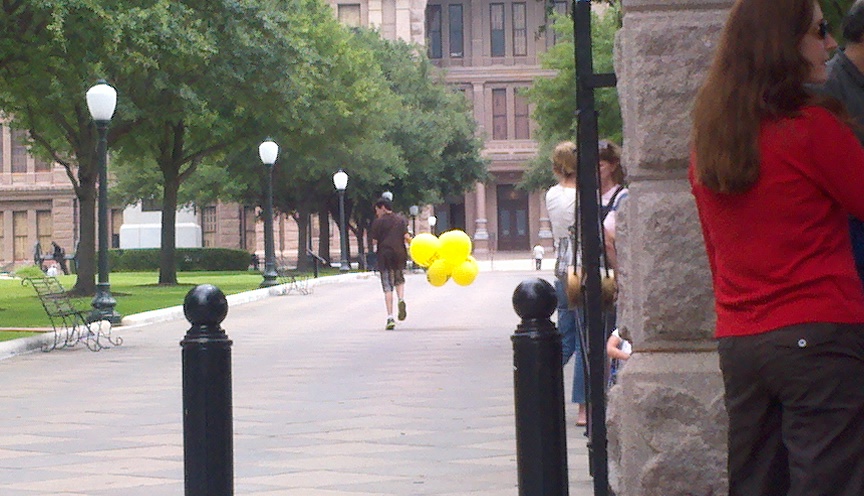
Image

That’s a kid running around the capitol with a bunch of pro-life balloons.  Yeah.

We didn’t talk to anybody and no one seemed to pay us any mind…likely do to Shaun’s apparel.  We decided to take in the local monuments while we were there.  So I innocently walked up to one and it was this one:

Image

Before I actually read the thing, I, for whatever ignorant reason, thought the dude on the top was Lincoln.  But, obviously, that is a statue of Jefferson Davis.  I guess the common hair styles of the 1860’s threw me off or something, but I done learned.

We wandered around the park and found that half the monuments there were memorials for people who had died for the Confederacy.  I was…astounded.  I live in such a liberal area that I forget periodically that this is a thing.

In addition, I was asked to remember the Alamo and appreciate the “Rough and Romantic Riders of the Range” by a couple of other statues.  The rough, romantic rider statue had a horse with ridiculously huge balls.  I guess what they say about everything being bigger in Texas is true.

Or something.

Shaun has been remarking about how active the atheist community is in Austin.  I asked him how he thought we could make it like that in Philadelphia and he reminded me that in Texas, you have to be out and proud and active to make life livable for the differently minded.  We are very lucky in Philadelphia to be able to, for the most part, be who we are, what we are, without a specific community to help us to do it.

I had forgotten all that before arriving at the Capitol.  At the Capitol, there is always something to remind you that you are, in fact, in Texas and that, as progressive, non-Christian, liberal people with tendencies towards slutdom, we are in a minority here.

But for now, I should get off this computer and go check out the parts of the town I feel at home…namely, bars with awesome sound systems and hilarious bartenders.

A Very Long Post About Laughing at Stuff


When I was going to Drexel, everyone was required to take three Humanities classes.  The classes were Humanities 101, 102, 103 and they were relatively stupid.  101 and 102 were the same for everyone.  They covered things like basic composition.  Actually, that’s all they were about.  They were boring and having come from a highschool where the writings of everyone I ever read there were at least coherent and relatively well crafted, workshopping the pieces of people who could clearly speak English but couldn’t seem to write it down was quite aggravating.  I became known for bringing a red pen to class and decimating the drafts of people’s essays.  I was nice about it in that I often rewrote people’s thesis paragraphs and such, so, you know, less work for them.  I think they all got A’s so no particular bitterness ensued.

Anyway, the third Humanities class ended up being a wild card.  This class was more specialized and each teacher had a different focus.  I was unaware of this and the class descriptions were the same regardless of time slot, so I picked whatever class was most convenient schedule-wise.  This was a mistake.

I ended up in a humor in literature class.  I suppose that this could have been interesting and entertaining.  I mean, I love laughing, love writing humorously…and apparently I think that everything is funny, so this should have been a win.  However, talking about humor is only entertaining if you are talking about it with someone with a sense of humor.  You would think that someone really interested in humor would be funny themselves…or perhaps only I assumed that…but as it turns out, this was not the case.

It was taught by a woman who wrote a giant paper with her husband on the subject of humor in literature.  Her thesis was that all humor could be broken down into four specific categories and that each of these categories could be assigned to a specific season of the year.  Satire, being old and cynical, was winter humor (when all the trees were dying or whatever) and fables, being young and ignorant, were spring.

I hated this class very, very much.  The woman teaching it was completely humorless.  It was astounding how incredibly unfunny she was.  I would spend entire classes pondering how this was possible.  I didn’t laugh ONCE in that class in the entire 10 weeks we were subjected to it.  One of the reasons is that while we were talking about humor classifications the whole time, no one was ever cracking jokes or anything.  In addition, our text book was a collection of “humorous” stories and poems from throughout the centuries that our teacher compiled.  Everything in it also happened to be public domain (advantage being that it kept the cost of the book down), so the most recent thing in there was from the 1920’s or 30’s.  Our daily assignments were to read passages from it and then explain why they are funny, assigning specific qualities that make things funny.  For instance: Is this story about being getting drunk and getting into craaaazy hijinks?  Then that gets a 2. Debauchery.  Is the story about stupid shit happening because someone mistook a person for someone else? That’s 3. Mistaken Identity.  What was worse was that because everything in the book was completely dated, I found that nothing in there rang as funny to me.  Some of it was a language issue (the fables, for instance, were written in some kind of dialect and I wasn’t entirely sure what was being said all the time), but clearly much of it was “you had to be there” humor, in that it would have perhaps been funny if you were around at the time it was written.  If you are amongst the culture, you have the context to “get it”.

My teacher was seemingly frustrated that we were too dim or something to find anything we were reading hilarious.  What she failed to recognize was that humor changes through the years.  The taste of the population shifts with time.  Also, the things that are deemed “appropriate” change.  For instance, black face used to be hysterical, apparently, but now it’s just gross…unless the joke is that the character in question is a big fucking racist.  Something that current people find hilarious today would make no sense to someone from a hundred years ago, and likely, they also wouldn’t understand why things from back then might not be particularly hilarious now.

So, as I may have explained previously, the people I work closest with at my job are pretty inappropriate in general.  I have grown to like this about them as I enjoy working in an environment where I can drop F-bombs to my heart’s content .  I am never particularly inclined to making “inappropriate” jokes here…unless you count all of my chemical safety related jokes as inappropriate…which you might since I’m on the safety committee and all.  I remember making a joke at school once about dissolving someone’s face with acid and someone who had gotten a very bad chemical burn informed me that this wasn’t funny.  Yet later I made a decapitation joke and she laughed, so I guess it’s all contextual.  I got massive amounts of solvent in my eyes once and STILL make eye melting jokes, so maybe I’m twisted.  Also, I’m not blind, so I’m not bitter…not too much (bastards in the lab who didn’t help me when I yelled for help!).

However, there are still a lot of types of jokes I don’t appreciate, unless it comes from someone who I respect as an intelligent, progressive, critically thinking.  For instance, I don’t appreciate any kind of sexist joke from any of the sexes (I dislike “Women are all smarter than men” jokes as much as “Women are all stupid, crazy, and obsessed with shopping” jokes).  The only time I think that’s funny is if it’s being said quite sarcastically or ironically, with clear understanding that the reason it’s funny is because assholes think that way.  I feel similarly about racist humor or anything like that.  I find it funny if it’s some kind of social commentary.  I do laugh if you clearly are a racist or a misogynist and it is usually quite easy to tell.

In gaining a place at work, I had to endure a lot of bullshit in this regard.  I was never sexually harassed (well, not in the traditional sense.  I got hit on by plant employees and it could be a little uncomfortable at times, but they weren’t in a position of power and, if I felt uncomfortable enough, I probably could’ve had them fired), but I was uncomfortable a lot about the type of jokes that got thrown around…simply because I know that many of the people were/are homophobic, racist, sexist, ableist…you name it.  I sensed greatly that the humor came from a place of great ignorance.  My presence as a “Capable Woman” helped to keep the sexism at bay.  If there was ever a “You know how woman do X” comment, I would quickly say, “No, tell me what I do.”  And that would be it.  But everything else?  I can only point out that what they’re saying is bullshit, which doesn’t really do anything.  And there have been times when I have felt that I was fighting a one woman battle.  No one else fights against this crap.  They either laugh or stay silent.

And yet, I feel guilty for many of the things I do laugh about that in a politically correct world are frowned upon.  For instance, I find the word “retarded” hilarious.  The word itself just is funny to me.  Much in the way that people hate the word “moist” just because of the sound of it, the word retarded rolls off the tongue and seems to be the perfect thing to describe something that is screwed up.  I don’t say it myself often, but it always makes me snicker when I read or hear it.  I’m not really thinking of mentally challenged people when I hear it, but I know that’s where it comes from and can’t really be separated from that.

The people close to me are very smart, very anti-ignorance, very inquisitive and progressive.  I feel OK sitting there with them making terrible jokes because we know that they’re jokes.  If you make an off-color joke that offends no one that hears it, does it make an impact?

I make a lot of jokes about things that aren’t super relevant anymore.  For instance, I make a lot jokes about communism, Russia threatening to bomb us, and Joseph McCarthy.  The reason for this is that known Communists don’t get black listed anymore.  People’s lives aren’t exactly torn asunder for being socialist.  I am distant from the time when these fears were real and entrenched.  Looking at it from my modern perspective, that entire period in history is so absurd that I can’t help but find it hysterical.  The Russian space program of the 50’s and 60’s cracks me up due to how very much of a death trap the entire thing was (this links in with my science safety humor trigger I guess).  But perhaps if I was living in the 50’s, I wouldn’t find McCarthy to be the comical idiot that he was but instead of loony monster hell bent on destroying lives.

I admit that I likely don’t have the reverence for various things in history that I should.  I am distanced from historical atrocities by time and circumstance.  I view the world as a most absurd place and this is on the same wavelength as my sense of humor.  Part of it is likely a coping mechanism.  I laughed a lot about the idiocy that was the “War in Iraq”.  I laughed quite a bit about how ignorant and nationalistic Americans are.  I laugh about the concept of the “Homosexual Agenda”.  I laugh about it all.  I make jokes about it all.

But in moments of quiet when I find myself thinking about the difficulties going on for so many, I don’t laugh.  I simply wish that there wasn’t anything to make fun of.  And often I take a minute to remind myself of the reality of the history I mock.  I read an article about the brutality of the Russian space program back then and was upset reading it.  I was so moved by it that I wrote a song about it (a bluegrass number called “The Cosmonaut’s Wife”…I can’t keep my sense of humor completely out, people).  I try to remember.  I want people to educate me when I make a joke out of ignorance.  I’m trying, always trying.

This whole thing was inspired by reading Jason Alexander’s apology to the gay community for calling cricket a gay sport.  It was a heartfelt, very real (seeming anyway, I can’t be in the guy’s head) apology.  He made a stupid joke and some people got offended and instead of simply saying, “I’m sorry that you were offended”, he didn’t offer up an apology until he really thought about WHY people might be offended and, upon understanding that, decided that he had been, in fact, wrong.  When I think about all the dark stuff I laugh at, I sometimes fear that I’m not feeling enough, that I don’t care enough.  In a society where the disenfranchised have a much louder voice than before, I wonder if I should be laughing at anything at all.

I have been amused lately in watching shows like Star Trek and Babylon 5 that all the alien cultures on there make statements about how humans are so unique, that they’re wild cards, so unpredictable.  Humans laugh and do crazy shit because they’re emotional and passionate…as opposed to all other humanoids apparently.  I, at this point, don’t have any alien life forms to compare us to, but I will say that humor is something very important to us as a species.  If we can’t laugh at the ridiculousness, we will just cry instead.  Perhaps I laugh at some ignorant humor, but I won’t stop laughing.  If I laugh in a way that is remiss, the best I can do is approach it like Alexander and think about it critically and if I come to the conclusion that I was wrong, I will apologize.  But offending someone doesn’t automatically mean that you are wrong.

I think that’s my point…I knew I’d get there eventually.

Gina Sez: “Snow White and the Huntsman” Offers Important Commentary about Monarchies


It was a dark and stormy night, and Gina, Wes, and Jessie decided to go see a movie.

OK, it wasn’t dark OR stormy when the decision to go see “Snow White and the Huntsman” was made.  However, as soon as I said, “We should leave now so that we can go get candy (to get one over on The Man, you see)” the skies opened up and there was a torrential downpour.  So…eventually it was a dark and stormy night.  Anyway, before that, Wes and I were sitting in the hot tub drinking mojitos (because our lives totally suck, obviously) and we realized we were in the mood to see something culturally relevant.  That being said, our options were clearly only “Snow White and the Huntsman” or “Battleship”.

“Battleship” was my initial choice because I’ve been going nuts every time I see the trailer for it.  I really wanted to see how they were going to make an entire film out of a game as simple as “Battleship”.  In one of the trailers, I swear I saw them contrive a reason why there was some kind of invisible yet vision-tricking barrier between the good guys and the bad guys to make it actually like the game.  I also hoped that in seeing it, I would see a trailer for the next big thing: CONNECT FOUR – Rise of the Red Circle or Hungry Hungry Hippo (this would definitely offer interesting social commentary about the state of famine in Africa, much like James Bond: Die Another Day offered great insight into blood diamond trading and the rampant “villains with diamonds stuck in their face” problem).

Unfortunately, the times were not convenient, and ultimately I don’t know if my brain was in a state that could handle the number of explosions promised in “Battleship”, so “Snow White and the Huntsman” it was.

Now, some would say that this movie is just a bunch of eye candy.  It certainly is visually impressive.  The effects are quite good and there are lots of pretty people in it.  The forestscapes are stimulating and immersive.  The costumes are elaborate and interesting.  Also, Ian McShane is a dwarf in it…so…I don’t know.  That gave it points for me.  Perhaps you’re not as easy to impress.

But beyond that, “Snow White and the Huntsman” is a perfect Republican allegory for how they view the use of various segments of society.

***OMG SPOILER ALERT***

1. The Power and Importance of Beauty (AKA: The Woman’s Place)

Snow White is born and is deemed the prettiest girl EVER.  Everyone in the kingdom is completely enamored with her…kindness…and also, her pretty face.  The kingdom prospers also because her dad is a nice guy or something, but then he goes off and fights a war because his wife died and upon winning a peculiar battle, he rescues a prisoner, Charlize Theron.  He sees her, notices that she’s totally hot, and decides to marry her THE NEXT DAY.  On their wedding night, she stabs him and, apparently never being questioned or anything, becomes Queen.  While she stabs him she says something akin to “A woman needs a man like a fish needs a bicycle” and all aquatic bicycle sales in the kingdom cease.  Snow White gets thrown in a tower and all is torn asunder.  All the apples rot and all the dwarves are out of work.

The film is basically a battle between the Queen and Snow White for who is really the prettiest…and…um…therefore the nicest and, er, best.  The Queen stays young and pretty by sucking the life force out of pretty girls (unless they have mild scarring on their faces…that apparently keeps them safe because they’re not pretty enough then).  This is because her mom told her that the only thing she had was her beauty…unless some bitch was prettier.  CAT FIGHT!  Only Snow White can kill her because she’s prettier and, um, she’s nice to animals and stuff.  Yeah.

Meanwhile, there’s a Huntsman played by Thor.  He apparently falls in love with Snow White because she’s so nice and doesn’t punch dwarves in the face (not all the time anyway).  He thinks she’s pretty because she reminds him of his dead wife and therefore, apparently, his kiss brings her back to life.   She comes back alive and gives a pep talk to the troops and everyone follows her for some reason…because…I don’t know, apparently she’s “Life Itself”.  The forest full of fairies and deer with giant racks (antlers, that is) flock to her. In other words, she’s hella pretty.

In the end, everyone bad dies and everyone good (with the exception of one dwarf) lives and all the peasants rejoice when Queen Hotlips takes the thrown.  Apparently she makes flowers grow, probably because of her beauty and her virtue.

So, ladies, let this be a lesson to you: You can do anything you want, as long as you are pretty and thin!  This isn’t obvious in modern society, so I’m glad that this movie gave us a unique perspective.

2. Christian Faith is Always Relevant

Still, in this land of fairies and dwarves and evil magic queens, Snow White never loses faith…IN JESUS.  That’s right: Snow White is a Christian (shown to us when she, still locked in the tower as a young woman, picks up straw replicas of her parents and says the “Our Father” prayer).  This makes so much sense.  I mean, we would have no way of knowing she was virtuous if she didn’t believe in Jesus.

3.  Lift Yourselves By Your Bootstraps and You Shall Be Allowed into Society!

So, apparently, when the king was alive, everyone was happy.  Then he was dead and everyone was sad and unemployment was at an all time low.  Take, for instance, the dwarves.  They were apparently gold miners (the best anyone had ever seen), but then…for some reason…no one wanted gold or something and they came out of the caves to find a world that wanted nothing of them.  But no worries because The Fairest of Them All is here and she will take advantage of your desperation!  “We will die for you, Snow White…because you are the one!” “OK!”  “We will wade through shit for you and open the gate, and then we will all prosper because you are going to be the same caliber of leader as your dad because…um…obviously.” (They literally walk through the castle’s sewer system to do this)

Snow is helped by various disenfranchised people along the way, who are subsequently beaten or burned for harboring her.  But it’s cool, because in the end, she gets to be Queen and she gives everyone a nod for their sacrifice.  Or, at least, I thought I saw her head move a little bit.  I’m sure she’ll take care of them because she is pretty and nice or something and being Queen is totes easy!

4. Blood Determines What Kind of Ruler You Will Be

Her dad rocked, and so will she.  It was destined…by either the giant deer (I don’t know…he seemed to know something no one else did, and I guess they didn’t want to put a unicorn in there instead for fear of being too cliche or too much like “Legend”) or by God, since they’re all Christians.

So, we’ve got women as figureheads given power AND weakness due to their own beauty and level of virtue, Christians, disadvantaged people having value because of the crappy things they’re willing to do for the privileged, and the idea that family value/legacy is really the most important thing.  This is basically a Mitt Romney commercial.

Yep.

In conclusion, “Snow White and the Huntsman” was pretty terrible and not even really terrible in the way that I usually like.  But at least I got to see Kristen Stewart really show off her acting talent.

These Gina Sez articles are really hard to write.

The False Analogy


I am a Professor of English, and though that means that I get to teach literature, creative writing, and even an occasional course in public speaking, my bread and butter is first year composition (i.e. English 101 at most colleges/universities). The thing I emphasize most in composition courses is critical thinking. It’s more important than perfect grammar, good organization, and even a strong thesis. Thinking critically is what allows one to write effectively. It’s far and better to struggle to find the proper words for one’s excellent thoughts than to express vapid ideas quickly and easily, even if they’re expressed eloquently. On this I assume we can all agree.

One of my favorite lessons in critical thinking is the lesson on logos, pathos, and ethos. A key part of that lesson involves identifying logical fallacies. I suspect that I’ll talk often about logical fallacies in this blog, since they’re not only one of my personal areas of interest (and frequent perturbation) but are ubiquitous in our mass culture. One of the most common logical fallacies is the false analogy. A good analogy, of course, compares two similar things, usually using “like” or “as,” and the comparison is often striking, thought-provoking, or entertaining. A false analogy fails because it purports to compare two similar things but does not adequately consider their dissimilarity/ies.

I recently came across this image on my Facebook feed:

An iPad is like a church marquee…

I think the logical first question is: how is faith like WiFi? The image claims that they’re both “invisible” but that they have “the power to connect you to what you need.” Is that so? Let’s break this down.

We should probably start by examining the word “invisible.” WiFi is invisible in the sense that we can’t actually see radio waves move through the air. Faith is a subjective state of mind, so we cannot fairly say it is visible to the naked eye (perhaps we could quibble about whether evidence of subjective states is literally visible via something like a FMRI scan, but I’ll concede the point here). But I’m not sure “not perceptible by the eye” is the best definition of “invisible” in the context of this slogan. More likely, its author meant “withdrawn from sight,” or perhaps even “not perceptible or discernible by the mind.” But that’s where the analogy begins to fail. WiFi is not imperceptible/discernible by the mind. We know exactly how it works. We can’t actually see it working (in a manner of speaking), but it’s not mysterious in any way. Faith, by definition, is a belief in something unknown. We don’t have to believe in WiFi. It simply exists.

In addition, there are ways in which faith is very visible. Outside of an atheism convention or meetup, one would be hard pressed to find a room full of people who did not show their faith outwardly. Christians wear crosses around their necks, some Jews wear yarmulkes, some Muslims wear the hijab, etc. WiFi can also hardly be said to be invisible. When was the last time you were in a public place that didn’t advertise a nearby WiFi hot spot?

But the second part of the slogan is equally fallacious. I suppose if we “need” the internet–would it be hypocritical of me to post on a blog about our use of the web as a want rather than a need?–WiFi connects us to something we need. But even that is probably giving the WiFi too much agency. We connect to what we need. WiFi is just a mode of obtaining that access.

In what way, then, does faith connect us to “what we need”? In the context of this slogan, it’s a hard question to answer because the referent of “what we need” is absent. I think we’re meant to assume that some sort of god is what we need. But does faith connect us to that god? I don’t see how it does. Faith might be said to allow us to conceptualize the notion of a god/gods, but believing in something (or someone) doesn’t actually connect us to it. If we assume that the deity of the Abrahamic religions exists, and if we assume that the scriptural texts of those religions are true, we could argue that Yahweh/Allah/Jesus/etc. demand that we have faith in them in order for us to get to heaven. Getting to heaven would be one way to connect with the deity. If that’s how we’re meant to interpret the slogan, though, we have another problem: it begs the question (which is a logical fallacy for another blog post).

In short, then, WiFi may be invisible and aids in our connecting to something we want, but faith is often visible and only connects us to something we need if we make a ton of assumptions. It’s actually a pretty awful analogy, pithy though it may seem at first blush.

Now you may wonder why I’d spend so many words (approaching 1000) on a silly internet image. The typical reader/viewer would probably have a quick reaction (positive or, as I did, negative) and move on. The slogan is certainly not meant to invite deep analysis. But that’s precisely why we must examine it deeply. Often the things that resonate the most with us are the things that seem to be “simple” common sense. We respond quickly/viscerally when a new idea/image either slots easily into an existing schema or confounds us by not fitting anywhere into our existing way/s of thinking.  We must resist the temptation to put new ideas into either category too hastily. That’s the only way for us to do the hard work of separating propaganda and dogma from ideas that are worthy of debate and serious consideration. It also allows us to see new ideas in all their nuance and complexity, when those things are present.

Jerry DeWitt in Austin (part 2)


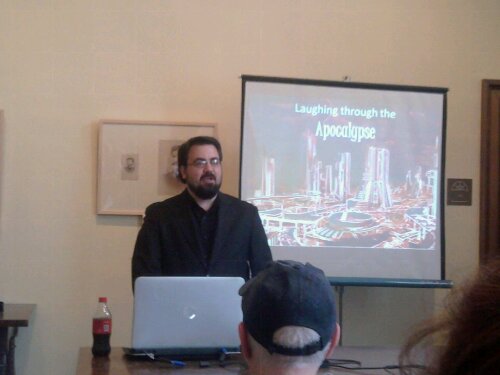
Yesterday I uploaded a picture of Jerry DeWitt starting his talk at the Austin History Center, here in Austin, TX.  I was mobile, and wanted to listen to the talk, and promised an update.  Well, here it is.  I was unable to update yesterday due to being caught up in socializing, sitting in studio for the Atheist Experience, and then socializing again after.

You know, like vacation stuff!

Well, now that I have a bit of time while Ginny catches up on some reading for school, I thought I would talk about the day’s events from yesterday.  Let’s start with Jerry’s talk.

I had not met Jerry before yesterday, but had followed his coming out through the Clergy Project and his position at Recovering from Religion.  Jerry wanted to talk about what he called “laughing through the apocalypse,” which is his way of saying that he is quite enjoying his experience as being an out atheist, perhaps in ways he could not have foreseen a few years ago.

He said that in a time which was supposed to have been the lowest point in his life, he discovered that other people–other preachers, that is–were going through the same thing.  The bottom line is there are many priests, pastors, ministers, and other leaders of Christian denominations (there was no mention of non-Christian leaders that I remember now) who are secretly non-believers.  But because their position, both professionally and socially, is tied to the church, they are reluctant to come out.

Slowly, more and more are working on coming out.  Jerry mentioned 25 or so people involved, and about 100 new applicants for the Clergy Project.  Who knows how many more there are out there that either don’t know about the Project or who are not ready to step forward, even behind the anonymity which the Clergy Project offers.

And Jerry has something to say to the atheist community.  While we talk a lot about creating a community, Jerry DeWitt thinks we already have a community.  He thinks that we already have everything the church has ever had, “plus more.”

Jerry emphasized that he, despite this coming out and all of the consequences of it has had, is the same person he has always been.  He emphasizes that there is a person that we are, and that throughout his ministries over the years he had been trying to figure who he was.  When he stepped into the light of atheism, that search simply evaporated.  He had found that the culture of Christianity As I understand his message) acted as a sort of stumbling block to finding who he had been the whole time.

Christianity had ripped out a Jerry Dewitt shaped hole in his heart, and tried to put ‘God’ in that hole.  The only thing that fits in that hole is Jerry DeWitt.  The only thing that fits in our hearts is ourselves.  I find this to be a wonderful image, and it resonates with me, even though I have never had his Christian background.  Jerry and I both have a deep interest in religion, of truth, and while his is stronger than mine a love of people. I can be, as readers here will know, a bit of a cynic often enough.  Jerry truly cares for people and the truth, and that compassion and care are not christian; they are Jerry DeWitt.

So, now that Jerry does not have to pretend to be somebody else anymore, he hopes, through Recovering from Religion, to help people get out of religion and find themselves.  I find it a noble, caring, and beautiful goal.

Jerry, as I got a chance to see over lunch, The Atheist Experience TV show, dinner, and ice cream afterwards, is indeed “enjoying the Hell out of my life.”  If you have a chance to see Jerry speak, talk with him, or read his upcoming book (still being written), then I urge you to do so.  I would be happy to call Jerry my friend, and am glad that I was in Austin to meet him.

Lastly, I want to thank Matt Dillahunty and Beth Presswood for being awesome hosts, both of the TV show and of us out-of-towners.  Not only have they been an influence on me over the last few years (Matt for longer, since I have known about him longer), but it turns out he, as He has been most gracious thus far in giving us a ride when we needed one, and in giving us a ride to get some Austin BBQ later tonight.  We’re looking forward to it, and may have more stories from Austin later on.


Seriously, folks, visit Austin.  I do enjoy this city.

Justice Scalia is Scared of Genitals, OR Sexnegativity and the Law


Editorial Note: This post was written by Wes Fenza, long before the falling out of our previous quint household and the subsequent illumination of his abusive behavior, sexual assault of several women, and removal from the Polyamory Leadership Network and banning from at least one conference. I have left Wes’ posts  here because I don’t believe it’s meaningful to simply remove them. You cannot remove the truth by hiding it; Wes and I used to collaborate, and his thoughts will remain here, with this notice attached.

—–


So, you may not know this, but speech in America isn’t completely free.  You’ve probably heard of the “fire in a crowded movie theater” exception.  However, unless you’ve gone to law school, you probably don’t have much of an idea what is protected, and what isn’t.  Here’s a quick quiz.  Some of these things are protected speech, and some are not:

  1. Flag burning
  2. Cross burning (for explicitly racist purposes)
  3. Cursing in public
  4. Cursing at the Supreme Court
  5. Pornography
  6. Hate speech
  7. Advocating violent overthrow of the government
  8. Depictions of animal cruelty

If you guessed “all of those are protected,” you would be WRONG!  All of them are protected… except for pornography.  According to our Supreme Court, certain categories of speech are “of such slight social value as a step to truth that any benefit that may be derived from them is clearly outweighed by the social interest in order and morality.”  These categories are generally limited to “fighting words” and obscenity.

Obscenity is not what you’re thinking, though.  “Obscenity,” according to our Supreme Court (and most recently by Justice Scalia), is limited to strictly sexual imagery.  Not cursing.  Not blood & gore.  Not torture.  Just sex.

How obscene!

The Court never really offers a rationale WHY sex has no value to a society; it just operates under the assumption that sexual imagery is less than worthless, and can be actively harmful.  Look back at the list at the top of the post.  The Court has held, at one time or another, that each one of those examples has enough value to our society to be worthy of protection.  But not sex.  When it comes to sex, it’s just too dangerous.

I don’t know what happened to make SCOTUS so afraid of sex, but let’s hope the next generation approaches the issue with a little more sanity.

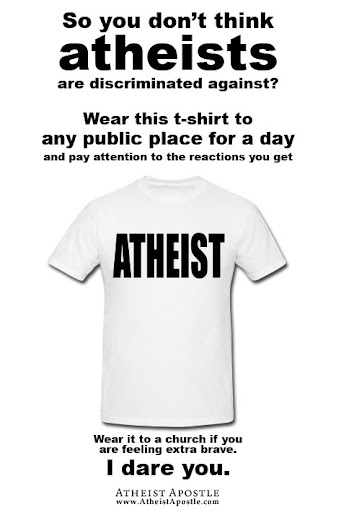
So, you don’t see atheist discrimination?


A challenge (via Atheist Apostle…via Dead Logic)

Wear if you dare!


Now, I have been wearing shirts that advertise my atheism for many years.  I have some acquaintances who question why I wear them as well as why it matters.  They are atheists too, in most cases, and nobody seems to care about it around them.

Well, a few things:

1) Most of my acquaintances who make such comments, especially people I’ve known from from high school, are very privileged private school educated, upper middle class, white men.

2) They rarely or never talk about their atheism, especially to non-atheists.  How would they know if discrimination existed? It’s easy not to be discriminated against if you are so deep in the closet nobody can see you there.

3) I’m not sure if most of these people would know what discrimination looks like, from the receiving end, if they did experience it.

My own admitted privileged status in our culture means that I don’t fully comprehend the repercussions of discrimination myself, and this is magnified for those who don’t expose themselves to being out atheists.  I am well aware of my ignorance about the experience of serious discrimination.  But what small amount of lack of privilege that being an atheist entails in our society (especially when compared to what women, non-white, trans, etc (not to mention the various intersectionality that people experience), I can assure you it does exist.

It’s nothing immediately dangerous (in the vast majority of cases, but I also live in a liberal metropolis), and in most cases it amounts to awkward conversations with clueless people.  It certainly can make job-hunting problematic, as advertising atheist activism on a resume may not be wise.  Although I once did get hired for a job (years ago) while wearing a “Hi, I’m your friendly neighborhood atheist” shirt.

So, atheist discrimination, in comparison with discrimination received by other groups of people is comparatively tame.  But it exists.  The more people that come out of the closet as atheists, the better it will eventually get.

So, whether you wear a shirt like the one pictured above or not, keep in mind that there are significant religious privileges in our society, and that we need more people standing up, speaking, and acting in the name of social justice of all kinds.

All social justice activists are working to make their activism irrelevant.  Let’s make atheist activism irrelevant.

Women at TAM: I think what you meant to say was…


The sphere is all abuzz with DJ Grothe’s complaints about how all the attention on sexual harassment at atheist and skeptic conferences may be discouraging women from attending. If, somehow, you’ve missed it, here’s the offending comment, from facebook:

Last year we had 40% women attendees, something I’m really happy about. But this year only about 18% of TAM registrants so far are women, a significant and alarming decrease, and judging from dozens of emails we have received from women on our lists, this may be due to the messaging that some women receive from various quarters that going to TAM or other similar conferences means they will be accosted or harassed. (This is misinformation. Again, there’ve been on reports of such harassment the last two TAMs while I’ve been at the JREF, nor any reports filed with authorities at any other TAMs of which I’m aware.)

I have to say, I find this more funny than upsetting. Maybe it’s outrage fatigue… but it’s just becoming comical to me that, after all the conversations we’ve had in this community around this issue, somebody who (I do believe) is sincerely on the side of increasing women’s voices and women’s presence in the community could say something this obtuse. Somehow he’s missed the part where women who are subject to harassment often fear that they won’t receive institutional support if they report it. He’s missed the part where multiple reports of harassment and abuse are passed around as backchannel warnings between women, because they believe (justifiably, in my opinion) that the prominent status of the abusers would mean that a public report would do much more damage to the reporter than to the perpetrator. Saying “we haven’t had any reports of harassment” is like… well, it’s like saying “I’ve never seen a monkey turn into a human, so I don’t believe in evolution.” That objection just proves you weren’t listening in the first place. Saying that harassment occurs has only been half of the point of most bloggers I’ve read writing about this: the other, far more urgent half, is that women on the receiving end of harassment often don’t feel safe reporting it. And Grothe’s comment has only exacerbated the latter problem.

While I think Grothe is probably correct that part of the attrition of women at this year’s conference is due to the conversations we’ve been having around harassment, here’s the response that would have made it better instead of worse:

“I’m afraid a lot of women are avoiding attending TAM due to fears of harassment. While I’m not aware of any incidents at the last two TAMs, I want to assure all our attendees that we take the problem of harassment seriously, and that we’ve put the following policies in place to ensure the safety of our attendees: [insert policies here]. I encourage anyone on the receiving end of harassment to submit a written report to JREF, so that we’re better able to track this problem and address it.”

It can be less PR-speaky (I hope it is!), but that’s the essence of the message any conference organizer should be putting out in response to the harassment buzz, and possibly-related attrition in women’s attendance. Convince us your meeting is safe by showing us what you’re doing to make it safe, not by claiming that it was never unsafe in the first place. That cat is already out of the bag.