Poly Porch Swing!


Editorial Note: This post was written by Wes Fenza, long before the falling out of our previous quint household and the subsequent illumination of his abusive behavior, sexual assault of several women, and removal from the Polyamory Leadership Network and banning from at least one conference. I have left Wes’ posts  here because I don’t believe it’s meaningful to simply remove them. You cannot remove the truth by hiding it; Wes and I used to collaborate, and his thoughts will remain here, with this notice attached.


—–

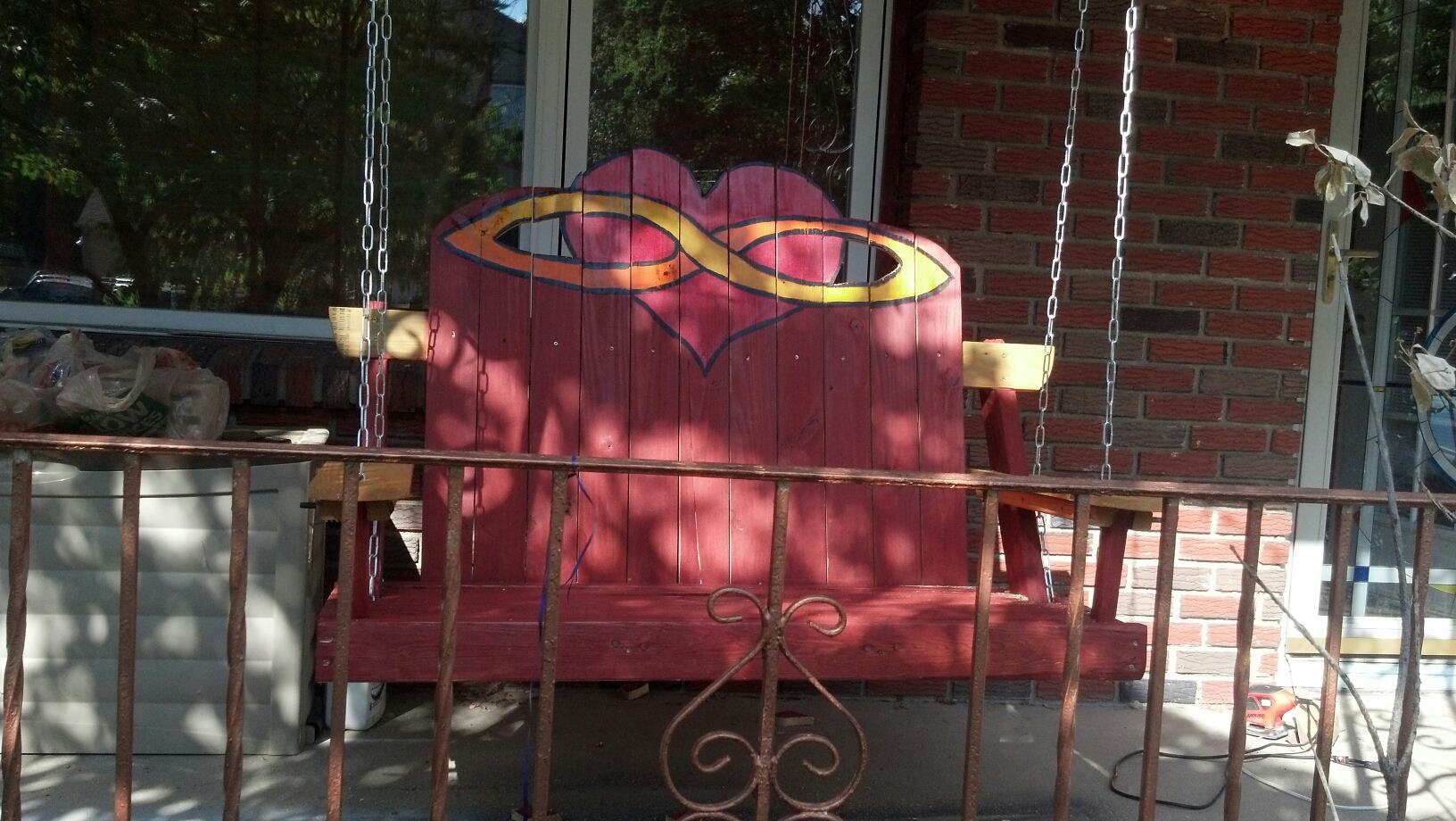
I made this porch swing a couple weeks ago, and Gina painted/stained it today! Someone insert a “swinger” joke…

Honesty is Hard


Editorial Note: This post was written by Wes Fenza, long before the falling out of our previous quint household and the subsequent illumination of his abusive behavior, sexual assault of several women, and removal from the Polyamory Leadership Network and banning from at least one conference. I have left Wes’ posts  here because I don’t believe it’s meaningful to simply remove them. You cannot remove the truth by hiding it; Wes and I used to collaborate, and his thoughts will remain here, with this notice attached.

—–


For the past month or so, the skeptic blogosphere has been talk a lot about harassment at skeptic events. Throughout these conversations, I’ve made a few disturbing observations:

  • People (mostly women) are getting harassed at skeptic events. This doesn’t seem to be occuring at higher rates than at other events, but any harrassment is too much, and we can do better than that;
  • Many people (mostly men) in the skeptic community are not taking this problem seriously. This is also fucked up, and I’m glad it’s getting some attention.

These issues have been extensively documented by Stephanie Zvan at Almost Diamonds.  Everything that I could say on the topic (and how disturbing it is) has been said much more eloquently elsewhere, and I have nothing new to add. Suffice it to say that yes, this is happening, and I hope atheist/skeptic conferences all adopt strong harassment policies, with an emphasis on enforcement.

What I’d like to discuss is a secondary issue (which is not nearly as important as the two identified above, but I think is worth discussing): the issue of harassment has led to a number of discussions about exactly where the line is between consensual flirting and harassment.  These are important discussions to have, I think, but I’m bothered by two (somewhat related) themes I keep seeing crop up in these discussions:

1) It’s wrong to want sex from people without being interested in getting to know them

This is generally couched in reasonable-sounding language like this from PZ Myers:

I have a simple suggestion. Think of sex as something two or more friends do; but also keep in mind that most friends don’t have sex together. When you’re at a meeting, plan to make friends promiscuously, but remember: the purpose first and foremost is friendship, not sex partners.

At first glance, this seems like a reasonable suggestion. Most people prefer to get to know people before having sex with them, and most people would rather have sex with someone they like for nonsexual reasons also. But some people just want sex, and there is nothing wrong with that. It’s not up to us to tell people what their goals should be in a social interaction. Denigrating anonymous men for wanting to “bag a young hottie” (which is Jen McCreight’s paraphrase, not an actual quote from anyone) at each speaking gig sends the sexnegative message that desiring sex with a person you find attractive (which is how I would have phrased it) is WRONG and CREEPY. In addition, speaking about it as something that only men do contributes to the myth of men not being hot. McCreight puts desiring sex with attractive women in the same category as talking only to a woman’s chest, nonconsensual groping, and following a woman to her hotel room. I think that’s terribly unfair. There is nothing wrong with sexuality. There is nothing wrong with desiring sex for purely physical reasons. Resorting to slut shaming is not necessary to discuss harassment. It’s bullshit, and it should stop.

2) Dishonesty is expected, and even encouraged, where sexuality may be involved

This is related to Point 1 by virtue of the fact that if wanting sex is wrong, then people who want sex are going to be encouraged to hide that fact until the socially appropriate time. People who just come out and say they want sex (even in the least coercive and lowest pressure way I can think of) are disrespectful, objectifying, and should be ashamed of themselves. Fuck that. Asking for sex is not seeing a person “as your plaything.” It’s just asking for sex. Objecification only happens if you see the other person’s desires as irrelevant. As long as you are genuinely seeking enthusiastic consent, if you want sex, you ought to ask for it! Hiding your intentions is just being dishonest, not respectful. As one commenter on this blog put it:

I too find smart, interesting people who think about things quite sexy, yet am generally skittish of strangers. I’m also alternately oblivious to and skeeved out by the way flirting (in most mainstream venues) happens most times. Still, I’d far prefer for someone to tell me they think I have great boobs and would like to make out with me than to just hint at it, assuming they are respectful of my possible “no thank you.” I like transparent, respectful asks, and people who ask for consent frequently and sincerely.

In addition to those desiring of sex being encouraged to remain silent, women who are objects of such desire are also encouraged to be dishonest about their refusals. The (true) observation that rapists ignore refusals is used to suggest that women shouldn’t be encouraged to clearly communicate their own desires. The (also true) observation that women are socialized not to clearly communicate a refusal is used to suggest that we should not be encouraging women to break free of that socialization and be more honest about what they want. This is confusing the “is” and the “ought.” The undeniable state of mainstream heterosexual flirting is that men are expected to be the aggressors, that clearly communicating a desire to have sex is disfavored, and that a clear refusal is often met with hostility. None of this is an argument that the status quo is the way things ought to be. We should all be encouraged to be more open and honest about what we want from a social interaction, even if the we may be subject to negative social consequences.

The exception, of course, is when physical safety is in question. If anyone is in doubt about his/her physical safety in an interaction, all of these rules go out the window, and people should do whatever they need to in order to get to safety. That cannot be stressed enough, and it should never be forgotten.

Of course, the flipside of this is that we should stop punishing women for being blunt. A woman who clearly communicates a “no” is not being harsh, she’s being honest. A woman who says she’s not interested in someone (even if s/he hasn’t made any advances) is just being communicative. Hurting someone’s feelings through deception is a dick move. Hurting someone’s feelings by telling them the truth is a brave and awesome thing to do, and we should encourage people to do it.

However, the danger of social disapproval is not a good reason to be dishonest. If your friends will think of you as a bitch for giving a clear refusal, get some new friends. If the object of your affection will see you as creepy for being clear about your sexual interest, that’s not a reason to hide your interest. Honesty often has negative social consequences. It does not follow that dishonesty is justified. If flirting should be about creating intimacy, then it relies on both parties behaving in a trustworthy way (i.e. not lying to each other).
Jadehawk disagrees:

You can’t remove the social context because the social context is what determines how women will respond. they’re not flirting with you in a social vaccum, and pretending otherwise is just fucking stupid. We have to fix the social context first (i.e. not punish women for being above-average-assertive, and instead shut down those why try to punish women for blatantly and “rudely” setting boundaries and even taking initiative themselves), before you can seriously expect women to consistently “help” socially inept guys at flirting by being blunt with them.

I agree that it’s unrealistic to expect anyone to completely go against their socialization, but that doesn’t mean that we should not ask them to do so, or, when we’re discussing behavioral standards, to hold up an against-the-mainstream behavior as ideal. Society socializes us to do many things that we reject. Dishonesty could be one of them. Jadehawk’s view is that women are just brainless products of society’s conditioning, and have no choice in how to act. I think we all have a choice, regardless of what we’re told, or how we’re taught. I don’t think “the social context is what determines how women will respond.” I think women will respond based on their own individual choices, in light of the social context.

To be clear, I don’t think people are always (or even usually) obligated to express their sexual interest or lack thereof. It’s all about your intentions. If you intend to send the message for someone to back off, do it clearly. Don’t use subtle social cues that are open to interpretation. If you want to get to know someone, do that. If you intend to communicate sexual interest, do it clearly. Don’t do it by pretending you want to get to know someone. And don’t pretend you’re interested in sex if you’re only interested in getting to know someone. If you want to get to know someone, and also have sexual interest, then feel free to communicate either or both. My only problem here is dishonesty about one’s intentions.

This also shouldn’t be taken to mean that I think people always have clear intentions. It’s perfectly reasonable to be hours, days, weeks, or years into a social interaction, and still not really be sure what you want out of the interaction. That is actually, I would argue, the mainstream expectation. The problem occurs when people know what they want, and pretend that they don’t.

Flirting is not easy. But if we try, we could make it a little easier.

Surrender to me, and all will be well…


Some of us who have left religion can rightly be considered abuse survivors. Sometimes the abuse is obvious and extreme. Sometimes it’s more subtle, but still leaves a lasting impact. The abuse largely consists of having been denied intellectual and emotional autonomy; denied the right to form our own opinions, to choose our own identities, to pursue pleasure and avoid pain. We were taught to be complicit in our own abuse, to agree and submit and accept that yes, denying ourselves was right and good. We were taught to thank the people who held the rod over our heads.

I don’t think all religion does this, or that all people who were religious in their formative years suffer the psychological damage I’m talking about. I think it’s more likely to occur for those who had a parent or spiritual leader with a personality disorder (narcissism is common, in my experience) and who had a compliant, anxious-to-please temperament.

Being one of these, let me tell you what it’s like in my head. I have no confidence in my own ability or freedom to decide what’s right or best, what “a good life” or being a good person means. From infancy, these things were handed to me, with unquestionable authority. Although I began the process of rejecting and questioning that years ago, there’s a part of my brain that is still waiting to accept beliefs and moral dictates from outside. We all have that vulnerability, I think, that sense that it would be such a relief to let someone else tell us what is good and bad, true and false. But mine was strengthened by having been allowed to dominate for the first two decades of my life. My brain was nearly fully formed by the time I shook it off, and it’s still there. Still a threat.

It’s the thing I fear most. I was thinking through my fears today, and when I voiced this one to myself — “I’m afraid of living the next two decades under someone’s thumb, the way I was for the first two” — I began shaking and crying. I’m really, really afraid of that. And I know how my brain works, so I know how real a danger it is.

One thing this means is that when someone expresses their opinion in a flat, factual way, I become hella defensive. Those who are close to me know this well. It’s true that a person can state their beliefs without implying that those beliefs are absolutely correct and you’d better believe them or else — but the part of my brain that’s looking to receive truth from outside is seduced by their confidence, their apparent certainty. I feel it leaning in, wanting to just let go, acquiesce, say “Ah yes, you’re right of course” without giving it further thought. And that feeling terrifies me, and I pull back as hard as I can, in a way that is not at all rational or measured.

We’re all threatened by having our beliefs challenged, but some of us are also threatened by the possibility that we’ll change our beliefs not because we thought them through, not because they fit with our experience of the world, but because it feels so good to surrender and let someone else do the deciding.

I don’t know how to deal with this. I don’t know how to let my defenses down while the surrender-hungry part of my brain is still so strong. I’m not at all convinced that that would be a wise thing to do. So for me, right now, anyone who tries to convince me of something using emotional tactics, or blunt statements that don’t explicitly acknowledge their uncertainty or my right to think differently, is likely to trigger a shitstorm of defensiveness. If anyone who’s been through this has any advice, let me know.

Opening Up About OpenSF


Annalisa and I spent the last week in San Francisco. In part, we wanted to have a nice vacation: I had never been west of Chicago and we had not traveled together for any real length of time for a while. But one of the major reasons for going was also to attend OpenSF, a conference on nonmonogamy, open relationships, and polyamory organized by Pepper Mint. The conference (and related events) lasted from Friday until Sunday, and I’d like to take a bit of time to talk about some of the interesting panels I attended and some of the people I met in and around the conference itself.

Friday

Friday was essentially a welcome/orientation day. Pepper gave an opening address and initiated an interesting icebreaker activity, for which I am thankful because it forced me to meet some new people right off the bat. One of my goals for the conference was to socialize, but walking into a room of strangers, almost all of whom live in the San Francisco Bay area, was daunting for me. I learned an important lesson this weekend: I am extremely bad at approaching people I don’t know, even for casual, “low stakes” chat/interactions. Once I’ve been introduced to people, or compelled to interact with them, I think I’m actually a fairly gregarious person. But the initial awkwardness of “how do I approach that person, and what do I say?” is a huge anxiety trigger for me.

Luckily, the icebreaker required us to move from table to table, each time beginning with a new group of people and a “prompt” question that we were all asked to answer in front of the group (if we chose to answer: enthusiastic consent was a theme of the con, so anyone could opt out of any activity without judgment). Pepper provided excellent questions (“What do you hope to get out of the con,” “What is one of your wildest or most unusual poly moments,” etc.), and I felt mostly at ease meeting 20-30 new people in 15 minutes or so. It was a fun activity, and I might adapt it for use in the classroom.

After the welcome address, many con guests left to attend an off-site lecture/dance/play party. Sadly, I was unable to register in time for the sold-out event, but a group of other event castaways organized a rousing game of Cards Against Humanity, to which I was graciously invited. There I met Dylan of the Life on the Swingset podcast–who had brought a large contingent to the con–and several other people I would see throughout the weekend.

Saturday

Saturday was a day of panels, beginning with Charlie Glickman’s talk, “Sex, Shame, and Love.” For me, this was a highlight of the convention. Glickman discusses shame as a “tent” or “cloud” of emotions, any of which can disconnect us from people with whom we have relationships. One of his most important points, though, and one on which he disagrees with many writers on the subject (and some of his own psychologist colleagues), is that shame is not always detrimental. For Glickman, feeling shame is an important indicator that we’ve broken a communication/relationship “bridge”–yes, he used a lot of analogies–and need to mend it. Awareness of our feelings of shame is the first step in repairing the relationship (I should probably note here that one of the key relationships we can damage with shame is our relationship with ourself). Glickman elaborates on these concepts herehere, and here (among other places).

Most people in romantic/sexual minorities face shame at some point in their lives, often daily. I found it refreshing to hear someone talk about shame’s adaptive value and about avoiding a shame “spiral” (i.e. being ashamed of feeling shame, which only leads to more shame). As an anxiety disorder sufferer, I found in Glickman’s philosophy some useful coping mechanisms.

One other session of note on Saturday (they weren’t all gems, though I can’t say I thought any one was particularly terrible) was on “Poly Theory.” Joy Brooke Fairfield, a Stanford graduate student, gave a staggeringly expansive and eloquent talk about establishing a branch of cultural studies called poly theory (in the vein of feminist theory, queer theory, etc.). She also expanded on Deleuze and Guattari’s metaphor of a rhizome to describe polyamorous relationships. Contrasting her conception with the traditional linear (or arboreal) relationship model–we can see the arboreal model in family trees, corporate organizational flow charts, etc.–Joy argued that our relationships more resembled the root system of rhizomes. Rhizomes lack a central or ultimate root but rather expand from node to node in many directions. If we imagine ourselves each as nodes, we can see how we connect to other nodes, and those nodes to still others, in a complex but interconnected system. It is an elegant, non-hierarchical way to look at groups of linked relationships, polyamorous or otherwise.

After Saturday’s sessions, I got to try Poly Speed Dating. It was a lot of fun, if chaotic. I wonder if something like this would work in our area?

After speed dating was a dance party at Love Triangle dance club, a poly-friendly club in San Francisco’s Mission District. I was heartened to learn that the Mission has not one but several clubs that cater to nonmonogamous folks. Again, I wish our city/region did a better job of providing safe spaces for nonmogamous people to gather to socialize. My overriding feeling all weekend long was that this was one of the first times in my life that I’d found a group of people with whom I fit in totally. Even though I met theists, omnivores, and even (gasp!) political moderates, I felt a deep, almost instant common bond. We’d all wrested loose the shackles of monogamy, and that’s a remarkable thing.

Sunday

The fatigue of late Friday and Saturday parties began to show for most con guests (and even some of the presenters) Sunday, but the day did bring a few highlights.

Tristan Taormino‘s keynote speech was an enthusiastic call to arms. She made several important points, one or two of which I will write about in more depth another time. Briefly, though, she called on the LBGT community not to throw polys under the proverbial bus in their fight for marriage equality. Conceding our opponents’ post hoc and slippery slope arguments hurts both our causes.

In addition, Taormino called on those of us who have the privilege to be “out” as nonmonogamous to live our lives as openly as possible. One of the things that prompted me to start writing for this blog was that I realized that I am fortunate enough to have a job for which I will not be fired for being polyamorous, a supportive and loving family, economic and emotional security, etc. I really must live my life openly, if only to show other people that people like us not only exist but are happy, healthy, and thriving.

I liked a few of the early Sunday panels, but I was really impressed with Cunning Minx‘s afternoon session on creating a non-threatening, attractive online dating profile (i.e. how not to be creepy guy). While her advice was useful, even for those of us who already consider ourselves non-threatening/non-creepy, I was particularly struck by her polished, stimulating, and well-organized presentation. You would be amazed at how many presenters were not particularly well-organized. We’re lucky to have Minx as an advocate/representative/colleague/peer, and I was glad to have met her.

I was also able to meet Dossie Easton, whose inscription in my copy of “The Ethical Slut” left me smiling with fanboy glee.

Monday and Beyond

I’m still processing the experience of OpenSF–and I expect I’ll share some of the fruits of that processing with you in the weeks and months to come–but right now I feel overjoyed to have spent three days among fabulous, non-judgmental, like-minded people. I increased my polyamory vocabulary, something I wasn’t sure was possible nearly four years into my own poly life. And I left San Francisco, and return home, eager to be more of an activist and particularly to advocate for more sex-positive events and safe spaces in our own city. I think we can do it, but I’ll probably need a bit of help. Who’s with me?

Ideas and beliefs do not deserve respect


There is a discussion going on all over the internet about civility and belief.  There is a demand that people’s beliefs, ideas, and opinions be respected.  That idea is fundamentally wrong, and we need to get over it.

Ideas stand or fall on their own merits.  If they are respectable ideas, they will withstand any mockery, criticism, or down-right disrespect we can throw at them.  If they are not respectable, then we, as mature adults, need to be able to handle that.

Our ideas are not held for purely rational reasons.  I don’t care how intelligent you are, how well you have thought out your ideas, or even if you are Vulcan.  Our ideas are based upon emotional values that we have, which are beyond our control, and then we rationalize those opinions after the fact.  In many cases, those opinions can be rationally and skeptically justified, but it is not how we originally form most ideas.

If you care about the truth, then you should be able to mock your own ideas and hear mockery with the ability to remain rational. This is not to say that people will not be emotional in such cases, but that we all need to practice hearing mockery by challenging our own ideas so it does not make rationality impossible in the face of such criticism. The truth will attend to itself, whether we respect it or not.

If you don’t care about the truth, then why do you care if others respect your beliefs? If you don’t care about the truth, then you don’t respect your beliefs.  So why should anyone else?

We all, as adults, need to maintain a safe distance from our beliefs.  We should not make them sacred, protect them from criticism, or demand that people respect them.  To demand that ideas remain protected in such ways, we are telling people that we are less concerned with truth than with our comfort.  We are declaring that we don’t care if our ideas are true.  And, again, if truth doesn’t matter than other people’s respect is irrelevant.

This, above, is the essence of new atheism.  This is the essence to the new movement lead by people such as Richard Dawkins, PZ Myers, and others who have been called “strident,” disrespectful, or unsophisticated.  Rather than defend them, I think we need to recognize that the charge is loaded with assumptions which need to be smashed open, criticized, and mocked.  The truth is that our various bad ideas, whether religious, political, or spiritual in nature, have survived because of the unwarranted demand for respect.

This bubble we create around our personal beliefs has become sacrosanct in the postmodern west.  It is certainly tied to modern liberalism, and certainly it is the weakest part of liberalism from where I stand (and I identify as a liberal).  We need to stop demanding respect for ideas until those ideas have survived skeptical analysis.

We need to distinguish between respect for ideas, legal protection of maintaining ideas, and people.  The first, that of ideas themselves, never deserves automatic respect; that respect must be earned by surviving criticisms both harsh and gentle.  Legal protection of ideas and of people do deserve respect, as we all have the right to our ideas and our ability to articulate them.

We just don’t deserve respect for those ideas automatically.  And by demanding it, we betray that we know that the idea might not survive criticism.

Criticism is not uncivil.


Those damned kids…are making me have hope!


So, over the last few years there have been a number of stories about high school students standing up for something they believe in.  Specifically, in my memory, are those students who stood up for the first amendment, LGBTQ rights, and general social progress.  Whether it has been Jessica Ahlquist, Damon Fowler, Matt Leclair, or any of the many other not-quite adults (And yet displaying great adult understanding and maturity), I find it quite promising that the next generation seems to be willing to stand up for what they believe is right.

What bothers me is that those in charge now–the school administrators, politicians, many parents, etc–are the ones they are fighting against.  Shouldn’t the older generations, ideally anyway, be the ones demonstrating maturity and understanding? Is it sad that the students are schooling the teachers and administrators?

I am, of course, severely oversimplifying the issue with a huge dose of confirmation bias; I’m remembering the heroic youth and the egregiously unaware and backward adults they fight against while ignoring the many uninformed students and the many adult activists who have been working tirelessly for decades.  I admit that I do have a bias for the less powerful against the powerful, and have a rebellious streak in me (“no shit,” many of you are saying).  My point is that I’m glad that there are signs that despite an educational system with many flaws and shortcomings, many students seem to get it.

I’m glad that there will be another generation with leaders within it to keep the progress progressing.

But ultimately, I look forward to an ideal world where teenagers can stand up against things of lesser importance at best, mostly because their teachers, administrators, and school board understand the rights and responsibilities that their positions affords them and the students they are placed over.  Again, as is the goal of all activism, I look forward to making activism irrelevant.  I don’t expect that we shall succeed in my lifetime.  If ever.

For decades now, conservative Christians have had the long-term view to take control of school boards, and we have been seeing the result of it now with what happened in Dover, PA a few years back, arguments to “teach the controversy” (hint, there is none), and the various fights between homophobia and LGBTQ supporters.  The internet certainly has helped to keep information flowing in order to combat ignorance about rights and legal protections, and I’m sure we are all glad for that.

I think there is reason to be optimistic.  I think there will be hard fights for many years, but I think that all is not lost.

The sky is not falling, but where there is forecasts of rain there are also many people with umbrellas, and willing to hand out more of them in hopes of sunnier days.

The Avengers, reviewed by a non-chemist


For those still sulky about Gina’s scientific criticism of The Avengers, here’s a writeup on my other blog from a more tropes-and-narratives point of view, and which is much more complimentary (not to say gushing. We really fansibbed over this movie, what can I say?)

And also, just as an aside, it’s a mark of maturity to be able to appreciate that a movie might be awesome in some dimensions (narratively, for example) but flawed in others (scientifically, for example).

polymoons, set theory, and boundaries


Ginny and I returned from Austin, Texas yesterday.  Gina, who had been with us for s few days, had returned a few days before that.  Ginny and I had decided to go to Austin for a few reasons.  One, she attended a conference which would be helpful for her academically and (potentially) professionally.  Two, Austin is pretty awesome, and three, there is a very active atheist community there.

Oh, right…we also just got married.  So, it was partially a honeymoon.

So, for those of you not paying full attention, what happened here is that my girlfriend came with us for part of our honeymoon.  In a sense, it became a polymoon.  That’s right folks, a polyamorous honeymoon.

There was some discussion while planning this trip, as to whether it was appropriate to have one’s other significant other (OSO) join them for their honeymoon.  Ginny and I agreed, months before the wedding, that this relationship is not all about us.  Neither of us feel very strongly about the idea of hierarchies in polyamorous relationships, and so there does not need to be a sacred space, time, or vacation that is just about us.  Yes, we wanted some of it to be just about us, but all of it did not need to be so.

At the wedding itself, Gina was not only there, but she was a central part of the party as well as the ceremony, as I chose her to be my signing witness on the license.  For most of my relationship with Gina, she has played a central, integrated, and important part of my life.  So why wouldn’t she come with us to Austin? And being that Austin is one of the best places to hear live music and be around the vagaries of hipster culture, Gina and I had a great time watching ridiculous and down-right awesome live music while enjoying some good local food and drinks.


A new paradigm of relationships

What I am not sure many people fully understand about polyamory, at least as I view it, is that it is not merely about adding relationships to our lives.  It isn’t merely having a girlfriend and a wife (in my case).  It’s about discarding the very foundation of traditional monogamous culture.  It’s about saying that there may, in fact, be something fundamentally broken about the way our culture looks at relationships.

In short, I am trying to destroy so-called “traditional marriage” in our culture.  But more precisely, I’m trying to show that this “traditional” idea is not particularly good nor even very traditional.  It is a broken, largely unhealthy, and unskeptical approach to relationships which does not answer our needs and desires in this short life.  Some changes need to be made, if we are to live this life on our terms, not the terms of obsolete ideas about sex, love, and relationships.

Why do we make the logical leap from “I like this person and want to be with them” to “they are mine, and nobody else can have them”? Well, partially because this is not a logical leap at all, but it is a leap based upon emotions which are largely driven by uncertainty and fear.

Surely, at the beginning of relationships we are often genuinely distracted by the relationship, but why, upon having the relationship mature, do we continue along the path of exclusivity? Why do we seemingly forget that a relationship with another person does not have to be a contract of exclusivity, setting one person above all, forever, forsaking all other loves?

Why do we place other relationships second, third, etc hierarchies below that one special place?  I don’t mean the people we are not very close to or perhaps don’t like; why do friends, other potential love interests, etc all become somehow demoted below that relationship necessarily and automatically?

Don’t get me wrong, when people voluntarily enter into relationships of their choosing, they can do so in any hierarchical fashion they like.  But why (as I ask again and again) is their a default setting to put your significant other into a role of unique importance?  Why can’t anyone else be placed there, or at least near there, as well?

The problem isn’t that people are not more or less important to us and our life, it is that we artificially have a slot for that one special person, when in real life things are not so simple.  There is no reason to have to choose one person to inhabit that special part in our lives.


Poly set theory?

What I offer as an alternative is something like the following.  Let’s think of relationships as fitting into sets. Each set may or may not overlap, especially over time, but they have levels of intimacy, care, and importance attached to them.

  • Let’s start with what I will call strangers.  These are people with whom you interact at a very superficial level, and who you either don’t know or don’t know well. These people are not close to you, you probably don’t know their name, and they are less likely to become part of your life in any meaningful way.
  • Then there is a set of acquaintances.  These are people with whom you share familiarity, but not closeness.   You may like them or you may dislike them.  You may, in fact, like them or hate them a great deal.  They may be people from work, people in your network of social ties, neighbors, or distant relatives you see occasionally.  These people may become close to you under certain situations, but likely only for short periods of time before returning to their relative distance.
  • Also, there is  the set of what I will call platonic friends.  These are people with whom you share commonalities of interest, background, etc and with whom you have no romantic of sexual interest.  You like, possibly love, these people and you enjoy spending time with them and may do so often.  There is no rule that you cannot be lovers with them, but one or both of you is not interested in this arrangement, for whatever reasons, and so you do not.  A good example here is your best friend from high school, college, work, close family members, etc.
  • Then there are your friends, perhaps we could call them poly friends, with who you share romantic, sexual, etc relationships.  These people are not your partners, not in the sense of a “girlfriend” or “boyfriend” kind of way, but they are people with who you have more than a mere friendship.  Whether you do kink scenes with them, have occasional sex, or just like to spend time with them talking, sharing emotional intimacy, etc they are not mere friends, but also lovers and people with whom you share some level of intimacy.  But they don’t quite make the set of partners, significant others, or even spouses.
  • That last set, those with who you are closest and with whom you share highly integrated lives in addition to sexual and/or romantic intimacy are your partners or perhaps your family.  In mainstream relationship culture, this role is set aside of one person, usually your wife, husband, etc.  These are the people with whom you plan long-term lives with.  You consider these people in making life-choices, they know you very well and care for you, and you may hope to spend the rest of your life with them around as part of your life.

But why should this last set, your partners, be defined as being a set of one ideally? What is the rational explanation for this? The fact is that any of these sets can have many or few people in it.  And, I would argue, many forms of polyamory probably maintain the arrangement of that last set being set aside for one person.


Hierarchy in Polyamory

In my experience, many forms of polyamory still include this idea that one person is still relegated to this last set.  Some poly people see the primary relationship as sacred, unique, and other partners should not transgress the boundaries set by a primary partner.  Now, clearly boundaries agreed to are important, but I wonder to what extent those boundaries are necessary or ideal.

The idea that my girlfriend should not join my wife and I on our honeymoon assumes a boundary around such times and places.  It assumes a sacred space into which another person should not tread.  Now, if my wife and I decide to set that boundary, a girlfriend should not cross it, but the question is whether such a boundary should be created.

In polyspeak, are rules and boundaries necessarily a good thing to require, or do they perpetuate the very basis of mainstream monogamous culture?

Basic rules about safety, property, etc are good ideas, but it seems to me that any healthy relationship would not have to enumerate such rules.  Why, for example, would I want to be in a relationship with a person who would flaunt and disregard safety, property, etc?

If a new lover said to me something like “don’t bother with the condom.  I know we haven’t talked about it or cleared it with your partner, but I’m clean and I won’t tell anyone,” then not only am I most-certainly using a condom, but I might decide to discontinue the sexual relationship under some circumstances.

Why? Because it shows that this person cannot be trusted to respect safe sexuality.  How many other partners has this person said that to? How many of them are usually safe? There are too many uncertainties for me to follow this request and still consider myself a loving partner.  It shows that this is a person I should not want to be very close to me because I already know they are willing to lie and deceive.  Such a person could not enter my last set of partner, and may not last long as a poly friend, depending on other factors.

Boundaries are rules that grown organically out of actually loving and being considerate of the people we are with.  It seems to me that to enumerate such rules demonstrates some level of distrust.  And so the more a person moves from one set to another, the less rules should be necessary.  When we have people we wish to think of as partners, family, and spouses, we should not have to have rules so much as respect and good decisions.  We should want to keep them as safe, or safer, than we would be willing to keep ourselves.

Bottom line, Ginny and Gina are my partners.  I trust both of them, even in their times of human weakness and uncertainty.  My life is entangled with both of them, and as a  result their lives will be entangled with each other, and also with the people with who they are entangled.  Therefore, Gina does not need to be relegated to a second-class place in my life any more than I would want to be relegated to a second-class place in hers.

And through this tangled web of sets, a family forms.  Not that we are all extremely close, that we are all necessarily intimate, but that the decisions I make affect them and vice-versa.  Rules and boundaries for such arrangements only betray lack of trust, and I want trust as part of my life.

There Isn’t Really Any Easy Way Out


I have been thinking a lot about identity.

Living in society we get a lot of input from all sorts of sources about who we should be, could be, would be if only xyz.  Everyone has an opinion about what a good person is and what a bad person is.  People like to make statements like, “I’m a person who…” and you fill in something you consider to be truly definitive of “Who You Are”.   But, in my experience, figuring out the answer to the question, “Who am I?” is a lifelong quest.

I have spent a considerable amount of my life dealing with self-loathing and worrying about what other people think about me.  Looking back at my life thus far, my entire identity has been told to me by outside observers.  It is only recently that I have begun to get an idea of me.

When I was a kid growing up around astrology, it was easy to get swept up into a ready-made identity bestowed upon you by the stars.  “You are an Aries.  This means that you are passionate, outgoing, intense, FIREY!  On the flipside, you are prone to bad versions of these things, mainly in emotional overreaction, an overinflated ego, and a need for people to be around you to be happy.”  This description was very convincing and looking at it currently, it makes me laugh because, well, all of those things are true.  I don’t particularly describe myself as firey or intense, but the struggles I have certainly fall into the above stated categories.

Of course, I can boil these truths down to nature and nurturing; genetics and environment.  When people talk casually about astrology, they generally refer only to a person’s sun sign.  This explains you in broad strokes, which is good enough for most people.  If you happen to be talking to someone who knows a little more, you can explain all of your other qualities.  For instance, I am an Aries with a shitload of Libra in my chart.

Yes, my “chart was done” when I was born.

When I was a kid I had considerable problems dealing with expressing my preferences and requesting my needs be met while over-accommodating other’s people’s preferences and requests.  I know…I should probably not talk about that in the past tense as it is still something I struggle with.  But I used to have fits of stress followed by fits of anger and sadness when a friend spent too much time at my house.  I would talk about this with astrology buffs and they would identify this as me having a need for balance.  Libra, represented by the scales, is very focused on balance…so it all makes sense.

Looking back, I thought this was amazing.  “Of course!  I have been dealt the ‘you have a need for balance’ card in life! That’s why spending a long time with my friends makes me crazy!”  This fact also had me convinced that I was an introvert.

As it turns out, it’s just that I’m pleasant and over-accommodating so I used to attract mostly assholes as friends.  I worry too much about what everyone thinks so I fear stating opinions and calling people on their shit.  Assholes love that!  Also, people would call these Pisces problems and, as I was born on the cusp between Aries and Pisces, again, this all makes sense.

Astrology can get really complicated…you know, like the human genome and quantum mechanics.  OK, I suppose it stops short of the other two, but for most people’s purposes you can explain every single thing about them by fitting all of their attributes into the different houses and ascensions, moon landings, solar flare mega action and…oh, who knows.  In the end, you can completely discount that you are a bag of chemicals at the mercy of electrons.

Astrology also gives you the idea that you are written in stone.  On the day you are born you are given a group of “good things” about you and a group of “bad things”.  Your mission, if you choose to accept it…haha, choices, that’s rich…is to learn to “just be” with the bad things.  I mean, what choice do you have?  The stars have proclaimed it!

And, of course, astrology is not the only belief system that says this.  Every person is born for a purpose and everything happens for a reason is a tenet of many a religion.  This idea gives support to the thought that all the things that drive you crazy about yourself are necessary and unchangeable, but it’s OK because you’re that way from some Grand Purpose.

Growing up I got a lot of labels put on me.  “You’re so nice!  You’re so theatrical!  You’re so out there and unique! You’re funny!  You have such an interesting style!”  And while these were mostly good (though some were often thinly veiled criticisms), now I can give you multiple bad sides to all of those attributes.  “I am spineless.  I am afraid to speak.  I like a lot of attention.  I might make you uncomfortable with my view of the world and my disdain for your mainstream view.”  The terror of being honest and alienating people whose opinions about me I valued has oft stopped me from saying anything, for speaking up for myself and others, for doing what I really want to do.

When I was in highschool, I was miserable.  I spent my days surrounded by people I didn’t particularly like but refused to say so.  I had completely “valid” reasons for finding these people distasteful, but I wouldn’t speak up for fear of them knowing and being mean back or whatever.  I never said what I wanted from people.  I never asked what they wanted from me.  I let everyone tell me who I was because I didn’t have a way to articulate my own thoughts on the subject.  I spent years in silence feeling only free on a stage playing someone else, or in front of classroom reading something I had written or presenting.  On the outside I was strong, theatrical, and brave and I never got upset.  On the inside I was insecure, constantly questioning everything I did or said, and worrying about everyone’s opinion all the time.

I have changed drastically over the last several years.  Wes helped me to discover that I was most certainly not written in stone.  He helped me to find a level of awareness about what I wanted in life, what would make me happy, and what I was personally doing to stand in my way.  I am always open to change.  I want to be as happy as possible.  If there’s something that always bothers me, then I need to figure out why and address it.  There is no “this is too hard” or “well, I’m not the kind of person who can do that” for me.  I can do anything I want.  I can affect whatever change I want.  The only thing standing in the way would be my own dishonesty or my own false value assessment.

Like I said, I’ve been thinking a lot about identity.  And I realize that despite the fact that I have spent so long struggling with insecurities and worrying about everyone’s opinion, and despite the fact that I have worked so hard to change the things about myself that cause me harm and stress, I have never really not known “who I am”.  Or, at least, I have a strong sense of self deep inside that never waivers.  At 31 years of age, I still can’t articulate what that means in words.  The only thing I can say is never once during the journey to those changes have I worried about losing sight of myself.  And each success, each stressor that I struggle with and learn to control, I am happier and the happiness brings a clarity to that sense of self.  The harder I work, the more I learn and grow, the stronger that sense of self is.  I am flawed but I am strong.  I am scared but I am committed.  I am crazed but I have a sense of humor about it.  I am emotional, passionate, ridiculous, confident and insecure.

In other words, I am human and will never know everything about me.  I know myself better at 31 than I did at 21.  At 51, I will likely look back at this and laugh at how much further I was going to go and at 81, I will be old and too busy doing my full time “Old Lady with funny hats and accents” impression.

You are an active participant in your identity.  I look at myself as clay over iron framework.  I am malleable but retain my underlying composition as I stretch and expand.  I am vigilant about the things with which I struggle.  I see no reason to not identify the things I dislike and work to change them.  There is never a downside to this and much like an old piece of clay holds onto pieces of previous forms it was in, these things are always there in some way as a part of me.  But they are not “Who I Am”.  They do not have to control me or define me.  They are just there, sometimes nagging at me to indulge them.  Other times they are just memories of a darker moment.

You are who you truly want to be.  Change attempted for the sake of other people will not stick and only leads to resentment.  Change must come from within one’s self.  You have to want it.  You have to be honest.  And you have to work.  Having to work hard doesn’t make me feel like I’m being inauthentic.  It makes me feel like I am finally taking on all of the bullshit that keeps me from enjoying this one beautiful, irreplaceable life.

And every day that I am alive and moving ahead or even when I am standing still in a mire I have likely created, I think to myself that it is always worth it to push through, to let go, to be brave against my own demons.  Every day is a light at the end of yesterday’s tunnel.  Each day is new and full of potential.  I will not waste it saying, “Well, I guess that’s just who I am.”  No.  Not again.

A Revisit to “My Big House”


I was talking to Shaun recently about my other blog and some of the important posts I have made there.  My other blog doesn’t have much of an audience because it tends to be about more personal things.  However, it is also where I started writing a lot about polyamory and atheism.  When Shaun invited me to write here, I stopped writing about these things over there for the most part but I reference a few old posts often.

At his suggestion, I am reposting the only post I ever wrote there that I would consider remotely “famous”.  Other than a moderate amount of page views (very small in the spectrum of actual famous bloggers), it served to help a lot of people understand why polyamory is right for me.  This served as a coming out post and also a celebration of when Wes and I invited Jessie to move in with us.

This was also written almost a year ago, so I’m taking the opportunity to update where I see fit (new comments in italics).  I hope all you new readers enjoy it!

“My Big House”, originally published in July, 2011

As I have mentioned in a recent post, I started this blog so that I could write intelligently and interestingly (and amusingly) about my life.  I have had blogs in the past and was very honest in them about various things going on, but back then there was never anything I felt like I had to hide.  Part of it was naivety…there were things about me that didn’t occur to me as overly strange or offensive that I offhandedly referenced, like my atheism.  Who knew it was something so controversial?  I missed that memo, but over the past several years I have learned differently.

But this post isn’t about atheism.

I have been struggling to write here because I had been leaving large chunks, very very important chunks of my life out, dancing around subjects, choosing not to tell hilarious stories because of life events or characters that are crucial to the punchline.  I have left out important revelations from my happiness project because I wasn’t ready for the world at large to know everything.  But that’s so silly.  If you asked, I’d tell you in a heartbeat.

So, here we go:  Wes and I are polyamorous.

What does this mean?  It means that we are in love with and devoted to each other.  We are completely committed to each other.  Hell, we just got married and the law says that it’s a big pain in the ass for us to not be in a relationship together.  We completely respect and care for one another.  In short, we are in a relationship that you can understand.

Except we can also sleep with, date, love, respect, care for, become devoted to other people as well.

Many of you already know this, but I realized that there are many who do not.  Our relationship has been of this form for a little over 2 years and we don’t particularly hide it, but I certainly don’t make a million Facebook statuses a day about it either.  We have come out to our immediate families, but we didn’t go make a big announcement at Christmas.  But it is most definitely a defining factor in our lives and to leave it out of conversation, or to leave out the intimate nature of some of our relationships is kind of ridiculous.

Wes has been dating a wonderful woman, Jessie (whom I have mentioned many a time on this blog) for a little less than a year.  From the very beginning, she and I got along very well and while, at times, I resisted it, it was always clear that she could be integrated into our lives, both of our lives, beautifully.  Insecurity and worries about what other people would think of me for being happy about her presence stopped me from embracing it immediately.  I don’t break rules.  I don’t walk on the grass when the sign tells me not to.  But we have grown to be close friends and she has been practically living with us for a few months now.  She was in our wedding.  She spent a day with us at the beach during our honeymoon and it was possibly the most fun day ever.  I realized that something I didn’t think I’d ever be ready for as a polyamorous person was something that I wanted.  I love Wes and Jessie together.  I love her being in our home and I found myself thinking how silly it is that she isn’t officially living there.

So, we asked her to move in with us the other day and she accepted the offer.  So, here we are, adding a wonderful person to an already fabulous household.  Our little suburban house just got a little bit bigger.

There is so much to say about all of this.  Polyamory for me was something I wanted to do initially to purge myself of terrible emotions like jealousy and possessiveness.  I wanted to do it because I believed that it would add to the longevity of our relationship.  But what I found was that it added so much more to my life than I ever thought it could.

Some people believe that you only have a finite amount of love to give.  Perhaps this is true for some people, but it is not true for Wes and it is not true for me.  What I have found is that I have unlocked a capability in myself for more love.  The communication in our relationship(s), the respect, rationality and caring that can be given seems limitless.

In short, I have gotten over so much of my shit, or at least, have learned how to deal with it in a positive way. I am so much closer to the person I want to be and everyday I get closer.  I love myself more now than I ever have before and I owe it all to casting away convention and having an amazing partner to take the journey with.

I have recently started seeing someone who, in a very short time, has added a great deal of happiness to my life.  He has a girlfriend who is absolutely delightful and brings me joy to be around.  We are officially adding Jessie to the house for even more joy and 8 years ago I met the perfect man for me and married him a few weeks ago.

I think I often forget that all this wonderfulness happened around the same time last year.  Now that it has almost been a year, I am so happy to report that I was not wrong about the continuing joy I would experience after this post.  Jessie has lived with us for almost a year and no one has ever regretted the decision.  Shaun and I are approaching a year of being together and each day brings us closer.  We were already high-functioning polyamorous people back then but now…well, you read the blog.  You know.

I have a career I actually like.  On a regular basis I get to make awesome music with my best friend (and sometimes get paid for it) and produce entertaining and interesting theater.  The old me would have been suspicious of all this.  Who am I to be able to have such a wonderful life?  I am flawed.  I am imperfect.  I struggle with emotions and can be crazed.  I can be insecure and worry about how the world, how those close to me will judge me.

This last bit hasn’t changed.  I still struggle with all of this, but it has always been completely worth it.

But this brings us back to that whole atheist thing I mentioned earlier.  This is my life.  It is the only life I have. When my body fails, I will disappear and all I will have had is this one charmed, miraculous existence and I refuse to do anything less than live it to the fullest.  I want to share it.  I want to love and revel in the positive things and get through the negativity rationally and with purpose.  I want to continue to improve myself.  I want to give of myself.  I want to get over myself and all the silly things I hold onto when I am sleep deprived, dehydrated and feeling down.  I want so much and I think I can have it.

30 has been one hell of a year.

31 hasn’t been too shabby either.  If anything, I am more committed to making this life everything that it can be.  Thank you to all who make me so happy to be alive.  I wish that everyone could be so lucky.